
Before You Raise Prices, Check Cash Collected Per Sale

I hope you enjoy reading this blog post. If you want my team to just do your marketing for you, click here.
Author: Jeremy Haynes | Published October 16, 2026
Earnings Disclaimer: You have a .1% probability of hitting million-dollar months according to the US Bureau of Labor Statistics. As stated by law, we cannot and do not make any guarantees about your own ability to get results or earn any money with our ideas, information, programs, or strategies. We don’t know you, and your results in life are up to you. We’re here to help by giving you our greatest strategies to move you forward, faster. However, nothing on this page or any of our websites or emails is a promise or guarantee of future earnings. Any financial numbers referenced here, or on any of our sites or emails, are simply estimates or projections or past results, and should not be considered exact, actual, or as a promise of potential earnings – all numbers are illustrative only.
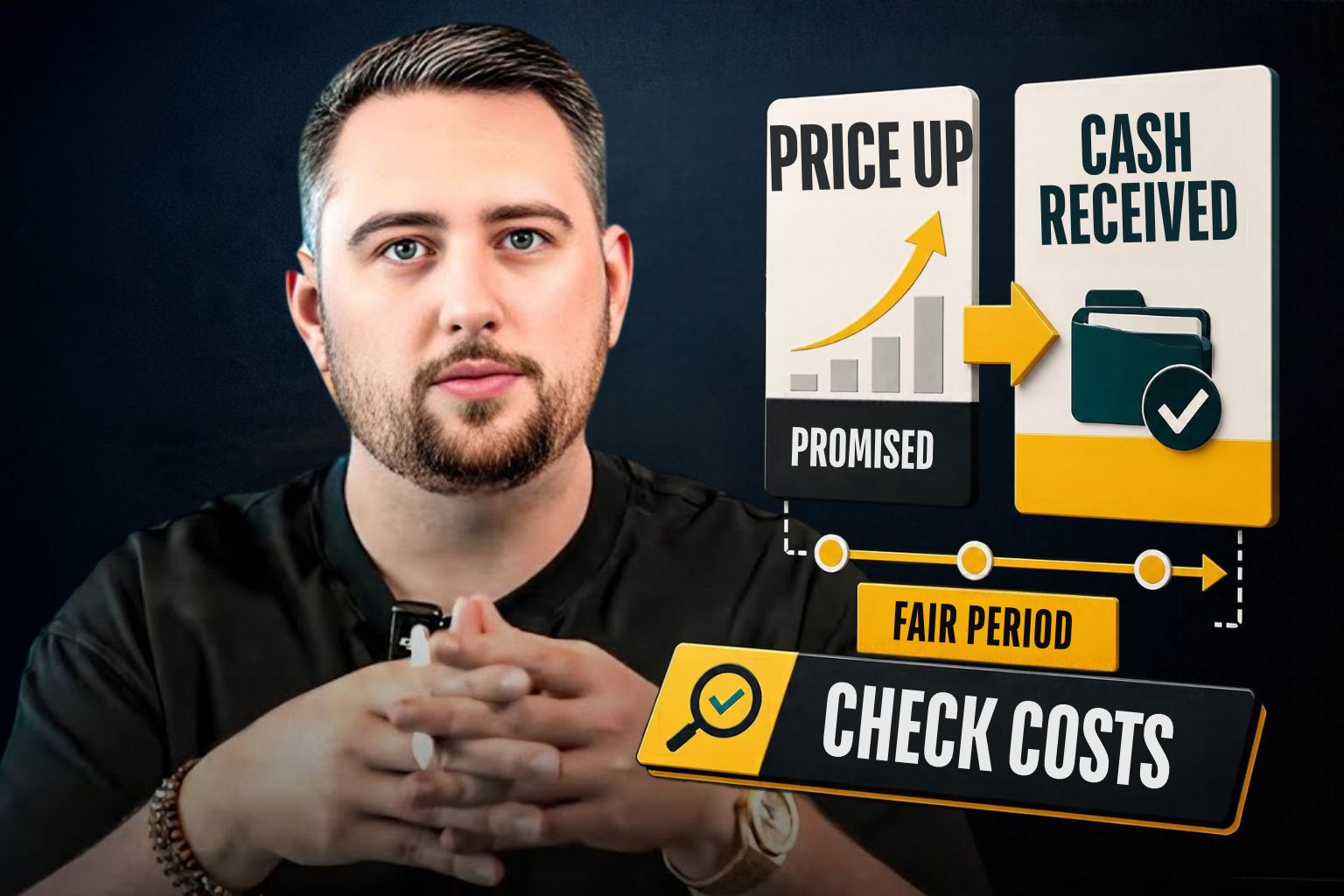
You can raise the price and still collect less cash per sale. If the payment mix changes at the same time, the bigger number on the sales page can hide what each new buyer actually pays. Before calling the price increase a win, I want to see cash collected from those buyers, when it arrived, and what the business spent to acquire and serve them.
I ask about the advertised price and the amount collected separately. Pay-in-full purchases, financing, and an in-house payment plan can produce different cash timing. Putting them all under one headline price makes the sales report easier to read and the next decision harder to make.
That does not mean every gap between the price and collected cash is a default. Some money may be scheduled for later under the deal the buyer accepted. Find out which situation you have before changing the price, blaming the customer, or asking sales to push a different payment option.
Already making money? See what it takes to make a lot more.
Why I Ask What Each Sale Actually Collected
The price tells me what you are asking for. Cash collected tells me what buyers have paid so far. I need both to understand what a sale is doing for the business.
A strong close rate can make a price increase worth testing. It does not settle how much money will arrive from the next group of buyers. If those buyers accept a longer payment schedule, the contract value can rise while the initial collection stays flat or declines.
That is a possibility to check in your records, rather than an argument against payment plans. The buyer may be paying exactly as agreed. You still need to fund acquisition and delivery while the remaining payments are outstanding.
A signed sale and a collected payment belong in separate columns. When those columns get merged, the team can report a stronger month while the owner has less money available for the work already sold.
The broader timing between acquisition spend and customer payments explains why that matters. For a pricing decision, I would start with the narrower question of what the buyers at each price actually paid.
What Counts as Cash Collected Per Sale
Choose the buyers and the collection period before calculating the average. Then divide the money received from those buyers in that period by the number of sales in that same group.
Keep the definition visible. Are you looking at the initial payment, collections received since purchase, or the eventual amount after the agreed schedule? Those are useful views of different things. Comparing one with another can create an improvement that exists only in the labels.
Keep first-offer payments separate from later purchases as well. An upsell can add real value, but counting it in one group’s average and leaving it out of another’s makes the original price comparison harder to interpret.
The same applies to refunds and processing costs. Show the adjustments separately and state whether the number is gross customer payments or the amount remaining after those adjustments. Have the person responsible for the accounts reconcile the records before you build a spending decision around the result.
The U.S. Small Business Administration emphasizes proper bookkeeping and understanding revenue and expenses. That is the level of clarity I want here. A useful average should be something the team can trace back to actual payments, rather than a number everybody repeats because it appears in a dashboard.
How Payment Mix Changes the Price Comparison
A change in the share of buyers using each payment option can move collected cash even when the headline price stays unchanged. Read the average alongside that mix.
A pay-in-full buyer, a buyer using an outside financing provider, and a buyer paying your business in installments may produce different receipts at different times. Use what your own agreements and payment records show. Do not assume the financing provider pays on the same terms as an in-house plan.
Look at the sales count and actual collections for each option. If the overall average falls, ask whether the business sold more plans, received lower initial payments, or has payments still due later. Those explanations lead to different choices.
There is no reason to label a payment method bad simply because it collects more slowly. It may help a suitable buyer purchase on terms the business can support. The question is whether you understood that timing when deciding what you could spend.
Stripe’s invoice documentation distinguishes invoice states, including open and paid, and explains that open invoices can carry past-due or retrying badges. Keep those states separate in your review. An invoice sent to a buyer cannot stand in for a payment received.
If you decide to redesign the options, evaluate payment-plan timing and default risk as a separate decision. First establish what the current options are doing. Changing terms before understanding that leaves you with a new offer and the same unanswered question.
Why Two Sales Periods Need a Fair Comparison
Buyers who purchased earlier have had more time to pay. Account for that before deciding that the newer price collects worse.
Compare initial collections with initial collections. When reviewing later installments, give each group a comparable amount of time since purchase. Keep payments from older customers attached to the sales they came from.
Total deposits for the month can hide that distinction. Earlier payment plans may be supplying cash while newer sales collect less upfront. That money can help fund the business, but it does not establish that the new price is producing stronger collections.
Also check whether the buyer population changed. A new traffic source, different qualification rules, or a different closer can affect the comparison. Record those changes rather than assigning every movement to the price.
This is where keeping a price test separate from existing sales conversations helps. The test needs a clear group of buyers before the collection review can say anything useful about it.
If the sample is still young or the records do not reconcile, say so. You can keep gathering evidence without turning an incomplete average into a permanent rule about what your customers will pay.
When a Payment Still Has Not Reached the Bank
A buyer paying and the money reaching your bank are different points in the process. Check where the money is before treating every delay as a collection failure.
The customer might still owe an installment. A completed payment might be pending settlement. A payout might be on its way to the bank. The person responsible for the money needs to identify which state applies.
Stripe’s balance documentation explains the difference between pending and available funds. It also explains that settlement timing varies by location and payment method. Check the dates and status in the actual account instead of borrowing another operator’s expected payout timing.
Keep that distinction in the report. The sales review can show what the customer paid, while the cash review shows what is available for obligations. A payment does not become profit merely because it clears, either. The business still has acquisition, sales, delivery, and other costs to cover.
You can explore Master Internet Marketing, my 7-week live comprehensive training for broader marketing education. For the accounting treatment and the money the business can commit, work from reconciled records with the person responsible for your finances.
Results are not typical. Your results will vary and depend entirely on your individual capacity, business experience, expertise, and level of desire. There are no guarantees concerning the level of success you may experience. The testimonials and examples used are not intended to represent or guarantee that anyone will achieve the same or similar results. We don’t believe in get-rich-quick programs. We believe in hard work, adding value and serving others. As stated by law, we can not and do not make any guarantees about your own ability to get results or earn any money with our information, courses, programs, or strategies.
What the New Price Has to Prove After the Sale
The new price has to make sense across conversion, collections, and delivery. A higher amount quoted is only one part of that comparison.
I would look at how many suitable opportunities became sales, what those buyers paid, and what it cost to acquire and serve them. Then I would ask whether the change left the business with a better result over a fair collection period.
A lower close rate may be acceptable if the amount collected and the cost of serving each buyer support the trade. A higher close rate may still leave the business short if the collection assumptions were wrong. You need the combination before choosing which sales result to celebrate.
Keep fulfillment in the picture. A bigger price may come with more work or a different promise. If the business changes the delivery at the same time, include that cost rather than treating the entire increase as money it can keep.
This is also why the offer’s price, sales process, and fulfillment need to fit together. You can improve one number while creating pressure somewhere else.
The next pricing decision should survive a look at what happened after the buyer said yes. If the numbers are mixed, find the unresolved question. You may need a better comparison period, clearer payment records, or a closer look at which buyers selected each option.
7 weeks. Real frameworks. Covering copywriting, funnels, paid ads, and conversion systems.
What I Want Cleared Up Before the Next Increase
Before the next price change, get a plain answer to how much a sale collects. Name the buyer group, define the period, and keep the payment options visible. Separate later installments from new sales and separate customer payments from money available in the bank.
Then connect those collections to the work the business has committed to deliver. The number should help the owner, finance, and sales have the same conversation. If each person means something different by revenue, an extra dashboard will not fix the disagreement.
When the records show a real issue, fix that issue. A past-due payment needs the agreed billing process. A delayed payout needs a status check. A price test with too little evidence needs a more complete comparison. Raising the number again leaves those questions waiting.
Bring the current price, payment mix, collections, and delivery costs when reviewing the decision with other operators. You can explore my Inner Circle if that peer mastermind fits where you are. I would rather have that conversation with the actual receipts in front of us than argue about whether a higher price should have made the business healthier.
Results are not typical. Your results will vary and depend entirely on your individual capacity, business experience, expertise, and level of desire. There are no guarantees concerning the level of success you may experience. The testimonials and examples used are not intended to represent or guarantee that anyone will achieve the same or similar results. We don’t believe in get-rich-quick programs. We believe in hard work, adding value and serving others. As stated by law, we can not and do not make any guarantees about your own ability to get results or earn any money with our information, courses, programs, or strategies.
Get my content first on Google
Add jeremyhaynes.com as a preferred source and Google shows my articles more prominently in your search results, including AI Overviews and AI Mode.


Jeremy Haynes
Owner and CEO of Megalodon Marketing
Jeremy Haynes is the founder of Megalodon Marketing. He is considered one of the top digital marketers and has the results to back it up.