
Inside My Q4 Inner Circle Mastermind With High-Ticket Operators

I hope you enjoy reading this blog post. If you want my team to just do your marketing for you, click here.
Author: Jeremy Haynes | Published October 20, 2026
Earnings Disclaimer: You have a .1% probability of hitting million-dollar months according to the US Bureau of Labor Statistics. As stated by law, we cannot and do not make any guarantees about your own ability to get results or earn any money with our ideas, information, programs, or strategies. We don’t know you, and your results in life are up to you. We’re here to help by giving you our greatest strategies to move you forward, faster. However, nothing on this page or any of our websites or emails is a promise or guarantee of future earnings. Any financial numbers referenced here, or on any of our sites or emails, are simply estimates or projections or past results, and should not be considered exact, actual, or as a promise of potential earnings – all numbers are illustrative only.
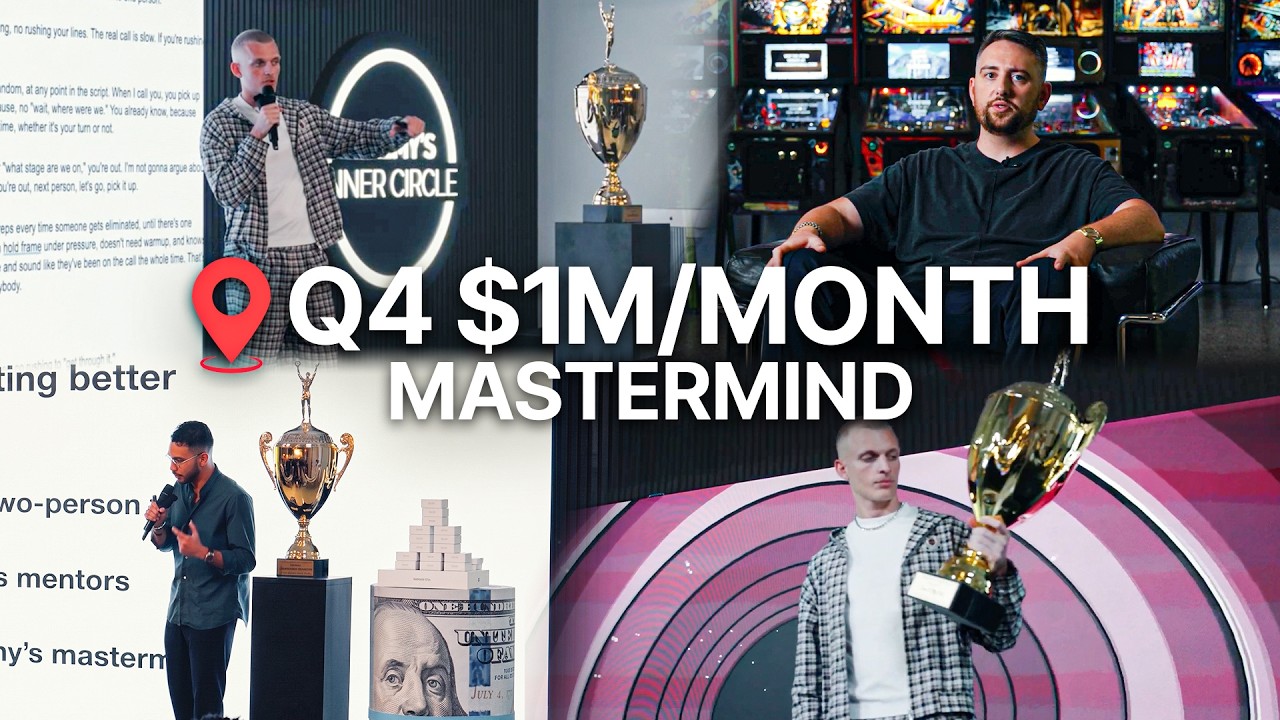
At my Q4 mastermind in Miami, members got on stage and shared what they had to change in their businesses before they earned their trophies. We heard about sales teams that were falling short, an owner who stepped back into sales himself, and a different way of entering a crowded market. Those are the conversations I want from these quarterly gatherings. Tell the room what worked, what disappointed you, and what you finally had to face.
There was plenty of time to enjoy being together, too. We had pinball, coffee, good food, and conversations between the talks. But the reason to get everybody in the same place is that people running high-ticket businesses can ask each other questions that come from actually being in the work.
Already making money? See what it takes to make a lot more.
What Made This Q4 Mastermind Different
This gathering gave me more room for my opening talk than I normally have. We had expected about four members to receive trophies, but travel disruptions kept some of them from attending. I opened with a longer session, and we heard from the members who were able to make it.
The trophy presentations matter to me because of what comes after the award. I want to hear the decisions behind the milestone. What did the member try, and what had to change? What looked promising and failed once they put it to work?
A finished result hides a lot of that history. Somebody sees the business today and misses the earlier versions of the offer, the uncomfortable sales conversations, or the attempt that cost time without helping. The person who lived through it can explain those details.
When they share them with peers, the discussion becomes specific quickly. Someone else in the room recognizes the problem and can ask what happened at the point where their own business is getting stuck. That is a much better conversation than admiring the award from a distance.
The members who spoke were describing their own experiences. Their results are not typical, and somebody else joining the room should not expect the same path or outcome. What is available to learn from is the reasoning they were willing to share.
Results are not typical. Your results will vary and depend entirely on your individual capacity, business experience, expertise, and level of desire. There are no guarantees concerning the level of success you may experience. The testimonials and examples used are not intended to represent or guarantee that anyone will achieve the same or similar results. We don’t believe in get-rich-quick programs. We believe in hard work, adding value and serving others. As stated by law, we can not and do not make any guarantees about your own ability to get results or earn any money with our information, courses, programs, or strategies.
Why I Opened by Asking People to Stay Close to Reality
I opened with staying close to reality because I had noticed people moving away from facts they did not want to face. Sometimes it was a story they were telling themselves. Sometimes it was a difficult problem they kept finding a reason to avoid.
My group spans more than 200 operators at different stages. They have different businesses, different revenue levels, and different immediate pressures. My job when I get in front of them together is to find something important across that range.
For this gathering, that common thread was honesty about the current situation. You cannot make a useful decision about your sales team while pretending the team understands the buyer better than it does. You cannot improve an offer while refusing to look at what customers actually experience.
A room full of experienced people gives you a chance to say what is happening and have the explanation challenged. Bring the numbers. Explain the part you are unsure about. Let somebody ask the question you have been trying to skip.
I have talked about business narratives that pull decisions away from reality before. At the mastermind, I wanted the people sitting in front of me to recognize that pattern in their own work, while they could still do something about it.
The Standard I Wanted Everyone to Hear
The standard I wanted people to hear was that honest effort starts with the person setting the expectations. You cannot keep asking everybody else for a level of intention you are unwilling to bring yourself.
I used an example from elite basketball during the opening talk. The part that mattered was a leader willing to push for the standard while doing the work himself. Being liked in every moment was not the goal he had organized his effort around.
That does not mean being difficult for effect. It means being clear about what the team is trying to accomplish and what the work requires. If you accept the weak version of the task every time, the standard you talk about has very little meaning.
It also means holding yourself to the same test. Before you blame the team for not understanding the buyer, ask when you last listened closely to a real sales conversation. Before you demand a better message, ask how much attention you have given the customer problem yourself.
Your standard becomes much clearer when people can see you act on it. That was the connection between my opening talk and the member presentations that followed. The people sharing on stage had decisions to talk about because they had gone back into the work.
Taking Ownership of an Underperforming Sales Team
One member described realizing that he had been waiting for somebody else to save the business. He had spent heavily on sales management and was frustrated with what he was getting back. Eventually, he had to look at his own part in the situation.
He told the room about being away on a skiing trip and checking the business against a goal he had communicated to his team. The numbers were not where they needed to be. More importantly, he believed the salespeople did not understand the ideal customer well enough.
His response was to step into the sales conversations himself. He described learning by doing the work instead of continuing to complain about the funnel or the people around it. Start by getting close enough to the calls to judge what is happening.
What I wanted people to hear was ownership. If you cannot tell whether the team understands the buyer, get close enough to the conversations to find out. A new management hire cannot substitute for your understanding of what is being sold and to whom.
That is also why vetting a closer needs more than a confident interview. You want evidence that the person can do the work your business needs. And if you are the owner, you need enough understanding to judge that evidence.
Finding a Different Offer in a Crowded Market
Another member’s presentation centered on a unique mechanism in a market that already had competitors. The useful part was how the business looked at the existing ways of delivering the result and saw something it could do differently.
Entering later gave those operators other approaches to study. They could see where buyers were being let down and what an alternative would need to improve. They described building their offer around that difference and pricing it to fit.
That is the version of second-mover advantage I wanted people to notice. Existing competition can give you information. It does not automatically tell you that there is no room left, and it certainly does not guarantee that your alternative will work.
The Small Business Administration describes competitive analysis as examining competing businesses and their strengths and weaknesses. The important part for an operator is turning that observation into a real difference the buyer can understand.
A better name for the same delivery does little on its own. What changes for the customer? Why would they prefer it? Can the business fulfill that promise? Those questions deserve answers before the new mechanism becomes a headline.
Master Internet Marketing, my 7-week live comprehensive training, covers the copywriting, funnels, and paid-advertising work behind presenting an offer to the market. A member sharing a useful idea gives you something to examine. You still have to understand how it fits your own buyer and business.
Results are not typical. Your results will vary and depend entirely on your individual capacity, business experience, expertise, and level of desire. There are no guarantees concerning the level of success you may experience. The testimonials and examples used are not intended to represent or guarantee that anyone will achieve the same or similar results. We don’t believe in get-rich-quick programs. We believe in hard work, adding value and serving others. As stated by law, we can not and do not make any guarantees about your own ability to get results or earn any money with our information, courses, programs, or strategies.
The Sales Mini Games Got the Room’s Attention
The sales mini games got attention because the member describing them had a specific problem to solve. Closers were joining team sessions while doing admin work and giving the conversation only part of their attention.
His team changed the practice so people could be called into a live role-play at any moment. A sales manager played the prospect, and different closers took over the conversation. The exercise made it obvious whether somebody could pick up the thread and move the conversation forward.
That is a very different demand from sitting quietly through another team meeting. People had to listen closely because they might be next. The member also described how the competitive format exposed gaps among people joining the team.
I would take the lesson about active practice seriously without turning the member’s entire staffing approach into a rule for your company. A difficult practice round is information about a skill gap. How you support and assess a salesperson still needs to fit the role and the evidence you have.
HubSpot’s sales-training examples similarly include role-play and games as ways to get people participating. The useful question is what somebody can demonstrate after the session. My closer onboarding readiness checks keep that distinction attached to the work the person must be able to handle.
The Conversations Between Talks Matter to Me
The conversations between talks matter because that is where I get to hear the question behind an individual operator’s situation. I cannot have a long private conversation with every person at a gathering, but I make a point of moving around, saying hello, and interacting with as many people as I can.
One conversation turned toward being honest with the people who pay you. If you depend heavily on a particular customer’s next payment, it can become harder to say something that customer needs to hear. Notice that pressure before it changes what you are willing to tell them.
We also talked about directing emotion into useful work. Frustration can point toward a problem you need to address. Fear can give you a reason to examine a risk and decide what would reduce it. Neither feeling has to make the decision for you.
That distinction matters. Feeling strongly about something does not make the explanation correct. Get specific about what is happening, then choose an action that can improve the situation. You can be candid and deliberate at the same time.
The setting leaves space for those exchanges. Someone gets an answer after a presentation. Another conversation continues over coffee or between games of pinball. The room has more going on than the person currently holding the microphone.
Why I Keep Coming Back to the Next Moment
I keep coming back to the next moment because it is a decision I can actually make. After giving the opening talk, I was tired. There were still member presentations ahead and another chance for me to speak to the group.
I could not make myself as rested as I had been at the start of the day. I could decide how much attention to give the person in front of me. My best at that point was different from my best earlier, but it was still my responsibility to bring it.
That is what I mean by being intentional. The standard is not a promise that every day will be perfect or that working hard produces a particular financial result. It is remembering what you are trying to do and taking the current opportunity seriously.
The same thought sat behind the conversation about time. People build businesses because they want something different from the life they would otherwise have. It is easy to lose sight of that purpose while getting through the daily work.
I want the reminder to change the next choice. Pay attention to the conversation. Deal honestly with the problem. Use the information you have. A big goal becomes more useful when it affects the decision directly in front of you.
7 weeks. Real frameworks. Covering copywriting, funnels, paid ads, and conversion systems.
What I Want Members to Take Home From Miami
I want members to leave with a clearer view of their business and something useful to do next. A good question, an introduction, or a lesson from somebody else’s experience can give that next decision more substance.
Do the work of separating what you heard from what applies to you. An operator’s sales exercise may address a problem your team also has. Another member’s new delivery mechanism may raise a better question about your offer. You do not need to copy the entire business to learn from the decision.
Atlassian’s retrospective guidance centers a review on what worked, what did not, and what to improve next. That is a useful discipline to carry home. Write down what you intend to change while the conversation is still clear, then return to the actual work.
The trophies, the talks, the conversations, and the time together all belong to the same gathering. I enjoy seeing people recognize what another member went through and ask the question that makes the lesson useful to them. That is what I want us to keep bringing into the room.
These quarterly gatherings are part of my Inner Circle. I care about who is in the room, how people behave, and whether they are willing to share honestly with other operators. If you want to be considered, use the current application information and see whether it is a fit; a place is not promised.
Results are not typical. Your results will vary and depend entirely on your individual capacity, business experience, expertise, and level of desire. There are no guarantees concerning the level of success you may experience. The testimonials and examples used are not intended to represent or guarantee that anyone will achieve the same or similar results. We don’t believe in get-rich-quick programs. We believe in hard work, adding value and serving others. As stated by law, we can not and do not make any guarantees about your own ability to get results or earn any money with our information, courses, programs, or strategies.
Get my content first on Google
Add jeremyhaynes.com as a preferred source and Google shows my articles more prominently in your search results, including AI Overviews and AI Mode.


Jeremy Haynes
Owner and CEO of Megalodon Marketing
Jeremy Haynes is the founder of Megalodon Marketing. He is considered one of the top digital marketers and has the results to back it up.