I hope you enjoy reading this blog post. If you want my team to just do your marketing for you, click here.


I hope you enjoy reading this blog post. If you want my team to just do your marketing for you, click here.
Author: Jeremy Haynes | founder of Megalodon Marketing.
Earnings Disclaimer: You have a .1% probability of hitting million-dollar months according to the US Bureau of Labor Statistics. As stated by law, we can not and do not make any guarantees about your own ability to get results or earn any money with our ideas, information, programs, or strategies. We don’t know you, and besides, your results in life are up to you. We’re here to help by giving you our greatest strategies to move you forward, faster. However, nothing on this page or any of our websites or emails is a promise or guarantee of future earnings. Any financial numbers referenced here, or on any of our sites or emails, are simply estimates or projections or past results, and should not be considered exact, actual, or as a promise of potential earnings – all numbers are illustrative only.
Sometimes you hit a month with higher-than-usual revenue, and then the next month feels challenging. Maybe you closed several deals in October, which spiked revenue, but by November the team was busy delivering those commitments. Marketing and lead generation might have slowed as a result.
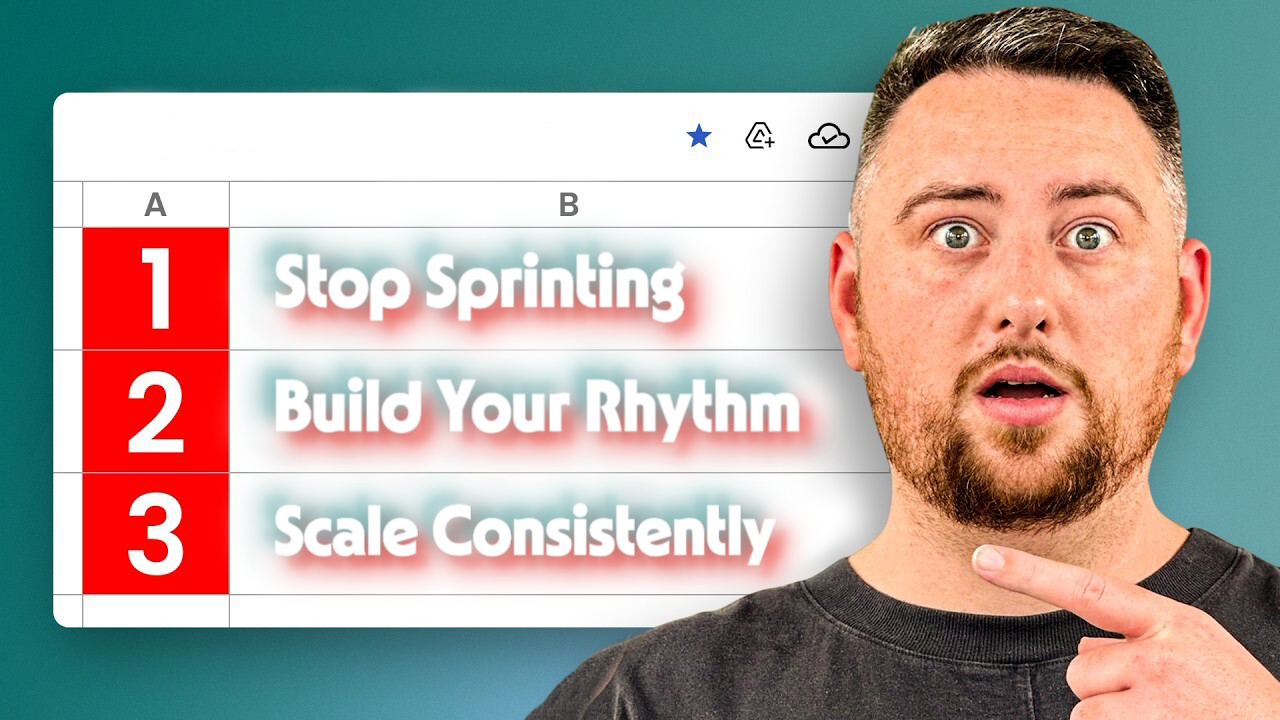
This pattern, which I call scattered sprints, is common in many growing businesses — executives and management research show that companies without a clear operating cadence often fall into feast-or-famine cycles and struggle to sustain growth.
Short-term wins can feel great, but without a consistent operating rhythm, maintaining that momentum can be difficult. Many businesses have the offer, skills, and systems in theory, but struggle with operational alignment as they scale.
From my experience, businesses that maintain stability at higher revenue levels often implement a tight operating cadence where metrics are reviewed consistently by the right people. A structured rhythm can help reduce misalignment and improve operational consistency, though individual results may vary.
Let me show you how to build this into your business so you stop sprinting and start scaling predictably.
If your business is already generating $100k+ per month, My Inner Circle is where you break through to the next level. Inside, I’ll help you identify and solve the bottlenecks holding you back so you can scale faster and with more clarity.
Before we build the rhythm, you need to understand exactly why operating without one breaks down when you try to scale. Because it’s not just that you’re disorganized. There’s a specific mechanical reason why businesses without rhythm hit a ceiling.
The pattern starts when everything runs through the founder or a single key person. You’re making all the decisions. You’re reviewing all the numbers. You’re solving all the problems. When the business is smaller, that works fine. You can keep it all in your head and react to whatever’s happening in real time.
But as revenue grows and the team expands, the number of decisions that need to be made every week explodes. You can’t keep up. So decisions get delayed. Problems don’t get addressed until they’re emergencies. Different parts of the business drift out of sync because nobody’s coordinating them.
That lack of coordination is what creates the sprint pattern — research on meeting design and team routines shows that structured, regular forums stop firefighting and surface cross-functional issues before they become crises.
Marketing is running hard trying to generate leads. But sales is underwater trying to close the backlog from last month. And delivery is drowning trying to onboard all the clients sales closed two months ago. Everyone’s working hard but nobody’s aligned on the same timeline.
The result is feast or famine. You have huge months when everything happens to align by accident. Then you have terrible months when misalignment catches up and different parts of the business are working against each other without realizing it.
In the businesses I’ve worked with, this misalignment usually shows up in predictable ways. The sales team closes a bunch of deals right at month-end to hit their targets. Then the delivery team gets slammed on the first of the month with a wave of onboardings they weren’t staffed for. Quality drops. Clients get frustrated. Churn goes up. And the extra revenue you generated gets eaten by the costs of fixing delivery problems and replacing churned clients.
Or marketing runs a successful campaign that floods the pipeline with leads. But sales isn’t staffed to handle the volume. Show rates drop because setters are rushing through qualification. Close rates drop because closers are taking calls with unqualified prospects. The campaign looks like it failed when really the breakdown was in handoff and capacity planning.
These aren’t people problems. They’re rhythm problems. When you don’t have regular touchpoints where different functions align on capacity, priorities, and timing, everyone optimizes for their own metrics without considering the downstream impact. Marketing optimizes for lead volume. Sales optimizes for deals closed. Delivery optimizes for current client satisfaction. And those optimizations conflict with each other.
The fix is creating an operating rhythm where everyone syncs at predictable intervals. Weekly meetings where you review the numbers and make small course corrections before problems compound. Monthly reviews where you look at trends and adjust capacity. Quarterly planning where you make bigger bets on new channels or offers. That structured cadence keeps everyone aligned and prevents the scattered sprint pattern.
But most businesses resist implementing rhythm because it feels like overhead. You’re already busy. Why would you add more meetings? The answer is that the right meetings prevent way more work than they create. One hour a week reviewing metrics and making aligned decisions prevents dozens of hours of firefighting misaligned execution.
Businesses that maintain operational consistency often work more systematically, with a clear rhythm that helps align functions and reduce chaos. This approach can improve efficiency and decision-making, though results depend on many factors unique to each business.
You can’t have an effective operating rhythm without knowing what numbers to review. Too many businesses track everything and focus on nothing. Or they track vanity metrics that don’t actually tell them if the business is healthy. You need a small set of metrics that directly indicate whether you can keep scaling or need to fix something.
In the businesses I’ve worked with that run sales-led models with calls as the primary conversion mechanism, the core weekly metrics fall into three categories. Top of funnel lead generation. Middle of funnel sales conversion. And financial health. That’s it. Everything else is noise that distracts from what actually matters.
Top of funnel is about lead volume and quality. The metrics that matter here are total leads generated this week, qualified leads that met your BANT criteria, and cost per qualified lead. Not total cost per lead. Cost per qualified lead. Because unqualified leads are worthless and including them in your metrics makes everything look cheaper than it actually is.
These numbers tell you if your acquisition engine is healthy. If qualified lead volume is consistent week over week, you can plan capacity. If it’s spiking or dropping, you need to understand why before it impacts sales. If cost per qualified lead is rising, you need to know if it’s because CPMs went up or because your qualification got sloppy or because your targeting drifted.
I’ve seen businesses where qualified lead volume drops twenty percent over three weeks but nobody notices because they’re only looking at total lead volume which stayed flat. Unqualified leads increased while qualified leads decreased. By the time they realized, their sales pipeline was thin and it took another month to fix. That’s what happens without weekly metric review.
Middle of funnel is about conversion efficiency. The metrics that matter are show rate, close rate, average deal size, and sales cycle length. Show rate is the percentage of booked appointments that actually happen. Close rate is the percentage of appointments that convert to sales. Average deal size is exactly what it sounds like. Sales cycle is how long from first contact to closed deal.
These numbers tell you if your sales motion is healthy. Show rates below seventy percent mean your qualification is broken or your nurture isn’t working — industry benchmarks indicate healthy show-rates for well-qualified appointments typically sit in the 70–85% range, so sub-70% is a strong signal to fix qualification or reminders.
Close rates below fifteen percent for high-ticket offers mean your sales process needs work or you’re talking to the wrong people. Average deal size trending down means you’re discounting too much or attracting smaller buyers. Sales cycle extending means deals are stalling somewhere in your process.
In the businesses I’ve worked with, we review these metrics every single week in our sales meeting. Not just the overall numbers. We look at them by setter, by traffic source, by offer, whatever segmentation reveals patterns. When we see show rate drop for one setter but not others, that’s a coaching issue. When we see close rate drop across all traffic from one channel, that’s a targeting issue. The weekly review lets you catch these patterns early.
Financial metrics are about sustainability. Cost to acquire a customer, payback period on that acquisition cost, net margin after all costs, and cash runway. These tell you if you can afford to keep scaling at your current pace or if you need to slow down and optimize before you run out of money.
CAC is your total marketing and sales cost divided by customers acquired — tracking CAC and CAC payback period is essential to know whether you can sustainably scale or need to optimize acquisition economics.
Payback period is how long it takes for a customer to generate enough profit to cover their acquisition cost. Net margin is revenue minus all costs. Cash runway is how many months you can operate at current burn before you run out of money. These are the metrics that keep you from scaling into bankruptcy.
I review these weekly in leadership meetings for the businesses I work with that are actively scaling. Not just to see the numbers but to discuss what they mean for decisions. If CAC is trending up but LTV is also trending up faster, we might be fine to keep scaling. If CAC is rising and LTV is flat, we need to pause spend and fix something. The weekly conversation around these metrics is what prevents scaling mistakes that cost six figures to unwind.
The key is keeping the metric set small and focused. If you’re tracking thirty metrics every week, you’re tracking nothing because nobody can hold that much information and make decisions. Pick the five to eight metrics that directly indicate business health. Track them consistently. Review them with the right people. Make decisions based on what they tell you. That’s the foundation of operating rhythm.
The weekly rhythm is where most of the value happens. This is where you catch small problems before they become big problems. Where you align different functions so they’re not working against each other. Where you make the tactical decisions that keep execution on track.
The structure I’ve implemented across multiple businesses starts with a leadership weekly. This is the CEO or operator plus the heads of each major function. Sales, marketing, delivery, operations, whoever runs a key part of the business. Sixty to ninety minutes. Same time every week. Non-negotiable.
The agenda is always the same. Review last week’s metrics against targets. Identify what’s working and what’s not. Make decisions on what to stop, what to start, and what to double down on. Surface any cross-functional issues that need resolution. Assign clear owners and deadlines for any actions. That’s it. No other topics. No general updates. Just metrics, decisions, and actions.
This meeting prevents most of the misalignment that creates scattered sprints. When everyone reviews the same numbers at the same time, you can’t have sales thinking everything’s great while marketing knows the pipeline is about to dry up. You see the full picture and you make coordinated decisions about what to do next.
The format I use is simple. We go through each metric. Green if it’s on target. Yellow if it’s trending wrong but not critical yet. Red if it’s broken and needs immediate attention. For anything yellow or red, we discuss root cause and decide on an action. One owner. One deadline. No ambiguous “let’s keep an eye on it” decisions that mean nothing happens.
For example, if show rate dropped from seventy-five percent to sixty-eight percent this week, that’s yellow trending to red. We dig into why. Was it one setter who had a bad week or is it across the board? Did we change something in our booking process? Did we run a new traffic source that’s generating lower quality leads? Based on what we find, we assign an action. Maybe it’s the setter manager doing a coaching session. Maybe it’s marketing pausing that traffic source. Whatever it is, someone owns it and it’s due before next week’s meeting.
That rapid iteration is what keeps the business healthy. Problems don’t fester for weeks until they’re crises. They get flagged in the weekly and addressed immediately. And because we’re reviewing metrics every single week, we build an intuitive sense for what normal looks like. When something deviates, it’s obvious and we can act fast.
The second key weekly meeting is the sales-specific rhythm. This is the sales leader plus all setters and closers. Also sixty to ninety minutes. Also same time every week. The focus here is pipeline, coaching, and deal review.
We start by looking at the pipeline. How many appointments are scheduled for this week and next week? Are we on track to hit our close targets based on historical conversion rates? Are there any big deals that need special attention? That pipeline review takes maybe fifteen minutes but it prevents the whole team from being surprised when the calendar suddenly looks empty.
Then we go deal by deal on the biggest opportunities. Not every deal. Just the ones that are significant enough to matter or the ones that are stuck and need help. We discuss what’s blocking each deal. We identify specific actions to move them forward. We assign who’s doing what. That deal-level attention is what closes revenue that would otherwise stall.
The last part of sales weekly is coaching. We listen to actual calls from the previous week. We identify what went well and what could improve. We discuss specific techniques for handling common objections or closing hesitant buyers. This isn’t theory. It’s applied coaching based on real situations the team encountered. That’s what actually improves performance versus generic sales training.
The third weekly meeting that matters for some businesses is the marketing and growth sync. This is shorter, maybe thirty to forty-five minutes. Marketing lead, whoever manages ad accounts, and usually the CEO or operator. The focus is channel performance, cost metrics, and spend decisions.
We review each acquisition channel. What did we spend? What did we get? What’s the cost per qualified lead? Are we in the target range or off? Based on those numbers, we make daily or weekly budget decisions. If a channel is performing well within target CAC, we approve increasing spend. If it’s trending expensive, we pause or reduce while we figure out what changed.
This weekly cadence prevents expensive mistakes. I’ve seen businesses blow through tens of thousands in ad spend before they realized a channel stopped working because they weren’t reviewing performance weekly. By the time they caught it, they’d wasted budget that could have been deployed elsewhere. The weekly review catches these issues in days instead of weeks.
The pattern across all these weekly meetings is the same. Review metrics. Identify issues. Make decisions. Assign actions. Follow up. That simple rhythm executed consistently is what creates operational excellence. You’re not fighting fires. You’re systematically reviewing what’s happening and making small adjustments to keep everything on track.
Weekly rhythm handles tactics and execution. Monthly and quarterly rhythm handles strategy and capacity planning. These longer timeframes are where you make the bigger decisions about offers, channels, hiring, and investments that shape the next phase of growth.
The monthly review in the businesses I work with is usually a half-day session. Leadership team plus key operators who have visibility into what’s really happening in the business. The focus is deeper analysis that you can’t do in a weekly meeting. Funnel conversion by stage. Offer performance. Lifetime value and payback trends. Team capacity and utilization. Cash flow projections.
This is where you zoom out from the week-to-week noise and look at patterns. Is one offer consistently outperforming others? Maybe that tells you where to focus. Is one stage of your funnel consistently underperforming? That tells you where to invest in optimization. Are certain traffic sources producing higher LTV customers even if the initial CAC is higher? That changes how you think about spend allocation.
The monthly review is also where you address capacity issues before they become bottlenecks. If your close rate is strong but you’re maxing out your closers’ calendars, you need to hire or you’ll cap revenue. If your delivery team is at capacity and quality is starting to slip, you need to add people or slow client acquisition. These decisions need to be made proactively based on trends, not reactively after things break.
In a typical monthly review, we spend the first hour going through metrics and identifying what’s working and what needs attention. The second hour is decision-making. Based on what we learned, what are we changing? Are we launching a test of a new channel? Are we adjusting our offer structure? Are we opening a new hire req? Each decision gets a clear owner and a timeline for execution.
The key with monthly reviews is not trying to make too many big changes at once. You might identify ten things that could be better. But you can only effectively execute on two or three major changes in a month without overwhelming the team. So you prioritize ruthlessly. What will have the biggest impact? What’s the most urgent? What has the right resources available? Everything else goes on a backlog for future months.
Quarterly planning is where you set the bigger strategic direction. This is typically a one or two day offsite with leadership. The goal is defining three to five company-level objectives for the next quarter with clear measurable outcomes. Then you cascade those objectives into functional priorities so everyone knows how their work connects to the company goals.
The businesses I’ve worked with use something similar to OKRs. Objectives and key results. The objective is the qualitative goal. Increase revenue. Improve unit economics. Expand into a new market. The key results are the measurable outcomes that indicate you achieved the objective. Revenue hits X by end of quarter. CAC drops below Y. LTV increases to Z. New channel generates A percent of total revenue.
These quarterly objectives guide everything else. Your monthly reviews are checking progress toward quarterly goals. Your weekly meetings are making tactical decisions that support the quarterly plan. That alignment from quarterly to monthly to weekly is what keeps hundreds of small decisions moving in the same direction instead of pulling against each other.
The quarterly planning session is also where you make the big bets. Should we launch a second offer? Should we open a completely new acquisition channel? Should we bring a function in-house that we’re currently outsourcing? These are the decisions that reshape your business model and they need dedicated time to think through properly.
I structure quarterly planning as reviewing the previous quarter first. What did we commit to? What did we achieve? What did we learn? That review informs the next quarter’s planning. If we committed to testing three new channels and only one worked, that tells us to focus deeper on what’s working instead of continuing to test new things. If we hit all our revenue targets but margins compressed, that tells us the next quarter needs to focus on efficiency not just growth.
Then we look forward. Given where we are and what we learned, what are the most important objectives for the next three months? We debate. We prioritize. We settle on three to five objectives that everyone agrees are the right focus. Then we define the key results that will tell us if we achieved each objective. Those key results become the metrics we track monthly and the targets we’re working toward in our weekly rhythm.
That quarterly to monthly to weekly cascade is how you translate strategy into execution. The strategy gets set quarterly. The tactics get adjusted monthly. The execution happens weekly. And because everything’s connected through shared metrics and aligned objectives, the whole business moves forward in sync instead of scattered sprints pulling in different directions.
Even with perfect rhythm and great metrics, execution breaks down if decision-making authority isn’t clear. In the businesses I’ve worked with that successfully scaled past scattered sprints, they all implemented clear decision rights so people know who can make which calls without constantly escalating to the founder.
The framework is simple. Every type of decision has a clear owner. That person has the authority and the accountability for that domain. They can make calls within defined parameters without asking permission. And they’re responsible for the outcomes.
For the CEO or operator, the domains that typically stay at this level are the scorecard, capital allocation, and when to scale or pause spend. The CEO owns defining what metrics matter and setting the targets. They own deciding how to deploy capital between growth, operations, and reserves. And they own the call on whether the business is healthy enough to push growth or whether it needs to stabilize first.
These decisions stay at the CEO level because they’re the ones who see the whole picture and carry the ultimate risk. But everything else should be delegated to function leaders who have authority to make decisions in their domain.
The sales leader owns the forecast, the show and close rate targets, hiring and firing of sales people, and weekly coaching. They don’t need CEO approval to run a coaching session differently or to put a struggling rep on a performance plan. Those are sales execution decisions that should be made by whoever runs sales.
In the businesses I’ve worked with, this delegation is what lets sales move fast. If the sales leader sees show rate dropping, they can immediately implement a fix. They don’t have to wait for a meeting with the CEO to get approval. They have the authority and the accountability to manage their numbers.
Marketing and growth typically own lead volume targets, cost per lead and CAC, creative testing calendar, and channel mix decisions. They can launch tests, pause underperforming channels, and shift budget between channels without escalating to CEO. As long as they’re hitting their numbers and staying within budget, they have full authority.
That autonomy is critical for maintaining rhythm. If every spend decision needs CEO approval, you slow everything down. Marketing sees an opportunity, they have to wait for approval, by the time they get it the opportunity is gone. Decision rights let them move at the speed of the market instead of the speed of your calendar.
Delivery and customer success typically own retention metrics, customer satisfaction scores, and expansion revenue. They decide how to allocate support resources. They decide when to implement process changes that improve onboarding or delivery. They own the initiatives that lift lifetime value by keeping customers longer and expanding their spend.
That ownership is what drives accountability. When delivery owns retention, they can’t blame marketing for sending bad leads or sales for overselling. They own the outcome. So they figure out how to improve it within their domain. That clear ownership prevents the finger-pointing and blame-shifting that happens when nobody’s clearly responsible for specific outcomes.
The boundaries on these decision rights are usually defined by budget and metrics. Marketing can shift spend between channels as long as total budget stays within the approved range and CAC stays within target. Sales can hire as long as headcount stays within the approved plan and the new hires hit productivity benchmarks. Delivery can change processes as long as retention and NPS stay above target thresholds.
When something falls outside those boundaries, it escalates. If marketing wants to increase total budget by twenty percent, that’s a capital allocation decision that goes to CEO. If sales wants to restructure comp plans in a way that changes unit economics, that’s a scorecard decision that goes to CEO. But everything within the boundaries stays with the function leader.
That balance of autonomy within clear boundaries is what scales decision-making. The CEO isn’t making every call. But they’re setting the framework and the constraints within which other people make calls. That’s how you go from everything running through one person to a team that can execute independently while staying aligned.
In the businesses I’ve worked with, implementing clear decision rights is usually one of the highest-leverage changes. Execution speed doubles when people can make decisions without waiting for approval. Quality improves when the people closest to the work have authority to fix problems immediately. And the CEO’s time frees up to focus on the strategic decisions that actually need their attention instead of getting pulled into tactical minutiae.
Understanding the framework is different from actually implementing it and making it stick. The businesses I’ve worked with that successfully transitioned from scattered sprints to sustained rhythm all did a few specific things that made the difference between a system that works and a system that gets ignored after two weeks.
The first implementation principle is starting with the weekly rhythm before trying to build monthly or quarterly. Weekly meetings are where the value is. If you can’t make the weekly cadence work, monthly and quarterly won’t matter. So you start there. Pick your core metrics. Schedule your leadership weekly and sales weekly. Commit to running them consistently for at least a month before you judge whether they’re working.
In my experience, it takes three to four weeks for weekly rhythm to feel natural. The first week feels like overhead. You’re in the meeting wondering if this is a waste of time. The second week is awkward because you’re still figuring out how to run it efficiently. The third week you start catching things early. By the fourth week, you can’t imagine not having this visibility into what’s happening.
That’s why commitment matters. If you run the weekly meeting once, decide it’s not valuable, and stop, you never get to the point where it actually delivers. You have to commit to the full month to see the benefit. And you have to run it well, not just schedule it and hope it works.
Running it well means three things. First, everyone comes prepared. If you’re reviewing metrics, those metrics are updated before the meeting, not figured out during the meeting. People show up having looked at the numbers so the meeting is discussion and decisions, not reporting. That requires discipline but it’s what makes meetings productive instead of status updates.
Second, the meeting follows a consistent agenda. Same format every week. Metrics review. Issues identification. Decision-making. Action assignment. That predictability is what makes it efficient. Everyone knows what to expect and how to contribute. When meetings are different every week, they’re inefficient because people don’t know how to prepare or participate.
Third, actions get tracked and followed up. When you assign an action in the weekly meeting, it has an owner and a deadline. And the following week, you start by reviewing whether last week’s actions got done. That accountability is what makes the rhythm effective instead of just being meetings where you talk about problems but nothing changes.
The second implementation principle is protecting the meeting time religiously. The weekly meetings are non-negotiable. You don’t cancel because something came up. You don’t move them every week based on people’s calendars. You schedule them at the same time every week and you don’t let anything override them except genuine emergencies.
This sounds rigid but it’s necessary. If the meetings are optional or constantly rescheduled, they lose effectiveness. People don’t prepare because they’re not sure if the meeting will happen. The rhythm breaks and you’re back to ad-hoc decision-making. The consistency is what makes it a system instead of just occasional check-ins.
The third implementation principle is adjusting based on what you learn. Your first version of the rhythm won’t be perfect. Maybe you’re tracking the wrong metrics. Maybe your meetings are too long or not focused enough. Maybe your decision rights aren’t clear. You iterate based on what works and what doesn’t.
In the businesses I’ve worked with, we usually adjust something about the rhythm every month for the first quarter. We add or remove metrics based on what actually drives decisions. We tighten the agenda based on where meetings drag. We clarify decision rights based on where bottlenecks appear. That continuous refinement is what turns a theoretical framework into a practical system that actually runs your business.
The last implementation principle is cascading the rhythm down as you grow. When you’re small, leadership weekly might include everyone. As you grow, leadership weekly is just the leadership team, and each function has its own internal weekly rhythm below that. Sales has their weekly. Marketing has theirs. Delivery has theirs. All feeding up into the leadership weekly.
That cascading is how rhythm scales. The CEO doesn’t need to be in every meeting. But every meeting follows the same basic format. Metrics, issues, decisions, actions. That consistency makes the whole organization more efficient because everyone’s operating the same way just at different levels.
Build the rhythm into how your business operates and you stop lurching from heroic months to chaos. You create a system that catches problems early, keeps functions aligned, and makes decisions at the right level with the right information. That’s what sustained scale looks like. Not working harder. Working with better rhythm that prevents wasted effort and misaligned execution.
Start with your core metrics and your weekly leadership meeting. Get that working consistently. Then add sales weekly. Then layer in monthly reviews. Build the system one piece at a time until the full rhythm is running smoothly. That’s how you go from scattered sprints to predictable scale that holds.
Most business owners waste years figuring out what actually works. In my Master Internet Marketing program, I compress that learning curve into 7 weeks, covering copywriting, funnels, ads, and more. If you’re ready to invest $5k and get serious about your skills, apply here.

Jeremy Haynes is the founder of Megalodon Marketing. He is considered one of the top digital marketers and has the results to back it up. Jeremy has consistently demonstrated his expertise whether it be through his content advertising “propaganda” strategies that are originated by him, as well as his funnel and direct response marketing strategies. He’s trusted by the biggest names in the industries his agency works in and by over 4,000+ paid students that learn how to become better digital marketers and agency owners through his education products.

Jeremy Haynes is the founder of Megalodon Marketing. He is considered one of the top digital marketers and has the results to back it up. Jeremy has consistently demonstrated his expertise whether it be through his content advertising “propaganda” strategies that are originated by him, as well as his funnel and direct response marketing strategies. He’s trusted by the biggest names in the industries his agency works in and by over 4,000+ paid students that learn how to become better digital marketers and agency owners through his education products.



This site is not a part of the Facebook website or Facebook Inc.
This site is NOT /endorsed by Facebook in any way. FACEBOOK is a trademark of FACEBOOK, Inc.
We don’t believe in get-rich-quick programs or short cuts. We believe in hard work, adding value and serving others. And that’s what our programs and information we share are designed to help you do. As stated by law, we can not and do not make any guarantees about your own ability to get results or earn any money with our ideas, information, programs or strategies. We don’t know you and, besides, your results in life are up to you. Agreed? We’re here to help by giving you our greatest strategies to move you forward, faster. However, nothing on this page or any of our websites or emails is a promise or guarantee of future earnings. Any financial numbers referenced here, or on any of our sites or emails, are simply estimates or projections or past results, and should not be considered exact, actual or as a promise of potential earnings – all numbers are illustrative only.
Results may vary and testimonials are not claimed to represent typical results. All testimonials are real. These results are meant as a showcase of what the best, most motivated and driven clients have done and should not be taken as average or typical results.
You should perform your own due diligence and use your own best judgment prior to making any investment decision pertaining to your business. By virtue of visiting this site or interacting with any portion of this site, you agree that you’re fully responsible for the investments you make and any outcomes that may result.
Do you have questions? Please email [email protected]
Call or Text (305) 704-0094