Separate Paid and Organic Funnel Results Before Reading Blended CAC
I hope you enjoy reading this blog post. If you want my team to just do your marketing for you, click here.
Author: Jeremy Haynes | Published November 6, 2026
Earnings Disclaimer: You have a .1% probability of hitting million-dollar months according to the US Bureau of Labor Statistics. As stated by law, we cannot and do not make any guarantees about your own ability to get results or earn any money with our ideas, information, programs, or strategies. We don’t know you, and your results in life are up to you. We’re here to help by giving you our greatest strategies to move you forward, faster. However, nothing on this page or any of our websites or emails is a promise or guarantee of future earnings. Any financial numbers referenced here, or on any of our sites or emails, are simply estimates or projections or past results, and should not be considered exact, actual, or as a promise of potential earnings – all numbers are illustrative only.
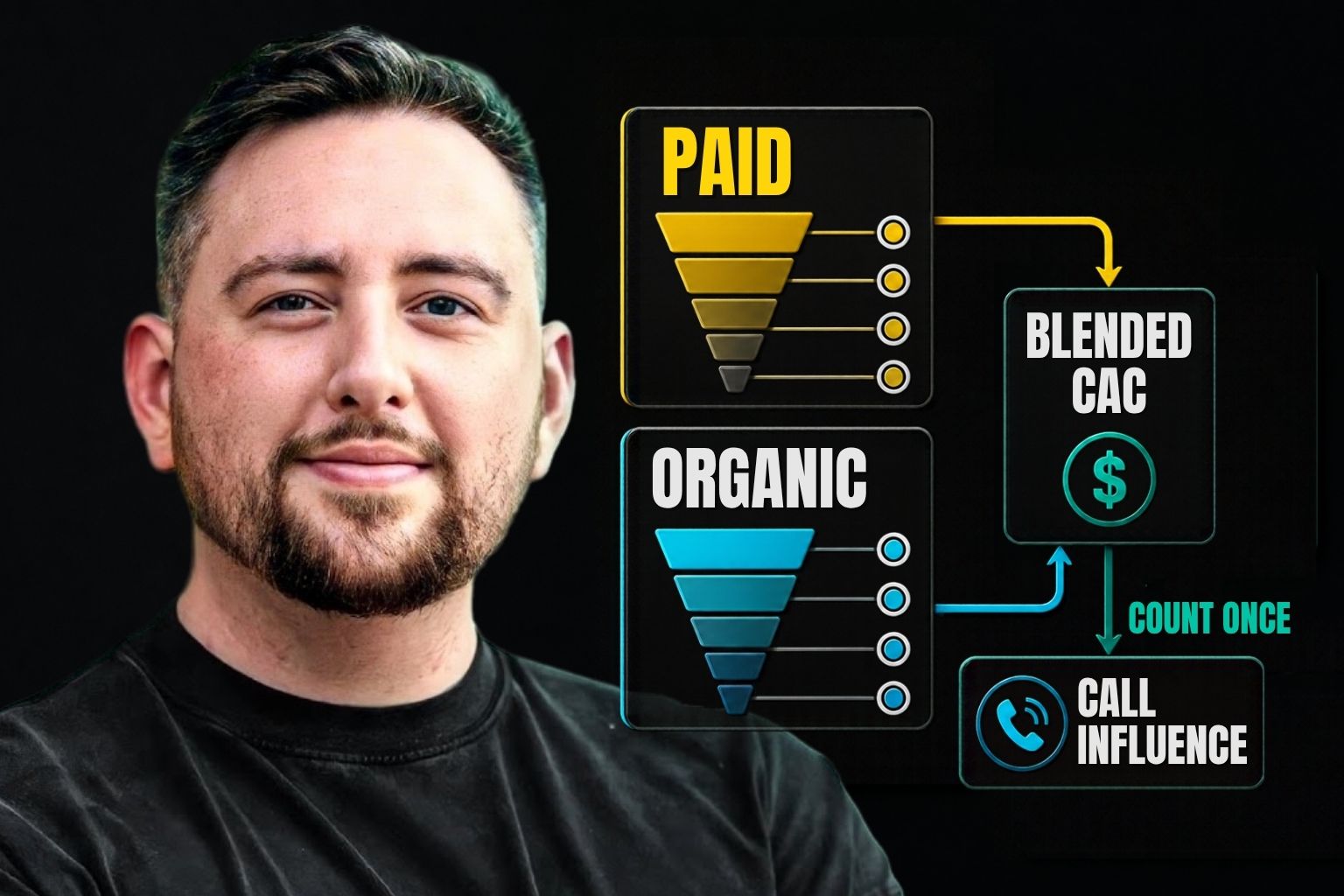
Your blended customer acquisition cost can improve while paid traffic delivers the same results as before. More organic buyers came through, more people closed, and the combined report looked healthier. I want to see which part of the funnel changed before I give the ads credit or spend more money on them.
I worked through this with an operator whose team had been reporting paid and organic calls together. He raised another problem. Some buyers looked cold in the tracking tool but said on sales calls that they’d been watching his YouTube content. Those are two different gaps. You need separate numbers for the routes buyers entered through, and you need room to record the influence you hear about later.
Already making money? See what it takes to make a lot more.
Blended CAC Can Move While Paid Results Stand Still
Blended customer acquisition cost, or CAC, is useful when you’re asking what the business spent acquiring customers across the sources included in the calculation. It becomes less useful when you ask it to tell you whether a paid campaign got better. That question needs its own comparison.
Suppose paid bookings and paid customers stay roughly the same while more people come in through organic content. If acquisition spending stays flat, the combined cost per customer can fall. Nothing about that calculation tells you whether paid buyers booked, showed up, or closed any differently.
That cuts both ways. A period with less organic demand can make the combined close rate look worse even when paid performance hasn’t deteriorated. Check whether the channel changed or whether you got a different mix of buyers. Those two answers lead to different spending decisions.
Compare Paid and Organic at the Same Funnel Stage
Give paid and organic their own view of bookings, attended calls, and customers. Keep the definitions the same so you can see where the paths start to behave differently. If this week’s paid bookings haven’t had time to turn into sales, comparing them with last month’s completed organic sales tells you very little.
I want to see the counts next to the rates. Booked-to-attended tells me whether people are showing up. Attended-to-customer tells me what happened once they got on the call. A blended booked-to-customer rate can hide the fact that the problem is attendance on one route and closing on another.
Use consistent labels for the traffic you observed. Google’s campaign tagging guidance explains how campaign parameters identify referring traffic. They help you label the visit or campaign you captured. They don’t give you a record of every piece of content someone watched beforehand.
You can do this even when both groups book through the same funnel. Building separate funnels for different sales motions is a bigger decision. Here you can start with the reporting. If you’re considering another ad platform, getting the current reporting ready first matters even more.
A Paid Booking Can Still Have an Organic History
When somebody clicks an ad and books, the paid source is useful information. If they spent months watching your content without taking a trackable action, that history can be absent from the report. The ad may have been the route into the funnel even though the buyer already knew the offer.
Google Analytics distinguishes first-user and session traffic sources because those labels answer different questions. The route that brought someone to a particular visit can differ from the earliest route the tool recorded. Both are limited to what the system can see.
Keep the paid booking in its observed bucket. Add a separate note that the buyer reported watching organic content. If you move that person into the organic bucket instead, you lose the paid booking you observed. If you count them as two customers, the totals no longer reconcile. One customer can have a paid entry and reported organic influence.
Use Sales Calls to Hear What the Dashboard Missed
Ask what the person knew before booking and what helped them decide to speak with you. A question like “What had you seen from us before you booked?” gives the buyer a chance to explain the path in their own words. Listen for the detail that changed what they understood.
If someone says they’d watched several videos and the ad reminded them to book, keep that answer close to the deal. It gives the sales team something to work with. It doesn’t prove the ad was unnecessary or tell you how much revenue each video produced.
Google’s attribution guidance describes attribution as assigning credit to touchpoints. That’s useful as long as you know which touchpoints are eligible for credit. A conversation can fill in context without turning someone’s memory into a tracked event.
In my Inner Circle, I would rather discuss a handful of actual calls alongside the report than argue over whether an entire channel should get the credit. You can hear what buyers understood and see whether the numbers tell the same story.
Results are not typical. Your results will vary and depend entirely on your individual capacity, business experience, expertise, and level of desire. There are no guarantees concerning the level of success you may experience. The testimonials and examples used are not intended to represent or guarantee that anyone will achieve the same or similar results. We don’t believe in get-rich-quick programs. We believe in hard work, adding value and serving others. As stated by law, we can not and do not make any guarantees about your own ability to get results or earn any money with our information, courses, programs, or strategies.
7 weeks. Real frameworks. Covering copywriting, funnels, paid ads, and conversion systems.
Make the Spending Decision From the Right View
Use blended CAC to see what acquisition costs the business overall. Use source-level funnel results to see where paid or organic buyers are getting stuck. Use the call evidence to decide what the paid path might need to explain sooner.
If paid bookings show up but arrive less informed, listen to the people who already understood the offer. What did they learn before they booked? That can point to useful education for the paid funnel. It connects the reporting decision to why cold traffic and organic buyers convert differently, without treating the channel label as a measure of how much somebody knows.
If paid attendance and closing haven’t improved, a healthier blended figure alone isn’t a reason to raise the budget. Check the paid numbers and what the team learned from the calls. You may have a better organic month and the same paid funnel you had before.
Reading traffic, messaging, and sales together is part of Master Internet Marketing, my 7-week live comprehensive training. Keep the combined view for the business, then put the paid and organic numbers next to it when you need to decide what to change.
Results are not typical. Your results will vary and depend entirely on your individual capacity, business experience, expertise, and level of desire. There are no guarantees concerning the level of success you may experience. The testimonials and examples used are not intended to represent or guarantee that anyone will achieve the same or similar results. We don’t believe in get-rich-quick programs. We believe in hard work, adding value and serving others. As stated by law, we can not and do not make any guarantees about your own ability to get results or earn any money with our information, courses, programs, or strategies.
Get my content first on Google
Add jeremyhaynes.com as a preferred source and Google shows my articles more prominently in your search results, including AI Overviews and AI Mode.

Jeremy Haynes
Owner and CEO of Megalodon Marketing
Jeremy Haynes is the founder of Megalodon Marketing. He is considered one of the top digital marketers and has the results to back it up.