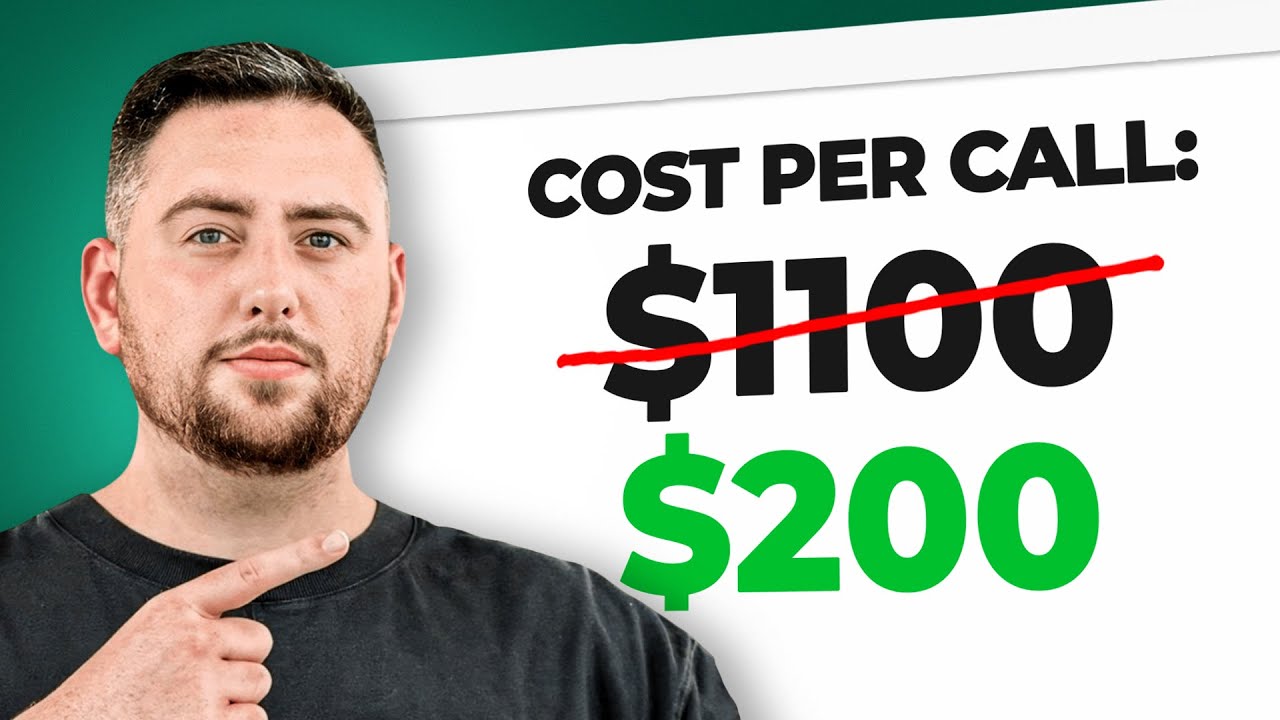
How to Lower Your Cost Per Call and Stop Guessing at What’s Actually Wrong

I hope you enjoy reading this blog post. If you want my team to just do your marketing for you, click here.
Author: Jeremy Haynes | Published April 14, 2026
Earnings Disclaimer: You have a .1% probability of hitting million-dollar months according to the US Bureau of Labor Statistics. As stated by law, we can not and do not make any guarantees about your own ability to get results or earn any money with our ideas, information, programs, or strategies. We don’t know you, and besides, your results in life are up to you. We’re here to help by giving you our greatest strategies to move you forward, faster. However, nothing on this page or any of our websites or emails is a promise or guarantee of future earnings. Any financial numbers referenced here, or on any of our sites or emails, are simply estimates or projections or past results, and should not be considered exact, actual, or as a promise of potential earnings – all numbers are illustrative only.
The same question arrives constantly through comments, DMs, and tweets: “Jeremy, my cost per call is too high. What do I do?”
Most operators don’t actually have a problem.
They’re operating on gut feelings instead of data. They’re comparing current numbers to what they paid three years ago, completely ignoring that Facebook, Google, Snapchat, and LinkedIn are publicly traded companies that need to increase revenue every single quarter. Ad costs rise. According to Statista’s advertising research, global digital ad spending continues to climb year over year, which means platform costs rise accordingly.
Before changing everything in your funnel, establish whether your cost per call is actually high. This diagnostic process is something I cover extensively in my 7-week live comprehensive training. Without understanding your actual numbers, you’re just guessing.
Results are not typical. Your results will vary and depend entirely on your individual capacity, business experience, expertise, and level of desire. There are no guarantees concerning the level of success you may experience. The testimonials and examples used are not intended to represent or guarantee that anyone will achieve the same or similar results. We don’t believe in get-rich-quick programs. We believe in hard work, adding value and serving others. As stated by law, we can not and do not make any guarantees about your own ability to get results or earn any money with our information, courses, programs, or strategies.
What follows is exactly how I approach diagnosing and addressing this issue.
Why Financial Modeling Should Come Before Any Funnel Changes
Stop operating on feelings. You need to financially model out your entire funnel to understand what you can actually afford.
What often happens is that a number becomes an anchor bias. When you’ve maintained a certain cost per call for a while and costs jump, panic sets in. That original number becomes stuck as the benchmark, even when the math might support a higher cost.
The first step isn’t changing your ads or tweaking your landing page. It’s doing the actual math to understand your constraints. You might already be in a workable position and just don’t realize it.
Factor in things like Q4 fluctuations. Ad costs tend to spike during the holidays when a significant portion of annual ad spend gets concentrated into a short window. Add an election cycle on top of that? You’re experiencing a Black Swan event where costs will be higher, and that’s not necessarily a reflection of your funnel performance. WordStream’s advertising benchmarks show how costs fluctuate across industries and time periods.
How to Map Out Every Step of Your Funnel and Find the Real Bottleneck
Once you’ve established that your cost per call genuinely needs attention, map out every single step of your funnel and quantify the statistics at each point.
Track these metrics in your approach:
CPM: the cost to reach 1,000 people. This is your starting point.
Unique link click-through rate: the percentage of people actually clicking on your ads.
Conversion rate on your landing page: whether that’s an opt-in, an application, or a DM.
Show rate: how many scheduled calls actually happen.
Close rate: how many calls turn into sales.
Average order value: what you’re actually collecting per sale.
ROAS: return on ad spend.
Every one of these statistics impacts the next one. More importantly, every one of these statistics has a cost associated with it that directly influences your final cost per call.
The Doubles Game Strategy for Finding Your Path of Least Resistance
The strategy that’s made the biggest difference in how I approach these problems is to identify which statistic is easiest to double.
If your click-through rate is sitting at a lower number and you can double it, you’ve addressed a significant portion of your cost per call issue. If your CPM is elevated and you can reduce it substantially, same result.
The key is finding the path of least resistance.
Improving click-through rate is relatively straightforward from an operational standpoint. Fresh ad creatives, better hooks, improved thumb-stop rate. Any of these changes can be tested quickly.
Addressing close rate requires sales training, better sales management, potentially hiring new people. That’s not a marketing knob you can turn immediately. That’s a people problem that takes weeks or months to address.
One of my colleagues put it perfectly when I was pushing him to hire more salespeople faster: “Jeremy, these aren’t marketing knobs. These are human beings.” That changed my entire perspective.
Marketing knobs (things like ad creatives, landing page copy, targeting) can be changed and tested within hours. People problems take substantially longer to address.
When you’re playing the doubles game, prioritize the marketing knobs. They’re faster, they’re more within your control, and they compound through the rest of your funnel.
What Causes High CPM and How to Approach Reducing It
If your CPM is abnormally high, there’s usually a specific reason.
Has your page ever been banned? Have you had a high number of ad disapprovals? These things stay on your record and the platform can factor that into your costs.
Are your ad creatives misaligned with your audience? If you’re targeting a highly specific demographic but your ads look generic, the platform can’t figure out why you’re showing these ads to these people.
Sometimes it’s as simple as breaking out your demographics. During election cycles, certain demographics get hammered with ad spend: married businessmen in specific age ranges and locations, for example. If that’s your target audience, you might be competing with political campaigns for ad space.
Try separating your audience characteristics into different ad sets. Test which demographics are driving up costs and eliminate the expensive ones. This is one approach I’ve seen work well in practice.
How to Fix Low Click-Through Rates with Significantly Varied Creatives
Your link click-through rate is one of the fastest statistics to impact. And it has a compounding effect on everything that follows.
If your click-through rate is low, it’s usually one of two problems: ad fatigue or misaligned creatives.
Ad fatigue is straightforward. Your audience has seen your ads too many times. The solution? Fresh creatives. But (and this is critical) significantly varied creatives.
I’ve seen situations where operators think changing the b-roll in their ads would be enough. It often isn’t. The platform algorithms are sophisticated. According to Meta’s own advertising documentation, their systems can detect when you’re making minor tweaks to existing creative.
You need to vary tonality, messaging, environment, and accessories. Shoot from a different angle. Change your shirt. Take your glasses off. Say something completely different.
The path of least resistance (changing captions or swapping b-roll) has inconsistent results. Sometimes it works. But if you want more consistent results, you need significant variance.
Landing Page Optimization for Better Conversion Rates
Once people click your ad, your landing page needs to convert them. This is where conversion rate optimization comes in.
For a standard VSL page (headline at the top, video in the middle, application at the bottom), there are a few key statistics I focus on:
Play rate: the percentage of people who actually press play on your video.
Engagement rate: how long people are staying on the video. If people are dropping off immediately, your video might be too long or not engaging enough.
Application completion rate: how many people who start your application actually finish it.
Sometimes the fix is as simple as cutting down your application. Every additional question adds friction. Every additional step in your process can reduce conversions. Keep it as short as possible while still getting the information your sales team actually needs.
Other times it’s the headline. Or the thumbnail. Sometimes a video thumbnail converts differently than a static image. Sometimes it’s the overall aesthetic of the page.
Test these elements systematically. Change one thing at a time so you know what’s actually moving the needle.
How to Increase Show Rates with Email Deliverability and Personal Outreach
Show rate is where a lot of businesses lose money. You’re paying for the call whether someone shows up or not.
There are two categories of solutions here: marketing knobs and people processes.
On the marketing side, email deliverability is huge. If your emails are landing in spam, people aren’t seeing your reminders. The number of operators who could improve their show rate just by fixing their domain reputation is significant.
The “hammer them” strategy works well in my experience. Send multiple emails per day leading up to the call. Not just “don’t forget your call” emails. Send valuable content that gets them engaged before they show up.
On the people side, having your salespeople reach out before the call can make a difference. Selfie videos, text messages from an actual iPhone instead of your CRM (because those show up like Android messages and people assume they’re automated), phone calls before the scheduled time.
When a salesperson makes personal contact before a call, show rates tend to improve. When you combine that with the email strategy, you’re in a stronger position.
Why Close Rate is Harder to Fix Quickly and What You Can Control
Close rate is harder to impact quickly because it’s mostly a people problem, not a marketing problem.
You need proper sales training. You need competent sales management. You need the right people on the phones.
But there are some marketing knobs that influence close rate too.
Better qualified leads tend to close at higher rates. If you improve your targeting and your messaging, you’re getting better people into your funnel in the first place.
Better educated leads tend to close at higher rates. If your VSL does a better job pre-framing the offer and handling objections, your salespeople have an easier starting point.
The propaganda ad strategy (running retargeting ads to people who’ve booked calls) can help by keeping your brand and message in front of prospects before they talk to your team.
How Changes at the Top of Your Funnel Compound Through Every Step
Changes at the top of your funnel compound through every step that follows.
If you improve your click-through rate, you’re not just addressing your cost per click. You’re affecting your cost per application, your cost per scheduled call, your cost per show, and your cost per sale.
Changes at the bottom of the funnel don’t have that same effect. If you improve your close rate, that’s valuable, but it doesn’t impact any of the statistics that came before it.
That’s why I prioritize the top of the funnel when diagnosing these problems. The impact tends to be bigger and more immediate.
Next Steps to Stop Guessing and Start Testing Systematically
Most operators reading this don’t have a cost per call problem. They have a data problem.
They’re not tracking the right statistics. They’re not modeling out what they can actually afford. They’re making decisions based on how things feel instead of what the numbers actually say.
Map out every step of your funnel. Quantify every statistic. Identify the bottleneck, the one statistic that, if improved, would have the biggest impact on your business.
Then test systematically, changing one thing at a time. Measure the results. Double down on what works.
This isn’t complicated, but it does require discipline. It requires you to actually look at your data instead of just running ads and hoping for the best.
This systematic approach to identifying and fixing bottlenecks is exactly what I cover in detail in my 7-week live comprehensive training. For operators who want ongoing support with implementation, my Inner Circle (a private, application-gated mastermind) provides the structure and community to work through these challenges consistently.
Results are not typical. Your results will vary and depend entirely on your individual capacity, business experience, expertise, and level of desire. There are no guarantees concerning the level of success you may experience. The testimonials and examples used are not intended to represent or guarantee that anyone will achieve the same or similar results. We don’t believe in get-rich-quick programs. We believe in hard work, adding value and serving others. As stated by law, we can not and do not make any guarantees about your own ability to get results or earn any money with our information, courses, programs, or strategies.
You don’t need to overhaul your entire funnel. You just need to find the one or two statistics that are easiest to improve and focus all your attention there until you see results.
That’s how I approach lowering cost per call.
Get my content first on Google
Add jeremyhaynes.com as a preferred source and Google shows my articles more prominently in your search results, including AI Overviews and AI Mode.


Jeremy Haynes
Owner and CEO of Megalodon Marketing
Jeremy Haynes is the founder of Megalodon Marketing. He is considered one of the top digital marketers and has the results to back it up.