What Changes When I Move Ad Copy From Meta to LinkedIn
I hope you enjoy reading this blog post. If you want my team to just do your marketing for you, click here.
Author: Jeremy Haynes | Published September 24, 2026
Earnings Disclaimer: You have a .1% probability of hitting million-dollar months according to the US Bureau of Labor Statistics. As stated by law, we cannot and do not make any guarantees about your own ability to get results or earn any money with our ideas, information, programs, or strategies. We don’t know you, and your results in life are up to you. We’re here to help by giving you our greatest strategies to move you forward, faster. However, nothing on this page or any of our websites or emails is a promise or guarantee of future earnings. Any financial numbers referenced here, or on any of our sites or emails, are simply estimates or projections or past results, and should not be considered exact, actual, or as a promise of potential earnings – all numbers are illustrative only.
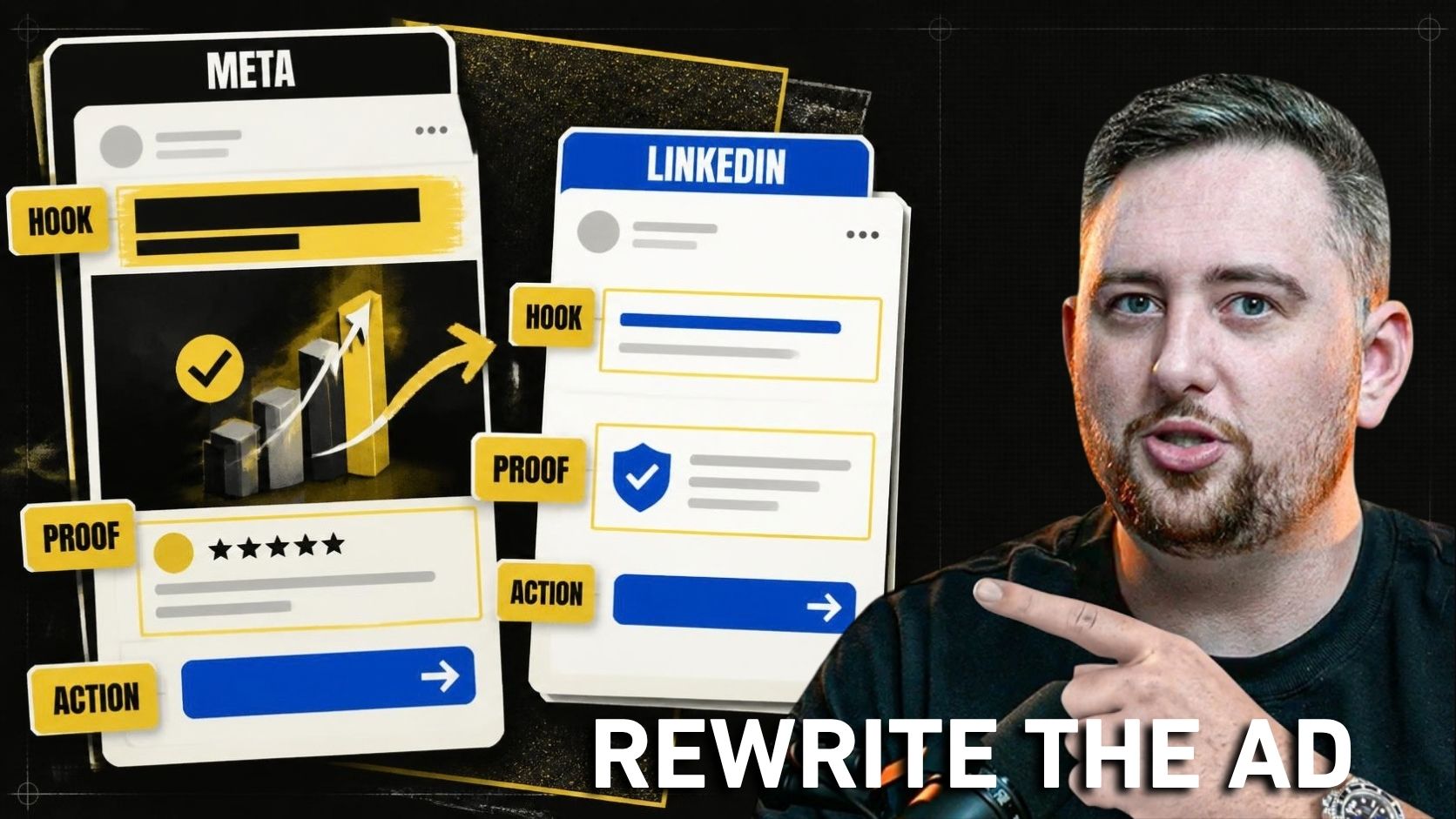
I see operators move a working Meta ad to LinkedIn and change almost nothing except the placement. The offer may still be sound. The copy needs to tell a business buyer what problem it addresses, who should care, and what happens after the click. When I adapt Meta copy for LinkedIn, I keep the buyer problem. Then I rewrite the opening, proof, and next step for the role I am trying to reach.
That does not mean every Meta ad should sound casual or every LinkedIn ad should sound formal. Both feeds contain busy people making quick judgments. The useful distinction is the decision each ad asks someone to make and how much context that person needs before taking the next step.
Already making money? See what it takes to make a lot more.
The Same Offer Needs a Clearer Business Case on LinkedIn
Start with the promise in the Meta ad. What actual problem does the offer solve? Strip away the platform styling and write the answer in one plain sentence. If the sentence does not say who has the problem or what changes when it is solved, the LinkedIn version will be vague before you write a headline.
On Meta, a visual or video may do much of that work. A founder can speak directly to camera while the caption gives the viewer a reason to keep watching. Meta’s advertising update describes video creative tools and several ad surfaces, so I check how the message appears in its actual placement. The format alone tells me nothing about which copy length will work.
On LinkedIn, I want the written opening to survive without the video. State the problem in the language the buyer uses at work. Then tell them what they will learn or see next. A business outcome can be specific without inventing a percentage or pretending a case study exists.
This is the same discipline behind supporting a marketing claim with real proof. The copy can make a strong point, but the evidence underneath it has to be available to the buyer.
Write the Opening for the Person Making the Decision
A role changes which part of a problem matters most. A demand generation lead may care about lead quality and the handoff to sales. A sales leader may care about whether the booked conversation contains a buyer who can make a decision. An owner may care about whether either team can explain where money is getting lost.
LinkedIn’s advertising guide lists job title, seniority, company, industry, and related targeting options. Those controls give you a way to build a relevant audience. They do not guarantee that every viewer has the same authority, budget, or immediate need. The copy still has to qualify the right person.
I would write a different opening for a sales leader and a marketing leader even if both land on the same offer. Each person should recognize the part of the problem they own. If one line is trying to speak to every department at once, it often says very little to any of them.
The audience work in adding paid ads to a B2B sales motion matters here. The ad should join a real buying process, including the people who answer the lead and the evidence those people need.
Keep the First Line Useful Before the Ad Expands
LinkedIn’s single image ad specifications recommend concise introductory text and a separate headline. I treat the opening line as a complete thought because many readers make their first judgment before expanding the post or opening the page.
That first line can name a costly mismatch without making an unsupported result claim. For example, an ad for a sales handoff service might begin with the fact that marketing and sales use different definitions of a qualified lead. The next sentence can explain what the prospect will see when they click.
Move the long explanation to the landing page when it needs room. A dense first paragraph is rarely improved by adding more credentials, adjectives, and promises. If the buyer cannot identify the problem from the opening, extra copy lower down will have a hard time rescuing it.
The first line should make the right person feel recognized. It does not need to make every person curious.
Translate the Proof Instead of Reusing the Same Testimonial
A Meta ad may rely on a customer’s face, story, or short clip to carry the proof. A LinkedIn buyer may need something they can explain to another person inside the company. Show the process, a documented example, an attributable quote with approval, or a case study whose measurement you can defend.
Do not turn a testimonial into a universal outcome. Do not add a client logo because the brand looks impressive. A relationship, quote, figure, or named result belongs in ad copy only when the client has approved it for that use. If the evidence is thin, describe the mechanism accurately and ask for a smaller next step.
My approach to high-ticket messaging without hype applies across both platforms. The wording can change, but the claim has to survive a buyer asking how you know it is true.
For complex offers, I also check whether the proof matches the exact objection in the ad. A proof point about speed does little for a buyer worried about adoption. A strong case study on the wrong problem still leaves the buyer with the original doubt.
Ask for the Next Step the Buyer Can Actually Take
The call to action should match what the ad has earned. If the reader has only seen a brief statement of the problem, a useful demonstration, case study, or explanation may be a better next step than a sales call. If the ad already answers the major questions and the buyer is ready to evaluate a vendor, a call can be reasonable.
LinkedIn’s Lead Gen Forms documentation shows how a form can collect profile information inside the platform. That can reduce form friction, but a completed form is still only a submitted form. Sales needs to assess fit before it is counted as a qualified opportunity.
I check the destination after the CTA. The ad may promise to show the buyer how a process works, while the page immediately asks for an application. That gap breaks the conversation. Carry the same problem, offer, and next step through the ad, page, form, and follow-up.
Inside Master Internet Marketing, my 7-week live comprehensive training, I teach operators to connect ad messaging with the offer and the sales path so the click has a clear job.
Results are not typical. Your results will vary and depend entirely on your individual capacity, business experience, expertise, and level of desire. There are no guarantees concerning the level of success you may experience. The testimonials and examples used are not intended to represent or guarantee that anyone will achieve the same or similar results. We don’t believe in get-rich-quick programs. We believe in hard work, adding value and serving others. As stated by law, we can not and do not make any guarantees about your own ability to get results or earn any money with our information, courses, programs, or strategies.
A Simple Example of Rewriting One Offer for Each Feed
Suppose the offer helps B2B teams understand why inquiries are failing to become useful sales conversations. This is an illustrative copy exercise, not a performance claim. The Meta version could lead with the frustration a founder notices when the calendar looks busy but the sales team keeps rejecting the leads.
The LinkedIn version could address the person responsible for the handoff. It might open with the mismatch between the fields marketing captures and the information sales needs before accepting a meeting. Then it could offer a short walkthrough of the qualification steps and the record sales will receive.
The offer stays recognizable. The buyer’s role, opening tension, supporting proof, and requested action change. Neither version needs a made-up benchmark or a borrowed client story.
Before launch, I read both versions next to the landing page. If the LinkedIn copy introduces a different promise, I repair that mismatch before spending on the campaign.
Judge the Copy by Sales Quality After the Click
Click-through rate can tell you whether the opening attracts attention. It cannot tell you whether the buyer was suitable, understood the offer, or took a useful step. Record the lead source, the message they saw, the form response, the sales disposition, and the reason a conversation did or did not progress.
A LinkedIn ad may produce fewer inquiries and still be useful if the sales conversations are stronger. It may also attract people with the right job title who have no buying need. The sales record tells you which interpretation is supported. Compare both platforms on the same downstream definition rather than declaring the cheaper lead the winner.
The question in how backend value affects channel choices becomes relevant once you know what each channel actually sends into the business. A front-end cost alone does not describe the full relationship.
Operators in my private mastermind, Inner Circle, can bring the ad, page, and sales notes into the room and examine where the message stops matching the buyer.
Results are not typical. Your results will vary and depend entirely on your individual capacity, business experience, expertise, and level of desire. There are no guarantees concerning the level of success you may experience. The testimonials and examples used are not intended to represent or guarantee that anyone will achieve the same or similar results. We don’t believe in get-rich-quick programs. We believe in hard work, adding value and serving others. As stated by law, we can not and do not make any guarantees about your own ability to get results or earn any money with our information, courses, programs, or strategies.
7 weeks. Real frameworks. Covering copywriting, funnels, paid ads, and conversion systems.
What I Check Before Moving Meta Copy to LinkedIn
I keep the underlying buyer problem and check the role, opening line, evidence, CTA, and destination in that order. Each piece should help the next person in the chain understand why the offer is relevant. If the page or sales team is answering a different question, the copy is not finished.
Use the first campaign to learn what the audience understood. Read the comments and form responses, then read the sales notes. Rewrite the line that caused confusion and test the next version with a clear reason for the change. A platform swap becomes useful when it gives you a sharper conversation with the buyer.
Results are not typical. Your results will vary and depend entirely on your individual capacity, business experience, expertise, and level of desire. There are no guarantees concerning the level of success you may experience. The testimonials and examples used are not intended to represent or guarantee that anyone will achieve the same or similar results. We don’t believe in get-rich-quick programs. We believe in hard work, adding value and serving others. As stated by law, we can not and do not make any guarantees about your own ability to get results or earn any money with our information, courses, programs, or strategies.
Get my content first on Google
Add jeremyhaynes.com as a preferred source and Google shows my articles more prominently in your search results, including AI Overviews and AI Mode.


Jeremy Haynes
Owner and CEO of Megalodon Marketing
Jeremy Haynes is the founder of Megalodon Marketing. He is considered one of the top digital marketers and has the results to back it up.