I hope you enjoy reading this blog post. If you want my team to just do your marketing for you, click here.


I hope you enjoy reading this blog post. If you want my team to just do your marketing for you, click here.
Author: Jeremy Haynes | founder of Megalodon Marketing.
Earnings Disclaimer: You have a .1% probability of hitting million-dollar months according to the US Bureau of Labor Statistics. As stated by law, we can not and do not make any guarantees about your own ability to get results or earn any money with our ideas, information, programs, or strategies. We don’t know you, and besides, your results in life are up to you. We’re here to help by giving you our greatest strategies to move you forward, faster. However, nothing on this page or any of our websites or emails is a promise or guarantee of future earnings. Any financial numbers referenced here, or on any of our sites or emails, are simply estimates or projections or past results, and should not be considered exact, actual, or as a promise of potential earnings – all numbers are illustrative only.
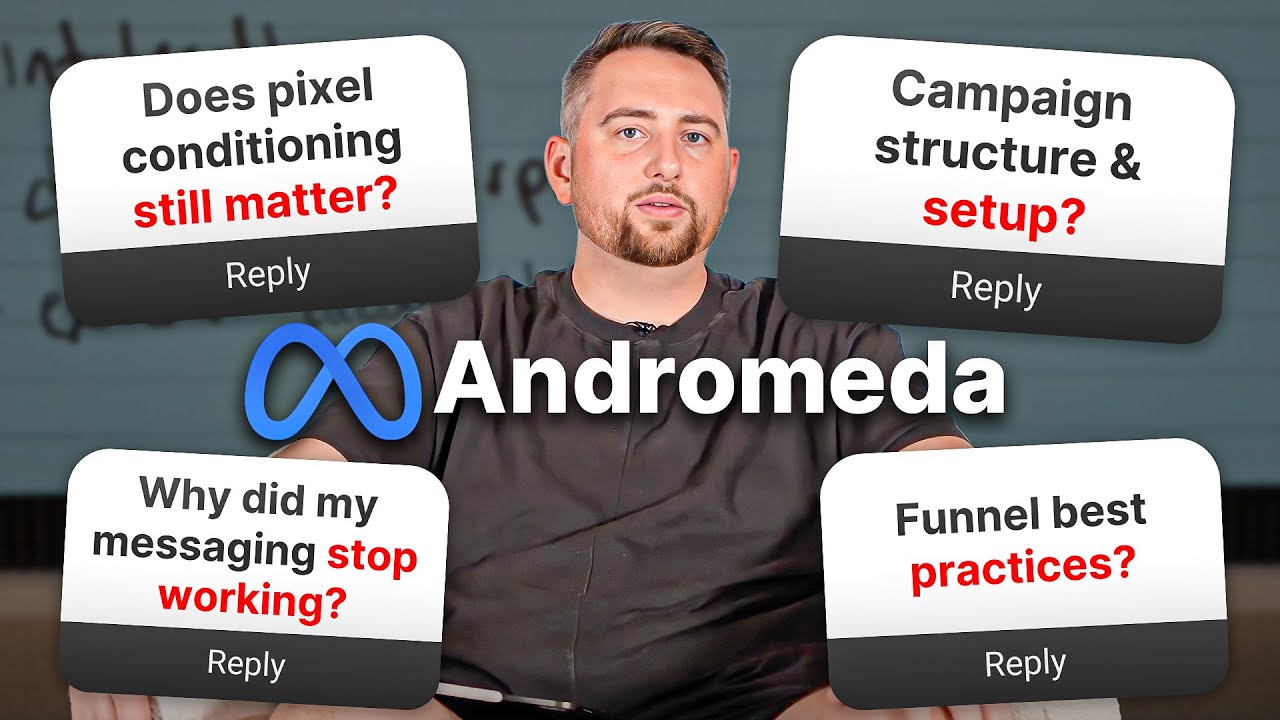
Your top questions about Meta Andromeda answered. I’ve got a whole list of questions here that you guys have asked on recent content that I’m going to sit here and answer for you today.
For all those who don’t know, my name is Jeremy Haynes and all we talk about around here is cracking million-dollar months.
And Meta Andromeda can really hold you back or it can really help you if you actually figure it out and know what you’re doing with it.
So this should be quite helpful to you in your journey.
Of course, there are no income claims. We have no idea who you are. And there’s a really high probability that you’ll never hit those numbers.
According to the US Bureau of Labor Statistics, there’s a 0.1% probability of ever hitting $10 million a year, let alone the even smaller probability than that that you’d ever crack $12 million a year, aka million-dollar months, whether it’s your first million or your next million.
All we’re doing around here is just handing down lessons from people who have been there, done that.
But again, no earnings claims. We have no idea if you can flip money into more money at all.
And at the end of the day, look at you here reading about what Andromeda is, how it works, and how you can have it stop hurting you so you can get better results with your Facebook ads.
If your business is already generating $100k+ per month, My Inner Circle is where you break through to the next level. Inside, I’ll help you identify and solve the bottlenecks holding you back so you can scale faster and with more clarity.
Long story short, ladies and gentlemen, whether it’s your first time here or you’re already following along, it’s a pleasure to have you here with us.
Let’s dive into this whole thing.
So for those who aren’t privy to this yet, first of all, wow. Wow, you’re behind.
July, we started seeing about half our accounts get hit by this. They technically announced this in November of 2024.
They then came out with a Meta Engineering article. Oh, you don’t know what that is either? I mean, how untapped are you?
Anyway, Meta has two things. They have the Facebook newsroom, what they call the Meta newsroom now, which is more like the general populace version of like how to get news from them.
And then you have what they call the Meta Engineering newsroom, which is where the internal devs typically write up more elaborate, expansive, in-depth versions of the same information.
They came out with those in November of 2024 and December 2024.
April of 2025, the Meta Newsroom announced that, hey, here’s another article on Andromeda and how it works.
Generally, as a best practice, just for clarity, when Meta Newsroom like first announces something, you probably have a couple months. Could be like a month, could be like 6 months, who knows? But you got a couple months to kind of prepare for whatever they talk about.
When Meta Engineering announces it, same kind of logic.
And then usually when that second newsroom article hits, you bet that it’s already been tested across some different accounts.
So anyway, back to my point. You’re behind if you don’t know what this is, but I’ll explain it regardless.
Meta Andromeda is essentially the first step of the retrieval and ranking algorithm that they have as it relates to ad distribution.
So Andromeda’s job is to sift through every single possible ad that’s available for it to serve to a specific audience type at a given time and pick thousands out of those – who knows how many ad combinations are available to it in a given moment – and then hand off those ads that it’s selected.
Usually it’s a few thousand. I’d imagine at the lowest sometimes probably a couple hundred.
Hands it off to what they call Meta Lattice. Oh, you don’t know what Meta Lattice is either? Wow. And you spend money on that platform, huh?
Anyway, long story short, Meta Lattice was announced in 2023.
There’s a two-step process to Facebook’s algo, right?
Again, you have the retrieval, and then you have the ranking part of the process.
To keep it super simple, just so you can understand it in the easiest way possible, Andromeda sifts through all the ads, hands them off to Meta Lattice.
And then Meta Lattice is responsible for taking whoever you’re trying to target, whatever you’re optimizing for, past data that’s already attributed to your campaigns and saying, you know, this specific ad that Andromeda gave me out of all the ads it gave me would be best for this type of person.
I bet with a high probability, a high degree of certainty that that person would convert with it.
So that’s all it really is.
Andromeda specifically is the part where it sifts through all the different ads and it tries to determine what to hand off to Lattice.
Lattice is responsible for determining which out of all those ads it was given it’s going to distribute to who.
So anyway, back to my point with Andromeda. The reason this was such a big deal is it changed dramatically – this is an integral part. This is like the entire thing. It’s 50% of the equation of how their algo distribution works.
So anyway, moral of the story, Andromeda being updated, the reason that they did it, just for clarity, in this generative AI world, there is a ton more creatives than ever before. Meta’s official data confirms that over a million advertisers used their generative AI tools to create more than 15 million ads in a single month, with businesses using AI-powered creative generation experiencing up to 22% higher returns on ad spend compared to traditional manual campaign management.
So they had to build a more elaborate powerful system to be able to truly and actually sift through all of the creatives that it was being given and also to anticipate kind of like the future amount and the higher volume that they’re likely projecting are going to come.
So long story short, here’s what Andromeda technically does in a nutshell and practicality.
Now that you understand how it’s designed and like the way it technically works, they take the tiniest little hooks, the things that you say, and they just try to pair it up with people.
That’s it.
So when it sifts through all the different ads that are available to it, it’s just trying to create a bunch of little compartments of what types of ads Lattice could then use to help pair it to specific types of people to help you as the advertiser and to help the customer who’s sitting there scrolling pair together.
You can make money. Customer can buy some things that they need. And then Meta obviously makes some money having that middleman of being the distribution.
My point is with Andromeda, what we’ve seen, which is very interesting compared to any other time in history with how the algo has been, it’s taking not just big majority hooks and distributing them out to people after it hands it off to Lattice, it’s taking little tiny minority hooks.
What Andromeda technically requires you to do, this is what Meta put out in their newsroom article, and we have a whole piece dedicated just to this, by the way, if you want something that’s truly more expansive and elaborate on how this all works.
Long story short, it technically asks of you three specific things. It asks of you to give it diversified messaging, diversified themes, and diversified visuals.
And in that original content that I came out with, I talked about the fact that we tested that it didn’t really need themes and visuals. It seemed to have just need a difference in messaging.
Now if you want to go above and beyond and you want to do a difference in like theme, a difference in environment, a difference in, you know, the visual side of things in addition to the difference in messaging, feel free.
Most of our clients are just busy rich people and they prefer to do things in a more efficient way.
And so one of the first things we tested was do any of those other things actually matter or is it truly just messaging?
And we feel like and we still feel confidence in this that it technically just wants a diversification in the messaging itself.
Now that you’re caught up to about how it works, some of the most common questions that I’ve got as it relates to this.
Here’s the first one. Campaign structure and setup preferences.
So yeah, I have a preferred campaign structure that we like to use. Let me walk you through it.
So the first thing that we like to do is we have two campaigns. We typically have a cold campaign and we have a warm campaign.
What we’ll do is we’ll have three total ad sets within that cold campaign.
Specifically, we’ll have broad. And by the way, just for technicality, broad generally means just a restriction of age and a restriction of like a geographic area. Other than that, we let it rip.
Then we have what’s called an interest stack, which as it kind of sounds, we just take a ton of different interests, demographic traits, behavior traits, whatever is available to us really, and we throw them all inside of one big old ad set.
Same thing. We’ll do the geographic restriction and we’ll do the age restriction if necessary as well.
And then we do a lookalike stack.
The lookalike stack would obviously presume that you are not in a special ad category where obviously that’d be restricted for you to use.
If that was the case, then we would just do the two ad sets of the broad and the interest stack.
Now also I just want to point out in terms of efficiency, when I originally create this campaign, I will create the cold campaign. I will create one of those ad sets and then I’ll go and create all the ads within that ad set.
That way, I don’t have to recreate the ads so many times over, especially with how many ads we technically need nowadays.
Once I get all those ads built out that we’ll talk about here next, I then go back to the ad set level. I duplicate that broad ad set out twice, create my interest stack, create my lookalike stack, and I’ll publish it from there just for efficiency.
So anyway, long story short, the broad ad set, the interest stack ad set, and the lookalike ad set, they’ll all have the same amount of ads.
Usually, we will launch with 25 to 30 unique ads.
And again, they will all be the same. Those 25 to 30 unique ads are going to all be, when I say unique, they have completely unique ads inside of them. Content, images, etc. that have a difference in the message that they say.
Gone are the days where you just do the things that are efficient for you. Like, oh, I’m just going to change the first 3 seconds of the hook and keep the same body on every single ad.
That doesn’t work right now from what we’re seeing nearly as well as literally just having like 25 to 30 completely different reasons that somebody should buy or do whatever action you’re trying to inspire them to do in the ads.
Also, just for technical purposes, I’ll also articulate this. Even though we’re using individual ads, we still get the function to use dynamic copy.
And so we’ll have five headlines and we’ll also have five pieces of body copy.
No, we do not create five unique headlines and five different pieces of body copy per ad out of these 25 to 30.
We’ll use the same five headlines and the same five pieces of body copy that are written in a more generalized way across every single different ad.
If you again, if you want to go above and beyond and you want to write individual copy for each individual ad, feel free.
We don’t because here’s the thing and we’ll talk about this more later. Generally about one to three of these ads will actually get distribution.
The other 22 to you know 28, 29 that you launch they aren’t going to get much for distribution.
And again we’ll talk about that here more later.
Back to my point. The warm ad set that’s typically just what we call a warm audience stack.
That warm audience stack for clarity is usually made up of like all the social interaction. As an example like page engagement, visited the page, you know, interacted with a button, whatever, all that kind of stuff.
Visited the profile. We’ll create a big old stack of people just like that. We’ll throw it all together.
Video views up to a certain threshold, websites, email, website visitors, email lists, exclude customers, whatever.
And then we’ll do the same 25 to 30 ads, the same five headlines, same five pieces of body copy, etc.
Now a few little nuanced questions that I get at this specific stage are usually things related to, well, what do I do when I publish it and only one to three of the ads are actually going to distribute?
All right? So there’s a few things to consider here. Keep this in mind.
When I say that like out of 25 to 30 ads, literally one to three are going to get the reach, it will look when you actually go look at the dashboard and literally like just see the stats like a majority of them will have spent like a couple cents, you know, and then the ones at the top that get all the reach like they might have, you know, upwards of, you know, all the money like a thousand, 2,000, 3,000.
Usually, it’s pretty significant for the variance between the ones that actually got the reach and the ones that didn’t get the reach.
Here’s the good news. From what we’ve found, it’s actually really good things that this occurs, and I’ll explain why.
First of all, the ones that don’t get reach, they aren’t bad. Don’t demonize them.
There was a period in time with advertising on Facebook and Meta where you would see a specific ad not getting distribution and you could technically be like, “All right, well, that ad must have been bad.”
Or it got a little bit of distribution and like a bad cost per result. And again, you could conclude like, “Oh, that ad was bad.”
When it comes to how we see Andromeda working, it just quickly latches on like within the first dozens, maybe hundreds of impressions to one to three out of all the ads that you’ve given it.
Now a lot of people get this like nuanced set of perspectives I just want to address real quick, like where they’ll say things like, “Well, why do I need to launch with 25 to 30?”
Because that’s what Andromeda requires you to do to get awesome results nowadays.
Like, yeah, if I could whittle it all down to just launching with one to three ads because I know which one to three are going to make the biggest impact – like, obviously, we do that.
But here’s the thing, it doesn’t work when you try to do that because Andromeda requires you to have a high volume of well-diversified creative for it to do its job the best.
That’s what it requires nowadays.
Like, this specific setup that I’m sitting here telling you, I just want to be extremely clear. I’ve tested like crazy.
You got to keep in mind how many students I have. I got like 5,000 plus paid students that I intimately learn from as well as they learn from me. We all share information.
We spend a ton of money on clients’ behalf. We have tested against this thesis. We continue to test against this thesis to reinforce that this is the current best structure.
This is currently what’s ripping for us.
And although yeah, majority of those ads won’t get a lot of reach or distribution doesn’t matter. The ones that do get the reach in the distribution, they typically rip – like they do really well for a long duration of time.
And now here’s the other and very important thing. Ad fatigue cycles are far longer than they ever have been before. Industry research shows that while traditional ad fatigue once set in after 2-3 weeks of exposure, modern creative lifespans under Andromeda’s AI-powered delivery can extend 4-6 weeks for ongoing campaigns with proper creative diversity, with some evergreen ads maintaining strong performance for 3+ months when properly rotated and refreshed.
Like we’re not really having to relaunch stuff at nearly as high of a frequency.
There is a piece that I just recently published. It was on messaging best practices. And in that content, I talked about the fact that like you may experience some problems when it comes to messaging.
Like you may exploit a very tiny pocket of people who a very particular ad that you’ve created is best for. And then you’ll rapidly milk that little audience and then it just kind of runs dry.
And then generally from there you’ll get a bunch of bad results or your cost will inflate rapidly.
That can still happen but it’s not like how traditional ad fatigue used to be. Traditional ad fatigue is very different than this modern ad fatigue.
And if you do exploit a larger pocket audience, it rips for a long duration of time and you really can milk it.
And you don’t really want to touch those ad sets when that starts to happen. Soon as something starts to work on an ad set with this level of how it’s set up with Andromeda, we don’t touch it. We just start scaling it.
A lot of people, they have this like old school way of running ads where they’ll pull the winners out of an ad set and like throw them into their own new ad set, like a winner ad set.
Dude, don’t do that. Like, that’s insane to do.
As it relates to this, treat every ad set like, okay, you’re launching it with a set of test budgets.
As soon as you see those one to three ads, get the right cost and the right types of people coming through it, convert that ad set to a scaling ad set. Hit the ceiling.
We have a whole set of lessons. It’s actually one of my favorite lessons in the Jeremy’s Inner Circle weekly group call library for my paid Inner Circle members where I talk about this concept called foundational campaigns.
Your goal with all these ad sets is to accumulate as many of these ad sets that you’re scaling and that you’re looking to hit like a ceiling where there’s a certain amount you can spend where you continue to extract customers out of it profitably, but if you spend beyond that, it starts to make it less profitable and the funnel metrics don’t make as much sense or you start to get into like the wrong types of people.
Digital advertising research shows that Meta’s frequency tracking reveals ad saturation typically occurs when frequency exceeds 3-4 impressions for cold audiences, with cost per result doubling once creative fatigue sets in, making it critical to identify spending ceilings before performance degradation accelerates.
There’s these like ceilings that are very evident when you just run square into them and you have to be very mindful of what to do when you run into those specific ceilings.
But again, that’s a totally different topic. That’s a totally different concept. Like I won’t sit here and explain all that. But again, like it’s a very critical thing for you to know.
Anyway, back to your common questions. The ones that don’t get the distribution, right? Like what do you do with those?
So you’re going to be sitting there and you’re going to be thinking, “Man, I just did this like exhaustive amount of effort to take the time to film like 30 ads and you’re telling me one to three of them are going to get all the reach.”
And again, you can’t frame it like that’s a bad thing.
What you get the opportunity to do is you get the opportunity to duplicate out that ad set, pull out the one to three that got all the reach in the original ad set you duplicated from.
And then what you want to do is put in a new one to three to replace the one to three that already got reach from the original ad set you duplicated from, and publish it and let them get an equal distribution test again.
And you could do that within the same campaign, you could do it within a different campaign. Preferentially, we do it within the same campaign.
And what we try to do is we try to see, okay, out of all these other ads that didn’t previously get distribution, are they now getting distribution?
And if there’s a few cycles where they don’t get distribution time and time again, that’s where we swap them out.
Usually after three times of us attempting to relaunch an ad set that had ads that didn’t get distributed, we will really try to say to ourselves like, I mean, let’s just try some new stuff in place of those ones.
Maybe they’re not bad, maybe they are bad, we don’t know. They just continue to not get distribution, right?
And so that becomes kind of the new failure metric that you want to look for is it just perpetually doesn’t get distribution. Treat it as bad, but doesn’t necessarily mean that that type of messaging was bad.
You get what I mean? An interesting new paradigm that we’re in here.
So again, here’s the good news, right? Like, yeah, you’re going to go film a ton of ads like maybe once or twice, but like then you kind of get to ride the wave of those original ads that you filmed, right?
One of the other things that people commonly do is when they go and see like, okay, these one to three ads got all the distribution and they’re bringing me the right types of customers.
A really good historical best practice would be to go film more ads that have that same kind of messaging.
Right now, if you do that in the age of Andromeda, you’re going to just pigeonhole yourself to that specific messaging pocket.
It’s kind of like drilling more wells, right? Let me just give you a visual here so you can understand this, right?
Let’s say you and I bought a plot of land and it’s got some pockets of water underneath it, right? And some of those pockets of water are real big and some of them are real small.
So you go up top and we, you know, we drill a well down and we start extracting water.
Now if I just consistently exploit the same messaging in all my future ads that I go film, I’m actually going to have a bad time because all I’m really doing is I’m just putting more wells into the same pocket audience.
I’m reducing the amount of people that are inside of that specific pocket faster.
And what I’m actually doing is I’m increasing the probability that I hit a ceiling or potentially am extracting too much to where I dry out that audience.
What you really want to do in this day and age of Andromeda is you want to continue exploring more messaging.
Sure, like you’re going to come across an occasional pocket that’s very small and that you’re only going to be able to spend like maybe a couple hundred a day into, maybe less, right?
But you’ll be able to ride it out at that and turn it into a foundational campaign.
What you really want to consistently try to find are those larger pockets, right?
Those larger pockets, you’ll only find them through consistently varying your messaging. You understand?
So don’t get attached onto one specific type of message. Try to vary and don’t pigeonhole yourself. It’s kind of like creating an echo chamber.
And then just to be clear, we get this question a lot as well when it comes to the messaging has stopped working and it relates to what I was just describing.
So the question is my messaging stopped working. What should I do?
So we treat it like this. Just as I just described with this analogy here where I’m like, hey, like treat it like you’re, you know, sucking water out of the ground.
I also compare it to oil fields where I’m like, “All right, look, oil is technically a non-renewable resource. And so if I’m extracting oil out of the ground, nothing replenishes it.”
There’s like a finite amount of people in a given market at a given time that are probable to convert on a given set of messaging, right?
And when you look at it from that perspective and you look at it like the well analogy where you’re drilling wells into the ground and you’re exploiting these audiences, eventually they could run dry.
And it’s tough to tell. Like sometimes all it takes is like you start to see some points where your messaging is not working. Just pull back the spend a little bit in that example and see if it’s more like an aquifer that’s fed by a spring.
Try to see if it replenishes, right? Because if you can spend a certain amount per day, but you just can’t scale it, that means that yeah, there’s an amount of people there that exist, but there’s also a new amount of people that enter that appeal for whatever that type of messaging appeals to.
There’s more people that enter into that pocket as time goes on. You just can’t extract more than what exists at its rate of replenishment.
You understand what I’m saying?
So anyway, moral of the story, sometimes it’s like an oil field where it will run dry and you’ll just have to abandon that type of messaging and get new messaging.
In other instances, you hit a certain pocket, but you can only scale to a certain point in that pocket. That’s where those campaigns become foundational campaigns and you just try to maintain them instead.
Very important consideration, right? You just got to continue to vary messaging.
And by the way, we have plenty of content that also would imply to you, which is a great solution to also think with that you might just need a new funnel.
You can take the same type of messaging and have a different funnel paired with it and that can also create a wild difference in results that you experience on the other side of that.
So consider that too.
Another question that I got which I actually thought was really interesting, does pixel conditioning still matter? And then what about the learning phase?
So first of all, pixel conditioning and the learning phase are like hand-in-hand.
We’ve actually found a pretty significant uptick in how much the learning phase matters right now. It has a lot of significance on how well a campaign is going to perform.
You do want to be able to get out of the learning phase.
I have an incredible piece here dedicated to pixel conditioning and I would absolutely encourage you check that out if you haven’t done so already. It’s extremely in-depth and absolutely that lesson still applies.
The people that report back to that results column are going to be people that the algorithm biases towards next.
So if you have a specific type of messaging that’s appealing to the right types of people and those people aren’t reporting back at a high rate because you have a low match score in your events manager, you aren’t sending data back through the conversion API or you’re sending too little data back or just you have tracking issues period, you’re really going to want to fix that.
You’re really going to want to master pixel conditioning.
Now at this point, I just want to be really clear. Like, if the ad people that you’re working with or you as an ad person aren’t already privy to this, you’re behind.
These are things that people in my Jeremy’s Inner Circle group, people in my Master Internet Marketing class, like they already know. And guess what? They know it in way more depth than what I’m sitting here talking to you about right now.
Just so you understand, I have like entire hour-long trainings for each one of these little things that we’re sitting here talking about right now that I’m condensing down to like summary versions that I’m sitting here giving you.
Unlike some of the people out here that do content in the personal development space, I don’t lie to you. I hold back a tremendous amount of information here from you.
So you are incentivized and encouraged to buy my stuff.
There’s links down below. Jeremy’s Inner Circle. We do twice a month one-on-one calls, weekly group calls, quarterly in-person masterminds right here at our facility in good old Miami, Florida.
We have an extensive course vault. Each piece is meant to be that one thing that makes back the money for the entire year to be a part of that thing.
Unlimited access to Jeremy AI. You can DM me in real time, whatever questions you got, and we have an extremely active group chat of people that’ll give you perspective, too.
And guess what? They’re not broke people. They’re vetted in there. High revenue levels, all rich people trying to get richer.
Master Internet Marketing, on the other hand, is an incredibly in-depth one-time cost to be a part of it for the lifetime of the program. We update it every year. We keep it up to date.
It’s incredible information in there as well.
Whichever one’s more appropriate for you, take action on it. Stop being so complacent of being behind.
If you’re sitting here learning this right now, it’s because there’s some serious implications to your revenue for not knowing how this works in depth.
You’re only going to learn so much here. And I’m still going to put you on game. I’ll always put you on game.
And I’ll give you more than what most people would charge you for in their terrible programs all right here for free.
But again, you’ve been jaded. You’ve been let down by so many bad education companies. People really just selling courses who don’t actually run an education company and take it serious that you probably project that on to me.
It’s like having a bad ex that you project that relationship to onto every future relationship.
Not me, my friend. I won’t let you down with my paid stuff. Quite the opposite. I’m extremely good at my job.
And I would encourage that you go check those out. Apply to one or the other and let me help you spend some money with me and let me help you get richer.
Anyway, back to my point in some of these other little nuance questions you guys have.
The learning phase. You got to either spend enough to get out of the learning phase faster or you got to send enough data back sooner to be able to get out of the learning phase faster because it does have significant ramifications on campaigns performances nowadays.
That’s not to say that you can’t have a wildly profitable campaign that’s in learning limited. I have those all the time too and that’s okay if that’s the case.
I’m just saying we see campaigns rip when it exits learning phase nowadays. So don’t take that lesson lightly.
One of these next questions. This is actually the last one.
When it comes to funnels, you guys asked the question, “What do I do with my funnel since one to three of the ads will distribute that assumptively have very specific messaging? Do I need to update my funnel, too?”
Yeah, you do.
So as a great best practice, something that we love to do right now, we will look – this is a pro, this ain’t even a best practice. This is a pro tip I’m putting you all game to right now.
Pro tip. So you have an ad that has a lot of the distribution and when it clicks to the landing page that you’ve got, whether that be a VSSL call funnel, webinar, low ticket, a high ticket, it could even be a lead form in the app itself. It could be anything.
Whatever they actually clicked through to this page should ideally be contextual to the messaging of the number one ad.
I can’t even believe I’m telling you this for free right now from how much money this has made me and my clients.
What this means is again when you have a total of 25 to 30 ads, right? And again only one to three actually get the reach.
What this implies is that you have to understand those one to three, they have a unique set of messaging in them. They have a specific reason to go convert.
If the page doesn’t parrot whatever the messaging is from the ad and it’s more like ambiguous, broad, or related to one of the other specific set of messaging that didn’t get the distribution, you could be making a lot more money if you actually updated the page to parrot the messaging inside of the ad.
Now just in terms of a technicality, and again, can’t even believe I’m putting you on game to this, but at the same time, I can, you know, my job here without you paying me any money is to try to make you enough money to be able to have you comfortably afford my paid stuff with house money from how much I’m able to make you here.
So make sure you actually apply this one so we can start that process together.
Here’s my point. You ideally to execute this per ad set have a specific unique URL.
So as an example, ad set one has URL one, right? And this could be the same like domain just a forward slash is different.
That way when inside of that ad set that specific one to three ads get all the reach, you can just go in your funnel builder and easily update that one specific funnel that is paired with that one specific ad set to reflect and parrot the messaging of whatever ads are getting all the reach in that one to three ads.
You get what I’m saying?
So if you end up with let’s say 20 ad sets, you’ll have 20 unique URL paths. That way again you have 20 unique sets of funnel messaging.
This, by the way, is not something that should be perceived as like a ton of work. You’re not a coal miner, you know?
You’re not going and pickaxing and blowing up with dynamite stuff in a mine. You’re clicking buttons, typing on keys, moving a mouse around, using your brains. Ain’t tough.
This a Google AdWords best practice forever. It’s called page relevancy. You should have been doing things like this, but you haven’t had to.
Thank goodness Andromeda finally woke people like you up. You need to go hard.
Andromeda is awesome. You saw close out today, I, in terms of algorithms, am a huge fan of Andromeda.
I love it. I think it’s sweet.
Ad fatigue is longer than it’s ever been before. Little niche micro hooks are getting a ton of reach. They’re hitting pockets of people with pain points I didn’t even think we’d ever be able to reach again.
I remember back in 2017 and prior to that time frame, you could target people’s credit scores, bank balances, active income, liquid net worths. Like you could target all kinds of crazy stuff back then.
And I remember thinking when targeting got stripped, I was like, damn, like this is cooked.
And then I remember, no, this is a trillion multi-trillion dollar company. They’ve got my back. They make all their money from paid ads.
Sure, they do some questionable things here and there, like all these AI generative advantage things on the ad level right now, but hey, maybe even those will get good as time goes on, like most stuff.
I don’t know about you, but Advantage Audiences was terrible when it first rolled out, and that makes a ton of money for us and my clients nowadays.
I believe in these guys. And here’s one thing that I deeply believe about them. They’re not going to nuke a trillion dollar market cap by doing bad things.
The things that they do are in almost all instances extremely beneficial. But it takes time for advertisers to adapt.
And the ones that don’t adapt, boy oh boy, do they complain loud.
The ones who do adapt, we don’t have to complain. As a matter of fact, we’re too busy with all the fulfillment that we have from how many customers we generate by milking the opportunity out of Andromeda and all the opportunity it provides.
I sure hope that’s you here soon enough because I’ll tell you point blank, there had never been a greater opportunity with Andromeda and Lattice in that ranking and retrieval step of the algo.
It is sick the opportunity it provides.
I’ll end it with this. Messaging controls targeting nowadays. Marketing research confirms that Meta’s algorithm now analyzes ad copy and creative content to determine audience delivery, with the system making real-time adjustments based on user response patterns rather than manual targeting inputs, meaning that creative messaging has become the primary driver of who sees your ads in the Andromeda era.
Messaging is more important than it’s ever been.
If you feel like you have not figured out messaging yet, go check out all the messaging content here. I’ve got some incredible pieces for you.
And of course, if you want the real sauce on messaging, check out those links down below. Give me some money and let me help you for real.
Go check out some of my other content.
What I can teach you isn’t theory. It’s the exact playbook my team has used to build multi-million-dollar businesses. With Master Internet Marketing, you get lifetime access to live cohorts, dozens of SOPs, and an 80+ question certification exam to prove you know your stuff.
Thank you so much for being here. Go out there and get richer.
Talk soon.
Watch the video:

Jeremy Haynes is the founder of Megalodon Marketing. He is considered one of the top digital marketers and has the results to back it up. Jeremy has consistently demonstrated his expertise whether it be through his content advertising “propaganda” strategies that are originated by him, as well as his funnel and direct response marketing strategies. He’s trusted by the biggest names in the industries his agency works in and by over 4,000+ paid students that learn how to become better digital marketers and agency owners through his education products.

Jeremy Haynes is the founder of Megalodon Marketing. He is considered one of the top digital marketers and has the results to back it up. Jeremy has consistently demonstrated his expertise whether it be through his content advertising “propaganda” strategies that are originated by him, as well as his funnel and direct response marketing strategies. He’s trusted by the biggest names in the industries his agency works in and by over 4,000+ paid students that learn how to become better digital marketers and agency owners through his education products.

This site is not a part of the Facebook website or Facebook Inc.
This site is NOT /endorsed by Facebook in any way. FACEBOOK is a trademark of FACEBOOK, Inc.
We don’t believe in get-rich-quick programs or short cuts. We believe in hard work, adding value and serving others. And that’s what our programs and information we share are designed to help you do. As stated by law, we can not and do not make any guarantees about your own ability to get results or earn any money with our ideas, information, programs or strategies. We don’t know you and, besides, your results in life are up to you. Agreed? We’re here to help by giving you our greatest strategies to move you forward, faster. However, nothing on this page or any of our websites or emails is a promise or guarantee of future earnings. Any financial numbers referenced here, or on any of our sites or emails, are simply estimates or projections or past results, and should not be considered exact, actual or as a promise of potential earnings – all numbers are illustrative only.
Results may vary and testimonials are not claimed to represent typical results. All testimonials are real. These results are meant as a showcase of what the best, most motivated and driven clients have done and should not be taken as average or typical results.
You should perform your own due diligence and use your own best judgment prior to making any investment decision pertaining to your business. By virtue of visiting this site or interacting with any portion of this site, you agree that you’re fully responsible for the investments you make and any outcomes that may result.
Do you have questions? Please email [email protected]
Call or Text (305) 704-0094