Why Operators Get Stuck and How Decision Rules Fix It

I hope you enjoy reading this blog post. If you want my team to just do your marketing for you, click here.
Author: Jeremy Haynes | Published May 18, 2026
Earnings Disclaimer: You have a .1% probability of hitting million-dollar months according to the US Bureau of Labor Statistics. As stated by law, we can not and do not make any guarantees about your own ability to get results or earn any money with our ideas, information, programs, or strategies. We don’t know you, and besides, your results in life are up to you. We’re here to help by giving you our greatest strategies to move you forward, faster. However, nothing on this page or any of our websites or emails is a promise or guarantee of future earnings. Any financial numbers referenced here, or on any of our sites or emails, are simply estimates or projections or past results, and should not be considered exact, actual, or as a promise of potential earnings – all numbers are illustrative only.
Look, most operators are stuck because they’re making the same decisions over and over again. Every single day, you’re answering the same questions, handling the same types of situations, and burning mental energy on stuff that shouldn’t even require your attention anymore.
And here’s what nobody talks about: the reason you’re not where you want to be isn’t because you don’t know what to do. It’s because you’re spending most of your time on tasks that could be delegated while the strategic work sits there waiting for you.
I’ve worked with enough businesses through Master Internet Marketing, our 7-week live comprehensive training, to see this pattern play out constantly. The operator is talented, the offer works, the market is there, but the founder is personally reviewing every deliverable, answering every customer question, and making every tiny decision that comes up.
Results are not typical. Your results will vary and depend entirely on your individual capacity, business experience, expertise, and level of desire. There are no guarantees concerning the level of success you may experience. The testimonials and examples used are not intended to represent or guarantee that anyone will achieve the same or similar results. We don’t believe in get-rich-quick programs. We believe in hard work, adding value, and serving others. As stated by law, we can not and do not make any guarantees about your own ability to get results or earn any money with our information, courses, programs, or strategies.
That’s not operating a business. That’s being employed by your own company.
7 weeks. Real frameworks. Covering copywriting, funnels, paid ads, and conversion systems.
Why Most Operators Are the Bottleneck in Their Own Business
Here’s the thing about hitting revenue ceilings. Most people think it’s a marketing problem or an offer problem or a market problem. But when I audit businesses, it’s almost always an operator problem.
You became successful because you’re good at everything. You can handle sales, you can manage the team, you can fix the tech issues, you can talk to customers. That’s what got you here.
But that’s exactly what’s keeping you stuck.
Because every hour you spend doing something that someone else could do at an acceptable level is an hour you’re not spending on the activities that actually move the business forward. And the math on this is brutal.
According to research on decision fatigue from the National Institutes of Health, the quality of decisions degrades significantly as decision volume increases throughout the day. You’re not immune to this just because you run a business.
The businesses I’ve worked with that break through all have one thing in common: the operator stopped making repetitive decisions and started building decision rules instead.
How to Actually Think About the Value of Your Time
Let me break down how to actually think about the value of your time, because most operators get this completely wrong.
There are basically four tiers of tasks in any business.
Low-value tasks are things like checking email, scheduling meetings, manual data entry, responding to routine questions, fixing small tech issues, formatting documents. Stuff that’s necessary but requires zero strategic thinking.
Mid-value tasks include managing team execution on established processes, handling customer issues personally, making basic marketing tweaks, attending routine meetings. This is work that requires some judgment but follows existing frameworks.
Leverage tasks are building systems, hiring key people, creating SOPs, optimizing funnels, setting up automation, training team members. This is the work that creates infrastructure.
Strategic tasks are high-level strategy, partnership deals, creating new offers, positioning, major capital decisions, vision-setting. This is the work that only you can do and that fundamentally changes the trajectory of the business.
Now here’s what I see constantly: operators running established businesses who are still spending the majority of their time on low and mid-value tasks.
And they justify it. “Nobody can do it as well as me.” “It’s faster if I just do it myself.” “I need to maintain quality control.”
All of that might be true in the short term. But in the long term, it’s catastrophic.
What Decision Rules Actually Are and Why They Matter
Decision rules are pre-made frameworks that eliminate the need to make the same decision multiple times. Instead of evaluating every situation from scratch, you create a rule that handles an entire category of decisions automatically.
This isn’t about being rigid or inflexible. It’s about recognizing that most of the decisions you make every day are repetitive and predictable. And every time you make one of those decisions manually, you’re wasting mental energy that could go toward the handful of decisions that actually matter.
Think about it this way: if you’re making the same type of decision more than twice, you don’t need better judgment. You need a rule.
The research on decision fatigue backs this up completely. The average person makes around 35,000 decisions per day according to various studies on cognitive load, and the quality of those decisions degrades as the volume increases.
Operators who run efficiently don’t make more decisions than you. They make fewer, better ones, and they’ve systematized everything else.
Building Your Core Decision Rules for Delegation, Spending, and Hiring
Let me walk through the specific categories where you need decision rules, because this is where the actual implementation happens.
Delegation rules are first because this is where most operators get stuck. My standard rule: if someone else can do a task at an acceptable level, delegate it immediately. Not next week. Not when you have time to train them properly. Immediately.
Another one: if you’ve done the same task twice and it’s not a strategic activity, the third time it happens, it must be delegated or automated. No exceptions. This forces action instead of perpetual delay.
Spending rules eliminate the constant back-and-forth on small purchases. If something costs less than a specific threshold and saves you more than an hour of time, approve it without deliberation. For most established businesses, this threshold should be meaningful enough to prevent constant approval requests.
I’ve seen operators waste 30 minutes debating whether to spend a small amount on a tool that would save them hours per week. The math is insane. Create a rule and move on.
Hiring rules are critical because most operators wait way too long to hire. The rule: if a role has been needed for three consecutive weeks, start the hiring process within 48 hours. Not “when things calm down.” Not “next quarter.” Within 48 hours.
Client and customer rules protect your boundaries and your team’s time. Example: if a client violates a specific boundary, they get one warning, then removal. No exceptions, no special cases, no “but they pay us a lot.”
The moment you start making exceptions, you don’t have a rule. You have a suggestion. And suggestions don’t scale.
Calendar rules are non-negotiable for protecting your strategic time. No meetings before a certain time. No calls on specific days. All communication batched into one or two windows per day instead of constant reactive mode.
In my experience, the first few hours of every day should be protected for deep work. Zero meetings, zero Slack, zero email. That’s when the highest-value work happens, and it’s not up for debate.
Opportunity rules keep you from chasing every shiny object that comes along. The filter I use: if an opportunity doesn’t have the potential to significantly change my current trajectory, it’s an automatic no. Most opportunities are distractions disguised as growth.
Your default answer to any new opportunity should be “no” unless it clears an extremely high bar. Because every yes to something new is a no to the core activities that are already working.
How to Track Where Your Time Actually Goes
Before you can build effective decision rules, you need to know where your time is actually going. And I promise you, it’s not where you think it is.
Here’s the process: track every 30-minute block of your time for five to seven days. Not what you plan to do. What you actually do.
Then categorize each block into the four value tiers: low-value, mid-value, leverage, or strategic work.
Most operators are shocked when they see the results. The typical finding is the majority of time on low and mid-value tasks, a smaller portion on leverage tasks, and very little on actual strategic work.
If you’re stuck and your audit shows this pattern, you’ve found your bottleneck. It’s not the market. It’s not your offer. It’s how you’re spending your time.
Once you have this data, you can start building decision rules to systematically move time from low-value to high-value activities.
What Actually Changes When You Build a Business That Runs Without You
Let’s talk about what actually shifts when you build a business that operates independently, because this is a real operational threshold.
Your role as the operator changes from doer to architect. You’re no longer managing tasks. You’re managing people who manage tasks. You’re no longer making decisions. You’re making frameworks that enable other people to make decisions.
The business needs to function at a high level without you for at least two to four weeks. If it can’t, you don’t have a business. You have a job that you own.
At this level, you typically need dialed offers, proven traffic and lead generation, either a sales team or an automated sales process, a fulfillment team, and operational leadership. That’s usually a COO or an operations manager who owns the day-to-day execution.
The operator’s time shifts almost entirely to strategy, new offer creation, partnerships, team leadership, and vision. Everything else should be handled by systems and people.
This is exactly what we cover in Inner Circle, our flagship program where we work with operators on building these systems.
Results are not typical. Your results will vary and depend entirely on your individual capacity, business experience, expertise, and level of desire. There are no guarantees concerning the level of success you may experience. The testimonials and examples used are not intended to represent or guarantee that anyone will achieve the same or similar results. We don’t believe in get-rich-quick programs. We believe in hard work, adding value, and serving others. As stated by law, we can not and do not make any guarantees about your own ability to get results or earn any money with our information, courses, programs, or strategies.
Creating Your If Then Playbook for Every Common Scenario
One of the most powerful tools for implementing decision rules is what I call the if/then playbook. This is a master document that covers every common scenario your team encounters and tells them exactly what to do.
Example: “If a client requests a refund within seven days, approve it automatically. If it’s after seven days, escalate to the manager. Never to the founder.”
“If a lead doesn’t book a call within 48 hours, they automatically enter this specific follow-up sequence.”
“If a team member misses the same KPI three weeks in a row, initiate the replacement process.”
The goal is to remove yourself from the majority of operational decisions. Every time a new recurring scenario comes up, you add it to the playbook. Over time, this document becomes the operating system of your business.
And here’s the key: this playbook isn’t just documentation. It’s enforcement of your decision rules. It’s how you distribute your judgment without being personally involved in every situation.
The Right Order to Remove Yourself from Different Business Functions
You can’t remove yourself from everything at once. There’s an order to this, and getting the sequence right matters.
First, replace yourself in admin and operations. This is scheduling, email management, basic project management, data entry. All the low-value stuff that eats up hours every day.
Second, replace yourself in fulfillment and delivery. This is harder because it often touches quality and customer experience, but it’s necessary. Document the process, train the person, set clear KPIs, and give them a transition period with oversight.
Third, replace yourself in sales. For most operators, this is the scariest one because sales feels like the lifeblood of the business. But if your sales process depends on you personally, you’re capped at whatever your calendar can handle.
Last, replace yourself in marketing and strategy. Notice I said last. This is the work that actually should have your attention. But most operators do this backwards. They try to delegate strategy first and stay involved in operations, which is exactly wrong.
Each replacement requires four things: a documented process, a trained person, clear KPIs, and a transition period. Skip any of these and the replacement fails.
Why Letting Go of Tasks Is Harder Than It Seems
Let me be real about this: the hardest part of implementing decision rules isn’t tactical. It’s psychological.
Your identity is probably tied to being the person who can handle everything. You started this business doing every role, and there’s a part of you that still gets satisfaction from jumping in and fixing things.
That needs to stop.
Because every time you jump in to handle something yourself, you’re reinforcing the pattern that makes you the bottleneck. Your team learns that they don’t actually own their roles. They learn to escalate to you instead of solving problems.
The mindset shift that’s required: your job is to make yourself unnecessary in every role, one at a time.
That doesn’t mean you’re not valuable. It means your value is in building systems, leading people, and focusing on the strategic work that only you can do.
Research from Harvard Business Review on founders being replaced by professional leadership as companies grow shows that companies often hit growth ceilings when founders remain too involved in operational decisions rather than strategic ones.
There’s going to be discomfort in stepping back from tasks you’re good at. That’s normal. The question is whether you’re willing to trade short-term comfort for long-term infrastructure.
Common Objections and Why They Keep You Stuck
Let me address the objections and mistakes I see constantly, because you’re probably thinking some of these right now.
“I can’t afford to delegate yet.” You can’t afford not to. Every hour you spend on low-value work is an hour you’re not spending on strategic work. The opportunity cost is massive. Start with a VA for 10 hours per week. The ROI will be immediate if you actually use those hours for high-value activities.
“Decision rules will make me too rigid.” No. Decision rules free you to be creative and flexible on the things that actually matter. You’re already rigid, you’re just rigid in a way that keeps you stuck in low-value work.
“My business is different.” The principles are universal. The specific implementation varies, but the core concept of systematizing repetitive decisions applies to every business model.
“I need to be involved in everything for quality control.” Your involvement is the quality problem at larger scale. The business can’t deliver consistent quality if it depends on you personally touching everything. Quality comes from systems and trained people, not founder involvement.
According to McKinsey research on how leaders push decision-making to the front line, businesses that replace micromanagement with clear delegation frameworks see significant improvements in both speed and quality of execution.
Already making money? See what it takes to make a lot more.
What You Need to Do This Week to Start Building Decision Rules
Here’s what you need to do this week if you’re serious about implementing this.
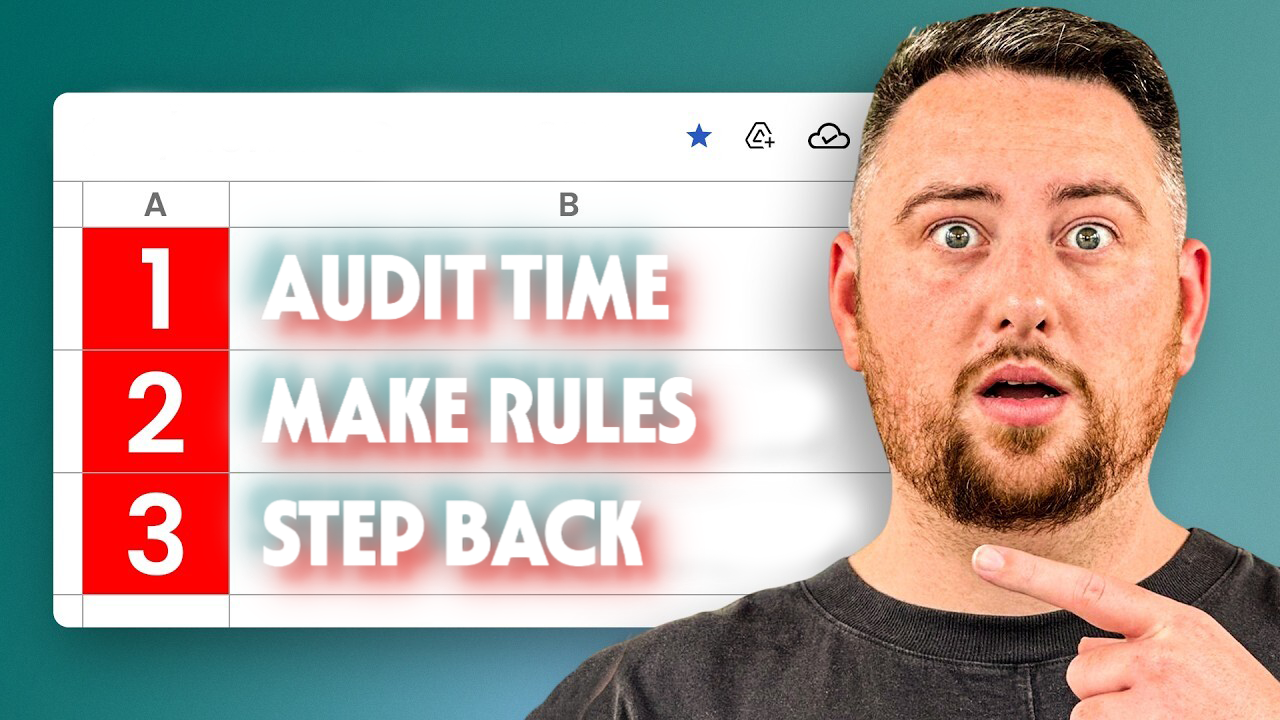
First, do the time audit. Track every 30-minute block for the next five days. Categorize everything into the four value tiers. This gives you the baseline data.
Second, identify your top five recurring low-value decisions. These are the decisions you’re making multiple times per week that don’t require your strategic judgment.
Third, create your first three decision rules. Write them down. Share them with your team. Start enforcing them immediately.
Fourth, delegate or automate one low-value task today. Not this week. Today. It doesn’t matter if it’s not perfect. The point is to break the pattern of doing everything yourself.
If you do these four things, you’ll start to see space open up in your calendar. That space is where the strategic work happens. That space is what gets you from wherever you are now to where you want to be.
The operators who build businesses that run without them aren’t smarter than you. They’re not working harder than you. They’ve just systematically removed themselves from low-value work and built decision-making frameworks that allow their businesses to run without them being the bottleneck.
You can do the same thing. You just have to be willing to let go of the identity of being the person who does everything and step into the role of being the person who builds the systems that do everything.
That’s the shift. Make it, and everything changes.
If you want help implementing these systems in your business, Master Internet Marketing is our 7-week live comprehensive training where we walk through exactly how to build these frameworks. Or if you’re already doing significant revenue and want to work directly with me and a small group of operators, Inner Circle is our flagship program focused on exactly this type of operational transformation.
Results are not typical. Your results will vary and depend entirely on your individual capacity, business experience, expertise, and level of desire. There are no guarantees concerning the level of success you may experience. The testimonials and examples used are not intended to represent or guarantee that anyone will achieve the same or similar results. We don’t believe in get-rich-quick programs. We believe in hard work, adding value, and serving others. As stated by law, we can not and do not make any guarantees about your own ability to get results or earn any money with our information, courses, programs, or strategies.
Get my content first on Google
Add jeremyhaynes.com as a preferred source and Google shows my articles more prominently in your search results, including AI Overviews and AI Mode.


Jeremy Haynes
Owner and CEO of Megalodon Marketing
Jeremy Haynes is the founder of Megalodon Marketing. He is considered one of the top digital marketers and has the results to back it up.