
What Marketing Strategies to Copy When Spending Hundreds of Thousands in Ad Spend Monthly

I hope you enjoy reading this blog post. If you want my team to just do your marketing for you, click here.
Author: Jeremy Haynes | Published January 7, 2026
Earnings Disclaimer: You have a .1% probability of hitting million-dollar months according to the US Bureau of Labor Statistics. As stated by law, we can not and do not make any guarantees about your own ability to get results or earn any money with our ideas, information, programs, or strategies. We don’t know you, and besides, your results in life are up to you. We’re here to help by giving you our greatest strategies to move you forward, faster. However, nothing on this page or any of our websites or emails is a promise or guarantee of future earnings. Any financial numbers referenced here, or on any of our sites or emails, are simply estimates or projections or past results, and should not be considered exact, actual, or as a promise of potential earnings – all numbers are illustrative only.
Top rules that you have to live by as a marketer spending a significant amount of money.
There is a substantial difference, like what we talked about in one of my last pieces with how to tell you have a poor marketer, there’s also some ways that you have to think when you’re spending a lot of money.
It is a completely different game. Going from one league to the next requires you to adapt to your skill set and outside of the things that you have to learn how to do, it is of the utmost important to also master how to think at the higher levels of the game.
This piece in particular will be very beneficial for the business owners that have marketers in their staff that they want to turn around and train on how to successfully spend more money.
This will also be very helpful for the marketers themselves.
Very excited to talk to you about this as a marketer that spends millions of dollars, low millions of dollars to be very transparent, very profitably every single month.
I look forward to the opportunity to drop some knowledge on you here today.
All of these lessons are centered around handing off the top tips, tricks, tactics and ways to think on your path to hitting million-dollar months.
These are critical foundational lessons that you must implement.
My name is Jeremy Haynes. For all those who are new to the site, that is all we talk about around here. 40 different businesses so far and growing have hit million-dollar months with my help either at the helm of their marketing team, consulting them, or them being inside of my Inner Circle program.
If your business is already generating $100k+ per month, My Inner Circle is where you break through to the next level. Inside, I’ll help you identify and solve the bottlenecks holding you back so you can scale faster and with more clarity.
I’m very excited to hand down those top lessons. We don’t make any income claims around here. We just reflect on what those businesses have successfully done, take them, put them into little bite-sized pieces for you and hand them down in lessons just like this today.
Here we go.
Why You Should Stop Trying to Be Right and Just Focus on Making Money
So top rules to live by as a marketer that’s spending an absolute ton of money.
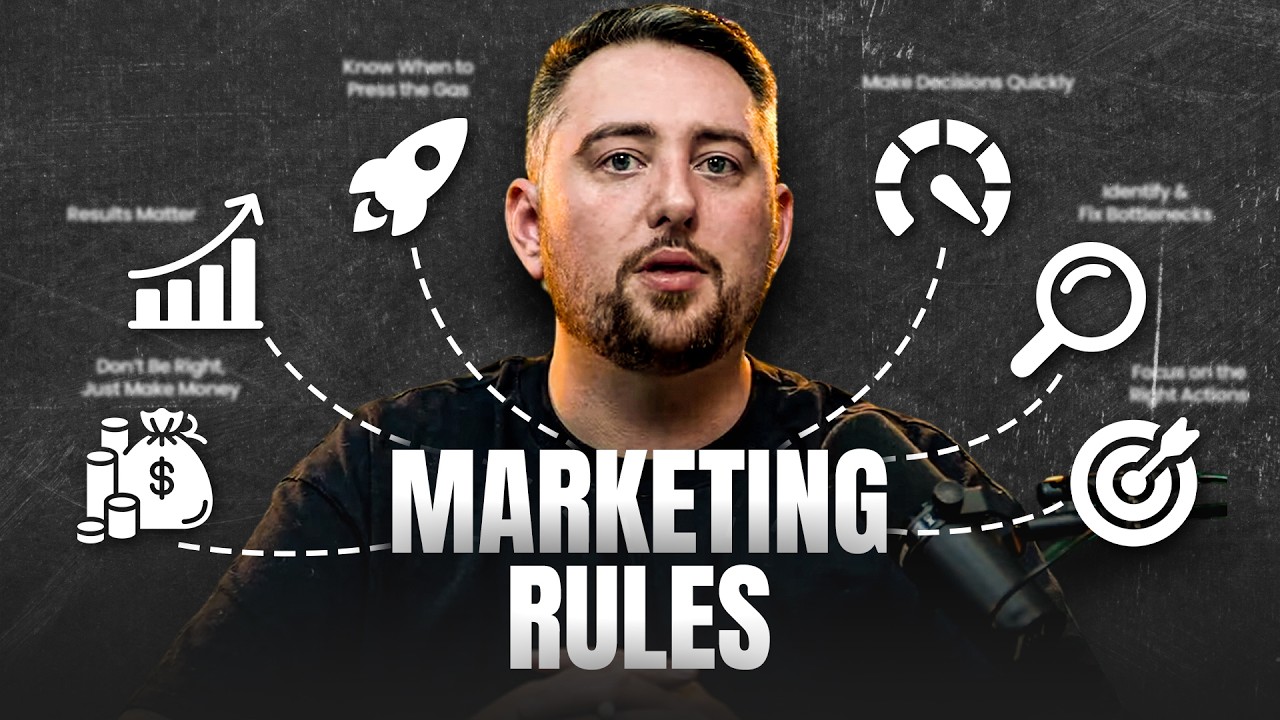
Number one and this one I say extremely frequently. I do not want to be right, I just want to make money.
This is very important to understand. A lot of marketers get attached to the ways that they think and they force their view and what they want to occur onto what they’re doing.
I am very quick to detach from the things that I am very tied to when something else is working better.
Give you a great example. Just recently an Inner Circle member joins in, he says “Hey guys, I am having a lot of success right now with using Type Form and Schedule Once. As a matter of fact I am getting about a 30% cheaper cost per booked call surprisingly using that combo of software comparatively to using Type Form and Calendly.”
For all those who are returning readers on this site, you know that I absolutely love Type Form and Calendly because typically it does exactly what that gentleman was saying he was having with another software combination.
Type Form and Calendly historically for me and still to this day has done a tremendous job at lowering my cost per qualified booked call because they integrate together. It has been phenomenal as a software combination.
I do not care about that specific set of softwares though if something else comes along and does better like the example of what that gentleman provided.
I just ask, I am like “Hey, when is the last time you tested a different software combination? How much spend did you test it with?” And if it sounds like a reasonable set of data to make that conclusion to bias in his favor for what he chose to do rather than what I prefer to do, I don’t care to be right, I just want to make the money.
This happens all the time when you have a specific thing that you are pushing for in a business, whether it’s a business that you operate in, a business that you own yourself, maybe a client relationship, whatever scenario it is.
I have tons of content advertising strategies that we make money on so consistently. They work so frequently and they do so well.
Yet I will give you a great example. Just recently with one of my sales manager partners that we work with, guy named Josh Troy from Wires From Strangers. If you are again new here you might not know Josh but he is one of the literal only sales agencies that exist that I actually enjoy working with and find consistent results. We do million-dollar months again and again and again with one another to be clear.
Josh was saying “Hey, when you first came onto this account and you implemented the Hammer Them strategy with the short form content exclusively, it worked really well immediately. The salespeople noticed a difference. Everybody was showing up more qualified, more aware, asking better questions. They all seemed further along in the sales process.”
After a good 6 months we started to notice that the problem was almost like representing itself and we were obviously still doing everything with the Hammer Them strategy. Nothing changed but the salesperson feedback changed.
He was saying to me, “Look, it seems like people are showing up in the sales process too early again. What do you think we have to do to fix it?”
And rather than just saying “Oh well, we already fixed it, we already did this, we already accomplished this, we’re not going to change anything, it’s your fault not our fault,” we said “Wonder what we can do.”
So what we did is we adapted the Hammer Them content advertising strategy to incorporate long form content as well rather than just the short form content.
The addition of the long form content, just pulling content from the person’s YouTube channel, getting them to film some good value dense content, pulling podcasts, pulling speaking gigs that this specific individual did that we were representing as a marketer and putting them alongside of the short form content and the Hammer Them strategy, bingo, immediately solved the problem again.
There are so many marketers that we work with that take things that they know work on other accounts, roll it over to a specific account that they’re new to or just working on, or just like the scenario I just articulated, they’re already in the deal, it is already technically been a box that is checked for that problem solved and we’ve moved on.
But when the problem represents itself instead of looking at what they can do to fix it they just point the finger.
And you don’t want to do that. You don’t want to be right. You want to get the result. You want to make money.
So when data presents itself that conclusively tells you “Hey, your ROAS is not as good as what it could be,” fix it.
I will give you a great example. We have a consulting client, incredible business, very high ticket service that these guys have. They have $10,000, $15,000 all the way up to $50,000 offers. They do a tremendous job.
They had a show rate issue out of nowhere. We implemented the Hammer Them campaigns. We implemented a very aggressive email marketing strategy. We updated some confirmation page videos that they had to incorporate some of our recent best practices.
None of those really made an incremental difference for them. It did not get a massive impact. Things improved but it didn’t improve as well as what we expected.
So we went into Google and we looked up the business name and the word Reddit. We also looked up the business name and the word reviews. We looked up the business name and the word scam.
And we found some troubling things about the business but nothing serious.
This specific business had two different Reddit threads that had non-buyers that said somebody asked “Hey, has anybody done business with these people? It’s this type of niche, any kind of feedback would be very helpful, let me know.”
And people who had not bought the product, there were about four different people in particular on this first Reddit thread that had gone in and commented something along the lines of “Oh no, you can get that cheaper elsewhere, you can probably get that for free on YouTube,” comments like that.
In addition to that there was a third person who said “Oh, I had gone through their sales process and it seemed expensive.”
And then there was a fourth person, honestly a pretty random comment and almost didn’t seem like it even made sense within the context of the thread, was just talking in general about that industry as a whole.
Second Reddit thread, there was one person in particular out of a dozen or so comments and it was the same general theme. Non-buyers, people who are just saying “Oh, you can probably get it cheaper elsewhere.” Some people saying “Oh, that industry as a whole is a scam, there’s nobody that does good in that niche.” Again, nobody that actually had bought.
And then there was one person out of the 12 that had said “I was a customer of this business, I think it is a ripoff.”
And then there were 12 total responses, a little over 12, about 13 or 14 total responses, like replies to that one comment of people asking additional questions.
And you had to click, if you’re unfamiliar with Reddit you had to click on that little button below the actual thread that says “View more replies” and then in that you also had to click again because again there was more than 10 different responses so you had to click “View more replies” twice to end up seeing that the guy just thought it was too expensive.
He actually openly says in that same comment within his own response thread that he thought the program was great and the results were great, he just thought he paid too much for it in comparison to what he otherwise wanted to pay.
So even the person who just says “I think I bought this, it was a ripoff,” later you have to really dig into it and if you’re unfamiliar with Reddit you have to really look, it is like a gray little hyperlink that you have to click that says “View more replies.”
So anyway my point is this, Reddit thread, these two sets of Reddit threads in particular correlated exactly like to the exact month that this company’s show rate started tanking for things like their webinars and their call funnels and their show rate started to correlate to going lower as this Reddit thread started to rank high in the search engines.
So what the point I’m trying to make is, we deployed the Hammer Them sequence for short form and long form content.
Again if you’re unfamiliar with that, if you’re new to the site, we have pieces dedicated to that entire content marketing strategy. Just to summarize it, long story short, when somebody takes a specific action like books a call, opts in for a webinar, does whatever, we immediately and aggressively get a lot of content in front of those people both short form content and long form content to help with the framing process, to warm the leads up more and attempt to replicate the organic sales process via paid advertising.
It works extremely well but in this case we did not in any way, shape or form address what was actually getting people to not show up which were these Reddit threads.
The confirmation page videos that we updated, all these common questions being addressed, they did not address anything about these Reddit threads and the skepticism that was introduced into the market.
There was actually an interesting document that you can look up and this is real by the way, this is not some random conspiracy I am about to drop on you, where there was a leaked document from the CIA, the Central Intelligence Agency here in the United States, that talked about how to sabotage an organization.
And one of the key bullet points out of the many different ways to sabotage an organization from the inside out was introduce doubt and skepticism.
It is all it takes sometimes. You just have to introduce a little bit of doubt and all of a sudden, bam, like wildfire, a show rate can go from 70% to 80% all the way down into the 40s and the business when leaving these things unaddressed, and potentially even being oblivious to it, thinking “Why am I implementing all the things that guys like Jeremy Haynes, these really smart marketers are telling me to do and they are still not necessarily making an impact?”
So what did we do immediately? We just said “Well, let us address it. Let us make a confirmation page video that immediately after the person opts in for a webinar, that immediately after they book a call, right then and there we start helping the person do their due diligence.”
Why Results Matter More Than Time and Effort When Managing Large Ad Budgets
This is what keeps a marketer great, is not attempting to be right. I already know the strategies like the Hammer Them strategies, short form, long form, I already know that confirmation page best practices work. I already know the proper best practices to email marketing in these different funnels to help with show rates.
And when those things don’t work I don’t just sit there and say “Oh, must be your fault, you must be executing it wrong.” No, we look at what’s happening and we improve, we update, we attempt to do something new, which is exactly what we did in that example.
What we also found by the way was in that exact scenario of addressing Reddit threads, we found one of the most important things that we’ve recently uncovered. Reddit is currently viewed by consumers as a non-biased place to get real feedback from real people about the businesses that they’re considering working with.
And so what we ended up doing as a best practice across every single client, across every single Inner Circle member where we do our twice a month one-on-one calls, weekly group calls, quarterly in-person masterminds and have our group chat full of rich people trying to get richer, we did a weekly group call as an example just recently in the Inner Circle on this.
But we talked at length with plenty of examples on what the best practices are relative to creating Reddit threads and giving customers an opportunity to go and talk within those Reddit threads about their experiences and taking existing Reddit threads like in that business I just articulated to you in the example I provided and sharing them with your customers, allowing real people who actually bought from you to share their experiences.
And no exaggeration, almost immediately we saw the show rate improve back to a little bit less than where it was prior for that specific business I articulated to you in the example. They were at high 70s, they got all the way back to low 70s with all those best practices in addition to just addressing what was on Reddit.
Point is, we learn new stuff as marketers when we’re spending a significant amount of money and are willing to be wrong because when we’re willing to be wrong we can actually take all the data that’s right there in front of us telling us exactly what to do and how we need to go about doing it to get a result.
Because that’s what it’s all about and that’s point number two. Results are what matter.
This is very important to understand and it might seem simple. You might be like “Oh dude, that is a pretty surface level one, I mean results matter of course, results matter.”
Yeah, well hang on, pay attention to this because you might be one of these people breaking this golden rule at high levels of spend.
One of the most interesting things that occurs, especially if you’re dealing with somebody who’s historically operated at smaller levels of managing money, is they typically pride themselves, it’s like this employee mindset, they pride themselves on the time and effort that they invest into the outcomes that they produce.
Research shows that companies with strategic budget allocation achieve 30% higher marketing ROI than those using ad hoc approaches, proving that how you think about spend matters more than how much you spend.
They’re not solely basing their pride and their sense of accomplishment exclusively on outcomes and results. Quite the opposite.
As a matter of fact in almost all instances you have somebody who is of the employee mindset that’s now managing hundreds of thousands of dollars in a month in ad spend. The disconnect that occurs most frequently is they are extremely inefficient so therefore they get nothing done. They don’t accomplish almost anything.
And businesses, here’s the thing that happens when you spend a lot of money, everything speeds up dramatically. It is an intense difference.
If you’re driving 10 miles an hour, I just got this new 911 Turbo S, it is awesome by the way, arguably probably one of the greatest cars that exists. If I drive that thing in normal mode and I’m driving in traffic versus if I’m on the causeway ripping over to Brickell and I’m going fast or something ridiculous like that, which is totally hypothetical by the way, I would never actually drive that fast just to be clear.
Either way, long story short, if I were to let’s say go that fast, how you drive the vehicle completely changes between 10 miles per hour in traffic and 100 miles an hour.
The vehicle response changes. Those German engineers know what they’re doing. It is almost as if it becomes a completely different car.
You and your body physiologically changes. Adrenaline starts coursing through you. All your decision making has to be rapid because the data that you’re getting while you’re driving that fast is coming in at an extremely fast pace.
So therefore if your decision-making is at the same speed as though you’re going 10 miles an hour in traffic where you have plenty of time unless the person brake checks you in front of you to make decisions, decisions are a lot slower at slower speeds. Decisions are incredibly faster at high speeds in order to not crash at high speeds.
This happens to marketers all the time due to the fact that they’re used to going small and slow and then all of a sudden things are big and fast. They stay stuck on this idea that grinds everything to a halt. Very little gets accomplished because they do not, again they do not pride themselves on accomplishment, they don’t pride themselves on outcomes, they exclusively pride themselves on time and effort. That is it.
That is how they view themselves as a hard day of work. They come back home after a long day and they say “Man, I did a whole lot today” versus that’s why Elon as an example sends off an email every single week to the people that work for him and he says “What did you accomplish this week?”
He does not care how long it took. He cares about how much you accomplished and what you chose to accomplish. You see what I mean? It’s a results driven outcome.
So to be clear, the money matters a lot. We had a consulting client recently that has a marketer that historically had managed the business when the business was doing very little money. They were making like $100K, $200K a month.
They were living in different Caribbean and tropical regions on Earth like there were the Bali entrepreneurs that are doing nothing in a day just hanging out eating bananas with monkeys and things like that in Costa Rica. You know what I mean?
And then all of a sudden bang, now they’re doing a million dollars a month and they got all the same people, same sales management, same operational staff and more importantly in this context the same marketer.
Well they expected the marketer to do a whole lot more than he ended up doing at half a million dollars a month in spend while they’re cranking up $1.5 million, almost $2 million a month in revenue.
The marketer ended up essentially just being a media buyer.
This is one of the worst things that you could end up doing to be clear. It is like a sub-point of what I am attempting to make here.
Some of the worst marketers that I know actively identify as media buyers. I think media buyer is one of the worst terms you could possibly use and identify with. It is like a derogatory term to serious people out there just to be clear in case you actively identify as one of those.
Media buyers do this, they get copy, they get ads sent to them, they get the images, they get the videos and all they have to do is just sit there inside of the ads manager. They take no responsibility for conversion rates on pages, funnels, marketing automation, getting involved in the sales teams. That is not what they want to do.
They exclusively want to be handed all the assets, not be involved in the creation of those assets and just literally put those things together inside of an ads manager and exclusively operate there.
You want marketers. You want people who are actually going to get in the trenches and actively identify bottlenecks that are hurting and push them forward.
How to Identify and Fix Bottlenecks Fast Using the Doubles Game
This is one thing that I’ve noticed differentiates us and our agency over the years in comparison to a lot of the other people that are out there that are trying to make some serious money. If there’s a bottleneck we attack it aggressively.
This is important to understand and I will explain it a little bit here before I continue.
So a bottleneck is very simple to understand. You have a clear idea of each step of your marketing and sales process and what each key statistic is that influences results the most.
You actively want to have some KPIs for what range they should be within and you also want to understand the implications typically through financial modeling for what those different statistics fluctuating can do for ROAS, total revenue out the other side and just profitability period and the overall results you’re going to be able to produce.
Bottlenecks are very simple to understand. Let me give you an example.
Let’s say that you start with CPMs in the advertising process. That’s a key statistic. If I go from a $40 CPM to an $80 CPM, I am logically going to get half the traffic for the same dollar spent. Therefore I am probable to get half as many people to do whatever I am optimizing my funnel for and I am probable to get half as many customers, half as much revenue total. Might be the same ROAS, might be half the ROAS.
I then have click-through rate, link click-through rate, unique link click-through rate. That statistic matters a whole lot.
If I have let us say a 0.5% click-through rate and I can get that unique link click-through rate all the way up to just 1%, that right there alone, same exact dollar spent, doubles my traffic, doubles the quantity of people taking whatever the action is, doubles the quantity of buyers with the same dollar spent, doubles the ROAS, doubles the revenue.
Studies confirm that increasing conversion rates from 2% to 3.75% while growing traffic 10% per month will nearly double revenue by year end, making conversion optimization one of the highest-leverage activities at scale. You see what I mean?
Versus again all the other statistics and whatever the process is that follows. The opt-in rate, the conversion rate, the application rate, the book a call rate, the webinar show rate, the call funnel show rate, whether it’s a one call close or a two call close, first call show rate, second call booking rate, second call show rate, close rate, average order value, lifetime value, sales cycle timeline.
All these are examples of statistics that we can map in a process when we’re thinking with bottlenecks and then what we want to do when we use bottleneck thinking is we want to play the doubles game.
This is one of the most high leverage things that we have found over the years that when we think this way, and it is a simple way to think but a lot of people omit this because they’re typically doing things where they focus, they hyper-focus on one specific thing.
You do not want to be hyper-focused on one specific thing until you recognize and identified it’s the bottleneck. It is the easiest thing to double.
Like I said with the click-through rate example, if I’ll just throw some statistics out, let us say I have a $20 CPM which nowadays CPMs is pretty good. Let us say I have a 0.5% click-through rate. Let us say I have a 50% opt-in rate on a webinar funnel. Let us say I have a 50% show rate to that webinar. Let us say that I have a 25% conversion rate on that webinar to people booking calls. Let us say I have a 75% show rate to the calls that people booked and let us say that it is a one call close. And then let us also say I have a 40% close rate and let us say I have a $10,000 product and my average order value is $9,500.
Out of each one of those statistics that I just mapped I then want to take a game here. I want to look at it and say out of all these statistics I’m aware of which one is the easiest to double.
In that particular case I’m paying attention to the click-through rate. It is at 0.5%. A good benchmark to be aware of, and this is also important to understand when you play the doubles game, you have to be aware of the benchmarks for whatever funnel you’re specifically running the traffic to.
Being oblivious to the benchmarks makes you have a dramatically higher probability to just take a random action rather than the calculated action that’s going to make the biggest difference.
With a 0.5% click-through rate, getting that to 1% should be a breeze. Should not be hard at all.
And like I said before that would double everything that follows in terms of the quantity of people that push through it and it doubles the revenue and gets us a lot more top line. Does not necessarily do a whole lot other than that but that is still extremely impactful when you are operating at scale and spending a whole lot of money.
That is the point I am attempting to make here. I want to be thinking with which one of these statistics is the easiest to double and I want to think with bottlenecks in order to do that.
Be aware of the benchmarks, tie them into the funnels that you’re running, pay hyper attention to which one needs the most attention, easiest to double, diffuse your attention again, pay attention to everything, bang.
When to Press the Gas and Spend More Money Even When Your ROAS Drops
Next one, when to press the gas.
I had a client recently at a 25x ROAS. They just joined into my Inner Circle offer where they wanted to get some help. They do their first one-on-one call with me because in the Inner Circle program we do twice a month one-on-one calls. They are 30 minutes a piece but we get a lot done on those calls.
You can message me in real time, send me Loom videos, I’ll review your stuff. You are paying me to care and I assure you of this, I do care deeply about you making a lot of money when you go through that.
I don’t make specific income claims but we understand the game and how it works. You want to spend money to be a part of it, you want to make more money than what you spend and we do that extremely well to be clear.
So anyway we do those one-on-one calls in the Inner Circle offer in addition to the weekly group calls, quarterly masterminds and the group chat full of rich people trying to get a lot richer. Very active by the way, not full of ineffective people like most of the masterminds or courses you’ve joined into in the past. This one is real and actually good.
But I digress. We run this one-on-one call and he specifically starts showing me this 25x ROAS campaign that he’s got going on and he is like “Dude, I just started, I went from about $1,000 a day to $3,000 a day and my ROAS dropped from 25x to 17x. So I pulled back the spend. I pulled it back to $1,000 and my ROAS did not go back up to 25x. So I lowered it again from $1,000 to $500.”
Research shows that as you invest more money into paid ads, your ROAS will decrease during the learning period, but paradoxically your company and profits will grow and ROAS will return over time, making the pullback decision exactly backward from what the data supports.
I was like “What are you doing? Who cares, spend more money. Just because you’re at a 25x ROAS and it goes down to 17 doesn’t negate the fact that you’re 17x profitable. Turn a dollar into $17 and you tell me that the rightful decision you chose to make was to lower your spend from $1,000 to going up to $3,000 to back down to $1,000 and then sub $1,000 to $500. That ended up being the best decision to make?”
In that example it didn’t make any sense. Did not make any sense at all but I am not exaggerating, that is the kind of thing that I see and it is not uncommon. It is extremely common.
One of the things you have to understand about spending a ton of money versus again when we talk about driving slow, going slow, it’s like guys I’ve had people, they spend like $10,000 in a month, let us use the same hypothetical, they get a 25x ROAS in this case and no exaggeration as soon as they go from $10,000 in spend to like $50,000 in spend and their ROAS drops from 25x to like 15x, they will do the same exact thing. Industry data confirms that ROAS will naturally drop in the long run as you scale because you are showing your brand to plenty of new people, and whatever way you scale, you will almost definitely see an initial dip in ROAS as the algorithm enters learning mode with the expanded audience.
They will get caught up in tinkering. You can split test your way into poverty. It is easy to do.
Do exactly what those guys are doing when you turn a dollar into 17, just pull back the spend because historically you turned a dollar into $25. How does that make any sense?
You know, you have to learn when to press the gas. Surprisingly this one is one of the most common things. It is one of the most common things that a marketer and/or the business owner will think with when they are trying to make a significant amount of money and get into this mindset that the best thing to do is to hold the business back and try to split test their way back to whatever the profitability was and then scale it up.
And if and when they are scaling up and that ROAS starts to drop again even at an extremely profitable level they go back to scaling back down and tinkering again.
It is one of the worst things you could do. You need people like me to come in and be on your case about spending more money.
And that’s why we encourage you to check out the link available, apply for the Inner Circle program if you are already doing low couple hundred grand a month. If you are already doing a million a month ready to tack on the next million, we help people like you too.
We do a lot, we do a lot and we are very helpful and we understand the game. We are trying to turn your money into more money every single month to keep you happy.
Long story short, don’t make these same mistakes. Try to adapt and become the best marketer that you can be. Be fully committed to the game of personal development and do not make these same mistakes. They hold businesses back so much.
There is a tremendous amount of additional lessons just like this inside of the programs that we offer for all of our paid members. We encourage you to step up and become one of those paid students or paid Inner Circle members of ours if you are not already.
And if you already are, thank you so much. We appreciate you and we are very grateful for you.
Most business owners waste years figuring out what actually works. In my Master Internet Marketing program, I compress that learning curve into 7 weeks, covering copywriting, funnels, ads, and more. If you’re ready to invest $5k and get serious about your skills, apply here.
Again, if you are already following along, thanks so much. Check out some of my other pieces and get richer. See you in another one.
Watch the video:
Get my content first on Google
Add jeremyhaynes.com as a preferred source and Google shows my articles more prominently in your search results, including AI Overviews and AI Mode.


Jeremy Haynes
Owner and CEO of Megalodon Marketing
Jeremy Haynes is the founder of Megalodon Marketing. He is considered one of the top digital marketers and has the results to back it up.