I hope you enjoy reading this blog post. If you want my team to just do your marketing for you, click here.


I hope you enjoy reading this blog post. If you want my team to just do your marketing for you, click here.
Author: Jeremy Haynes | founder of Megalodon Marketing.
Earnings Disclaimer: You have a .1% probability of hitting million-dollar months according to the US Bureau of Labor Statistics. As stated by law, we can not and do not make any guarantees about your own ability to get results or earn any money with our ideas, information, programs, or strategies. We don’t know you, and besides, your results in life are up to you. We’re here to help by giving you our greatest strategies to move you forward, faster. However, nothing on this page or any of our websites or emails is a promise or guarantee of future earnings. Any financial numbers referenced here, or on any of our sites or emails, are simply estimates or projections or past results, and should not be considered exact, actual, or as a promise of potential earnings – all numbers are illustrative only.
One question I get asked all the time by people who are in their journey of scaling to million-dollar months or looking to add that next million dollars a month to what they’re already doing is how can I get there a lot faster?
What are those quantum growth actions that I could take that can make giant lump sums possible or just instead of creating like a slow and stagnant up into the right growth with some occasional bumps in the road, what can add that giant jump, that quantum leap?
So today, that’s what we’re going to be talking about.
For all those unfamiliar, my name is Jeremy Haynes. All we talk about here is hitting million-dollar months. We take the lessons from the current 41 different businesses that we’ve been there, done that with. We hand down those lessons that have been the great things that have helped a lot and the things that have gone audaciously wrong.
And we hand them down to you in little bite-sized lessons.
We don’t in any way, shape, or form imply that you’re going to be hitting million-dollar months from the lessons that you learned here. But here’s what we do ensure – we ensure that we tell you about the lessons so you can do something with them.
If you’re already following along, it’s always a pleasure to have you.
This one’s going to make a big difference in your business when you’re looking to grow it aggressively.
If your business is already generating $100k+ per month, My Inner Circle is where you break through to the next level. Inside, I’ll help you identify and solve the bottlenecks holding you back so you can scale faster and with more clarity.
So one of the first things that makes the biggest difference, to no surprise, can be a new funnel, a new conversion mechanism.
A lot of the businesses that we come in and work with, generally they’re doing something like call funnels, DM strategies. Sometimes it’s even low ticket to high ticket. Occasionally, it’s a challenge funnel.
I just talked to a guy earlier today that was doing a daily webinar pushing people to a challenge and then upselling people in the challenge and that was his main thing.
Point is – generally you’ve got a main thing.
And the main thing’s done well. It’s in most instances still scaling but it’s just not scaling fast enough or it’s not adding enough ROAS.
So you want to look at other conversion mechanisms, other funnels that you can introduce into the game in order to get more results faster.
So a new funnel, to no surprise, can be a great way to go about doing that.
A lot of the businesses that we come in and help nowadays, they’re doing a call funnel and they’re reintroducing webinars and challenge funnels to what they do.
Challenge funnels especially.
I was talking to one of my longtime favorite clients, one of the smartest people I think I’ve ever had the opportunity to work with. And I won’t say his name so I could talk in a little more detail, but this guy’s been at a level of doing $10 million a month.
He’s sold 400,000 people into specific programs that he’s sold. This guy’s got a lot of different offers and a lot of different ways of converting people into those offers.
When we got back to the point just recently when we were going to re-engage and consider like, well, what could we do to get back in bed here and just scale the living daylights out of one of these six different offers that the guy’s currently got, it was a really simple answer.
Let’s do a challenge funnel. Let’s spend a couple hundred grand on it. Let’s get thousands of people to pay to attend it. And let’s upsell something high ticket within that challenge.
Easy.
That’s a lump sum play.
We just had a completely different client. They did a joint event with one of their longtime business partners and they cleared $19 million at the event.
It’s insane what either an in-person event and/or virtual events can do nowadays.
And virtual events are usually framed as challenge funnels or two to three day virtual events, workshops even some people call them, whatever you want to name it. That’s what we’re talking about here.
Now, here’s the thing. Webinars are great as well, depending on how you go about doing them.
Some people do them at a really high frequency and that generally reduces the overall revenue that you’re going to get per webinar. Some people do big monthly webinars and that creates a lot higher, in terms of size, a bigger lump sum that you generate out of that event.
The other thing that’s important to note is some of them do them weekly and so again they’ll get a higher lump sum comparatively to doing it at a higher frequency than that but again not as big of a lump sum in any way, shape or form as what a challenge could create.
Challenges though can be exhausting. In-person events can be exhausting. They take a lot of time and effort. They take a lot of coordination. And again, they just take a lot out of you financially, too.
They’re a big risk to take.
Webinars – lower risk, lower lump sum. Challenge funnels, in-person events – bigger risks, bigger financial rewards on the other side of those risks. Industry data shows that businesses using well-structured sales funnels see an average deal size that’s 102% higher, with 70-95% of revenue for companies offering these models coming from upsells and renewals.
You’ve got to keep that in mind. It depends on how much house money you have the ability to gamble with here for what you’re going to do to get your quantum leap on your journey to multi-million dollar months or just your first million-dollar month in general.
Here’s the thing I would encourage you to understand though.
Usually, when you take this specific tactic of adding a completely new conversion mechanism into the game, it’s because the current one that you’re running, if you just tried to spend the same exact dollars on it, it would break.
As an example, if you’re running a call funnel and you tried to add several hundred thousand a month in ad spend to it, it just wouldn’t really work because you have a closer capacity limit that you have to factor in.
In addition to all that, you’ve just got to consider the fact that your sales cycle, the amount of AOV, the ROAS on the whole thing – even if you had every salesperson on earth available to take all those calls, it just might not make as much and net as much as one of these other bigger risks that you can take and work into the equation.
The other key thing I want to take note on when it comes to quantum growth is how consistent you want that quantum growth to become.
If I incorporate a strategy like webinars as an example, there’s a lot more consistency to webinars. I could do them weekly, I could do them twice a week, I could do them bi-weekly, I could do them monthly, I could do it a lot.
And if I do them to cold audiences especially, I’m going to have a good time.
If I incorporate challenge funnels or any kind of in-person event, I can’t necessarily get away with doing those every month or every other month. Sometimes I’ve got to do them quarterly. Sometimes I can only do them twice a year because like I said, they’re exhausting.
And some of you, hopefully all of you reading this are busy rich people. And so you get exactly where I’m coming from. You just don’t necessarily have the ability to incorporate that as often as you would something like a webinar.
So as a result, they’re occasional quantum growth lump sums.
The duality. Second thing – sometimes you’ve got to fire somebody.
Sometimes you just got to let somebody go.
There’s that common thing that I hear amongst people who get to million-dollar months that are then trying to push up to like $5 or $10 million months, which is the what got you here won’t get you there logic.
And sometimes that’s the same thing when you’re stuck at a couple hundred grand.
Obviously, your business started at zero in almost all instances, unless you inherited something. You are getting to the point you’re at because of the talent that you’ve got and what that talent has done on behalf of your business to get you to that point.
Talent can only go so far. Everybody has an upper limit for what they know.
And if you’re not going to invest in these people, and that’s the thing – not everybody’s willing to invest in their people. Not everybody’s willing to spend on coaching, consultants, and mentors for their staff.
And not all your staff, especially if they’re contractors or vendors, are actively investing into their own growth and punching up on the deal sizes that they take on and that they’ve managed to climb to.
So you ultimately find yourself in a position where you’ve got to fire people.
That also leads to the contrary, which is you’ve got to hire new people, too.
I’ve seen many times over in many different ways – the wrong person being let go, a new person being brought in, and a nearly instantaneous better results on the other side of that.
I’ll give you two examples.
Just recently, we had an account when we started off on this account. We’re a consultant on this deal. It was at $100K a month. Big lifestyle business, one of those like Bali people.
Got to the point where the business scaled just shy of a year and a half later to about $1.4 million a month.
A lot of that revenue coming from Facebook and Instagram ad spend. The ad spend got to a point of just shy of $400K a month just on Facebook and Instagram out of that $1.4 million.
Now, here’s the thing. That advertiser, you could just kind of tell it kind of looked and appeared like exhaustion to a degree, like a lack of new ideas. And even though they had me in this case as a consultant on the account actively telling this advertiser everything to do and then some, a lot of that stuff just wasn’t being put into action.
And so that led to a stall. It led to a stagnant duration of time.
And thankfully for this business they have me and I straight up told them – listen, as unfortunate as it sounds, and they were having a lot of ideas about this internally that they brought to me that kind of sparked this conversation anyway – there was just a need to let that person go unfortunately and bring in somebody else.
So they started the process auditing people, reviewing people, just having a new hiring process get started for that exact role and position.
They brought in somebody from my Inner Circle program and this specific guy as soon as he comes in drives down the cost per call about 40% from what it was prior.
New people who have had a history of bigger accounts in this case especially have a lot of new ideas they can bring in and just a lot more willingness.
There’s a big difference between a guy who’s been on an account going from $100K a month to $1.4 million a month – and again, like the exhaustion and almost like the tiredness and to a degree the entitlement that comes along with that – versus a new guy who comes onto the account when it’s already at $1.4 million a month and the desire to earn the account and the willingness to execute anything and everything possible in order to grow the account bigger than what it currently is and obviously keep it too.
It’s just something you’ve got to do sometimes and it could be in a role like your advertiser in that example.
And other times it’s a leader position.
You don’t necessarily always have to fire somebody. Sometimes you just got to bring somebody new in.
There was an account that we’re on. They already do a couple million a month. They’re at like give or take the month like $2 to $5 million a month. And it fluctuates pretty widely depending on those lump sum events like challenge funnels or in-person events.
They brought in a new president. This guy worked in a very large organization and it was a very well-known YouTuber, one of arguably the largest that exists on earth and he was the head of operations over there.
And at first it’s almost confusing. You looked at this guy being brought into the business and you’re like, there doesn’t seem to be a lot of correlation between the guy’s past experience and this new account that he’s coming on to.
But hey, something’s got to be there. Obviously, we all trust the business owner and they are the ones who chose to hire this individual.
So hey, let’s trust the word of the business owner and let’s see what this guy does.
Man, this guy comes in. It was awesome.
This is arguably one of my favorite recent hires I’ve seen on an account that we’re on. Just instantly is like, I want to hit $100 million. I want to start doing a million dollars a week. I want anything and everything in terms of ideas. I want feedback on what’s holding it back. Let’s rock and roll.
And it’s so different when you get one of those people that’s like, “Oh, I want to be a trillionaire.” And it’s like, obviously they’re not realistic and they don’t even have any reality into that kind of goal versus a guy like this coming in and saying, “I want to hit $100 million. I want to start pushing up to a million dollars a week as the initial benchmark.”
And just seeing like, “Okay, this is not a joke. This is not just an audacious goal. This is a reality that we can make possible. We already do $5 million a month, give or take the month. Let’s push up.”
And immediately it’s like you start to see within the staff from having this new goal set and having a leader that’s pushing everybody to achieve the goal – the differences in like who’s about the action and who is clearly intimidated and not about the action at all.
And you start seeing people quit like week over week there’s like one to two people that quit and you at the same time start seeing the people who are about the action like me as an example – I’m super pumped about this and I start contributing a lot of ideas. I start communicating with the guy at a high frequency.
The sales manager on this account specifically also starts – it increases the enthusiasm that the A players who are on the account already have about the account and it immediately brings out like more potential from the people who have it to actualize.
There’s a big difference between people who get highly uncomfortable in those scenarios and people who are just instantaneously like, “I’m about the action. Let’s rock and roll.”
And so this guy shakes out a lot of the people in his own words that are just kind of like clocking in and out. Learns how to strategically press the potentially wrong people, a part of the organization and just also hears out all the A players for potential referrals and other vendors and contractors and employees that can be brought into the organization to replace these roles and to create new roles.
Dude, it was so awesome like what nearly instantaneously happens with that type of hire.
So again, sometimes it’s like you’ve got to fire the wrong person. Sometimes you just got to bring in a new person who shakes up the culture of the organization, sets a higher goal, starts holding people accountable, feet to the flames to actually accomplish that.
Quantum growth can come from hires and fires.
Here’s an interesting one. Messaging improvements.
I’m talking to a guy. He says he’s doing a couple hundred grand a month and he’s at about 300% ROAS. He’s at about 3 to 1 ROAS.
And it was really interesting strategy. They were running webinars and they were doing webinars at a really high frequency. They would use the webinars to promote a relatively low ticket challenge funnel that they called workshops. And then in the workshops, they would upsell a product that was tens of thousands of dollars.
And I thought this was a really high friction process. I would prefer to drive the traffic straight to the actual challenge funnel, aka the workshop itself, because that’s what we’ve historically seen have a lot of success for funnels like that.
But hey, they’re at a 3 to 1 ROAS. So outside of doing new things that could be a quantum leap, let’s also improve what’s already profitable and get it more profitable.
The one thing that they consistently said, and you could see it in all their statistics, there just wasn’t a lot of people that would show up to this webinar that they would drive the front-end direct response traffic to that would buy a couple hundred dollar product for this workshop, this challenge.
They had about a 12% conversion rate on a $297 offer. According to industry benchmarks, the average landing page conversion rate is 2.35%, with top-performing funnels reaching 5.31% or higher, making a 12% conversion rate significantly above average but leaving substantial room for optimization.
And to me, that was kind of perplexing. I was like, what’s holding back 88% of people from buying?
And when you look at the recordings from this specific offer and like the way they were doing the webinars, it didn’t seem like it was too far off.
But when you looked at the direct response ads that brought people in in the first place, none of it had any financial qualifying messaging. None of it had any very direct callouts for who this would be most appropriate for.
As a matter of fact, it was kind of the opposite. It seemed very broad. It seemed like a lot of their front-end messaging would have attracted somebody who might be in a needs-convinced category.
And that’s not always bad, but they didn’t have any financial qualifiers on top of that.
So all we did, and this is fairly simple, we just encouraged – hey, why not start adding some call to actions and some call outs in the front-end messaging of your ads. Like, I’m talking like right when the ad starts, just say some super basic things.
And I’ll give you some examples from other accounts that we were on. And these were the same examples I provided to this gentleman.
I’d said, “Listen, we have accounts where they require like $70,000 liquid and every ad starts with if you’ve got access to $70,000 in capital or you have $70,000 in working capital that you’re looking to put to work, pay attention.”
And then it’d start the normal ad.
We have other ads where it’s like to a lesser financially qualified person – hey, if you got $10,000 or access to $10,000, pay attention. I’ve got something great for you.
Something as simple as that.
Other times, you can call out the conditions. Like you could say, “Look, you’re already super successful in your career and you’re just looking for ways to amplify that with opportunities to make lump sums like this.”
And it doesn’t always have to be a direct like you’ve got this amount of money. But you can call out the conditions of the individual as well to appeal to who’s qualified and who’s not.
And if you notice, by the way, just the small little changes in words. When I talk to the $70,000 people, I’m using words like capital or working capital and liquid.
When I use the $10,000 people, I’m using the word dollars.
Even just little stuff like that appeals to a more financially qualified person comparatively to a less financially qualified person.
And even just calling it out in general obviously appeals straight away in the opening hook of the ad to the right type of person versus the wrong type of person.
It kind of correlates to this next one which is pixel conditioning along the lines of that same logic.
Like this can create massive quantum growth.
We had an account, they were at about $300K a month in paid ads when we came on to it in summer of last year.
And the most obvious thing was they were letting through all the wrong people to come back and hit the pixel.
It was a call funnel – drive traffic to a VSL page with an application on it. Application gets filled out. Those people then get allowed to book a call. People book a call, they go to a confirmation page.
I would like to optimize around the people who actually scheduled a call. And even further than that, I would want to optimize around the people who were qualified in the application that were allowed to book a call.
This advertiser, when I took over the account, was optimizing around qualified and unqualified applicants, not people who booked, not even qualified applicants – qualified and unqualified applicants.
And that was keeping them stuck around that $300K level in revenue.
All I did, and this is as simple as it was, I immediately created a route for the qualified applicants to schedule a call, and it forwarded them to a specific confirmation page. There were three levels of qualification here.
And I only optimized around the most qualified people who booked calls. Facebook’s conversion optimization guidelines recommend that advertisers focus on lead stages with conversion rates between 1%-40% to ensure the pixel has sufficient data to learn and optimize effectively for quality over quantity.
That got that account to $770K within that first 30 days that I came into the account with literally no other change. No difference in messaging, no difference in spend.
Literally just only optimizing around the people who are qualified, which makes the pixel go after more qualified folks.
Sometimes it’s that simple.
Sometimes it’s as simple as the messaging change. The messaging change is huge as well for what it can do because it opens you up to a whole demographic of person that’s just not responsive to your ads currently.
Whereas as soon as you make that change, all of a sudden, as an example, if you took that same webinar I talked about where the guy’s only converting 12% of people on a $297 challenge funnel purchase and you can double that to 24% – what’s that do for the revenue on a tens of thousands of dollar offer that’s sold in the challenge?
What’s that do to things like the show rate?
What if you incorporate other things?
You see, it’s like these are the little things that seem small and rather insignificant, but when executed at the degree of which they should be executed – at the precision that they should be executed, at the standard in which they should be executed – make a quantum leap level difference to the revenue potential of the business.
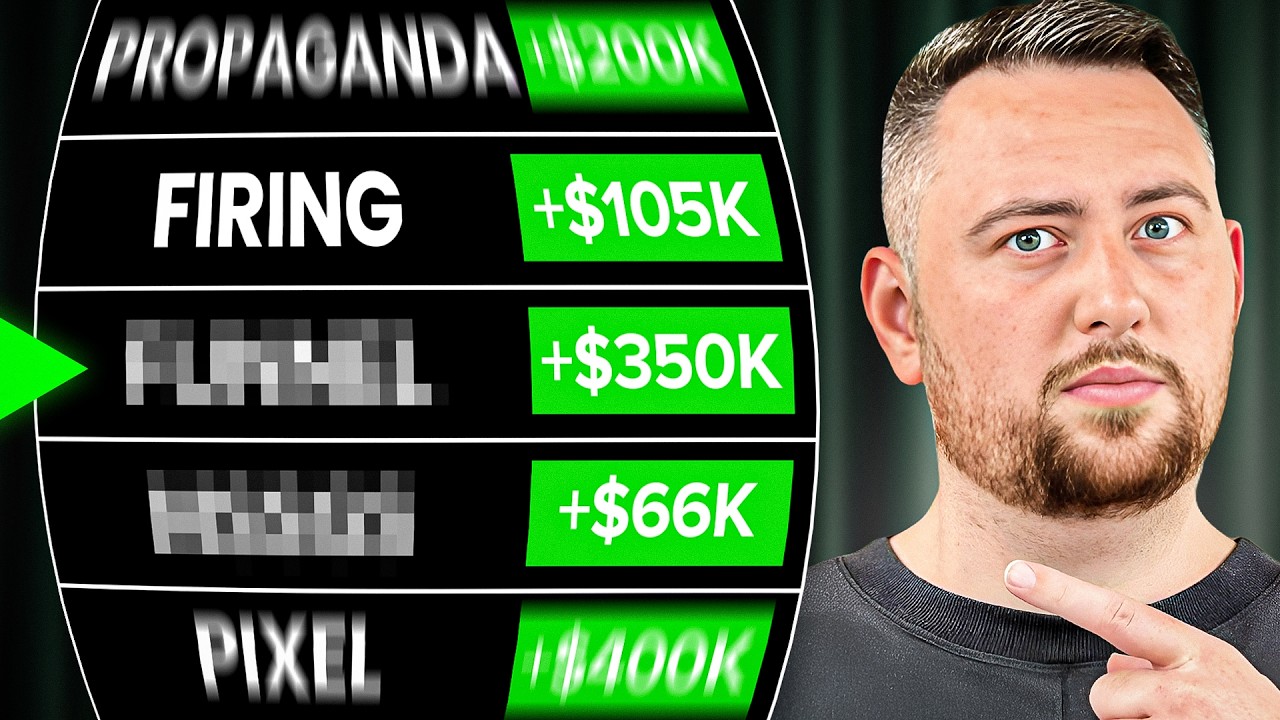
Let’s carry on to one of these final points. These are propaganda strategies.
Things like the hammer them strategy, which we’ve talked at length about, but if you’re unfamiliar with it, we take 30 to 50 short form pieces of content, anywhere from 20 to 30 long form pieces of content.
And after somebody does something like book a call, opt into a webinar, opt into a challenge funnel as an example, buy something low ticket and they’re going through the sales cycle, we will hammer them with that short form and long form content before they show up to the call, before they show up to the webinar, before they show up to the challenge while they’re going through the sales cycle to help influence statistics like show rates, close rates, the total amount of people doing PIFs (pay in fulls), and just shortening sales cycles.
All from propaganda content.
And it’s more than just the hammer them strategy that helps with this. It’s also confirmation page best practices, things like breakout videos, these modern due diligence tactics, which we have entire pieces of content dedicated to just these topics alone.
As a matter of fact, if you go through our content, there’s an entire section dedicated to just propaganda content and strategies that can help aid this.
Lastly, value dense emails.
These three things acting as propaganda content – hammer them strategy, value dense emails, confirmation page best practices – again can create quantum leaps in revenue growth and potential.
You see what I’m saying?
It’s just in most instances either a new funnel, a new hire, removing the wrong person, adding new messaging, getting your pixel conditioning finally in play, augmenting your existing direct response strategies by adding something like some propaganda campaigns.
And by the way, we go through these things in depth in all the programs you can find, including our Master Internet Marketing class, our Inner Circle, and for the very few of you that are going to be qualified to take a big bet and be in the financial position where we’re comfortable taking you on – our agency application as well.
The final point I want to close out with – sometimes it’s also as simple as adding on a new ad channel.
Doesn’t always have to be taking what you’re doing on an existing ad channel and doing any of the above.
Sometimes all you have to do is add TikTok, add search, add AdWords in general, YouTube – never really the display network. That’s definitely not a quantum growth tactic.
Sometimes it’s ad channels in general can also be technically considered outside of just paid advertising like doing something organically that you’re not doing now.
It is surprising to me how many times we come into a business that does like an either/or scenario. They do just paid ads, nothing organically. They do everything organically and nothing on paid ads.
Sometimes it’s as simple as just adding that opposite, which is a situation that a lot of you are unfortunately stuck in yourself.
And of course, it can seem daunting in order to do that. But you combine the concept of a new acquisition channel with a lot of these other tactics and especially the right people.
That’s what I want to make clear. When you do something that’s a big bet, a big risk, you’ve got to have the right people with you.
And that’s why we make ourselves available to those who want to work with us.
Again, check out those links. Keep following along if you’re not already. Check out some of the other content, even if you’re already following. You probably missed a few great ones, and they’re all there for the taking for you.
Unlike most courses that stop the moment you buy, my Master Internet Marketing course gets updated every year with fresh cohorts, live Q&A, and the latest strategies that are actually working today. It’s a $5k investment designed to keep paying you back. Apply here.
Really looking forward to helping you get richer either way.
Watch the video:

Jeremy Haynes is the founder of Megalodon Marketing. He is considered one of the top digital marketers and has the results to back it up. Jeremy has consistently demonstrated his expertise whether it be through his content advertising “propaganda” strategies that are originated by him, as well as his funnel and direct response marketing strategies. He’s trusted by the biggest names in the industries his agency works in and by over 4,000+ paid students that learn how to become better digital marketers and agency owners through his education products.

Jeremy Haynes is the founder of Megalodon Marketing. He is considered one of the top digital marketers and has the results to back it up. Jeremy has consistently demonstrated his expertise whether it be through his content advertising “propaganda” strategies that are originated by him, as well as his funnel and direct response marketing strategies. He’s trusted by the biggest names in the industries his agency works in and by over 4,000+ paid students that learn how to become better digital marketers and agency owners through his education products.


This site is not a part of the Facebook website or Facebook Inc.
This site is NOT /endorsed by Facebook in any way. FACEBOOK is a trademark of FACEBOOK, Inc.
We don’t believe in get-rich-quick programs or short cuts. We believe in hard work, adding value and serving others. And that’s what our programs and information we share are designed to help you do. As stated by law, we can not and do not make any guarantees about your own ability to get results or earn any money with our ideas, information, programs or strategies. We don’t know you and, besides, your results in life are up to you. Agreed? We’re here to help by giving you our greatest strategies to move you forward, faster. However, nothing on this page or any of our websites or emails is a promise or guarantee of future earnings. Any financial numbers referenced here, or on any of our sites or emails, are simply estimates or projections or past results, and should not be considered exact, actual or as a promise of potential earnings – all numbers are illustrative only.
Results may vary and testimonials are not claimed to represent typical results. All testimonials are real. These results are meant as a showcase of what the best, most motivated and driven clients have done and should not be taken as average or typical results.
You should perform your own due diligence and use your own best judgment prior to making any investment decision pertaining to your business. By virtue of visiting this site or interacting with any portion of this site, you agree that you’re fully responsible for the investments you make and any outcomes that may result.
Do you have questions? Please email [email protected]
Call or Text (305) 704-0094