I hope you enjoy reading this blog post. If you want my team to just do your marketing for you, click here.


I hope you enjoy reading this blog post. If you want my team to just do your marketing for you, click here.
Author: Jeremy Haynes | founder of Megalodon Marketing.

Earnings Disclaimer: You have a .1% probability of hitting million-dollar months according to the US Bureau of Labor Statistics. As stated by law, we can not and do not make any guarantees about your own ability to get results or earn any money with our ideas, information, programs, or strategies. We don’t know you, and besides, your results in life are up to you. We’re here to help by giving you our greatest strategies to move you forward, faster. However, nothing on this page or any of our websites or emails is a promise or guarantee of future earnings. Any financial numbers referenced here, or on any of our sites or emails, are simply estimates or projections or past results, and should not be considered exact, actual, or as a promise of potential earnings – all numbers are illustrative only.
Jeremy Haynes sat down for a wide-ranging conversation about what happens after you check all the boxes that come with getting rich. He just dropped $600K in cash to convert an 8,000 square foot warehouse in Miami’s Wynwood district into his office and mastermind headquarters, he’s accumulating luxury watches as inflation hedges, and he’s targeting a $2.4 million down payment on an $8 million house in Coral Gables because he believes the area will mirror Beverly Hills’ trajectory. But the most interesting part? He thinks all of this is what separates people who stay rich from people who just temporarily have money.
Haynes signed the lease on his Wynwood warehouse and had a contractor with a floor grinder walking in 10 minutes later. The fleck epoxy floor alone took three days. Then came waves of contractors working simultaneously to install HVAC, a fire sprinkler system, electrical upgrades, a 220-inch LED 4K wall, and $50K in audio equipment.
“I was here for a good 12 to 14 hours a day,” Haynes explained. The goal was to get everything done in time for his quarterly mastermind event. He initially bought the space just for those four events per year, but quickly realized that was shortsighted. “I’m pretty dumb to not think of the other 361 days out of the year.”
The permit process slowed things down. You can’t do anything that wasn’t already in the building without city approval. Even the Megalodon Marketing sign above the door required proof that a sign already existed in that location on Google Maps. Fire code requires specific spacing between sprinklers. ADA compliance means installing both high and low water fountains.
Haynes doesn’t complain about it. He gets it. A building collapsed in North Miami Beach, people died, and that’s why the city moves slowly. But it’s still a constraint when you’re someone who believes the best thing you can buy with money is speed.
Having the office changed more than just where Haynes works. He hired more local staff than he had when working remotely. That includes an office manager, a marketing helper who works in person, and a trainer who follows him around 12 hours a day managing his food, tracking his macros, and running him through mobility and weight training six days per week.
“When you have more space, you can unlock new thinking,” Haynes noted. You can’t be creative in the physical world until you have the space physically to be creative in. You can’t make sense of use of space until you have the space to use.
He’s got three different spaces now. The Wynwood office. A penthouse. A townhouse in Coconut Grove he calls the jungle house. Each one brings out a completely different version of how he behaves and optimizes.
The jungle house is relaxing. All trees, families, a classic black Bentelli golf cart that fits the vibe. The Wynwood office has a flashy golf cart with nine speakers and underglow that would never work in Coconut Grove but fits perfectly in the art district. “Different environments solicit different behavior and different outcomes,” Haynes explained.
Haynes is working toward a $2.4 million down payment, which is 30% of an $8 million property in the gated communities between Coconut Grove and Coral Gables east of Biscayne. He’s specifically targeting pockets like Cocoplum and similar areas.
His thesis? This area is what Beverly Hills was decades ago. You can’t buy a teardown house in Beverly Hills Flats right now for less than $10 million. Not even in the areas without views, just the ones with a different tree per road.
“I look at that little pocket in that Coral Gables area as that but with a lot more upside to go,” Haynes explained. Houses in ungated areas of east Coral Gables run around $5 million. Gated areas are $8 million to $10 million.
He generally disagrees with buying a primary residence. He prefers renting. But this is different. He believes the financial upside on this specific bet justifies the $2.4 million down payment plus the $30K to $50K monthly in mortgage and property taxes.
The interesting part? He’s not saving cash for that down payment. He’s buying luxury watches instead.
Haynes is what he calls a sophisticated gambler. That’s what you become once you’ve checked all the boxes. You’ve got the cars, the clothes, the locations. You’ve normalized large expenses. You’re investing consistently. At that point, what are you going to do, buy more stuff?
“All a sophisticated gambler means is instead of going to a casino and putting it on red, you take sophisticated bets instead,” Haynes explained.
Those bets come in the form of paid ads, watches, houses, whatever form of calculated risk you want to take. Right now, he’s betting on watches.
Tariffs are currently on Switzerland. Every major watch company raised their prices 15%. Rolex raises prices every year anyway. That pushes up the secondary market and gray market where most people actually buy luxury watches.
Here’s Haynes’s bet. The gray market will adjust down eventually. But luxury companies don’t lower prices after they raise them. Ferrari doesn’t go back down. Chanel raises prices every year and never reverses. Hermes does the same. When they get the justification of tariffs, they’re going to raise prices. “These aren’t products for regular people. These are products for rich people.”
He thinks watch prices will see a short-term lift in both retail and secondary markets because of tariffs. But the part nobody’s considering in mass? When tariffs go down, the prices won’t go down. There will be a shock reflex where everyone realizes the prices stayed elevated, and then everyone will just accept that as the new price.
He’s been aggressively accumulating. He bought the McLaren RM103 limited to 500 pieces. He bought the Asia edition Bubba Watson, one of 30. He’s not disclosing the total number, but he’s taking two sophisticated bets at once. Watches as inflation hedges, and real estate in an area he believes will appreciate like Beverly Hills did.
Haynes spoke at a mastermind event where he asked everyone making less than $50K monthly to sit down, then less than $100K monthly. Almost everyone sat down. Four people remained standing. One made $300K monthly. The rest were under $100K.
To Haynes, that’s not good. You can’t even get into his Inner Circle making that little. He proceeded to drop what he describes as world-class game about conditioning up financially, technical agency strategies, mindset, the works.
He got great feedback from everyone. Except one German kid. The guy made a video in German reviewing the event. Haynes ran it through YouTube’s transcription. The kid gave raving reviews of everyone else, then got to Haynes.
“Yeah, Jeremy Haynes just made me feel poor and criticized us for that,” the kid said. “In addition to that, his hair gets grayer and grayer and his belly gets bigger and bigger.”
That filled Haynes with rage. Not because the kid was wrong about the gray hair or the belly. Because this guy who makes sub-$50K monthly as an agency owner thinks he’s operating at a high enough level to criticize someone dropping free game that could change his business.
“I just can’t have this little impoverished person have that valid point over me,” Haynes explained. He wants to take that leverage away. When he’s in the middle of a set at the gym and he’s about to quit, he thinks of that German kid. It fills him with rage. He finishes the set.
But here’s the important part. Haynes holds no actual animosity toward the kid. The situation pisses him off, not the person. “I’ll likely thank that guy one day for that feeling that it gives me that I can later tap into.”
That’s the pattern Haynes sees in high performers. It’s not genetic. It’s not an “it factor” you’re born with. It’s having something that sits inside you that makes you want to go hard in the opposite direction.
His grandfather, a psychotherapist, told him once that he’s technically never going to reach a level of satisfaction. The only time he’ll feel more satisfied is when he gets further away from being poor. “The further away you get from being poor, the better you’ll be mentally,” his grandfather explained. But if it goes the other way, his behavior will be negative and he’ll have bad outcomes.
Haynes looks at that as a superpower. He watched his mother trapped in a bad relationship because she didn’t have enough money to leave. That shaped a belief that more money equals more options, more freedom, more ability to prevent bad circumstances.
“I fully believe in the power of money,” Haynes said. “Every choice comes down to the amount of money we have.”
The key is being self-aware about what drives you. It doesn’t have to come from trauma. Sometimes it’s just wanting to buy cooler stuff. Sometimes it’s wanting to afford a certain lifestyle. Sometimes it’s wanting to prevent something terrible from happening to others.
Even if it’s super selfish to the general population, that’s fine. Just buying a bunch of cool stuff so you can be a particular way, or going on a ton of vacations, or being the opposite of whatever you were before. All of that works.
Haynes’s first attempt at buying a Rolls-Royce cost him $37K in one week. He found a 2012 Ghost on a Texas dealership website for $112K. Low miles, all these crazy options, seemed like a great deal. He put $20K down and financed the rest with small monthly payments.
The car seemed fine for the first couple days. The air suspension lifted weird when starting, but nothing catastrophic. Then he was driving back from the design district and started to accelerate after slowing down on the highway. The car started shaking violently. Any time they came to a stop, it would shake again. It threw a drive shaft error.
He sent it to the dealership. The repair estimate came back at $83,000.
It wasn’t catastrophically broken. They wanted six grand to replace a door handle that wasn’t perfect but still worked. Four grand for a door hinge. The drive shaft malfunction required opening the transmission, which is a ton of labor hours on a Rolls-Royce.
Haynes learned a key lesson: never buy any of these cars out of warranty. Every car he owns now is under warranty. The Rolls he currently has? Under warranty with an extended Providence warranty. The 750S Spider, the Ghost, the 911 Turbo S Cabriolet, the Cayenne Turbo GT. All under warranty.
That’s why you see dramatic depreciation on certain luxury cars. A 2020 to 2022 Cullinan that was $500K to $600K new now sells for around $200K. Why? It’s out of warranty and someone didn’t extend it. Same with Aston Martins. They drop like a rock because they’re out of warranty.
His current strategy? Buy slightly used with low miles under warranty. His 750S had less than 1,000 miles when he bought it. It had already hit a depreciation curve, so it’s not nearly as costly as buying new, but it’s still fully covered.
When asked who’s impressed him most, Haynes immediately named Judge Graham. He won’t say Judge’s last name publicly because Judge doesn’t like being mentioned on platforms like this, but the story matters.
Judge sold the same agency twice. First time, mid-eight figures. Second time, low nine figures. He had hundreds of staff the first time, thousands the second time. Big corporate deals, low annual churn, large physical offices.
But that’s not why Haynes admires him. “He’s just a regular guy, man,” Haynes explained. Judge doesn’t look like a superhero. He’s got a family, a great house in Texas, and a low couple hundred million dollars that he’s squatting on. He put a ton of money into the market. He’s set. And he’s not old. He did all of this in his early-to-mid 40s.
“Judge dialed in,” Haynes said. He manages to balance everything in a way that seems effortless. He accomplished a significant amount in a short duration. He progressed in key areas of life at the same time and came out with huge outcomes.
You look at him after and it doesn’t even look like he just went through a multi-decade war. He’s well-rounded, still himself, gained wisdom and lessons from that level of effort and responsibility and accomplishment.
“Some people have a level of obsession that is healthy,” Haynes noted. As a result of their excessive obsession with whatever they’re putting attention on, they achieve a significant amount. That’s what separates high performers. They’re highly intentional with what they do. When you’re passive about practice and routine, you don’t get the same outcomes. When you’re locked in, paying full attention, being obsessed with being great, everything looks effortless even though your accomplishments are insane.
Getting rich enough to become a sophisticated gambler isn’t about having some genetic advantage. It’s about being self-aware about what drives you, what outcomes you actually care about, and what sacrifices you’re willing to make to get there. Haynes checks boxes rapidly. Cars, clothes, watches, locations. He normalizes large expenses by investing consistently and making more money. Then he graduates to sophisticated bets like real estate plays in areas he believes will appreciate dramatically and luxury goods that hedge against inflation. The optionality that comes with more money unlocks new things he couldn’t even think about before having the resources. Every time he gets richer, more unknown unknowns become possibilities. That mystery of what’s on the other side keeps him pursuing more. Whether your driver is selfish or empathetic doesn’t matter. What matters is identifying it, bringing it top of mind, and using it to push through when things get hard.

Jeremy Haynes is the founder of Megalodon Marketing. He is considered one of the top digital marketers and has the results to back it up. Jeremy has consistently demonstrated his expertise whether it be through his content advertising “propaganda” strategies that are originated by him, as well as his funnel and direct response marketing strategies. He’s trusted by the biggest names in the industries his agency works in and by over 4,000+ paid students that learn how to become better digital marketers and agency owners through his education products.
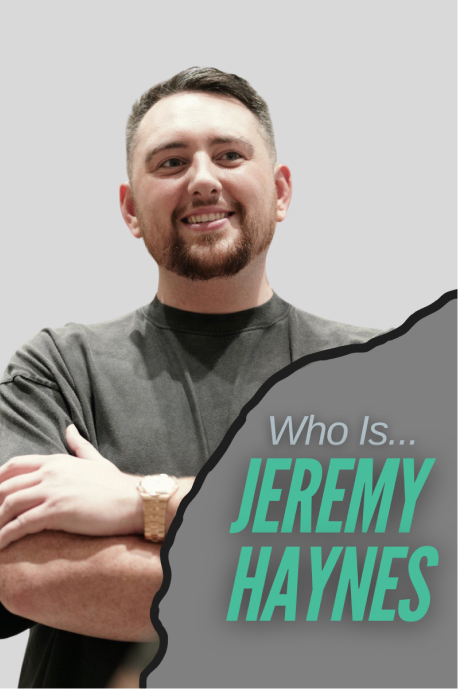
Jeremy Haynes is the founder of Megalodon Marketing. He is considered one of the top digital marketers and has the results to back it up. Jeremy has consistently demonstrated his expertise whether it be through his content advertising “propaganda” strategies that are originated by him, as well as his funnel and direct response marketing strategies. He’s trusted by the biggest names in the industries his agency works in and by over 4,000+ paid students that learn how to become better digital marketers and agency owners through his education products.


This site is not a part of the Facebook website or Facebook Inc.
This site is NOT /endorsed by Facebook in any way. FACEBOOK is a trademark of FACEBOOK, Inc.
We don’t believe in get-rich-quick programs or short cuts. We believe in hard work, adding value and serving others. And that’s what our programs and information we share are designed to help you do. As stated by law, we can not and do not make any guarantees about your own ability to get results or earn any money with our ideas, information, programs or strategies. We don’t know you and, besides, your results in life are up to you. Agreed? We’re here to help by giving you our greatest strategies to move you forward, faster. However, nothing on this page or any of our websites or emails is a promise or guarantee of future earnings. Any financial numbers referenced here, or on any of our sites or emails, are simply estimates or projections or past results, and should not be considered exact, actual or as a promise of potential earnings – all numbers are illustrative only.
Results may vary and testimonials are not claimed to represent typical results. All testimonials are real. These results are meant as a showcase of what the best, most motivated and driven clients have done and should not be taken as average or typical results.
You should perform your own due diligence and use your own best judgment prior to making any investment decision pertaining to your business. By virtue of visiting this site or interacting with any portion of this site, you agree that you’re fully responsible for the investments you make and any outcomes that may result.
Do you have questions? Please email [email protected]
Call or Text (305) 704-0094