I hope you enjoy reading this blog post. If you want my team to just do your marketing for you, click here.


I hope you enjoy reading this blog post. If you want my team to just do your marketing for you, click here.
Author: Jeremy Haynes | founder of Megalodon Marketing.
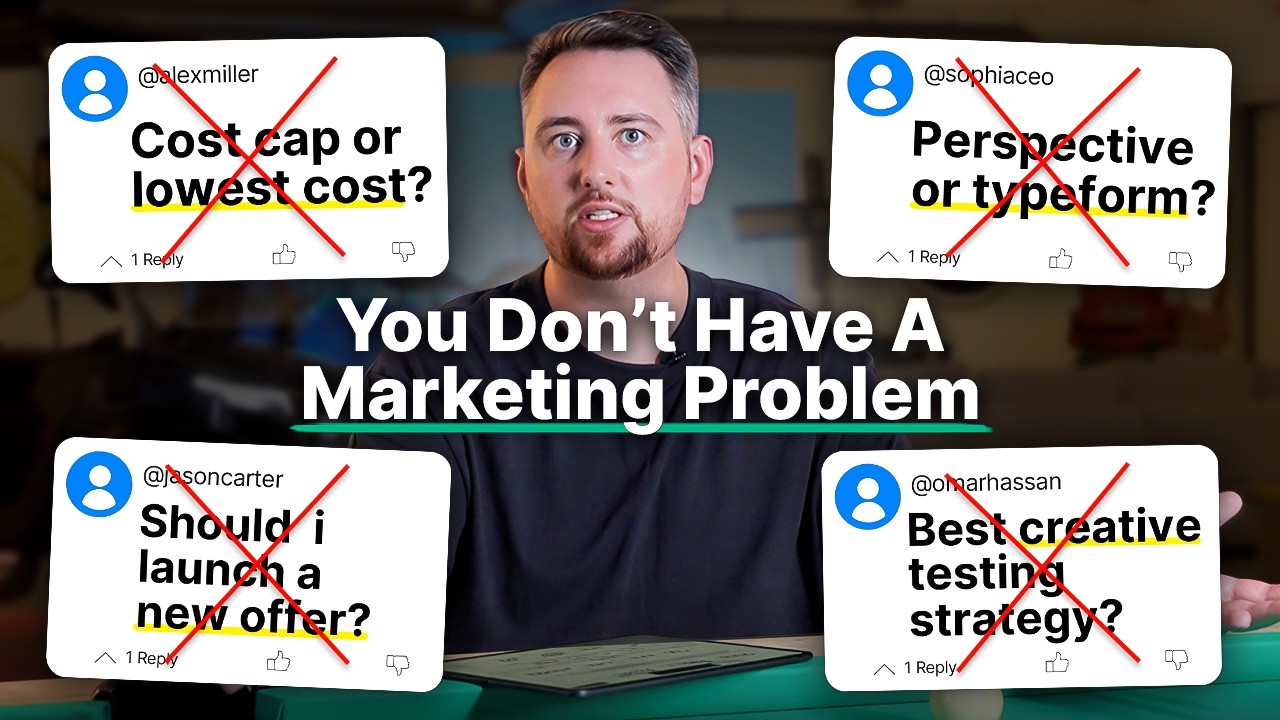
I’m going to be real with you right now.
Most entrepreneurs are out here thinking they’ve got a marketing problem. They’re convinced that if they could just figure out the right ad strategy, the perfect funnel, or the right social media platform, everything would click into place.
But that’s not what’s holding you back.
After working with business owners for years, I can tell you that the issue usually isn’t marketing. It’s the inability to make a decision and stick with it long enough to see what happens.
And if you’re struggling to grow your business, this might be the most operationally relevant thing you read all year.
Here’s what I see happen all the time.
Someone starts running Facebook ads. They give it two weeks, maybe three if they’re patient. They don’t see the results they were hoping for, so they pivot to Google ads. That doesn’t move fast enough either, so they jump to SEO. Then TikTok. Then LinkedIn. Then back to Facebook because they heard someone had a good run with it.
That’s not testing. That’s not being strategic. That’s just being indecisive.
And indecision is doing more damage to your business than any “wrong” marketing channel ever could. As MarTech has noted, marketers today face an overwhelming number of channels, tools, and platforms — and the resulting decision paralysis causes missed opportunities, stalled campaigns, and wasted resources across the board. (Source: MarTech)
The truth is, almost every marketing channel works. Facebook ads work. Google ads work. SEO works. Cold email works. Direct mail works. I’ve seen businesses operate successfully on every single one of these channels.
In my experience, the difference between operators who gain traction and those who don’t isn’t the channel they chose. It’s that they actually chose one and committed to making it work.
There’s this pattern I see constantly when people apply for my Inner Circle or my 7-week live comprehensive training.
Results are not typical. Your results will vary and depend entirely on your individual capacity, business experience, expertise, and level of desire. There are no guarantees concerning the level of success you may experience. The testimonials and examples used are not intended to represent or guarantee that anyone will achieve the same or similar results. We don’t believe in get-rich-quick programs. We believe in hard work, adding value and serving others. As stated by law, we can not and do not make any guarantees about your own ability to get results or earn any money with our information, courses, programs, or strategies.
People come to me frustrated because “nothing is working.” When I dig into what they’ve actually done, here’s what I find.
They ran ads for three weeks with a minimal daily budget. They posted on social media inconsistently for a month. They sent five cold emails. They tried SEO by writing two blog posts.
Then they tell me the channel doesn’t work.
But here’s the thing. They didn’t actually give anything a real shot. They dipped a toe in the water, decided it was too cold, and moved on before they even learned how to swim.
Marketing isn’t about finding the secret channel that nobody else knows about. It’s about picking something, learning it deeply, optimizing it relentlessly, and giving it enough time and resources to actually work.
Every time you switch strategies, you’re starting from zero.
Think about it. When you finally start getting some traction with Facebook ads, you’re learning what audiences respond. You’re figuring out what ad copy connects. You’re understanding what offers convert. You’re building data.
Then you switch to Google ads, and all that knowledge becomes useless. You’re back at square one, learning a completely different platform with different rules and different audiences.
Three months later, you switch again. Another reset.
A year goes by, and you’ve “tried” six different marketing channels. But really, you haven’t gone deep on any of them. You’re a beginner at six things instead of being competent at one.
Meanwhile, a competitor picked Facebook ads a year ago and stuck with it. They’re not smarter than you. They don’t have different resources. They just made a decision and committed to it.
Here’s another thing that stalls businesses.
People are waiting for the perfect time to go all in on something. They’re waiting until they have more money. More time. More clarity. More certainty.
But that perfect moment doesn’t show up.
The operational reality is this: you start now with what you have, making the most informed decision you can with the information available.
Is it going to be perfect? No. Will you make mistakes? Absolutely. But those mistakes become your operational data. That’s how the process works.
In my experience, a “pretty good” strategy executed with discipline outperforms ten theoretical strategies that never get real commitment. Consistent execution is the framework. Everything else is just planning without output.
So how do you actually fix this?
First, get honest about your decision-making process. Are you actually being strategic, or are you just jumping around hoping something works?
Here’s what the strategic process looks like in practice. You research your options. You look at where your target audience actually is. You consider your budget and resources. You pick the channel that makes the most sense for your specific situation.
Then comes the important part. You commit to that channel for at least six months. Minimum.
Not six weeks. Not six days until you see a competitor doing something else. Six actual months of consistent effort.
This timeline isn’t arbitrary. According to Circana’s research on marketing mix modeling, meaningful measurement requires at least 52 weeks of complete, consistent data from a given channel — and organizations that treat this as a disciplined, ongoing process rather than a one-time exercise develop stronger marketing intelligence over time. (Source: Circana)
During those six months, you’re not just running the same thing over and over. You’re testing. You’re optimizing. You’re learning what works and what doesn’t within that channel. You’re trying different audiences, different messages, different offers. You’re actually giving yourself a chance to learn the system.
Let me describe what real commitment looks like operationally.
If you’re doing Facebook ads, you’re running ads every single day. You’re testing new creatives weekly. You’re analyzing your data and making informed decisions about what to scale and what to cut.
You’re not checking your results every three hours and panicking when the numbers aren’t where you want them by noon. You’re looking at weekly trends and monthly patterns.
You’re building an actual system, not hoping for random wins.
If you’re doing SEO, you’re publishing content consistently. You’re building links. You’re optimizing your existing pages. You’re in it for the long haul because you understand that SEO is a time-intensive process.
See the difference? One approach is systematic and committed. The other is just dabbling.
When you actually commit to a channel long enough, you start gathering incredibly valuable data. You learn what messages resonate with your audience. You discover what offers they actually want. You figure out what price points work.
This data informs everything else in your business.
But when you’re constantly switching channels, you never gather enough data to learn anything meaningful. You’re just guessing over and over again. As Funnel.io’s analysis of marketing decision-making points out, the real problem isn’t a lack of data — it’s that teams pile on more metrics and dashboards without ever sticking with one channel long enough to turn raw numbers into actionable insight. (Source: Funnel.io)
The businesses that make data-driven decisions are the ones that stay on one channel long enough to actually collect data worth acting on. You can’t run an informed operation if you reset every eight weeks.
Here’s something worth considering.
The competitors pulling ahead of you aren’t operating with a different playbook. They don’t have some special insider knowledge you don’t have.
They just made a decision and stuck with it while you were cycling through strategies every month.
That’s it. That’s the whole operational difference.
And every time you restart with a new channel, they’re compounding what they’ve already built. They’re building momentum while you’re resetting to first gear.
Alright, so what do you do with all this?
Pick your channel. Look at your business, your audience, and your resources. Choose the marketing channel that makes the most sense. Don’t overthink this. There’s no perfect answer. Just pick something that has proven to work for businesses like yours.
Set a timeline. Commit to working that channel for at least six months. Put it on your calendar. Tell someone about it so you have accountability.
Create a plan. What are you going to test? How often will you create new content or ads? What metrics are you going to track?
Execute consistently. This is where most people break down. They have a plan but they don’t follow through. Show up every day and do the work.
Analyze and optimize. Look at your data regularly. Figure out what’s working and do more of it. Cut what’s not working.
And resist the urge to switch. When you see someone else operating on a different channel, acknowledge it and keep doing your thing. Their channel isn’t your channel. Your data is your data.
You don’t have a marketing problem. You have a decision problem.
The sooner you accept that and commit to actually sticking with something, the sooner the data starts working in your favor.
I’ve seen businesses built on Facebook ads, SEO, Google ads, cold email, and content marketing. In my experience, the channel matters far less than people think it does.
What matters is that you pick something, commit to it, and give it enough time and effort to actually generate usable data.
Your next marketing channel won’t fix your indecision problem. Only the decision to stop switching will.
If you need help actually implementing this and want someone to hold you accountable to your decisions, that’s the focus of my Inner Circle flagship program and the 7-week live comprehensive training.
Results are not typical. Your results will vary and depend entirely on your individual capacity, business experience, expertise, and level of desire. There are no guarantees concerning the level of success you may experience. The testimonials and examples used are not intended to represent or guarantee that anyone will achieve the same or similar results. We don’t believe in get-rich-quick programs. We believe in hard work, adding value and serving others. As stated by law, we can not and do not make any guarantees about your own ability to get results or earn any money with our information, courses, programs, or strategies.
But even if you never work with me, just remember this: the next channel won’t fix the pattern. Only committing to one will.
Watch the video:

Jeremy Haynes is the founder of Megalodon Marketing. He is considered one of the top digital marketers and has the results to back it up. Jeremy has consistently demonstrated his expertise whether it be through his content advertising “propaganda” strategies that are originated by him, as well as his funnel and direct response marketing strategies. He’s trusted by the biggest names in the industries his agency works in and by over 4,000+ paid students that learn how to become better digital marketers and agency owners through his education products.

Jeremy Haynes is the founder of Megalodon Marketing. He is considered one of the top digital marketers and has the results to back it up. Jeremy has consistently demonstrated his expertise whether it be through his content advertising “propaganda” strategies that are originated by him, as well as his funnel and direct response marketing strategies. He’s trusted by the biggest names in the industries his agency works in and by over 4,000+ paid students that learn how to become better digital marketers and agency owners through his education products.


This site is not a part of the Facebook website or Facebook Inc.
This site is NOT /endorsed by Facebook in any way. FACEBOOK is a trademark of FACEBOOK, Inc.
We don’t believe in get-rich-quick programs or short cuts. We believe in hard work, adding value and serving others. And that’s what our programs and information we share are designed to help you do. As stated by law, we can not and do not make any guarantees about your own ability to get results or earn any money with our ideas, information, programs or strategies. We don’t know you and, besides, your results in life are up to you. Agreed? We’re here to help by giving you our greatest strategies to move you forward, faster. However, nothing on this page or any of our websites or emails is a promise or guarantee of future earnings. Any financial numbers referenced here, or on any of our sites or emails, are simply estimates or projections or past results, and should not be considered exact, actual or as a promise of potential earnings – all numbers are illustrative only.
Results may vary and testimonials are not claimed to represent typical results. All testimonials are real. These results are meant as a showcase of what the best, most motivated and driven clients have done and should not be taken as average or typical results.
You should perform your own due diligence and use your own best judgment prior to making any investment decision pertaining to your business. By virtue of visiting this site or interacting with any portion of this site, you agree that you’re fully responsible for the investments you make and any outcomes that may result.
Do you have questions? Please email [email protected]
Call or Text (305) 704-0094