How to Target In-Market Customers and Stop Wasting Ad Spend

I hope you enjoy reading this blog post. If you want my team to just do your marketing for you, click here.
Author: Jeremy Haynes | Published May 22, 2026
Earnings Disclaimer: You have a .1% probability of hitting million-dollar months according to the US Bureau of Labor Statistics. As stated by law, we can not and do not make any guarantees about your own ability to get results or earn any money with our ideas, information, programs, or strategies. We don’t know you, and besides, your results in life are up to you. We’re here to help by giving you our greatest strategies to move you forward, faster. However, nothing on this page or any of our websites or emails is a promise or guarantee of future earnings. Any financial numbers referenced here, or on any of our sites or emails, are simply estimates or projections or past results, and should not be considered exact, actual, or as a promise of potential earnings – all numbers are illustrative only.
Most businesses hemorrhage money on advertising because they target the wrong people. I’m Jeremy Haynes, and I’ve run my agency for over a decade. We manage ad spend across fewer than 15 clients, and we do it profitably.
A specific marketing lesson from Eugene Schwartz’s Breakthrough Advertising has generated additional revenue for the businesses I work with, revenue they otherwise would never see. This piece I’m sharing right now breaks down exactly how to identify and target in-market customers so you can spend less and make more.
If you’re looking for a structured approach to agency operations and client acquisition, our 7-week live comprehensive training covers customer segmentation frameworks in depth. Results are not typical. Your results will vary and depend entirely on your individual capacity, business experience, expertise, and level of desire. There are no guarantees concerning the level of success you may experience. The testimonials and examples used are not intended to represent or guarantee that anyone will achieve the same or similar results. We don’t believe in get-rich-quick programs. We believe in hard work, adding value and serving others. As stated by law, we can not and do not make any guarantees about your own ability to get results or earn any money with our information, courses, programs, or strategies.
Already making money? See what it takes to make a lot more.
Why Most Businesses Talk to the Wrong People and Burn Cash Doing It
Chet Holmes addresses this in The Ultimate Sales Machine. Picture yourself on a stage addressing an entire audience. Different demographics fill the seats, and you need to understand who you’re actually speaking to.
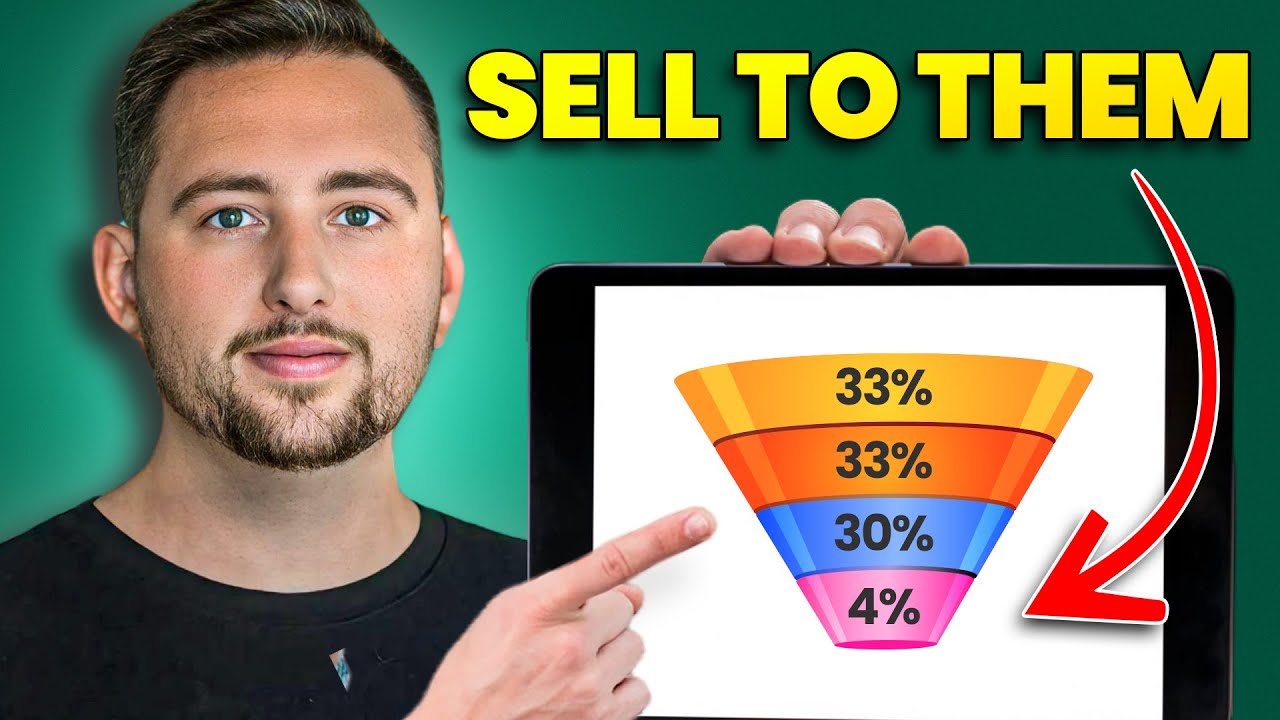
The farthest demographic (about 33% of people) aren’t in the market at all. They’re not buyers. They don’t think they have the problem you’re solving. These people would require significant convincing that they even need what you offer in the first place.
The second 33% might admit they have a problem your company could potentially solve, but they still require substantial persuasion. It’s a low priority on their list. They’re putting their money toward other things that make more sense for them right now.
The farther away from the stage you get, the more money it costs in ad spend to reach these people. According to research from the Harvard Business Review, customers who aren’t emotionally connected to a problem require significantly more touchpoints before conversion. It simply costs more to convince somebody who’s not in market that they need to purchase your product.
The People Who Admit They Have a Problem But Still Aren’t Ready to Buy
The next demographic (about 30% of people) are what I call probable customers. These people admit and acknowledge they’re struggling with whatever the problem is. They want the result your company can provide. But it’s still not at the peak of their priority list.
This demographic has a higher probability to convert than the outer circles, but there’s still a hotter demographic you should pursue first.
The People Who Are Actually Ready to Buy Right Now and How to Find Them
In-market customers typically have the highest probability to convert. These are people who actively identify that they have the problem your company’s solution can solve. They need the result. They want the result. They’re ready to put money toward it.
These people are literally money in hand, actively trying to find a company. They’re researching already. They’re searching on Google, YouTube, even ChatGPT. They’re clicking on ads when served. They’re ready to give money to somebody within the week.
This demographic gets ignored and neglected more often than you’d expect. Companies usually target the demographics that are higher up on the list, burning cash trying to convince people who aren’t ready to buy.
Studies from Gartner show that buyers are often 57% through their purchase decision before they even engage with a sales representative. That’s the in-market customer. They’ve already done the research. They’re just looking for the right vendor.
Why Your Message Has to Change Based on Who You’re Talking To
Consider an example from my own business. In my education company, I have an offer on how to start and scale marketing agencies. Notice I use both: start and scale. These are two completely different demographics.
In-market would be people who already run a marketing agency. These people already have problems with a different urgency compared to people who want to start an agency.
When I talk to existing agency owners, I can say: if you’re stuck at a certain monthly revenue and struggling to reach seven figures, let me teach you how to do rev shares.
I can tell them about how back in 2017, I had 27 staff, offices in Beverly Hills and Miami, flying back and forth between coasts every week. Dozens of clients across different niches. We were charging anywhere from a couple thousand to tens of thousands per deal with no consistency. We were doing monthly profit, but I was stressing hard.
I was going to sleep at 3-4 AM, waking up at 8 AM, and doing it all over again. My daily problems compounded at an excessive rate. I could never get ahead of my to-do list. I never felt like I could get ahead in that model, and I wasn’t making as much money as I should.
Then I started doing rev shares. For every deal, I started charging monthly retainers and taking a percentage net revenue share. My goal on every deal was to net a client significant monthly revenue so my agency could get paid well off that deal.
I ended up firing 23 of my 27 staff, closed three offices, and switched to work from home. I came back to Miami full-time. I make more money now with way less overhead. I have seven to eight staff depending on the time of year. Expenses are lower and quality of life is better.
When I articulate this to people who are agency owners already in the game struggling like I was, it resonates deeply. They emotionally feel the pain and burden. They’re sitting at their computer all day, working hard, none of their work gets acknowledged, and clients only care about results.
That specific story speaks directly to the “you already have a marketing agency” crowd.
How to Write Copy That Actually Resonates With People Who Don’t Have What You’re Selling Yet
The people who don’t have a marketing agency wouldn’t relate to that story as much. They don’t emotionally feel that pain. For them, I need completely different messaging.
I’d talk about how back when I worked a job, I was a full-time digital marketer for a well-known sales trainer. I loved my job (no complaints) and loved the people I worked with. However, my income was capped at a certain amount per year.
I wanted to make more money. I had digital marketing skills that were validated in that job, and I recognized there was an opportunity. I could sell these skills to businesses willing to hire me and work with multiple people at a time.
So I quit my job. My first client was supposed to pay me but never paid. I took a pay cut to reclaim 100% of my time. Then for the next 45 days straight, all I did was focus on sales. Within those 45 days, I reached a certain monthly revenue.
That story resonates with the “I want to start an agency” crowd. It’s a completely different message for a completely different demographic.
In our Inner Circle (a private, application-gated mastermind), we break down these messaging frameworks based on customer awareness stages. Results are not typical. Your results will vary and depend entirely on your individual capacity, business experience, expertise, and level of desire. There are no guarantees concerning the level of success you may experience. The testimonials and examples used are not intended to represent or guarantee that anyone will achieve the same or similar results. We don’t believe in get-rich-quick programs. We believe in hard work, adding value and serving others. As stated by law, we can not and do not make any guarantees about your own ability to get results or earn any money with our information, courses, programs, or strategies.
What It Actually Costs to Reach Each Type of Customer and Why It Matters
You are more likely to make more money sooner with less money spent targeting in-market customers than all those subsequent circles that follow.
Consider another example on the agency side. If I have a client who already runs ads versus one who wants to advertise, the same exact logic applies.
One client recently signed up who was generating monthly revenue off paid advertising. They’d been stuck there for months. This brand gets tens of millions of organic impressions monthly and makes significant revenue organically, but was barely scraping by on paid ads.
When they were referred to me, it was one of the easiest closes ever. I said, “I’ve got an ad strategy that replicates the organic sales process via paid ads. Here are three examples of people in essentially the same situation. You could do the same thing.”
Easy close. One of the easiest yeses you could possibly get. That customer is far easier to close because they’re already in-market.
Compare that to another client I had recently who wanted to advertise but never had before. They get all their customers via warm referrals. They raise capital for RV boat storage projects.
Completely different conversation. I had to explain how advertising works. I had to articulate the expectations of selling to warm inbound leads versus paid advertising leads. I had to break down sales assets they needed to develop and create. I had to explain how much longer the sales process would likely be.
Different messaging. Different communication. Different approach.
According to research from McKinsey, customer acquisition costs can vary by as much as 300% depending on how well your messaging aligns with the customer’s readiness to buy.
The First Thing I Do When I Take Over a Client’s Advertising and Why It Works
When I come into a business, one of the first things I do is ask: who are we talking to right now? The messaging is convoluted in most instances.
A majority of businesses combine these two types of messaging. They try to talk to everyone at once. That should not be how it’s done.
One of the very first things we do when we want to make a business more money is immediately identify the in-market customer. Who is the person right now ready to buy? What are we talking to them about? What do we need to break down for this individual?
We’ll make ads specific to them. We’ll write ad copy specific to them. We’ll create landing pages and funnels specific to them. We’ll create marketing automation with follow-up messaging specific to them. We’ll tell salespeople a specific way to identify that type of lead.
Sometimes you don’t even have to target the second layer. Sometimes there are so many people in one demographic that you don’t need to go out to the other layer.
What to Do When You Run Out of In-Market Customers and Need to Expand Your Reach
When you plateau, you’ve likely run out of in-market customers. You’re forced to go one layer out. When you plateau in that layer, you go to the next layer beyond that.
Businesses I’ve worked with don’t typically get the ability to constantly sell to people within that specific in-market customer range unless it’s a massive niche. At a certain point, you’ll have to expand to that second layer, and if you get big enough, you get to go to the further outer layers.
But remember, there’s not much beyond that third layer because those customer demographics don’t convert very well at all. They’re not ready to buy.
7 weeks. Real frameworks. Covering copywriting, funnels, paid ads, and conversion systems.
The Simple Framework for Spending Less and Making More on Every Campaign You Run
You get to spend as little as possible and make as much as possible targeting in-market customers. You have to spend a little more and make a little less when you step one layer beyond that. You have to spend even more and make even less at the third layer, but hopefully you’re still ROI positive.
Keep it simple. Always pursue the in-market customer type first. Create specific ads. Create specific marketing automation and follow-up processes. Have your salespeople know the differences in customer types. Identify them in the CRM. Have specific ads, funnels, body copy, and headlines.
Make things specific to in-market customers. You will immediately see a difference in revenue.
This is one marketing lesson that’s made the businesses I work with a tremendous amount of additional revenue they otherwise would never see. The key is understanding who’s actually ready to buy right now and speaking directly to them with messaging that resonates with their specific situation.
Stop trying to talk to everyone at once. Identify your in-market customers, craft messaging that speaks directly to their pain points and desires, and watch your conversion rates climb while your ad costs drop.
If you want the full framework on customer segmentation and agency positioning, our 7-week live comprehensive training walks through these exact processes. Results are not typical. Your results will vary and depend entirely on your individual capacity, business experience, expertise, and level of desire. There are no guarantees concerning the level of success you may experience. The testimonials and examples used are not intended to represent or guarantee that anyone will achieve the same or similar results. We don’t believe in get-rich-quick programs. We believe in hard work, adding value and serving others. As stated by law, we can not and do not make any guarantees about your own ability to get results or earn any money with our information, courses, programs, or strategies.
Get my content first on Google
Add jeremyhaynes.com as a preferred source and Google shows my articles more prominently in your search results, including AI Overviews and AI Mode.


Jeremy Haynes
Owner and CEO of Megalodon Marketing
Jeremy Haynes is the founder of Megalodon Marketing. He is considered one of the top digital marketers and has the results to back it up.