
How to Recognize Scarcity Mindset and Build an Abundance Operating System

I hope you enjoy reading this blog post. If you want my team to just do your marketing for you, click here.
Author: Jeremy Haynes | Published April 14, 2026
Earnings Disclaimer: You have a .1% probability of hitting million-dollar months according to the US Bureau of Labor Statistics. As stated by law, we can not and do not make any guarantees about your own ability to get results or earn any money with our ideas, information, programs, or strategies. We don’t know you, and besides, your results in life are up to you. We’re here to help by giving you our greatest strategies to move you forward, faster. However, nothing on this page or any of our websites or emails is a promise or guarantee of future earnings. Any financial numbers referenced here, or on any of our sites or emails, are simply estimates or projections or past results, and should not be considered exact, actual, or as a promise of potential earnings – all numbers are illustrative only.
Most people walk around with invisible chains they don’t even know exist. These chains aren’t physical; they’re mental patterns that keep you stuck in the same financial position year after year.
I’m talking about scarcity mindset, and in my experience it’s probably affecting your decision-making more than any tactical mistake ever could.
Your mindset isn’t some woo-woo concept that self-help gurus talk about. It’s the operating system running in the background of every financial decision you make. If that operating system is corrupted with scarcity programming, you’ll keep getting the same results no matter how many strategies you try.
If you want to go deeper on the systems and frameworks I use with agency operators, check out my 7-week live comprehensive training where we cover this alongside the tactical execution pieces.
How to Recognize Scarcity Programming in Your Daily Decisions
Let me be direct: if you’re constantly worried about money even when you’re making decent income, that’s scarcity talking.
Signs of scarcity programming include:
When you see someone else winning and your first thought is “there’s less for me.”
Hoarding opportunities instead of sharing them out of fear they’ll run out.
Making decisions based on fear of loss rather than potential for growth.
Nickel-and-diming everything and refusing to invest in the right systems.
Scarcity doesn’t always look like being broke. I’ve seen business owners generating solid revenue who still operate from scarcity. They protect what they have instead of investing in growth. That’s not strategy. That’s survival mode. You can’t build anything meaningful from survival mode.
Research from the American Psychological Association shows that scarcity mindset impairs cognitive function, making it harder to think clearly about long-term decisions. Your brain literally works differently when it’s operating from a scarcity state.
Why Social Media Creates Artificial Scarcity in Your Brain
Here’s something practical you can do right now with immediate impact: delete social media for one week.
Instagram, Facebook, TikTok. These platforms create artificial scarcity in your brain. You scroll through highlight reels of other people’s lives and compare your behind-the-scenes to their curated versions. Every post becomes a reminder of what you don’t have, and every success story becomes evidence that opportunities are running out.
When you remove that constant input of comparison, something shifts. You stop measuring your progress against everyone else’s curated success and start seeing opportunities instead of competition.
A study in the Journal of Social and Clinical Psychology found that limiting social media use to 30 minutes per day significantly reduced feelings of loneliness and depression. The comparison trap is real and it directly affects how you perceive opportunity.
Try a one-week detox and watch what happens to your mental clarity around money and opportunity.
Three Core Beliefs That Create Long-Term Persistence
Tony Robbins breaks down the abundance mindset into three core beliefs. This framework is built on execution, not wishful thinking:
Wealth exists abundantly in the world. Not for some people or in some places. Abundantly available, period. If you don’t believe this at a core level, you’ll always fight over scraps instead of building real value.
You will personally access that wealth with certainty. Not maybe or hopefully. With certainty. This is about unwavering commitment to the outcome regardless of how long it takes or what obstacles show up.
When you access that wealth, it benefits others too. If you believe getting wealthy means taking from others, you’ll subconsciously sabotage yourself. But if wealth creation helps others, you’ll pursue it relentlessly.
These beliefs create the foundation for decade-long persistence. The operators I work with who make it aren’t necessarily the smartest. They’re the ones who maintain certainty in the outcome even when everything looks like it’s falling apart.
How Compounding Works for Both Investments and Business Systems
Compounding applies to financial investments and business building alike. Here’s a practical framework I’ve seen work consistently:
Understand that compounding applies to everything: skills, relationships, systems, investments. Small, consistent actions over time create exponential results.
Prioritize consistency over intensity. A Vanguard research study showed that consistent investing over time produces more reliable outcomes than trying to time perfect entry points. The same applies to business.
Automate what can be automated. Removing human decision-making from repetitive actions creates consistency.
Treat investments in yourself and your business as non-negotiable line items. Not “I’ll invest what’s left over.” Set up automatic systems and don’t skip them because something came up.
Embrace marathon thinking over sprint timing. Trying to time perfect moments is how people stay stuck; consistent execution over decades builds real assets.
The businesses that understand this principle apply it across finances, systems, client relationships, and skill development. They think in decades, not quarters.
How to Audit Your Current Patterns and Stop Repeating Them
Most people are stuck in patterns they don’t recognize. They make the same decisions expecting different results and blame external circumstances instead of examining their behaviors.
Before implementing any new strategy, audit your current patterns. Ask:
What behaviors do I repeat that keep producing the same results?
Do I spend money to feel better when stressed?
Do I avoid investments because they feel risky even when the logic makes sense?
Am I surrounded by people who reinforce scarcity thinking?
These patterns are often subconscious. Until you identify and eliminate them, every new strategy can be sabotaged by old behaviors. The businesses that grow successfully often first eliminate the patterns that kept them stuck. They don’t just add tactics on top of broken foundations.
Why Solving Specific Pain Points Creates Sustainable Revenue
Building sustainable income isn’t about the perfect product or the most innovative idea. It’s about solving real pain points for people who are willing to pay to have those problems solved.
The entrepreneurs I work with who build sustainable businesses do three things:
Identify a specific problem their market experiences.
Build a repeatable system to solve it.
Systematize delivery so they can scale without trading all their time.
If you’re stuck at a level, you’re usually solving the wrong problems or solving the right problems inefficiently. Shift from asking “what can I sell?” to “what pain can I eliminate?” When you approach business this way, opportunities become abundant instead of scarce.
How to Control Your Information Diet and Rewire Your Default Thinking
Deliberate information control and exposure management works. Your subconscious runs programs installed years ago (often in childhood) that determine your automatic responses to money, opportunity, and risk. If those programs are scarcity-based, you’ll unconsciously make decisions that reinforce scarcity even when you consciously want abundance.
Strategies that help:
Deliberate affirmation work: not just repeating positive phrases, but systematically rewiring belief patterns through repetition and emotional engagement.
Control your information diet: avoid content that reinforces scarcity (apocalyptic economic news, social media comparison, conversations that focus on lack).
Expose yourself to abundance patterns: study people who’ve built what you want, consume content about opportunity and growth, and surround yourself with operators who think in terms of expansion.
This isn’t about ignoring reality. It’s about choosing which inputs you focus on and reinforce.
What Marathon Thinking Looks Like in Practice
Everything here requires patience for the long game. Most people play a sprint when the real game is a marathon. They want results in 90 days when real results come in 10 years.
Businesses that achieve sustainable growth don’t rely on quick hacks. They build systems, execute consistently, and make decisions based on where they’ll be in five or ten years rather than where they are today.
That requires delayed gratification and trusting the process when you can’t see immediate results. Investments in yourself today may not show dramatic changes next month, but consistent investments compound into something significant over years. Systems that serve clients exceptionally well rarely produce viral growth overnight, but they become valuable assets when executed consistently.
Shift from “what can I get quickly” to “what can I build that lasts.” From “how can I make money this month” to “what systems will generate value for decades.”
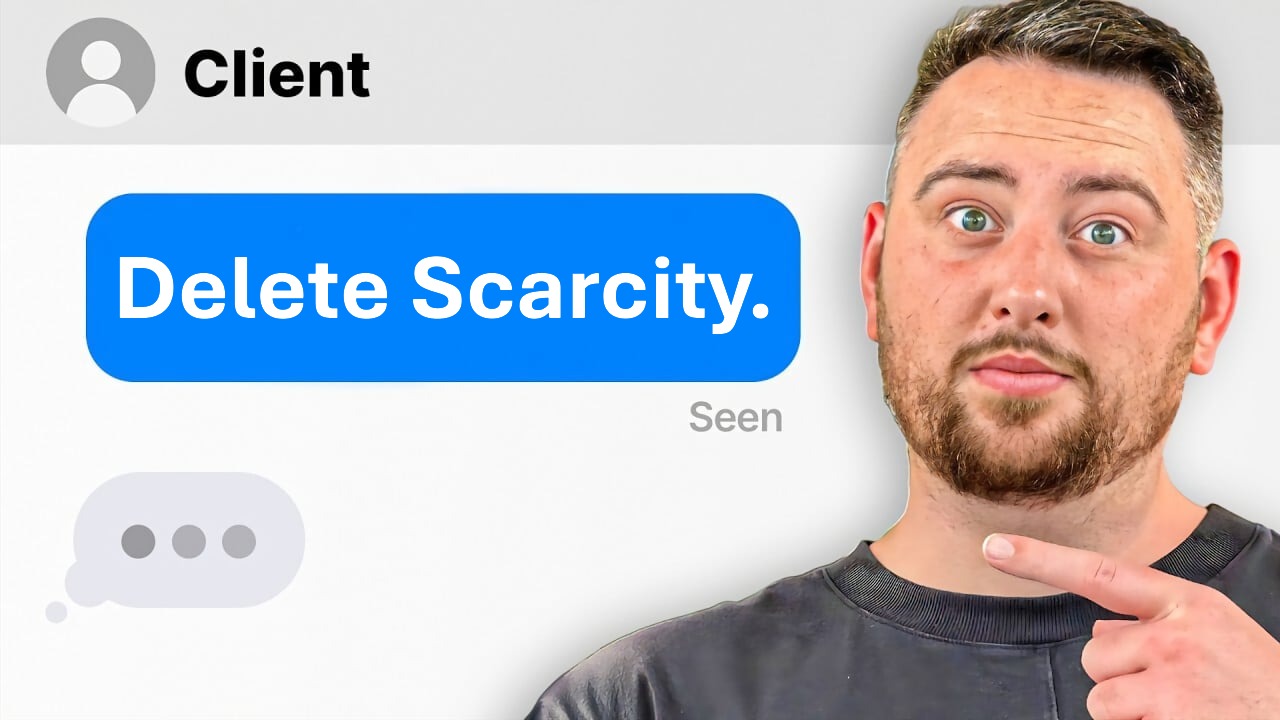
Your Next Steps to Delete Scarcity and Build Abundance Systems
After reading this, take these actions:
Do the one-week social media detox. Delete the apps and observe how your mental clarity and perception of opportunity changes.
Audit your behaviors. Write down every pattern that may be reinforcing scarcity and be honest about your actual actions.
If you’re not already investing systematically in your skills and business, set up a consistent system. The amount matters less than establishing the pattern.
Identify one major pain point in your market that you’re positioned to solve exceptionally well. Focus on one specific problem, not multiple markets.
Commit to decade-long thinking. Write down where you want to be in 10 years and reverse engineer the systems and behaviors to get there.
These are execution-focused systems that work when implemented consistently. The difference between people who build meaningful businesses and those who stay stuck isn’t intelligence. It’s mindset and execution over time.
Delete the scarcity programming. Build the abundance operating system. Execute consistently. That’s how meaningful outcomes get created.
If you want to work through these frameworks with direct guidance and a community of operators who think the same way, check out the Inner Circle where we go deep on both mindset and tactical execution.
Results are not typical. Your results will vary and depend entirely on your individual capacity, business experience, expertise, and level of desire. There are no guarantees concerning the level of success you may experience. The testimonials and examples used are not intended to represent or guarantee that anyone will achieve the same or similar results. We don’t believe in get-rich-quick programs. We believe in hard work, adding value, and serving others. As stated by law, we can not and do not make any guarantees about your own ability to get results or earn any money with our information, courses, programs, or strategies.
Get my content first on Google
Add jeremyhaynes.com as a preferred source and Google shows my articles more prominently in your search results, including AI Overviews and AI Mode.


Jeremy Haynes
Owner and CEO of Megalodon Marketing
Jeremy Haynes is the founder of Megalodon Marketing. He is considered one of the top digital marketers and has the results to back it up.

