I hope you enjoy reading this blog post. If you want my team to just do your marketing for you, click here.


I hope you enjoy reading this blog post. If you want my team to just do your marketing for you, click here.
Author: Jeremy Haynes | founder of Megalodon Marketing.
Earnings Disclaimer: You have a .1% probability of hitting million-dollar months according to the US Bureau of Labor Statistics. As stated by law, we can not and do not make any guarantees about your own ability to get results or earn any money with our ideas, information, programs, or strategies. We don’t know you, and besides, your results in life are up to you. We’re here to help by giving you our greatest strategies to move you forward, faster. However, nothing on this page or any of our websites or emails is a promise or guarantee of future earnings. Any financial numbers referenced here, or on any of our sites or emails, are simply estimates or projections or past results, and should not be considered exact, actual, or as a promise of potential earnings – all numbers are illustrative only.
Most businesses hit a wall when they try to scale delivery operations. The first instinct is always to throw more bodies at the problem: hire another coordinator, bring on more logistics people, add customer service reps to handle tracking questions.
That’s the expensive way to do it.
I’ve worked with businesses generating serious revenue who were bleeding margin because their delivery systems required constant human intervention. Every order needed someone to touch it. Every customer question needed a person to answer it. Every exception needed manual routing.
The reality is that most delivery bottlenecks aren’t headcount problems. They’re systems problems disguised as staffing issues.
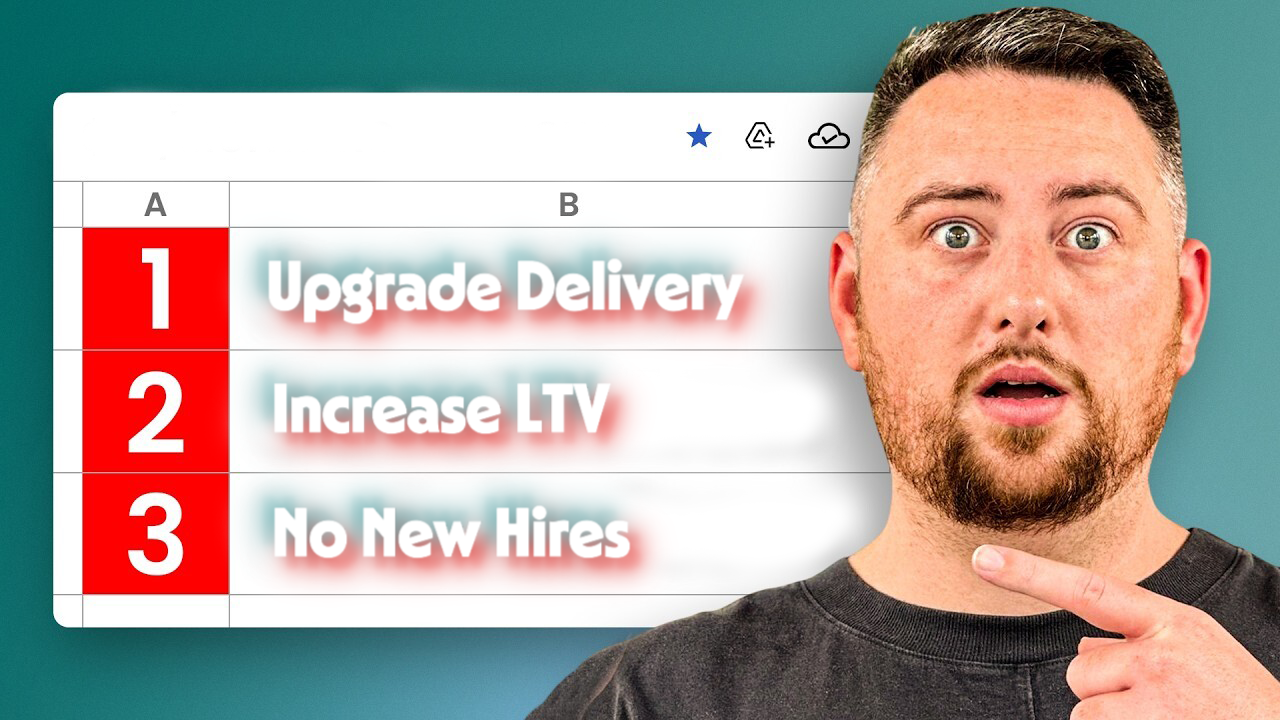
When you build the right infrastructure, you can work toward improving lifetime value without adding a single person to your team. The key is understanding which upgrades actually move the needle and which ones just sound good in vendor pitches.
If you’re looking to build better delivery systems without expanding your team, the frameworks covered in Master Internet Marketing, our 7-week live comprehensive training, walk through exactly how to approach operational infrastructure like this.
Results are not typical. Your results will vary and depend entirely on your individual capacity, business experience, expertise, and level of desire. There are no guarantees concerning the level of success you may experience. The testimonials and examples used are not intended to represent or guarantee that anyone will achieve the same or similar results. We don’t believe in get-rich-quick programs. We believe in hard work, adding value and serving others. As stated by law, we can not and do not make any guarantees about your own ability to get results or earn any money with our information, courses, programs, or strategies.
Here’s what most operators miss: delivery isn’t just a cost center. It’s one of your highest-leverage customer experience touchpoints.
Think about the customer journey. Someone buys from you, then they wait. During that waiting period, every interaction shapes whether they’ll buy again — the tracking experience, the communication cadence, how you handle exceptions, and whether the delivery window actually matches what you promised.
According to McKinsey research on customer experience, the post-purchase experience is one of the most overlooked areas for building customer loyalty. In my experience, tightening up the delivery experience can meaningfully impact repeat purchase behavior — not by offering faster shipping or eating more shipping costs, but by reducing friction and uncertainty in the fulfillment process.
The math is simple. If your average customer buys twice instead of once, you’ve improved LTV. If that happens without doubling your delivery team, you’ve changed your unit economics.
Most established operators are sitting on this opportunity right now. They’ve got the volume. They’ve got the customer base. They just haven’t systematized the delivery experience in a way that compounds value.
Let me be clear about what automation means in this context. I’m not talking about chatbots that frustrate customers or rigid workflows that break the moment something goes off-script.
The automation that supports LTV improvement is the kind that removes decision fatigue from your team while improving speed and accuracy for your customers.
Start with order routing. Businesses waste enormous amounts of time manually deciding which orders go where, which carrier to use, and which fulfillment center should handle what. This should be rules-based and automatic.
Set your system to evaluate orders based on destination, product type, inventory location, and carrier performance data.
Let the system route automatically.
The time savings compound fast when you’re doing any real volume.
Next is tracking and communication. Every “where’s my order” question that hits your support team is a tax on your operations. Proper tracking automation proactively updates customers at every milestone without human intervention.
The businesses I’ve worked with that implement proper tracking automation see support ticket volume decrease noticeably. That’s not just cost savings — it’s a better customer experience because responses are instant and accurate.
Exception handling is where most automation falls apart, and it’s also where the biggest opportunity lives. Build decision trees for common exceptions.
Example: If a package is delayed, the system should automatically decide whether to expedite a replacement or issue a credit based on customer value and order details.
You’re not removing human judgment entirely. You’re removing it from the majority of cases that follow predictable patterns so your team can focus on situations that actually need strategic thinking.
The delivery experience doesn’t have to be one-size-fits-all, and personalizing it doesn’t require someone manually customizing each order.
Use the data you already have. Purchase history tells you a lot about delivery preferences:
Customers who always choose the fastest shipping option value speed.
Customers who consistently pick the cheapest option are price-sensitive.
Customers who use a different delivery address each time might be buying gifts.
These systems can use behavioral data to automatically adjust the delivery options you present. Show speed-focused customers the fastest options first. Show price-sensitive customers the most economical choices prominently. Offer gift packaging to the person with varied shipping addresses.
This isn’t complex AI — it’s basic segmentation applied to the fulfillment experience.
Businesses that implement behavioral personalization see friction decrease for repeat buyers. Customers don’t have to dig through options to find what they prefer; you’re surfacing it based on what they’ve shown they value.
Timing personalization matters too. If someone consistently orders on the first of the month, your system should anticipate that pattern. Send a reminder. Pre-populate their cart. Make reordering frictionless.
The key is building feedback loops. Every delivery interaction generates data. Feed that data back into your segmentation and let the system get smarter about each customer’s preferences over time without anyone manually updating profiles.
Most businesses treat different sales channels as separate operations: website orders, marketplace orders, social commerce orders, and maybe wholesale or B2B fulfillment. Each channel often has its own workflow, systems, and communication patterns.
That fragmentation kills efficiency and confuses customers.
Businesses that have unified their delivery experience across channels operate with less overhead. One system handles routing, tracking, and communication regardless of where the order originated.
This matters as buying behavior shifts. A customer might discover your product on Instagram, research it on your website, and complete the purchase through Google Shopping. If each touchpoint has a different delivery promise or tracking experience, you’re creating friction.
Build your systems so the delivery experience is consistent:
Same communication cadence
Same tracking interface
Same exception handling protocols
The customer shouldn’t be able to tell whether they bought through your site or a marketplace based on how their delivery is handled.
Operational benefits include less context-switching for your team, unified inventory management, and consolidated carrier relationships.
Social commerce is worth calling out: businesses that enable direct purchasing through social platforms with seamless handoff to their delivery infrastructure shorten the path from discovery to door. That speed matters for conversion and for creating positive associations that drive repeat purchases.
This upgrade sounds futuristic but has immediate practical value for certain business models.
If you’re selling items where fit, size, or spatial relationship matters, giving customers a way to visualize the product in their space or on their body before ordering can reduce returns.
Returns are one of the biggest hidden costs in delivery operations: reverse logistics, inspection, potential restocking, and often a lost customer. Reducing returns can change your fulfillment economics.
According to Shopify’s research on ecommerce returns, visual preview and AR tools are becoming standard for businesses looking to reduce return rates. Businesses in furniture, home decor, and fashion have implemented AR preview tools that let customers see products in context before buying. The technology is accessible now and often doesn’t require custom development or massive investment.
The impact on delivery operations is indirect but meaningful: fewer returns means less exception handling, fewer customer service interactions, and better inventory turn because you’re not constantly cycling returned merchandise.
For businesses with complex products, visual search integration helps customers find exactly what they want faster, reducing the likelihood of ordering the wrong item and needing an exchange.
These systems are designed to work with your existing product catalog. You’re not manually creating AR experiences for every SKU; platforms handle that automatically once integration is set up.
Most businesses set up their delivery workflows and then never touch them unless something breaks. That’s leaving opportunity on the table.
Operators who consistently improve LTV treat delivery as an ongoing optimization opportunity. They’re constantly testing variables:
Notification timing
Packaging options
Carrier combinations
Delivery window presentations
The key is having infrastructure that makes testing easy. If every experiment requires developer time and project management overhead, you won’t run enough tests to find meaningful improvements.
Set up your systems so you can launch A/B tests on delivery variables with minimal friction. Examples to test:
“Arrives by Tuesday” vs “2-day delivery” framing
Whether proactive delay notifications increase or decrease satisfaction
Whether offering delivery insurance at checkout impacts repeat purchase rates
Businesses that run continuous delivery experiments find incremental improvements quarterly. Those gains compound: after a year, you’re operating at a different level of efficiency and customer satisfaction.
Measure the right metrics. Don’t just optimize for delivery speed or cost. Optimize for metrics that correlate with LTV: repeat purchase rate, time to second purchase, and customer satisfaction scores that correlate with retention.
Here’s a simple upgrade most businesses overlook: just ask customers what they want.
Zero-party data is information customers intentionally share with you. For delivery, this means capturing preferences such as preferred delivery windows, whether they want notifications, whether they need signature confirmation, and whether they prefer speed or cost savings.
According to Forrester’s research on zero-party data, this approach is increasingly important as third-party tracking becomes less reliable. Systems can capture this information once and apply it automatically to every future order. The customer sets preferences during checkout or in account settings, and your fulfillment system reads those preferences and routes orders accordingly.
This does two things:
Improves the delivery experience because you’re giving customers exactly what they’ve told you they want.
Reduces decision points in your checkout flow.
Businesses that implement preference capture see payoffs in repeat purchase behavior. Customers feel understood. The delivery experience feels personalized even though it’s completely automated.
The privacy angle matters: when customers explicitly tell you their preferences, you’re not relying on third-party data or making assumptions based on tracking. That builds trust and insulates you from platform changes and privacy regulations.
Avoid these common and expensive mistakes:
Don’t over-rely on third-party data for personalization. Platform policies change and tracking gets restricted. Build delivery intelligence on data you own and data customers give you directly.
Don’t ignore journey mapping. Most delivery problems are communication or expectation-setting problems that happen earlier in the customer journey. Map the full path from product discovery through delivery completion before optimizing individual pieces.
Don’t implement automation without exception handling. Systems must gracefully handle edge cases or you’ll end up with more manual work than you started with.
Don’t optimize delivery in isolation. Your delivery experience needs to align with your brand positioning, pricing strategy, and customer acquisition approach.
If you’re wondering where to start, here’s a practical prioritization:
Automate your highest-volume, most repetitive tasks first — order routing and tracking communication provide immediate time savings with minimal implementation risk.
Implement basic behavioral segmentation for delivery options to improve the customer experience for repeat buyers with minimal technical lift.
Tackle exception handling automation to reduce support overhead; this requires careful setup to handle edge cases properly.
Consider omnichannel unification if you’re selling through multiple channels; this can be complex but offers substantial operational benefits.
Add visual and AR tools if your product category benefits from them — implement only if returns and fit issues are costing you margin.
Build out experimentation infrastructure for ongoing optimization.
The key is sequencing so each upgrade builds on the previous one: automation first gives you bandwidth for personalization; personalization gives you insights for experimentation; experimentation gives you data to keep optimizing.
Most businesses compete on acquisition when they should compete on retention and LTV.
You can raise your customer acquisition cost ceiling by increasing each customer’s value over their lifetime. You can increase LTV without proportionally increasing costs if you build the right systems.
Delivery is one of the highest-leverage places to make that happen because it’s a repeating touchpoint that directly impacts whether customers come back.
The businesses that win over the next few years won’t be the ones with the cheapest shipping or the fastest delivery. They’ll be the ones that create delivery experiences so frictionless and personalized that customers default to buying from them again.
That doesn’t require a massive team. It requires smart systems that automate repeatable parts and surface the right information for strategic decisions.
If you’re already doing volume, you’ve got the data and the customer base to implement these upgrades. The question is whether you’re going to keep solving delivery problems with headcount or build infrastructure that scales without linear cost increases.
Operators who’ve made this shift don’t talk about delivery as a cost center anymore — they talk about it as a retention and LTV driver. That’s the mindset shift that opens up the real opportunity.
If you want to go deeper on building operational systems like this, Inner Circle, our flagship program, covers these frameworks in detail with ongoing support from operators who’ve implemented them.
Results are not typical. Your results will vary and depend entirely on your individual capacity, business experience, expertise, and level of desire. There are no guarantees concerning the level of success you may experience. The testimonials and examples used are not intended to represent or guarantee that anyone will achieve the same or similar results. We don’t believe in get-rich-quick programs. We believe in hard work, adding value and serving others. As stated by law, we can not and do not make any guarantees about your own ability to get results or earn any money with our information, courses, programs, or strategies.

Jeremy Haynes is the founder of Megalodon Marketing. He is considered one of the top digital marketers and has the results to back it up. Jeremy has consistently demonstrated his expertise whether it be through his content advertising “propaganda” strategies that are originated by him, as well as his funnel and direct response marketing strategies. He’s trusted by the biggest names in the industries his agency works in and by over 4,000+ paid students that learn how to become better digital marketers and agency owners through his education products.

Jeremy Haynes is the founder of Megalodon Marketing. He is considered one of the top digital marketers and has the results to back it up. Jeremy has consistently demonstrated his expertise whether it be through his content advertising “propaganda” strategies that are originated by him, as well as his funnel and direct response marketing strategies. He’s trusted by the biggest names in the industries his agency works in and by over 4,000+ paid students that learn how to become better digital marketers and agency owners through his education products.


This site is not a part of the Facebook website or Facebook Inc.
This site is NOT /endorsed by Facebook in any way. FACEBOOK is a trademark of FACEBOOK, Inc.
We don’t believe in get-rich-quick programs or short cuts. We believe in hard work, adding value and serving others. And that’s what our programs and information we share are designed to help you do. As stated by law, we can not and do not make any guarantees about your own ability to get results or earn any money with our ideas, information, programs or strategies. We don’t know you and, besides, your results in life are up to you. Agreed? We’re here to help by giving you our greatest strategies to move you forward, faster. However, nothing on this page or any of our websites or emails is a promise or guarantee of future earnings. Any financial numbers referenced here, or on any of our sites or emails, are simply estimates or projections or past results, and should not be considered exact, actual or as a promise of potential earnings – all numbers are illustrative only.
Results may vary and testimonials are not claimed to represent typical results. All testimonials are real. These results are meant as a showcase of what the best, most motivated and driven clients have done and should not be taken as average or typical results.
You should perform your own due diligence and use your own best judgment prior to making any investment decision pertaining to your business. By virtue of visiting this site or interacting with any portion of this site, you agree that you’re fully responsible for the investments you make and any outcomes that may result.
Do you have questions? Please email [email protected]
Call or Text (305) 704-0094