Jeremy Haynes Breaks Down the Exact Math to Hit $1M/Month and Why Most People Never Do It

I hope you enjoy reading this blog post. If you want my team to just do your marketing for you, click here.
Author: Jeremy Haynes | Published December 10, 2025
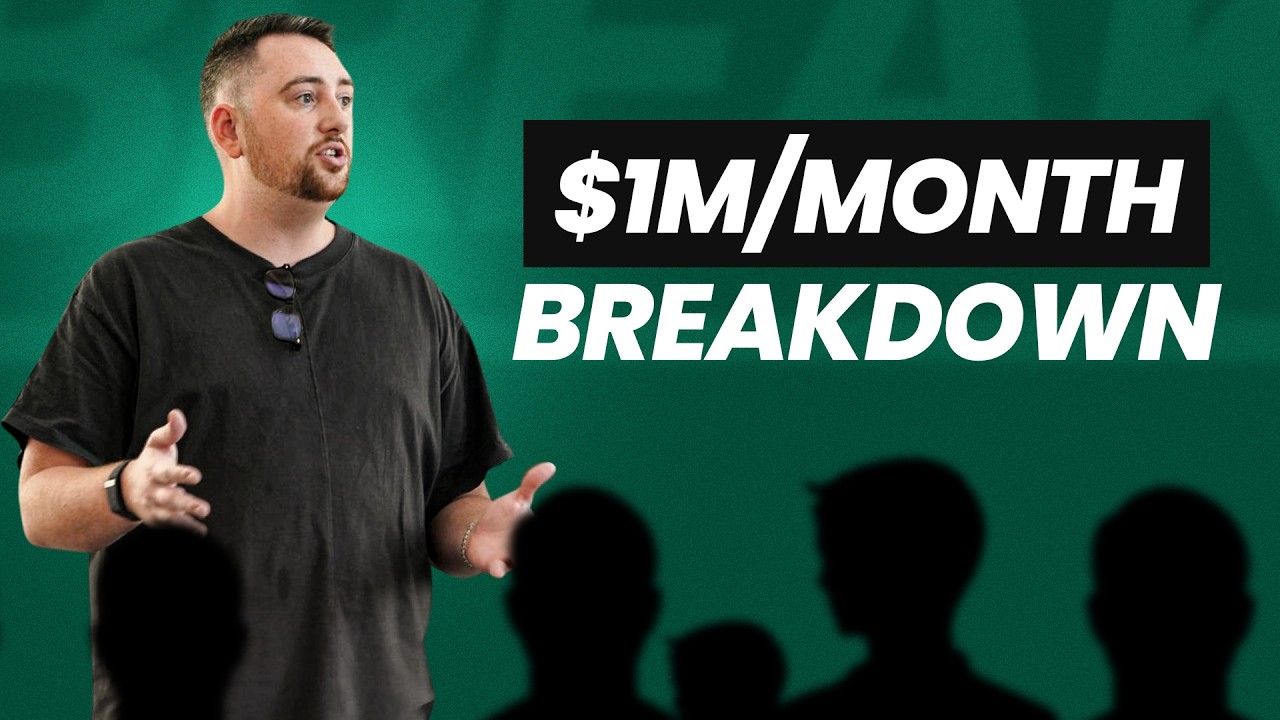
Haynes reveals why reverse-engineering your revenue goal into daily targets is the only way to make seven figures achievable, how adding a $500K secondary revenue stream can cut your client volume by 80%, and why conservative statistics give you the certainty to take massive risks.
Jeremy Haynes sat down with his Inner Circle mastermind group to walk through the exact math required to hit million-dollar months. Most of the 15 people in the room were already doing a couple hundred thousand per month and trying to break through to seven figures. Haynes started by making everyone write down their big revenue goal, then forced them to confront an uncomfortable reality: the way they’re currently operating might make that goal a complete nightmare to achieve. What followed was a ruthless breakdown of goal math that exposed exactly how many clients they’d need to close, how much ad spend would be required, and which statistics would make or break their ability to scale.
Start by Writing Down Your Monthly Revenue Goal and Working Backwards from There
The first step is writing down your monthly revenue target. Not a stepping stone goal like $250K or $500K along the way. The actual big number you’re going after. For Haynes, that number was always a million dollars per month. But here’s where it gets interesting. When he first did the goal math years ago, his average deal size was $8K to $12K per month. At $10K average, he’d need 100 clients to hit a million.
“That would be a fucking nightmare,” Haynes explained. Having 100 people individually paying $10K per month in the way he was delivering services at the time would have made his life hell. Too much stress, too many people to manage, a life he didn’t want to live.
That’s when Haynes realized something critical. The path he was on wasn’t going to make sense for hitting his target. He could have figured that out halfway through by reactively running into it, then scaling back to adjust. But doing the math upfront showed him immediately that he needed to change his business model entirely.
Haynes determined 10 clients was much more ideal. He was already making people a million dollars per month through his agency work. It seemed justifiable that someone would pay him 10% of that if he made them a million. Ten people at $100K per month instead of 100 people at $10K per month. Same revenue, 90-person difference, completely different quality of life.
Why Most People Use Fantasy Numbers Instead of Real Cash Collection Data
Haynes had everyone in the mastermind write down what they currently cash collect per customer per month. Not what they charge, but what actually hits their bank account after payment plans and other factors. One person said they charge $5K, but after doing the math, they actually cash collect $3,700. That $1,300 difference is massive when calculating how many people you need to sell to hit your target.
Once you have your big number and your average cash collected, you divide the big number by what you cash collect. That gives you the total number of customers you need to sell to per month. For most people in the room, that number was shocking. One member named Mason needed 430 clients per month to hit his $1.5M goal at his current pricing.
Haynes then asked everyone if their number was realistic or unrealistic. Only two people raised their hands for realistic. For everyone else, the math exposed fundamental problems. One person said he couldn’t do one-on-one calls with 65 people per month. Another didn’t have enough staff to handle the volume.
“I can’t fail because I don’t have enough people on those,” one member said. Staff issue. Bingo.
Here’s where it gets critical. For everyone who wrote “unrealistic,” Haynes made them write down why it was unrealistic, then pair each reason with a solution. If you can’t come up with solutions, that’s good, not bad. It means you don’t know what you’re doing yet and need help. But the solutions have to align with reasons that actually make sense for what you want in life.
How Conservative Statistics on Close Rates and Show Rates Give You Confidence to Spend Six Figures on Ads
Haynes walked through Mason’s math as an example. Mason needed 430 clients per month. His current close rate was 45%, so he’d need 956 people on the phone with closers. His show rate was 60%, so he’d need 1,593 calls scheduled total. Mason was already getting 550 calls per month organically like clockwork. That meant he needed about 1,053 additional calls from paid advertising.
At $150 cost per call, Mason would need to spend $157,950 per month in ad spend to hit his goal. That’s it. He was already one-third of the way there through organic. The math showed he was a measly $157K per month away from his target, assuming his statistics held.
But here’s the key insight. Haynes emphasized being conservative with statistics. Don’t factor in a 45% close rate from organic leads when calculating paid advertising results. Paid leads come from a different frame and will have lower show rates and close rates unless you’re running content advertising strategies to replicate the organic sales process. Be conservative. Factor in worse numbers. Give yourself wiggle room.
“The statistics being clear are what give you the certainty to take the risk,” Haynes said.
He gave an example of a client he just took on who normally gets 10,000 to 12,000 webinar registrants per month organically and sweeps a million per month from it. Her previous advertiser only got her to $200K to $300K monthly through paid ads despite spending $120K. Haynes looked at the account and immediately saw the opportunity. If he got paid registrants to 15,000, revenue would jump to $600K. At 25,000 registrants, she’d hit a million in the first month.
The client’s cost per registrant was $10. To get 25,000 people at $10 each would require $250K in spend. Haynes told her she could either be conservative and prove what he was saying was right, or roll the dice and go for 25,000 registrants from paid ads. She said go ahead. Within two weeks of launching ads, he was at over 14,000 registrants and mathematically on pace to hit 25,000 by the following Wednesday.
Here’s what made it work. Haynes overestimated his cost per lead. He underestimated the show rate from 20% down to 15%. He underestimated the close rate from 7% down to 5%. Conservative statistics on each metric gave a little room for error while still hitting the million-dollar target. That conservatism is what gave the client confidence to invest almost everything she made last month into the new advertising gamble.
How Adding a Secondary Revenue Stream Can Cut Your Required Client Volume by Half
Not every business can cleanly spend $258K and generate 430 sales per month from one revenue source. That’s where secondary income streams come in. They make your big number even more realistic. Haynes wanted his million per month to come from 10 agency clients at $100K each. But he also did consulting deals that took four hours per month. He thought he could contribute $200K monthly from consulting without complicating his life.
Ten consulting deals at four hours each would be 40 total hours per month. Spread across four weeks, that’s 10 hours per week. Spread across five days, that’s two hours per day. Haynes asked himself if he could do two hours per day of consulting calls without lowering his quality of life. The answer was yes. He loves talking to people about making more money.
To hit $200K with 10 consulting clients meant charging $20K per month. At the time he was charging $7,500 to $10K for consulting. Going from $10K to $20K felt way easier than going from $10K per month on the agency side to $100K per month. The consulting revenue stream would contribute 20% of his monthly target with only 10 additional people, not 100.
Haynes drilled this point with Mason. If Mason needed an extra $500K per month, he could either close hundreds more clients at his current price, or he could charge businesses $10K per month to train their entire copywriting staff. At $10K per month, he’d only need 50 businesses. Mason has 8,000 total customers right now. Fifty is only 6% of his current customer base.
“You can’t get 6% of your total fucking amount of people that give you money to give you $10,000 a month?” Haynes asked. “You need 50 people like that. You don’t think that’s possible?”
If Mason did that, he’d contribute a third of his revenue goal with only 50 people per year instead of closing 5,160 people per year at his current pricing. The 50 per month would be its own business model that wouldn’t complicate his life. But Mason’s reaction was telling. There was shock at the idea of charging $10K per month for teaching copywriting. That shock revealed he hadn’t sold himself on the value he provides.
Why You Have to Sell Yourself on Your Value Before You Can Charge What You’re Worth
Haynes emphasized you have to really sell yourself on these things. It can’t be shock. It has to be obvious how you’d make people more money than what you’re charging them. That part has to be obvious before you take action and add that revenue stream. It can’t be questionable. When Haynes looked at the consulting deal, it was a no-brainer. When he looked at raising his education products from $1,000 or $2,000 up to $5,000, it was a no-brainer.
He gave a wild example to illustrate the point. One of his friends pays a hypnotist $83,000 per month to be his on-demand hypnotist. The hypnotist charges a million dollars per year and has a dozen people paying that. The hypnotist isn’t judged by trackable revenue the way agencies and consultants are. Yet he charges more than most people in the room.
“You’re charging less than a hypnotist that is not tracked by tangible revenue,” Haynes said. “And you don’t think you could charge 10 grand a month to 50 people for something that trackably makes them more money?”
Haynes charges $20K per month for consulting and delivers actual trackable results. Easy revenue, easy $200K per month that he deserves. The same logic applies to anyone adding secondary revenue streams. When you look at the math, when you consider what people would have to pay you and what you’d have to teach them to make them that amount of money, it should be obvious. If it’s not obvious, you haven’t sold yourself on it yet.
Hitting million-dollar months starts with writing down the big number, then reverse-engineering exactly how many clients you need to close at your current pricing to make it happen. For most people, that initial math exposes a fundamental problem with their business model. Either they’d need an unrealistic number of clients, or they’d need staff they don’t have, or the quality of life would be terrible. The solution is either charging dramatically more, changing the offer entirely, or adding secondary revenue streams that contribute 20% to 50% of the target without adding complexity. But none of that matters if you’re using fantasy statistics. Conservative numbers on close rates, show rates, and cost per lead are what give you the certainty to invest six figures per month in advertising. The math has to be clear, the solutions have to be obvious, and you have to sell yourself on the value you’re providing before you ever try to sell anyone else. Most people never do this exercise, which is exactly why most people never hit seven figures monthly.
Get my content first on Google
Add jeremyhaynes.com as a preferred source and Google shows my articles more prominently in your search results, including AI Overviews and AI Mode.


Jeremy Haynes
Owner and CEO of Megalodon Marketing
Jeremy Haynes is the founder of Megalodon Marketing. He is considered one of the top digital marketers and has the results to back it up.