I hope you enjoy reading this blog post. If you want my team to just do your marketing for you, click here.


I hope you enjoy reading this blog post. If you want my team to just do your marketing for you, click here.
Author: Jeremy Haynes | founder of Megalodon Marketing.
Earnings Disclaimer: You have a .1% probability of hitting million-dollar months according to the US Bureau of Labor Statistics. As stated by law, we can not and do not make any guarantees about your own ability to get results or earn any money with our ideas, information, programs, or strategies. We don’t know you, and besides, your results in life are up to you. We’re here to help by giving you our greatest strategies to move you forward, faster. However, nothing on this page or any of our websites or emails is a promise or guarantee of future earnings. Any financial numbers referenced here, or on any of our sites or emails, are simply estimates or projections or past results, and should not be considered exact, actual, or as a promise of potential earnings – all numbers are illustrative only.
One of my favorite things to do is sell to rich people. I’m going to go through some of the best practices for call funnels and tie that together with some of my top lessons for advertising, selling, and just converting rich people in general.
You can make a lot more money selling to rich folks comparatively to selling to the general public.
Obviously, need I not say that rich people have a ton more money comparatively to the general public as a whole.
In addition to that, getting rich people richer typically gets you a lot richer proportionately to how rich you get them.
It’s a very simple game. You either save them time, make them enjoy their life more with some fun stuff, or you make them some money.
Today, we’re going to be talking about how to convert rich folks through call funnels.
If you’re new here, welcome in. My name is Jeremy Haynes. All we talk about here is getting to million-dollar months and then staying there.
We take all the top lessons from all my clients over the years, which currently sits at 41 that have gotten to the big million-dollar months. We’re working on 42 and 43 as we speak.
I do not make any income claims to you. I’m not telling you you’re going to hit a million a month. To even get to $10 million a year, according to the US Bureau of Labor Statistics, there’s a 0.1% probability of that.
We just take the lessons from all these people that we’ve worked with and hand them down to you.
If your business is already generating $100k+ per month, My Inner Circle is where you break through to the next level. Inside, I’ll help you identify and solve the bottlenecks holding you back so you can scale faster and with more clarity.
If you’re already following along, welcome back. Got a banger for you here today. Let’s dive in.
So the first lesson I want to make really clear, we’ve talked about this in a series that we have in content that you can look at where I talk about selling to rich people, advertising to rich people, offers for rich people.
Point being, one of those top lessons is how direct you must be.
Rich people absolutely hate when you waste their time.
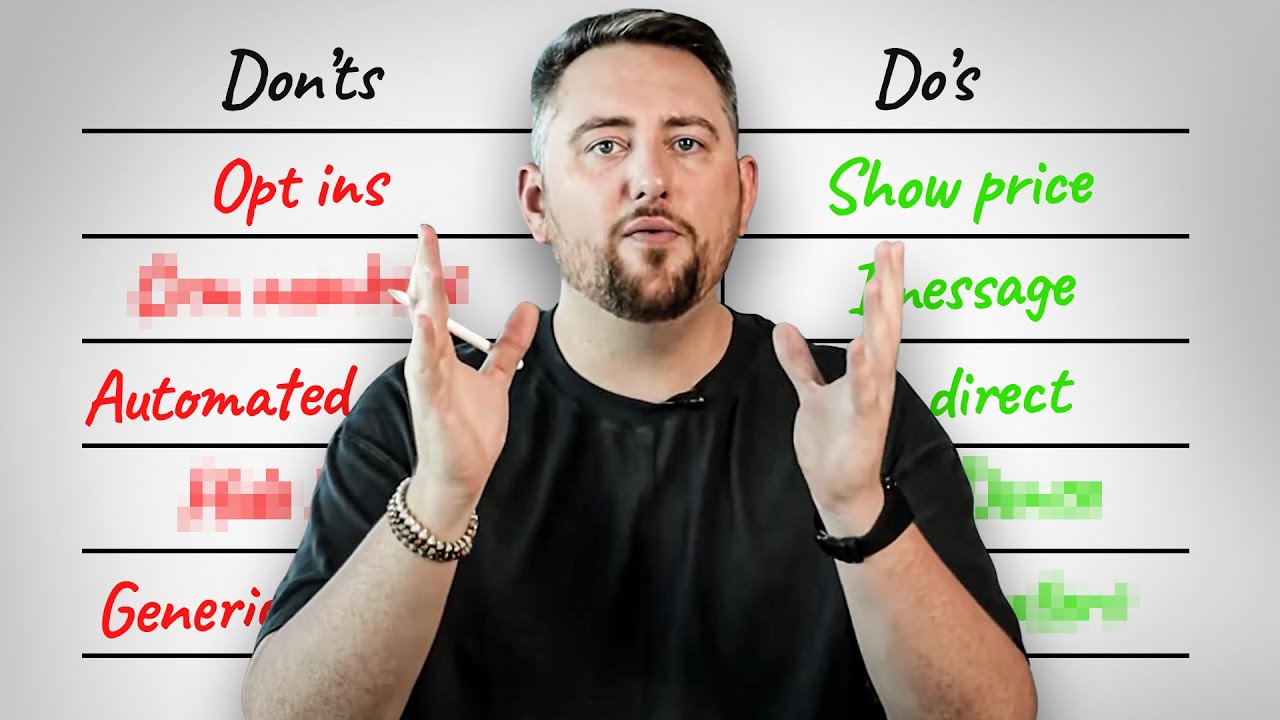
There’s a very simple rule that I generally start off with, which is no opt-in.
I always get a bunch of marketers who only use opt-ins that at this point have a big issue with this starting point. So allow me to address those folks.
Rich people don’t care to opt in for your pitch. It’s a pitch.
Yes, when you do a call funnel correctly when selling to rich people, you’re definitely going to have value in the content. That’s a requirement. It’s going to be value dense. You’re not going to have any fluff. You’re going to get straight to the point and you’re going to be very matter-of-fact with them.
However, it’s still a pitch.
We don’t make rich people opt in for pitches. They don’t want to give you their information yet. They want a very low level of commitment to get exposed to your pitch and see if it’s right for them.
You have to do things in an extremely efficient way when selling to rich folks. That’s why being direct is so important.
And one of the first ways that you can respect them, their time, and their desire to have a low commitment to get exposure to what you’re going to pitch them on is to start off by not putting them through an opt-in.
I want to be clear when I say this. If you’re a savvy marketer, there’s plenty of tools you can use, even without directly capturing their information, that will still allow you to capture their information and remarket to them.
And no, I’m not just talking about the pixel, but that’s a tip that I leave for my paid students and Inner Circle members.
I digress though. My point being, when you’re selling to the general public, you can use an opt-in all you want. When you’re selling to rich people, we don’t ever use an opt-in.
To my next point, the VSSL itself, the VSSL on this page can be a combination of a few things.
I like to generally follow a template that we have called the mini webinar 2.0.
We generally take the best practices from a full-blown webinar, consolidate it down, and cut out a majority of the fluff, and we do a very matter-of-fact presentation that goes through the exact steps of what you’re going to help somebody do, what the outcomes of that offer are, and how you’re going to onboard them.
You give them crystal-clear clarity into exactly what the outcomes are that they’re going to purchase. You drop the price and you’re going to make sure that they fully understand all of the little nuanced questions.
A pro tip from one of our Inner Circle members, Mr. Daniel Fazio, he got up at the Q1 Inner Circle mastermind in 2025 and he said, “Why would you not add chapters to a VSSL like you would with a piece of content?”
I would never watch content without chapters, is what he said on stage to our entire group.
And I couldn’t agree more. Right after I heard that, I felt like my IQ was lower than I had otherwise thought it was because it was such an obvious thing to do. It made so much sense.
So of course, right after the mastermind ended, I went back to my team and I said, “Add chapter titles to every single VSSL we have running for clients.”
I didn’t even bother to split test it because it didn’t make sense to split test it. It felt like such an obvious matter-of-fact action to take.
So we did it. And of course, like the gambler that I am, a great gambler at that, pushed all the chips in the middle of the table on that bet and it paid out tremendously.
We had more retention on average with the chapter titles, giving the rich people the opportunity to bounce around in the content to the different parts that they felt like were for them and skip the parts that they figured were not for them.
We saw because we use Wistia and Vidalytics in terms of our analytic video tools that give us insight into this little statistic called engagement rate.
And engagement rate represents the amount of the content on average that somebody actually consumed.
We saw the engagement rate jump 37% by adding chapter titles in comparison to having content without it. Video engagement research confirms that interactive video features like chapters and navigation controls can increase viewer engagement by 30-50%, with viewers watching 40% more content when given control over their viewing experience, validating that empowering viewers with navigation tools dramatically improves content consumption and retention.
Some of you out there are still trying to hide the play bar, let alone the resistance you’ll have to doing something like adding a chapter title.
For those of you that are actually going to do this, congratulations. You’re going to have a lot more people actually consuming that content.
For those of you that are stuck in the past with that caveman barbarian mentality that you’ve got, that thick skull packed to the brim with stubbornness, good luck.
Anyway, I digress. Chapter titles, they are critical. They work super well and as I described, they’re perfect.
They give people more opportunity to control things. Why is that important?
Rich people love to control things. They hate it when you try to force them through a specific process because you think they need to go through it in a particular way.
It’s disrespectful to them. They know what they need to know, or at least they think they know what they need to know.
And although yeah, you might have crafted a perfect flow that you think the people need to go through, that’s not how reality works, my friend.
They are by preference going to scrub that little bar at the bottom and jump to the part that’s for them.
Let’s get to this other little nuanced point. They should be able to go up to a 2x speed on the content.
Some of you right now reading this would watch content at a 2x speed. I would bet a lot of money that you wouldn’t watch content if you didn’t have the ability to do that.
It’s the same thing with VSSLs. It is silly to not show the player controls. It is silly to not allow them to control the playback speed in 0.25 increments.
Obviously, it should start with the standard playback speed, but they should be able to go to 1.25, 1.5, 1.75, and a 2x speed.
For some of you that talk like turtles, it should be even faster than that.
Here’s my point. Control.
You’ll notice a few things here. They really just relate to allowing them to control the process more. That’s the main thing I want you to understand about some of these initial nuances that I’m talking about.
Now I generally get this question. Does it have to be short or can it be long?
I have seen both work tremendously well. It depends on how you are at communicating. It depends on what you are communicating to them about.
I’ll give you a great example. We had an offer that felt like what we call a no-brainer offer. When you articulate it, it just immediately makes sense.
You need to jump right into the nuances of the offer about how you do it differently than the other people that do it, about what the outcomes are that you specifically are trying to help people with.
Pricing and onboarding details doesn’t have to be too long when it’s a no-brainer offer. Something that people hear, they generally already have thoughts of I already want this anyway.
You don’t need to do much beyond just like I said, jump right over into the little nuanced parts of your pitch.
Comparatively, we had a real estate offer recently, something that people had never heard of. It required a 40-minute VSSL.
The VSSL did a lot more explaining around what the offer is, how it works, how the game is played. A lot of the details that would otherwise be left out in a no-brainer offer have to be covered in something that people don’t already have thoughts about.
So it’s okay to be longer. The chapter titles enable people to go through it faster. And a 40-minute VSSL watched on 2x speed is really a 20-minute VSSL.
Chop out the parts that they’re going to skip anyway. Realistically, they’re consuming 10 to 15 minutes of it in terms of the actual time exposure that they have to content like that.
So it’s not perceptually actually 40 minutes. You see, it’s still much shorter than that.
However, for an offer that people don’t already have thoughts about, meaning they don’t show up saying, “I already know I want this.” There’s some convincing that has to take place.
Naturally, you’re going to have to cover more details and naturally that content is going to be a tad bit longer.
You still want to optimize around value dense information and you want to optimize around speed to articulating that information and you want to make it shorter in terms of when you go to execute it.
Don’t just sit there and drag it out because you hear me say, “I have a 40-minute VSSL and it’s crushing right now.”
I want to be really clear when I say this. Due to the fact that we add the chapter titles and that we allow people to control the speed of the content – that’s the main thing that’s made us feel more confident with longer form VSSLs recently comparatively to how it used to be where we feel like the shorter they were, the better they performed.
One of the most common things we get in call funnels from sales teams or from business owners that are relatively new to scaling something big, they say, “Hey, I am getting people to come through on the phones that aren’t consuming everything in the content.”
And that’s a problem, you know, and they explain why their salespeople have an information deficit, at which point they typically say, “Can we hide the application until a certain threshold of time is passed? Can we hide the play bar to make sure that people go through the content in its entirety?”
And they’ll say all kinds of silly things like that. They’ll even go as far as cancelling calls when people don’t watch the VSSL before the actual call itself.
They’ll go as far as asking questions in the application like, “Did you watch the content in its entirety?” And it shows how weak their back-end follow-up system is.
One thing that you have to understand about rich folks is generally once they commit to a cycle, they want to go through the cycle quickly to the point of closure. Sales psychology research shows that high-net-worth buyers exhibit distinct purchasing behaviors characterized by compressed decision timelines once engagement begins, with affluent prospects 2.3 times more likely to make purchasing decisions within 7 days of initial contact compared to average consumers, provided they receive comprehensive information upfront.
So they don’t have too many cycles that they’re actively committed to at once.
This is a very undermined tactic and a lot of people don’t understand this about rich folks. It’s called cycle management. It’s a lesson on its own that’ll provide your life value.
When you commit to something, you mentally are putting something onto the RAM of your internal device, your brain.
And just like a real computer, when too many things are loaded up on it, and that RAM is extended thin, you don’t really get as much efficiency and effectiveness out of that computer. Can’t take on more when you don’t clear the existing things off the RAM.
Humans are no different. Computers are technically modeled after some of the functions of the human brain. After all, you have to understand this very clearly.
And if you commit to too many things at once, some things that you commit to are going to be very long cycles, like long-term goals, as an example. Some things are very small, easy to open and easy to close in a matter of seconds or minutes, as an example.
This process that you’re going to put people through is generally a couple day process. So therefore, it’s a couple day cycle.
Look at your average sales cycle as an example of the cycle time that somebody is actively participating in. And consider that you can shorten that cycle both for your benefit and their benefit by adding a bunch of value dense follow-up and consumables on the back end of the call being booked.
This is one thing that is misunderstood about rich folks. People will think, “Oh, they’re rich. They’re not going to give the time to this, all this information that I could send to them. They’re not going to want to get that higher frequency of communication from me. They’re not going to read any of it. They’re just going to show up to the call and use my salespeople for the education.”
And although yes, you will get a percentage of the rich folks or any demographic for that matter that will completely ignore and neglect all of the consumables, information, valuation that you’re going to put in front of them pre-call.
But here’s the thing with rich people. They’re attempting to move through cycles as fast as they can. That way they can take more on.
That’s how they’re always able to do more than other people. They have other people that go through cycles for them and they themselves go through cycles that are in their control as quickly and efficiently as they can.
So once somebody books the call itself, it all starts right here. So our confirmation page has to be dense with information, common questions that are asked.
It needs to be laid out in such a way that I’m going to describe here.
First of all, you want to have an intro piece here that’s on your confirmation page. Not something that is long and drawn out. That’s inauthentic.
It just needs to say, “Hey, you booked your call with us. Thank you so much. Appreciate you doing that. You got a few emails from us coming your way that are all going to be very informative. Answer common questions that people have going through our sales process. Go through outcomes. Go through onboarding instructions.
On this page below this content, my responsibility from here forward between now and your call is to help you do your due diligence and make this decision as efficient as I possibly can for you.
You’re going to find information on people who have already bought from us. We don’t only cover the best people that have bought from us. We actually also cover some of the people who have gone through and had a bad experience with us.
That way you can see the spectrum of how good things can be and how bad things could be, give or take the outcome that we’re able to help you produce or fail to produce. We cover both sides of the spectrum.
In addition to that, we have these things we call breakout content. The breakout content on the page are going to openly disclose all the common questions that people generally show up to sales calls and have for us.
We do the courtesy of answering those now and in some follow-up emails that we’re going to send to you. That way, we make our sales call with you coming up as efficient as we can.
Also, for your benefit, we are not going to harass you on the phone between now and then. We will send some courtesy texts. If you have any questions that need answered, please feel free to communicate to my sales representatives.
They are knowledgeable. They will not let you down. They will answer all your questions and they will send you additional resources and consumables from our organization that help you with understanding what we can do for you, how we do it, and what’s required of you through that process.
Again, if anything is missing from here forward between now and our call that would prevent you from showing up to that call, please communicate with us. Respond to one of the emails that get sent to you or respond to the sales representative that reaches out and communicates.
Looking forward to helping you talk soon.”
That’s all that content needs to be.
And then from there you have two sections on the page. And those two sections are very simple like I described.
You have the testimonials. Now this is something like I described that is generally misunderstood about showing testimonials.
When you only show the best case scenarios and the best outcomes, people think that you’re lying and full of it because you’re not showing them the downside.
So what they’ll still go do is they’ll go look up things about you that could expose them to the true downside.
And as most of you know who are sitting here reading this right now as a business owner, there’s a lot of people like competitors as an example, people who didn’t even buy from you that can go on platforms like Reddit, Trust Pilot, or any other review platform for that matter and just leave lies about you.
So it’s likely better that you choose to proactively demonstrate this on this page in comparison to letting them go off and do their own research.
Anyway, one of the pro tips that we’ve talked about deeply in my Inner Circle offer where we do twice a month one-on-one calls, our weekly group calls, our quarterly in-person masterminds, our Telegram chat full of rich people trying to get richer, and unlimited access to Jeremy AI to do voice and texting with, which is very effective for helping you in real time 24/7, coming up with ad ideas, helping script copy, helping script ad ideas, answering common questions, going in depth with you on information like what we’ve discussed here as an example.
It’s very helpful. That group’s for rich people trying to get a heck of a lot richer. The minimum you have to make to be a part of that group’s $100K a month. Don’t even bother applying if you’re not there yet. Wait until you are.
And if you’re well above that, we have 15 guys in there doing a million a month already that are trying to hit their next million. It’s a wide range of people.
The average of the group is about $200K to $300K a month currently in terms of their monthly revenue. And obviously, we have clarity on what everybody’s goals are. Get to a million a month or add the next million a month to what they do.
But I digress. Inside of that group, what we’ve talked about in depth recently, showing examples of how to do it, teaching people how to do it in much greater depth than of course what we would do here where you just read this for free, is we’ve talked about exactly what these breakout pieces need to be.
We’ve shown exactly how the testimonials need to look. We’ve demonstrated that testimonial spectrum. We’ve leveraged Reddit threads with bad things written about people. We’ve leveraged the one-star reviews on Trust Pilot and actually created more trust, more transparency, shortened sales cycles, increased show rates, increased close rates from leveraging these tactics I’m discussing with you now, just starting with the confirmation page alone.
So I won’t bore you. Like I said, we’ve got to move on to the next step, which is the email sequence.
Now this might sound a little shocking to some of you who don’t understand modern-day sales, but to us, we get it, and we do it all the time.
Six emails a day can be sent to people on average. Email marketing research shows that high-intent prospects in active sales cycles respond positively to increased email frequency, with studies finding that sales sequences sending 4-6 emails over a 2-3 day period see 25-35% higher response rates than single-touch sequences, demonstrating that information-dense follow-up accelerates decision-making for qualified leads.
I generally encourage that you start with a little less. As an example, maybe start at three to four a day.
What you’re really trying to monitor is the open rates. You want to continue pushing additional information out in terms of increasing the frequency per day until you start to see a diminishing rate of opens.
If you get an occasional random person that’s like, “Oh, hey, you’re sending me too much stuff.” Who cares if everybody continues to open the emails, that means everybody else loves it. And they seek the information.
Remember, rich people want the information because by the time the sales call comes, ideally, they’re ready to buy. That way, it’s as efficient for them as it can be.
Your job in between the call being booked and the call itself happening, is to give them as much information as you possibly can.
I commonly get questions like, “Oh, should I talk about the price?” Yes, you should talk about the price. You should have a whole piece on your confirmation page about price.
Price should have been disclosed in the application to qualify. Price should have been disclosed in the VSSL. Price should be disclosed again in the email sequence.
Because price is not something to object to. Price is something to make sense of. You see?
So long story short, these emails have to be dense with information. They cannot be those surface level emails that are like, “Oh, hey, you got a call coming up. Make sure you show up.” You know, people who don’t show up are losers.
It’s like, “No, you’re a loser if you still communicate that way to people, especially rich people at that.”
You have to have dense, informative, non-selfish communication that goes to that counterparty that’s getting onto the calls. It’s good, not bad, to do that.
Reflect on all the things that your salespeople talk to you about. Listen to your call recordings for once. Look at what’s discussed on the calls.
If those things that your salespeople were frustrated with that they continue to have to answer due to your information deficit that you have prior to a sales call, those things were covered before the call, those things wouldn’t be coming up on calls.
And if they did come up on calls, they’re probably just trying to get clarity. They’re probably trying to ask second layer questions, which become really good to also reflect on after you’ve already made these improvements to make even more improvements.
You see how that works?
So besides the emails, you also want to make sure that you do the hammer them sequence.
For all those unfamiliar with the hammer them sequence, we typically have 30 to 50 pieces of short form content. And in addition to that short form content, we ideally have anywhere from 20 to 30 long form pieces of content.
We’re going to take that content, we’re going to add it to the social platforms, mainly Facebook and Instagram. We could do it on TikTok, too, for the short form stuff. Sometimes people do it on YouTube as well, to be fair.
But what our intention here is we’re going to take this audience of people who just booked a call and if it’s too small because you’re still operating at a lower scale, that’s fine. Just beef up the audience size a little bit to ideally have a minimum of 100 people targetable, which usually means you need at least 150 to 200 people to actually get 100 people targetable due to match rate issues.
Point is you’re going to take that specific little pocket audience of people who are booking a call and about to show up for the call. And if that’s too small, like I said, add the people who are going through your sales process currently. Add the people who are unclosed and hammer them.
There’s a minimum frequency that we have to make sure we hit if we do this in order to get the effectiveness of the strategy.
That’s one of the things I hate talking about this for here is you guys don’t pay me. You guys go out there and you try these things and you don’t actually do it with specifically what I’m saying you have to do in order to get the result. And then you wonder why you don’t get the result.
The minimum frequency count that you have to have within a 72-hour window to actually see the effectiveness of the strategy and justify the dollars going towards it is a minimum frequency of 15 to 20 different impressions, unique impressions from just the short form content.
Ideally, we have at least 10 to 15 total impressions for our long-form content as well in terms of our frequency count.
Very easy to do. You exclude 3-second audiences. You put one ad set with that pocket audience and one piece within that ad set. You dupe out the ad set, change the content, dupe out the ad set, change the content.
And in each one of those ad sets, you’re just making sure you’re targeting the pocket audience and excluding the people who watch 3 seconds of that content.
I have a whole SOP on the hammer them strategy that obviously I give to people like my Inner Circle members. We also give it to people in my Master Internet Marketing group.
The Master Internet Marketing group is a phenomenal program to be a part of. Seven weeks of very informative, value dense 3 to 5 hour classes for seven weeks in a row.
Dozens to sometimes even low hundreds of pieces to consume in between each one of the live classes. Each class is themed with a specific topic in mind for you to come out the other side to master it.
There’s worksheets to help with information retention. They also get access to Jeremy AI unlimited messaging in the Telegram group chat. 2,000 messages per month inside of a portal where it all remembers everything that they say and talk to it about.
In addition to that, they do a very low cost in terms of cost per minute for voice and for Zoom calls, like calls with Jeremy AI.
As an example, I had somebody the other day, they said they spent $6 for like three hours of calls on the Zoom with Jeremy AI to solve a huge problem that made them thousands of dollars.
It’s very cost-effective. I respect the Master Internet Marketing students greatly, but due to the fact they pay a one-time price for lifetime access, I have to charge for – essentially I charge 10% more than what we actually get charged for the cost per minute on the voice stuff.
It’s very cost-effective. It’s super cheap. I don’t know the exact amount, but I know it’s like pennies.
So anyway, moral of the story, you do the confirmation page, you do the value dense emails, plus you do the hammer them strategy.
Now this is the other most important part, and you’ll notice that I talked about it. You have to have a sales rep text.
Now recently, we’ve had some tools that have popped up that have allowed blue text messages to be sent from CRM. I want to be fair in saying that these things still have some room to grow until I officially endorse the usage of them.
I currently only endorse the use of iPhones. I absolutely do not encourage you using CRM phone numbers. I by no means encourage you to use Android phones for communicating with people. Especially rich people.
Rich people as little as people from other countries want to admit who all use Androids absolutely hate and think less of you when you use an Android phone. They just think you’re poor. That’s all it comes down to.
So when your company or your sales rep communicates with somebody from a random CRM phone number that shows up as green in their phone when they text them back, they just think it’s spam.
They don’t think it’s a real person. They think it’s a bot. They think it’s automated. They think it’s low quality. Or they just think you’re a poor person. Sorry, but that’s the truth.
Now to be clear, like I said, there are some services that are popping up that cost like mid couple hundred bucks per line to use, which is easy to justify when you’re selling to rich people with something that’s high ticket, of course.
However, there’s still a lot of problems with it. Just glitches, issues, things that just make it so I don’t openly endorse it yet. And on top of that, just the cost.
The benefit for why people use some of these services is it integrates with the CRM. That’s the main reason that people like to use it. So they can keep all their communication in one place that can be monitored.
However, I like to use real iPhones. Now here’s why.
You guys can reflect on the fact that email service providers all know when an email is coming from a mass marketed email versus when a real person emails you in comparison.
They know that because the lists of real people’s emails, company emails, CRM emails are all shared amongst all the giant corporations.
You have IP addresses that are known to have CRM links and ties that immediately put your email communications into the spam folder, the updates folder, the promotions folder, the social folder.
Very few people out there have mastered getting an email into the primary inbox for the leads that they’re attempting to communicate with.
Now that same exact logic applies to phones.
A couple years ago, people got absolutely bombarded with spam communication – people communicating to them about things they didn’t want, political stuff, go vote for XYZ, care about our cause, and just overall spam from companies in general.
So what did all the phone companies get regulated to do? The same exact thing that email service providers had to get regulated to do. Share all of the phone numbers with each other who are real people and share all of the phone numbers that are business lines, Twilio lines, and any and all other text-based services that are linked to businesses and not real people.
So it’s important to note both where texting is trending and where it already is. It’s trending to a place and for some of you who use different services is already there where a phone number that is linked to one of those business lines or CRM lines automatically goes to a spam folder on your phone where you don’t even see it in your text folder.
There’s third party apps right now which are downloaded in mass, especially by rich folks, because most of them cost money, that deny those numbers from even hitting their device versus a real cell phone number from a real person texted from an iPhone immediately hits the actual text message folder like any other normal text would from a real person.
That’s the main reason I constantly endorse communicating from real iPhones.
In addition to that, this is the other thing that I absolutely love and why I don’t currently endorse those like blue text message CRM service things is you can’t send content like you would be able to on a standard iPhone.
If I send you a selfie piece from my iPhone to your iPhone, it doesn’t come through compressed. It looks just like it does on my iPhone where I shot it.
And a selfie piece is one of the easiest ways to stand out. I know it’s not the most efficient thing to do, and I know that it’s not the most scalable action to encourage you to take.
However, especially nowadays with all the AI services that are available, you can do this so easily and so simply, and it creates a nice personal touch.
Personal touches are what rich people love. They like to have somebody that gets assigned to them. Luxury consumer research confirms that high-net-worth individuals value personalized service experiences above all other factors, with 86% of affluent consumers stating that personalized attention from dedicated representatives significantly influences their purchasing decisions and brand loyalty, particularly in high-ticket categories where relationship building drives conversion.
I’ll give you an example. I remember when I first spent enough money on AMX to no longer ever have to call the 1-800 number again. They assigned me an account manager that became like a personal concierge to do all kinds of things from managing my AMX points and spending them when I request them to getting random reservations and appointments to just being my communication for support requests when necessary.
It felt so good. It just felt like an upgrade.
For all those of you who shop with any kind of designer store, how great is it when you can just text the person who works there instead of having to physically go to the store and they’ll walk you through like you’re there in the store with these virtual tours of the products, sending you things that they’ll think you’ll like.
Just obviously trying to sell you stuff, but that personal touch, them having the willingness to send it instead of you having to go there in person.
You choosing to go there in person – you text the rep ahead of time and you say, “Hey, I’m coming in.” If there’s a line out the door, you’re not waiting in that line. You get to walk straight into the store to your personal rep.
It gives you a touch. I remember one time I was in New York on the Upper East Side going to Goyard to splash some cash. And I walked up and there was a line halfway around the block to go into that location.
I texted the lady who works in there that I’ve bought a lot of stuff from historically and I was like, “Hey, I’m pulling up in 5 minutes.”
I remember pulling up, popping out of the Uber, feeling like a celebrity, man. It felt awesome. Security guy pops open the door, lets me cut all these people. Oh, what a nice little high that was.
You know, again, rich people love personal touches. Your sales people sending texts from iPhones, especially anything that relates to like being that personal concierge – that is a huge undermining tactic in how selling to rich people works through call funnels.
If that piece starts off by saying, “Hey, what’s going on? It’s great to talk with you. My name’s Jeremy. Really excited to talk to you tomorrow at 3 PM. Between now and then, any and all questions you got, I’m here to help you with.
I have two different things that I think you’ll love that are going to help answer a lot of your questions. One of them’s just a giant FAQ document, and one of them’s something that we call a consumable with a handful of pieces on it that go through our common questions.
One’s in writing, one’s a bunch of content. Can you tell me which one you prefer, and if you’d like me to send it here via text, or if you’d prefer I send it to the email on file. Either way, looking forward to talking with you tomorrow. Have a good day.”
Dude, those things crush so good. Like they do so well.
It’s a joke to not do them in terms of the effectiveness it has on show rates and shortening sales cycles and just making people show up a little more disarmed than they otherwise would.
Here’s my point. You do all these things with rich people, you have a much higher probability to actually sell to the rich people by the time they show up.
Here’s the other tactic that I really encourage. This one’s from my buddy Josh Troy, who we actually just did content with that you guys can go and check out.
Josh and I sat down when he was here to speak for half the day at an Inner Circle mastermind that we had here in Miami. And as soon as he landed, we went over to a little content studio to film a talk that we did and we posted it.
It’s a little more than an hour long. He’s the best salesperson I’ve ever met. I’m one of the best marketers in his words, one of the most prolific marketers of our generation is what he says in that conversation.
And we just sat down and we just talked about deals that we’ve done, some of the things that have gone extremely well, some of the things that have really held back deals from hitting million-dollar months.
I digress. Point is Josh one time shared a tip with me. He called the 10-day sales frame.
This is really simple to understand. People who have long drawn out sales processes where they sell something big to rich people – we have rich people that buy things like full-on home remodeling. They buy things that are like a full-blown like backyard makeover.
We have rich people that buy through like capital raising deals where somebody’s raising money for a specific project that they’re doing or whatever it is that their business has and you know they’re trying to attract accredited investors with like certain high dollar thresholds to invest per person.
Those can be very long drawn out sales cycles.
We obviously have a ton of funnels and clients that are selling like info to rich folks for like tens of thousands of dollars. And we also just have high ticket products in general that are still high ticket sold to rich folks.
My point being, some of these sales cycles can be like weeks or even sometimes months long.
One tip that Josh shared in order to shorten sales cycles was the 10-day sales frame.
Very simple to understand. You go into the sales process once the person shows up for the call and you specifically ask them, you frame it like this.
You say, “Listen, I really appreciate your time. I respect your time. And one thing that we like to do with everybody who shows up for these calls is have a commitment to go through this whole process within 10 days.
We don’t want it to draw out longer than that. We ideally can get your commitment through this process to either be in or be out at the end of a 10-day frame. That way, we don’t waste your time.
I want to get you any and all information that’s necessary between now and then in order to help you make a decision. By the end of that 10-day time frame, if you tell me like, ‘Hey, this day is best for me to buy and it’s outside of that 10-day time frame,’ that’s totally fine.
I just want to get to the point where we can make a decision together at the end of the 10 days on whether it makes sense to continue or whether it makes sense to just stop the process there and just set you free so you don’t have to waste time with us any further.
Either way, throughout this entire process, we want to commit to a few key values. We want to be direct with one another. We want to be as honest and transparent as we can with one another. And that comes for all the good and all the bad.
If something comes up that you feel is holding you back that needs to be addressed, please follow those values. Be honest with us. Be transparent. Be direct, which we assume you are anyway, and let us know. That way, we can address it and help get this process to the point of completion.
If the decision is made prior to that 10 days, all the better for you. We’re optimizing ourselves to help save you time and get this finalized. Is that fair? And does that make sense?”
Get their commitment on whatever that cycle time needs to be for you.
Some of you sitting here know that you’re just naturally going to have a longer sales cycle anyway relative to what you sell. Some of you are like, “Forget 10 days. Like, I want it to be like 3 days.” And that’s great.
You just tell them whatever the number of days is or the amount of hours is for you to get them that information. Be reasonable. Don’t just push people aggressively because again, rich people don’t like to be hard sold.
I talked about it prior, but I’ll reiterate it again. They like control.
Optimize the process around control.
There’s a few specific tips as an example that I give to my Inner Circle members currently and that we intend on sharing in our upcoming live cohort for our Master Internet Marketing class on email context where we can use if this then that logic to present different questions and paths that users can commit to in real time to get information that they prefer to consume all just through simple if this then that logic.
But I won’t bore you with that here because after all you’re reading this and you don’t pay any money.
You can check out the links below if you would like to explore some of our product offers and just get more information from us in general so we can help you get richer.
Either way, when you sell to rich people, it all starts with no opt-in, taking them to a VSSL that’s direct, concise, value dense.
Ideally, it follows our mini webinar 2.0 template if you’re selling to rich people with a make money offer.
And there’s plenty of other things that we talk about including our master VSSL SOP where we go extremely in depth on how to structure VSSLs for both affluent people and the general public.
After you get that part accomplished, the pages are generally very simple. They’re generally a headline, the content, and the application.
Try to make the application concise. Yes, people can lie in the application about different questions that you may ask them.
We have content in our weekly Inner Circle group call library where I go through the best practices of application questions that you should be leveraging and the flow of where you should put what types of questions.
We also have in that same weekly Inner Circle group call library an entire training on pixel conditioning to ensure that you’re leveraging data to send back to the pixel either through autonomous function or through manual control where your salespeople will manually trigger who’s qualified and who’s not.
That way only the qualified people go back to the pixel. That way the pixel and the algorithm exclusively biases towards more qualified people.
The other things that I want to make really clear before we close out today are how important messaging is when you’re selling to rich folks.
It really all starts there. In your advertising process, your content is ideally very short, direct, and punctual as well.
But you have to learn the words that rich people use. As an example, very rarely do rich people use the word money. Usually they use words like capital.
Cash reserves are referred to as liquidity. Very rarely do they use words like savings. More so they’ll call it reserves or liquidity. They’ll say things like deploy cash, deploy capital.
You have to learn like these little nuanced terms that they use. And there’s a whole plethora of terms that they use.
Again, we exclusively teach that inside of our Inner Circle offer.
I want to be really direct when I say this. If you fail to get rich people to the funnel in the first place, it’s generally a combination of your failure to have proper targeting and a failure to have proper messaging that communicates effectively to the rich folk.
Obviously, that starts on the ad level, but it’s the exact same set of lessons that’s applied throughout the rest of the entire funnel. From the page itself, the VSSL, all communication that follows.
Everything in your organization has to be built and tailored around selling to rich folks.
Just recently, I was over in the Miami Design District and I was splurging some cash. I walked into Laurel Piano and I had an incredible experience. I bought a little bag. I bought some shoes for my fiance.
It’s a very great business that they have over there. Small store and there were two other guys in the store. One of them was wearing a $700,000 Richard Mille also shopping for his wife and one of them was a guy named Nick who owns Avian Co. and he was with his cousin Sam.
I got to meet both of these great guys and just do a little networking with them and obviously we all introduced one another through just complimenting each other’s watches.
And we got to the point where we were exchanging phone numbers and just hanging out.
After I walked out of there, I wanted to go and check out Louis Vuitton. They came out with a picnic bag that I wanted to get for my fiance.
I walk into the store and it was chaotic. There were nobody at the door withholding people from going in like you’d normally experience in some type of designer store.
Instead, they were just letting anybody and everybody in there. So the quantity of potential customers versus the quantity of sales reps was like 5 to 1. The sales reps stood no chance to give you the personal time and attention that you needed. It felt almost like a JC Penney.
We then walked right across the street to Dior and it was the exact same experience. The door was wide open. The security guy upon you walking in was like, “Hey, are you here for the cafe? Are you here to shop?”
And you just look around and it’s like, “What happened?” You know, it was way better when they would stagger the quantity of people that could go into the store at one time. That way, the sales rep to customer count ratio was an even 1:1.
The experience itself diminishes tremendously when you just allow a higher quantity of customers than the sales representatives in the store. That ratio has to be 1:1 at least. Otherwise, you lose a lot of the positives of going shopping at these places.
The experience diminishes.
It’s the same thing when you look at everything that we just talked about here. The experience itself from the start of the ad all the way through to the conversion happening, you have to really think, how am I going to intentionally build this for selling to rich folks?
You can’t leave a single stone unturned. It’s one of the most important things that you’ll understand when you truly reflect on everything that we just talked about here today.
As always, I’d encourage you to check out some of the links I have on the website to get access to one of our many offers that are going to help you in your journey of getting richer.
I am excited to welcome you into whichever is most appropriate for you. And I look forward to you consuming the other content here to help you in your journey of learning the lessons of the big dogs hitting million-dollar months.
What I can teach you isn’t theory. It’s the exact playbook my team has used to build multi-million-dollar businesses. With Master Internet Marketing, you get lifetime access to live cohorts, dozens of SOPs, and an 80+ question certification exam to prove you know your stuff.
Thank you for reading to this point. It’s an honor to be able to help you.
Go get richer.
Watch the video:

Jeremy Haynes is the founder of Megalodon Marketing. He is considered one of the top digital marketers and has the results to back it up. Jeremy has consistently demonstrated his expertise whether it be through his content advertising “propaganda” strategies that are originated by him, as well as his funnel and direct response marketing strategies. He’s trusted by the biggest names in the industries his agency works in and by over 4,000+ paid students that learn how to become better digital marketers and agency owners through his education products.
Jeremy Haynes is the founder of Megalodon Marketing. He is considered one of the top digital marketers and has the results to back it up. Jeremy has consistently demonstrated his expertise whether it be through his content advertising “propaganda” strategies that are originated by him, as well as his funnel and direct response marketing strategies. He’s trusted by the biggest names in the industries his agency works in and by over 4,000+ paid students that learn how to become better digital marketers and agency owners through his education products.


This site is not a part of the Facebook website or Facebook Inc.
This site is NOT /endorsed by Facebook in any way. FACEBOOK is a trademark of FACEBOOK, Inc.
We don’t believe in get-rich-quick programs or short cuts. We believe in hard work, adding value and serving others. And that’s what our programs and information we share are designed to help you do. As stated by law, we can not and do not make any guarantees about your own ability to get results or earn any money with our ideas, information, programs or strategies. We don’t know you and, besides, your results in life are up to you. Agreed? We’re here to help by giving you our greatest strategies to move you forward, faster. However, nothing on this page or any of our websites or emails is a promise or guarantee of future earnings. Any financial numbers referenced here, or on any of our sites or emails, are simply estimates or projections or past results, and should not be considered exact, actual or as a promise of potential earnings – all numbers are illustrative only.
Results may vary and testimonials are not claimed to represent typical results. All testimonials are real. These results are meant as a showcase of what the best, most motivated and driven clients have done and should not be taken as average or typical results.
You should perform your own due diligence and use your own best judgment prior to making any investment decision pertaining to your business. By virtue of visiting this site or interacting with any portion of this site, you agree that you’re fully responsible for the investments you make and any outcomes that may result.
Do you have questions? Please email [email protected]
Call or Text (305) 704-0094