I hope you enjoy reading this blog post. If you want my team to just do your marketing for you, click here.


I hope you enjoy reading this blog post. If you want my team to just do your marketing for you, click here.
Author: Jeremy Haynes | founder of Megalodon Marketing.
Earnings Disclaimer: You have a .1% probability of hitting million-dollar months according to the US Bureau of Labor Statistics. As stated by law, we can not and do not make any guarantees about your own ability to get results or earn any money with our ideas, information, programs, or strategies. We don’t know you, and besides, your results in life are up to you. We’re here to help by giving you our greatest strategies to move you forward, faster. However, nothing on this page or any of our websites or emails is a promise or guarantee of future earnings. Any financial numbers referenced here, or on any of our sites or emails, are simply estimates or projections or past results, and should not be considered exact, actual, or as a promise of potential earnings – all numbers are illustrative only.
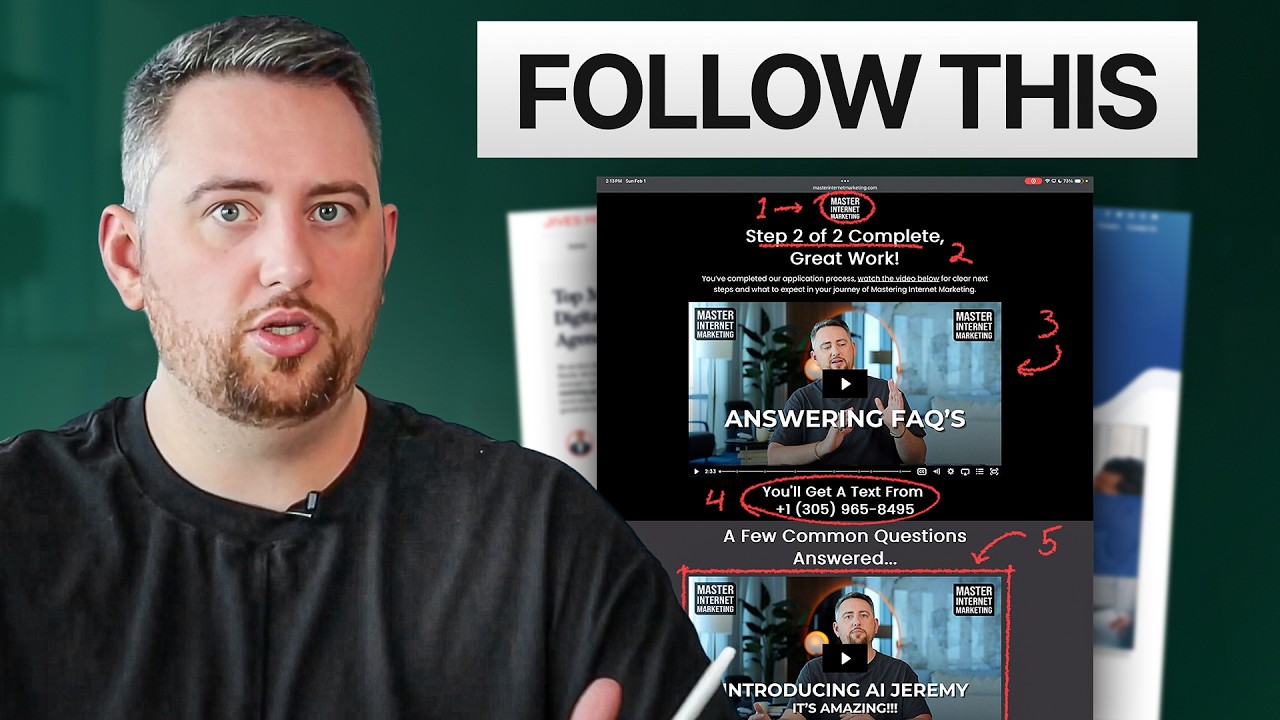
Most businesses treat confirmation pages like an afterthought. Someone books a call or registers for something, they land on a generic “thanks for registering” page, and that’s it. In my experience, this is a massive missed opportunity.
The confirmation page is one of the most underutilized assets in your entire funnel. Someone just took action. They’re engaged. They’re paying attention. And you’re doing nothing with that moment.
Here’s what most people don’t understand: the confirmation page isn’t just about confirming the appointment. It’s about pre-framing the conversation and building authority. When someone lands on your confirmation page, they should leave that page more excited, more informed, and more prepared than when they arrived.
Let me break down why this matters so much. When someone books a call with you, there’s a gap between when they book and when the call actually happens. It could be a few hours or a few days.
During that gap, one of two things happens. Either they get more excited and more ready to move forward, or they cool off and start second-guessing the decision. Your confirmation page helps influence which direction that goes.
According to research from the Nielsen Norman Group, confirmation pages serve as critical touchpoints that can reinforce user decisions and reduce post-action anxiety. If your confirmation page is just a calendar confirmation with no additional context, you’re missing an opportunity.
People show up to calls cold. They don’t remember why they booked. They haven’t been pre-framed on what you do or how you help. But when you use the confirmation page intentionally, people show up already understanding your approach, already familiar with your process, and already leaning toward moving forward.
If you want to learn more about building high-converting funnels and sales systems, check out my 7-week live comprehensive training.
Results are not typical. Your results will vary and depend entirely on your individual capacity, business experience, expertise, and level of desire. There are no guarantees concerning the level of success you may experience. The testimonials and examples used are not intended to represent or guarantee that anyone will achieve the same or similar results. We don’t believe in get-rich-quick programs. We believe in hard work, adding value and serving others. As stated by law, we can not and do not make any guarantees about your own ability to get results or earn any money with our information, courses, programs, or strategies.
Let’s talk about what actually needs to be on a confirmation page. This isn’t complicated, but it does need to be intentional.
First, you need the obvious stuff:
Confirm the appointment
Show the date and time
Give a calendar link so they can add it to their calendar
Make it crystal clear what just happened and what’s next
But that’s just table stakes. After that, you need to give them something to do. The worst thing you can do is confirm the appointment and then just leave them hanging with nothing else.
I use video here. A short video that does a few things: introduces me, explains what we’re going to cover on the call, and sets expectations for what they should prepare or think about before we talk.
This does a couple of things. One, it builds familiarity. By the time we get on the call, they’ve already seen my face and heard my voice — it’s not a cold conversation anymore. Two, it positions the conversation. I’m the one leading the process, not them.
This is where most people miss the opportunity entirely. Your confirmation page should be doing work before the call even happens.
I’m not talking about being pushy or salesy. I’m talking about educating people on what you do, how you help, and what makes your approach different. You want them thinking about their problem and your solution before they ever get on the phone with you.
One way I do this is by linking to case studies or client examples. Not just testimonials, but actual breakdowns of how we’ve approached businesses similar to theirs. This gets them thinking about their own situation in context.
Another thing I’ll do is link to a longer piece of content, like a training or a blog post that explains my methodology. I’m not trying to teach them everything. I’m trying to get them familiar with how I think and how I approach the problem they’re dealing with.
By the time they get on the call, they’re not starting from zero. They already understand the framework. The call becomes about fit and execution, not about explaining the fundamentals.
Authority content on your confirmation page is one of the most powerful tools you have. This is where you can link to things that establish credibility without you having to say “trust me, I’m credible” on the call.
Maybe it’s a podcast you were featured on. Maybe it’s a breakdown of a campaign you ran. Maybe it’s a piece of content that demonstrates your expertise in a specific area they care about.
The key is relevance. Don’t just throw random content at them. Think about what they’re dealing with and what would be most useful for them to consume before the call.
According to HubSpot’s research on buyer behavior, most B2B buyers prefer to research independently before engaging with sales. Your confirmation page can facilitate that research in a way that works in your favor.
In my experience, businesses that take the time to consume this content before the call tend to have much better conversations. They show up educated. They show up ready. They’re not spending the first 20 minutes of the call trying to figure out if you know what you’re talking about.
One of the biggest mistakes I see is not telling people what to expect on the call. They book, they get a confirmation, and then they show up not knowing what’s about to happen.
I’m explicit about this. On the confirmation page, I tell them exactly what we’re going to cover. I tell them how long the call will be. I tell them what they should have ready or what they should be thinking about before we talk.
This does a few things:
It reduces no-shows because people know what they’re getting into
It increases the quality of the conversation because they come prepared
It positions you as someone who has a process, not someone who’s just winging it
I also use this space to set boundaries. If there are certain things we’re not going to cover on the call, I say that upfront. If there’s a specific outcome I’m looking to determine on the call, I mention that too.
The goal is to remove uncertainty. People don’t show up to calls when they’re uncertain. The more clarity you can provide on the confirmation page, the better the call will go. Research from Calendly suggests that clear pre-call communication is one of the most effective ways to reduce no-shows.
Let’s talk about the technical side for a second. Your confirmation page needs to be clean, fast, and mobile-friendly. Most people are booking calls on their phone. If your page is clunky or slow, you’re losing people.
I use a simple structure:
Headline that confirms the appointment
Subheadline that tells them what’s next
Calendar add button
Video
Links to authority content
That’s it.
I don’t overcomplicate it. I don’t add a bunch of extra offers or distractions. The goal is to get them to consume the content and show up to the call. Everything on the page should support that outcome.
One thing I will add sometimes is a simple questionnaire or intake form. Nothing crazy, just a few questions that help me prepare for the call and get them thinking about their situation. This also increases commitment. When someone fills out a form, they’re more invested in showing up.
No-shows are a problem for most businesses. People book calls and then don’t show up. It’s frustrating and it wastes time.
A good confirmation page can help reduce no-shows. When people consume content, add the call to their calendar, and get reminded of the value they’re going to get from the conversation, they’re more likely to show up.
But beyond just reducing no-shows, a good confirmation page can increase the quality of the people who do show up. The people who watch the video, read the case studies, and come prepared are often the people who are serious about moving forward.
The people who ignore everything and just show up cold are usually not as engaged. So in a way, the confirmation page is also a filter. It helps you identify who’s actually ready to have a real conversation and who’s just browsing.
Let me talk about what not to do, because I see this all the time:
Don’t use your confirmation page to pitch a bunch of other stuff. Don’t try to sell them something else before they’ve even had the call.
Don’t add upsells, downsells, or random offers that distract from the main goal.
Don’t make it complicated with too many videos, too many links, or too much text. Keep it focused: one video, a few key pieces of content, clear next steps.
Don’t be vague. Saying “Thanks for booking! We’ll talk soon!” with no additional context is not enough.
The goal is to get them to show up to the call. Everything else is noise.
Your confirmation page is not just a confirmation. It’s a pre-framing tool and an authority-building tool.
When you treat it that way, your calls get easier. People show up already understanding your approach, already familiar with your process, and already leaning toward moving forward.
The framework I’ve outlined here is straightforward:
Confirm the appointment
Add a short video that introduces you and sets expectations
Link to relevant authority content
Tell them exactly what to expect on the call
Keep the page clean and focused
If you’re booking calls and your confirmation page is just a generic “thanks for booking” message, you’re missing an opportunity. Build a real confirmation page that does the work for you before the call even starts. That’s how you build a sales process that actually works.
If you want to go deeper on building systems like this, check out my 7-week live comprehensive training or apply for my flagship program.
Results are not typical. Your results will vary and depend entirely on your individual capacity, business experience, expertise, and level of desire. There are no guarantees concerning the level of success you may experience. The testimonials and examples used are not intended to represent or guarantee that anyone will achieve the same or similar results. We don’t believe in get-rich-quick programs. We believe in hard work, adding value and serving others. As stated by law, we can not and do not make any guarantees about your own ability to get results or earn any money with our information, courses, programs, or strategies.
Watch the video:
Jeremy Haynes is the founder of Megalodon Marketing. He is considered one of the top digital marketers and has the results to back it up. Jeremy has consistently demonstrated his expertise whether it be through his content advertising “propaganda” strategies that are originated by him, as well as his funnel and direct response marketing strategies. He’s trusted by the biggest names in the industries his agency works in and by over 4,000+ paid students that learn how to become better digital marketers and agency owners through his education products.
Jeremy Haynes is the founder of Megalodon Marketing. He is considered one of the top digital marketers and has the results to back it up. Jeremy has consistently demonstrated his expertise whether it be through his content advertising “propaganda” strategies that are originated by him, as well as his funnel and direct response marketing strategies. He’s trusted by the biggest names in the industries his agency works in and by over 4,000+ paid students that learn how to become better digital marketers and agency owners through his education products.
This site is not a part of the Facebook website or Facebook Inc.
This site is NOT /endorsed by Facebook in any way. FACEBOOK is a trademark of FACEBOOK, Inc.
We don’t believe in get-rich-quick programs or short cuts. We believe in hard work, adding value and serving others. And that’s what our programs and information we share are designed to help you do. As stated by law, we can not and do not make any guarantees about your own ability to get results or earn any money with our ideas, information, programs or strategies. We don’t know you and, besides, your results in life are up to you. Agreed? We’re here to help by giving you our greatest strategies to move you forward, faster. However, nothing on this page or any of our websites or emails is a promise or guarantee of future earnings. Any financial numbers referenced here, or on any of our sites or emails, are simply estimates or projections or past results, and should not be considered exact, actual or as a promise of potential earnings – all numbers are illustrative only.
Results may vary and testimonials are not claimed to represent typical results. All testimonials are real. These results are meant as a showcase of what the best, most motivated and driven clients have done and should not be taken as average or typical results.
You should perform your own due diligence and use your own best judgment prior to making any investment decision pertaining to your business. By virtue of visiting this site or interacting with any portion of this site, you agree that you’re fully responsible for the investments you make and any outcomes that may result.
Do you have questions? Please email [email protected]
Call or Text (305) 704-0094