I hope you enjoy reading this blog post. If you want my team to just do your marketing for you, click here.


I hope you enjoy reading this blog post. If you want my team to just do your marketing for you, click here.
Author: Jeremy Haynes | founder of Megalodon Marketing.
Earnings Disclaimer: You have a .1% probability of hitting million-dollar months according to the US Bureau of Labor Statistics. As stated by law, we can not and do not make any guarantees about your own ability to get results or earn any money with our ideas, information, programs, or strategies. We don’t know you, and besides, your results in life are up to you. We’re here to help by giving you our greatest strategies to move you forward, faster. However, nothing on this page or any of our websites or emails is a promise or guarantee of future earnings. Any financial numbers referenced here, or on any of our sites or emails, are simply estimates or projections or past results, and should not be considered exact, actual, or as a promise of potential earnings – all numbers are illustrative only.
Look, most businesses are bleeding money and culture because they don’t have a real hiring screen.
They post a job. They look at resumes. They do a couple interviews where everyone’s on their best behavior. Then they hire someone who either can’t do the work, costs way more than they produce, or completely destroys team morale.
Here’s what nobody talks about. A bad hire doesn’t just cost you the salary. It costs you in training time, lost productivity, team disruption, and the opportunity cost of what a good hire would’ve brought in. Research from the Society for Human Resource Management shows that the total cost of a bad hire often exceeds the position’s annual salary when you factor in all the hidden expenses.
I’ve built multiple businesses and worked with operators running established companies. In my experience, the ones who build sustainable operations all have one thing in common. They have a hiring screen that protects both margin and culture before anyone gets close to an offer.
This isn’t about being picky for the sake of it. It’s about building a filtration system that keeps your business profitable and your team functional.
If you want to go deeper on operational systems like this, the 7-week live comprehensive training covers hiring frameworks alongside client acquisition and delivery systems.
Results are not typical. Your results will vary and depend entirely on your individual capacity, business experience, expertise, and level of desire. There are no guarantees concerning the level of success you may experience. The testimonials and examples used are not intended to represent or guarantee that anyone will achieve the same or similar results. We don’t believe in get-rich-quick programs. We believe in hard work, adding value and serving others. As stated by law, we can not and do not make any guarantees about your own ability to get results or earn any money with our information, courses, programs, or strategies.
Here’s what happens in most companies.
Someone quits or you need to scale. You’re in a rush. You post the job, get a bunch of applications, and start interviewing based on who has the right keywords on their resume.
The interview is basically just a conversation where you’re trying to see if you like the person. Maybe you ask some generic questions. Maybe you don’t. You make a gut call and extend an offer.
Three months later, you realize the person can’t actually do the work. Or they can do the work but they’re slow and inefficient, eating into your margins. Or they’re technically competent but they’re negative, they complain constantly, and they’re dragging down everyone around them.
Now you’re stuck. Do you fire them and start over? Do you try to coach them up? Either way, you’ve lost months and significant resources.
The problem isn’t that you hired the wrong person. The problem is you didn’t have a screen that filtered them out before you wasted all that time and money.
Most hiring processes are designed to fill seats, not protect the business. That’s backwards.
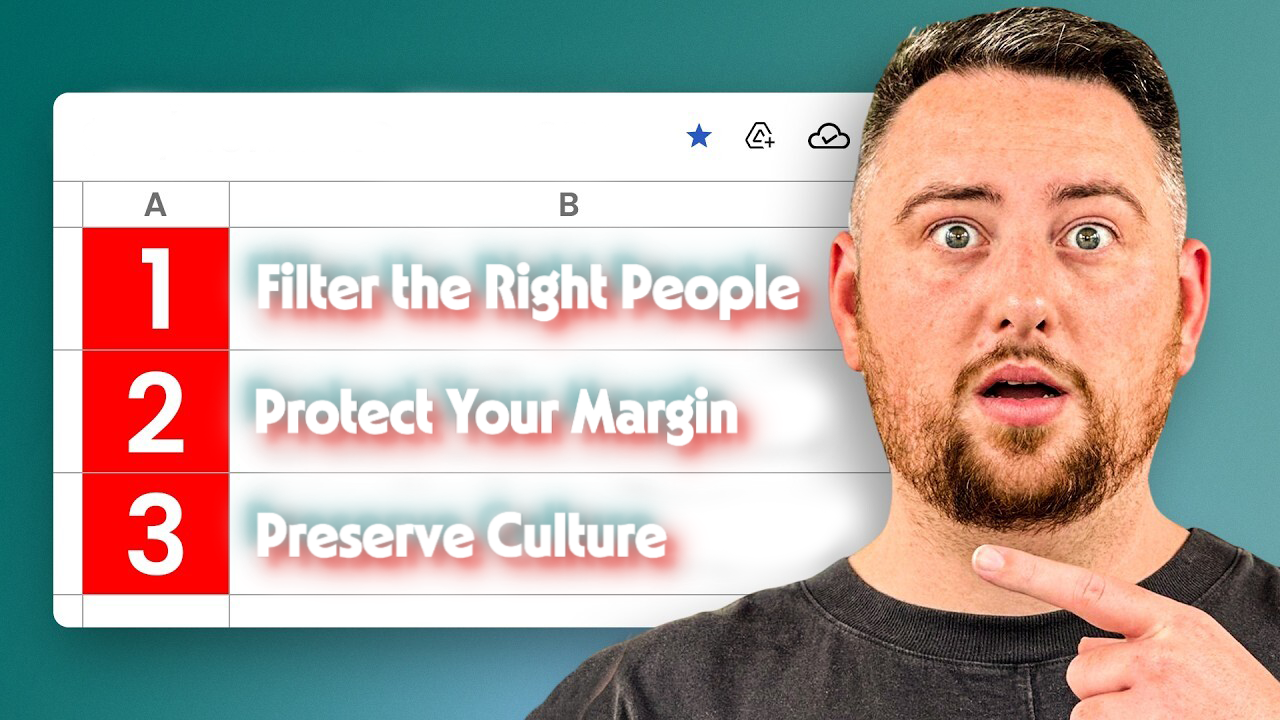
When I talk about a hiring screen, I’m talking about protecting two specific things. Margin and culture.
Margin means profitability. Every hire should produce more value than they cost. That sounds obvious, but most businesses don’t actually screen for this. They screen for credentials and experience, which don’t tell you anything about whether someone will be efficient, resourceful, or output-driven.
A margin-protecting hire is someone who gets things done fast, doesn’t need constant hand-holding, finds ways to do more with less, and actually moves the business forward. They make you money, not cost you money.
Culture means the way your team operates. Your values, your standards, your communication style, your work ethic. A bad culture fit doesn’t just underperform. They actively damage the team. They create drama, they lower standards, they make other people less productive.
A culture-protecting hire is someone who aligns with how you operate, raises the bar for everyone else, and makes the team stronger just by being there.
If your hiring screen doesn’t filter for both of these, you’re going to keep making expensive mistakes.
Here’s where most people go wrong. They ask hypothetical questions.
“What would you do if a project was behind schedule?”
“How would you handle a difficult client?”
These questions are useless because people just tell you what you want to hear. They’re performing. You learn nothing.
Instead, the framework I use involves behavioral questions that force candidates to talk about actual past experiences. Not what they would do, but what they did do.
For margin protection, ask questions like: “Tell me about a time you had to deliver results with limited resources. What did you do and what was the outcome?”
This tells you if they’re resourceful or if they just complain when things aren’t perfect. You want people who figure it out, not people who need everything handed to them.
Another one: “Walk me through a project where you had to move fast. How did you prioritize and what did you cut?”
This shows you if they understand speed versus perfection, if they can make trade-offs, and if they actually ship things or just talk about shipping things.
For culture, ask: “Tell me about a time you disagreed with your manager or team about how to approach something. How did you handle it?”
This reveals how they deal with conflict, whether they’re passive-aggressive, whether they can disagree professionally, and whether they respect authority or undermine it.
You want specific examples with details. If someone gives you vague answers, push them. “What specifically did you do? What was the result? How did the other person react?”
Vague answers mean they’re making it up or they don’t actually have the experience.
Gut feeling hiring is how you end up with expensive mistakes.
You need a scoring system that removes bias and forces you to evaluate candidates consistently. This isn’t about being robotic. It’s about making sure you’re actually measuring what matters instead of just hiring people you like.
Here’s the framework I use. Weight your criteria at roughly 40% skills, 30% culture, 30% margin mindset.
For skills, define exactly what the person needs to be able to do. Not credentials, not years of experience. Actual capabilities. Then score each answer on a 1-5 scale based on the evidence they provide.
Did they actually do the thing? Did they do it well? Can they explain their process clearly?
For culture, map their answers against your actual company values. If one of your values is ownership, did their examples show ownership or did they blame others and make excuses? If you value direct communication, were they clear and straightforward or did they dance around questions?
For margin mindset, look for efficiency, resourcefulness, speed, and results orientation. Did they talk about optimizing processes? Did they mention finding ways to do more with less? Did they focus on outcomes or just activities?
Score every candidate the same way. Have at least two people interview and score independently, then compare. If there’s a big gap in scores, that’s a red flag. Dig deeper.
Don’t advance anyone who doesn’t hit your threshold in all three categories. A high performer who’s a culture disaster will cost you more than an empty seat.
There are specific patterns that tell you someone’s going to be a margin drain.
Job hopping with no clear progression. They’re either running from problems or they can’t stick with anything long enough to create value.
Talking more about what they learned than what they delivered. Learning is fine, but you’re hiring them to produce, not to get an education on your dime.
Needing “the right tools” or “the right team” before they can perform. High performers figure it out with what they have. Margin killers make excuses.
Focusing on hours worked instead of outcomes. You don’t care how long something took, you care if it got done and if it worked.
Blaming others in every story. If every past failure was someone else’s fault, they’re going to bring that same victim mentality to your team.
Asking about work-life balance before asking about the actual work. This isn’t about grinding people into dust, but if their first concern is how little they have to work, they’re not going to be a high performer.
Any of these show up in the screen, you pass. Doesn’t matter how good the resume looks.
Culture fit is one of those things everyone talks about but nobody actually measures.
Here’s how I approach it. Before you even start interviewing, write down your actual culture. Not the aspirational version, the real version. How do decisions get made? How do people communicate? What behaviors get rewarded? What gets someone fired?
Then in the interview, test for alignment with specific scenarios.
If your culture is fast-paced and execution-focused, ask: “Tell me about the fastest you’ve ever moved on a project from idea to launch. What was the timeline and how did you do it?”
Someone who talks about a 6-month planning process isn’t going to fit in a move-fast environment.
If your culture values direct feedback, ask: “Tell me about a time you had to give critical feedback to a peer. How did you approach it and what happened?”
If they’ve never given direct feedback or they talk about “trying to be nice about it,” they’re going to struggle in a culture where people say what they mean.
One exercise that works well. Have candidates map their values against yours. Give them your list of 5-6 core values and ask them to rank how much they align with each one and give examples. Mismatches become obvious fast.
The goal isn’t to hire clones. It’s to hire people who can operate in your environment without constant friction.
Interviews only tell you so much. You want to see someone actually work.
A trial task is a short, paid project that mimics real work they’d be doing in the role. This protects your margin by showing you their actual output quality and speed before you commit.
Make it relevant, make it realistic, and make it paid. Don’t ask for free work. That’s how you lose good candidates and only attract desperate ones. Harvard Business Review research on hiring practices supports the use of work sample tests as one of the most predictive hiring methods available.
For a marketing role, it might be: “Here’s our product and target market. Create a 3-email sequence and explain your strategy. You have 3 days.”
For an operations role: “Here’s a process that’s broken. Audit it and give us a plan to fix it with specific steps and timeline.”
For a sales role: “Here’s our pitch deck. Record yourself doing a 5-minute demo and send us your approach to handling these three objections.”
You’re looking for quality of thinking, speed of execution, and how they communicate their work. Do they ask good questions upfront? Do they deliver on time? Is the work actually good or just okay?
This also shows you their margin mindset. Did they overengineer it or did they focus on what matters? Did they deliver exactly what you asked for or did they add strategic thinking?
Bad hires will either ghost the trial task, deliver something mediocre, or take twice as long as they should. Good hires will impress you and make the decision easy.
Here’s where a lot of companies mess up. They let consensus hiring turn into “everyone has to love the person.”
That’s how you end up hiring pleasant people who can’t do the work.
Instead, use a veto system. Everyone who interviewed scores the candidate. If anyone gives a strong no on culture or margin protection, you don’t hire. Period.
One person seeing a red flag is enough. They’re probably seeing something real, and the cost of a bad hire is too high to ignore it.
But you don’t need everyone to be excited. You need everyone to be at least neutral on culture and skills, and you need at least one person to be strongly positive on output potential.
After all interviews and scoring, do a 15-minute team debrief. Not a debate, just a calibration. “Here’s what I saw. Here’s my score. Here’s my concern.”
If there’s disagreement, go back to the evidence. What did they actually say? What did their trial task show? Don’t argue feelings, argue facts.
And if you’re on the fence, the answer is no. Desperation hiring is how you kill your business.
Your hiring screen should get better over time.
After someone’s been with you for 90 days, go back and look at their interview scores. Did high scores predict high performance? Did the red flags you ignored turn into real problems?
Track metrics like time to productivity, 90-day retention, manager satisfaction, and output quality in first quarter.
If you’re seeing patterns, like everyone from a certain background underperforms, or everyone who scored high on a specific question turns out great, adjust your screen.
This isn’t set it and forget it. Markets change, your business changes, what you need from hires changes. Your screen should evolve with it.
In my experience, businesses that refine their hiring screen regularly based on actual data avoid repeating the same expensive mistakes. The ones that don’t just keep cycling through bad hires.
Let me give you a real example of how this works in practice.
One business I know was scaling and kept hiring people who looked great on paper but couldn’t execute. They were burning resources on salaries for people who weren’t producing.
They rebuilt their screen around three behavioral questions focused on speed, resourcefulness, and past results. They added a paid trial task. They implemented scoring with a veto system.
The first round of hires after the new screen showed noticeable differences. People hit productivity faster, required less onboarding support, and fit the culture. No drama, no surprises, no expensive mistakes.
That’s not luck. That’s a system that filters for what actually matters before you waste time and money.
Another operator runs a remote team and was struggling with people who couldn’t self-manage. They added a question specifically about working independently and a trial task that required zero hand-holding.
The people who needed constant direction either didn’t finish the task or produced weak work. The people who thrived became solid hires. The screen did exactly what it was supposed to do. Protect the margin by filtering out people who would’ve been expensive babysitting projects.
Research from LinkedIn’s Global Talent Trends consistently shows that structured hiring processes correlate with better hiring outcomes across industries.
Here’s what you need to do to build this:
Write down your actual culture and values, not the version you wish you had.
Define the margin-protecting behaviors you need. Efficiency, speed, resourcefulness, whatever matters in your business.
Create 5-7 behavioral questions that test for skills, culture, and margin mindset.
Build a scoring rubric with clear criteria for 1-5 ratings on each question.
Design a paid trial task that mimics real work and shows you actual output.
Set your threshold scores. What’s the minimum to advance, what’s an auto-pass.
Train your team on how to interview consistently and score fairly.
Implement a veto system where one strong no stops the hire.
Track 90-day performance against interview scores and refine quarterly.
This isn’t complicated, but it does require you to actually do it instead of just winging interviews like most businesses do.
Let me be clear about what’s at stake here.
Every bad hire costs you significantly when you factor in recruiting, onboarding, lost productivity, and team disruption.
But it’s worse than that. A bad culture fit doesn’t just cost you their salary. They make everyone around them worse. They lower standards, they create drama, they make good people quit.
I’ve seen businesses lose their best performers because they hired someone toxic and didn’t deal with it fast enough. That’s not just one bad hire. That’s a compounding problem when you factor in the value of the person who left.
And on the flip side, a great hire doesn’t just do their job. They multiply the output of everyone around them. They raise standards, they move fast, they make the business better.
The difference between a hiring screen that works and one that doesn’t is literally the difference between a profitable, scalable business and one that’s constantly putting out fires and bleeding cash.
You can’t afford to not have this dialed in.
Your hiring screen is one of the highest-leverage systems in your entire business. It determines who you work with, how fast you can scale, and whether you’re profitable or not.
Build it right, and every hire makes your business stronger and more valuable. Build it wrong or don’t build it at all, and you’ll keep making the same expensive mistakes.
The choice is yours.
For operators who want to go deeper on building systems like this, the Inner Circle is where we work through hiring, operations, and scaling frameworks in detail.
Results are not typical. Your results will vary and depend entirely on your individual capacity, business experience, expertise, and level of desire. There are no guarantees concerning the level of success you may experience. The testimonials and examples used are not intended to represent or guarantee that anyone will achieve the same or similar results. We don’t believe in get-rich-quick programs. We believe in hard work, adding value and serving others. As stated by law, we can not and do not make any guarantees about your own ability to get results or earn any money with our information, courses, programs, or strategies.

Jeremy Haynes is the founder of Megalodon Marketing. He is considered one of the top digital marketers and has the results to back it up. Jeremy has consistently demonstrated his expertise whether it be through his content advertising “propaganda” strategies that are originated by him, as well as his funnel and direct response marketing strategies. He’s trusted by the biggest names in the industries his agency works in and by over 4,000+ paid students that learn how to become better digital marketers and agency owners through his education products.

Jeremy Haynes is the founder of Megalodon Marketing. He is considered one of the top digital marketers and has the results to back it up. Jeremy has consistently demonstrated his expertise whether it be through his content advertising “propaganda” strategies that are originated by him, as well as his funnel and direct response marketing strategies. He’s trusted by the biggest names in the industries his agency works in and by over 4,000+ paid students that learn how to become better digital marketers and agency owners through his education products.



This site is not a part of the Facebook website or Facebook Inc.
This site is NOT /endorsed by Facebook in any way. FACEBOOK is a trademark of FACEBOOK, Inc.
We don’t believe in get-rich-quick programs or short cuts. We believe in hard work, adding value and serving others. And that’s what our programs and information we share are designed to help you do. As stated by law, we can not and do not make any guarantees about your own ability to get results or earn any money with our ideas, information, programs or strategies. We don’t know you and, besides, your results in life are up to you. Agreed? We’re here to help by giving you our greatest strategies to move you forward, faster. However, nothing on this page or any of our websites or emails is a promise or guarantee of future earnings. Any financial numbers referenced here, or on any of our sites or emails, are simply estimates or projections or past results, and should not be considered exact, actual or as a promise of potential earnings – all numbers are illustrative only.
Results may vary and testimonials are not claimed to represent typical results. All testimonials are real. These results are meant as a showcase of what the best, most motivated and driven clients have done and should not be taken as average or typical results.
You should perform your own due diligence and use your own best judgment prior to making any investment decision pertaining to your business. By virtue of visiting this site or interacting with any portion of this site, you agree that you’re fully responsible for the investments you make and any outcomes that may result.
Do you have questions? Please email [email protected]
Call or Text (305) 704-0094