I hope you enjoy reading this blog post. If you want my team to just do your marketing for you, click here.


I hope you enjoy reading this blog post. If you want my team to just do your marketing for you, click here.
Author: Jeremy Haynes | founder of Megalodon Marketing.
Earnings Disclaimer: You have a .1% probability of hitting million-dollar months according to the US Bureau of Labor Statistics. As stated by law, we can not and do not make any guarantees about your own ability to get results or earn any money with our ideas, information, programs, or strategies. We don’t know you, and besides, your results in life are up to you. We’re here to help by giving you our greatest strategies to move you forward, faster. However, nothing on this page or any of our websites or emails is a promise or guarantee of future earnings. Any financial numbers referenced here, or on any of our sites or emails, are simply estimates or projections or past results, and should not be considered exact, actual, or as a promise of potential earnings – all numbers are illustrative only.
Look, if your revenue has stalled, there’s usually one core issue at play — and it’s not what most people think.
It’s not that you need a better funnel. It’s not that you need more traffic. It’s not even that you need a better offer.
The real issue? In my experience, revenue plateaus happen because you’re trying to operate a business that was built for a different stage.
Most businesses that plateau around the six-figure mark or low seven figures are stuck because they’re operating with systems designed for where they were, not where they’re trying to go. The infrastructure that works at one level doesn’t automatically support the next level. The math changes. The operational requirements change.
And the longer you try to force it, the more you’re going to spin your wheels.
If you’re looking for frameworks on how to approach stalled revenue, the 7-week live comprehensive training covers the operational systems discussed in this article.
Results are not typical. Your results will vary and depend entirely on your individual capacity, business experience, expertise, and level of desire. There are no guarantees concerning the level of success you may experience. The testimonials and examples used are not intended to represent or guarantee that anyone will achieve the same or similar results. We don’t believe in get-rich-quick programs. We believe in hard work, adding value and serving others. As stated by law, we can not and do not make any guarantees about your own ability to get results or earn any money with our information, courses, programs, or strategies.
Here’s what I’ve seen working with businesses across different industries. Revenue stalls happen when there’s a mismatch between your current business model and the operational requirements of the next stage.
You built something that worked at a certain scale. Maybe you were doing one-on-one work, maybe you had a small offer suite, maybe you were relying heavily on referrals or word of mouth. That got you to a certain point.
But now you’re trying to grow, and the same tactics aren’t producing the same results. You’re working harder, putting in more hours, maybe even spending more on ads or hiring more people. But the revenue isn’t moving.
That’s because you’re trying to apply more inputs to a system that wasn’t designed for that volume. You’re adding more effort to a model that’s already at capacity. And no amount of effort is going to change that until you rebuild the foundation.
According to Harvard Business Review research on scaling businesses, organizational structure and culture become critical bottlenecks as companies grow, often requiring fundamental changes rather than incremental improvements.
Most people think scaling is about doing more of what’s working. And in some cases, that’s true. But more often than not, scaling requires doing something completely different.
The infrastructure that supports a smaller business is fundamentally different from what supports a larger one. The offer structure is different. The delivery model is different. The way you acquire customers is different.
If you’re still operating like a smaller business while trying to hit bigger numbers, you’re going to stay stuck. Because the systems you have in place can’t support the growth you’re trying to create.
This is where most people get frustrated. They’re putting in the work. They’re showing up. They’re executing. But the business isn’t responding the way they think it should. And that’s because the problem isn’t effort. It’s infrastructure.
McKinsey’s research on organizational redesign shows that companies attempting to scale without restructuring their operational foundations often experience stagnation, regardless of how much additional effort or capital they apply.
One of the biggest reasons revenue stalls is because your offer structure doesn’t support the growth you’re trying to create. You’re either selling something that’s too labor-intensive to scale, or you’re selling something that doesn’t command enough margin to make the economics work.
If you’re doing one-on-one work, there’s a natural ceiling. You can only serve so many people. You can raise your prices, sure, but eventually you hit a point where the market won’t support higher pricing, or you don’t want to work more hours.
If you’re selling low-ticket offers, you need massive volume to hit big revenue numbers. And massive volume requires a level of infrastructure, marketing spend, and operational capacity that most businesses don’t have.
The businesses that approach scaling effectively have offer structures that are designed for operational leverage. That means higher-ticket offers with better margins, or productized services that allow you to deliver at scale without trading time for money.
In my experience, businesses that work through revenue plateaus do so by restructuring their offers to align with where they’re trying to go, not where they’ve been.
Here’s something most people get wrong. When revenue stalls, the instinct is to go find more customers. More traffic, more leads, more volume.
But that’s usually the wrong move. Because if your offer structure and infrastructure aren’t set up to support growth, adding more volume just creates more chaos.
What you actually need is better buyers — buyers who are willing to pay more, who are easier to serve, who get better results, and who refer other high-quality buyers.
This is a mindset shift that most people resist because it feels like you’re limiting your market. But the reality is, when you focus on attracting better buyers, your business becomes more manageable and much easier to run.
Better buyers also mean you can invest more in acquisition. If your average customer value is low, you can’t spend much to acquire them. But if your average customer value is higher, you can spend more on acquisition and still have healthy margins.
The businesses I’ve worked with that have grown past seven figures did so by focusing on attracting and serving a smaller, higher-quality segment of the market — not by trying to serve everyone.
Bain & Company’s research on customer economics demonstrates that acquiring higher-value customers, rather than simply more customers, is often the more sustainable path for service businesses.
This one’s uncomfortable, but it’s true. If your revenue has stalled, you’re probably the bottleneck.
Not because you’re not working hard enough. Not because you’re not smart enough. But because you’re still operating like you did when the business was smaller.
You’re still the one making every decision. You’re still the one delivering the core service. You’re still the one managing every client relationship. And as long as that’s the case, the business can’t grow beyond your personal capacity.
Scaling requires letting go. It requires building systems that don’t depend on you. It requires hiring people who can execute at a high level without your direct involvement.
And for most business owners, that’s the hardest part. Because the thing that got you to where you are is your ability to execute. You’re good at what you do. You’re the best person to deliver the service. You’re the one clients want to work with.
But if you want to scale, you have to transition from being the person who does the work to being the person who builds the systems that allow other people to do the work.
Here’s the thing about stalled revenue. It’s not a motivation problem. It’s a systems problem.
You can be the most motivated, hardest-working entrepreneur in the world, but if your systems aren’t set up to support growth, you’re going to stay stuck.
Systems are what allow you to operate without working more hours. Systems are what allow you to deliver consistent results without being personally involved in every client interaction. Systems are what allow you to bring on new team members and get them productive quickly.
The businesses that approach scaling effectively have documented processes for everything: how leads come in, how sales conversations happen, how clients are onboarded, how the service is delivered, and how results are tracked and reported.
When you have systems in place, growth becomes more predictable. You know exactly what inputs are required to produce specific outputs. You can identify bottlenecks quickly. You can optimize and improve without starting from scratch every time.
Most businesses don’t have this. They’re running on tribal knowledge and personal execution. And that works fine at a certain scale. But it doesn’t work when you’re trying to grow.
Gartner’s research on operational efficiency shows that documented, repeatable processes are foundational to scaling any service-based business, regardless of industry.
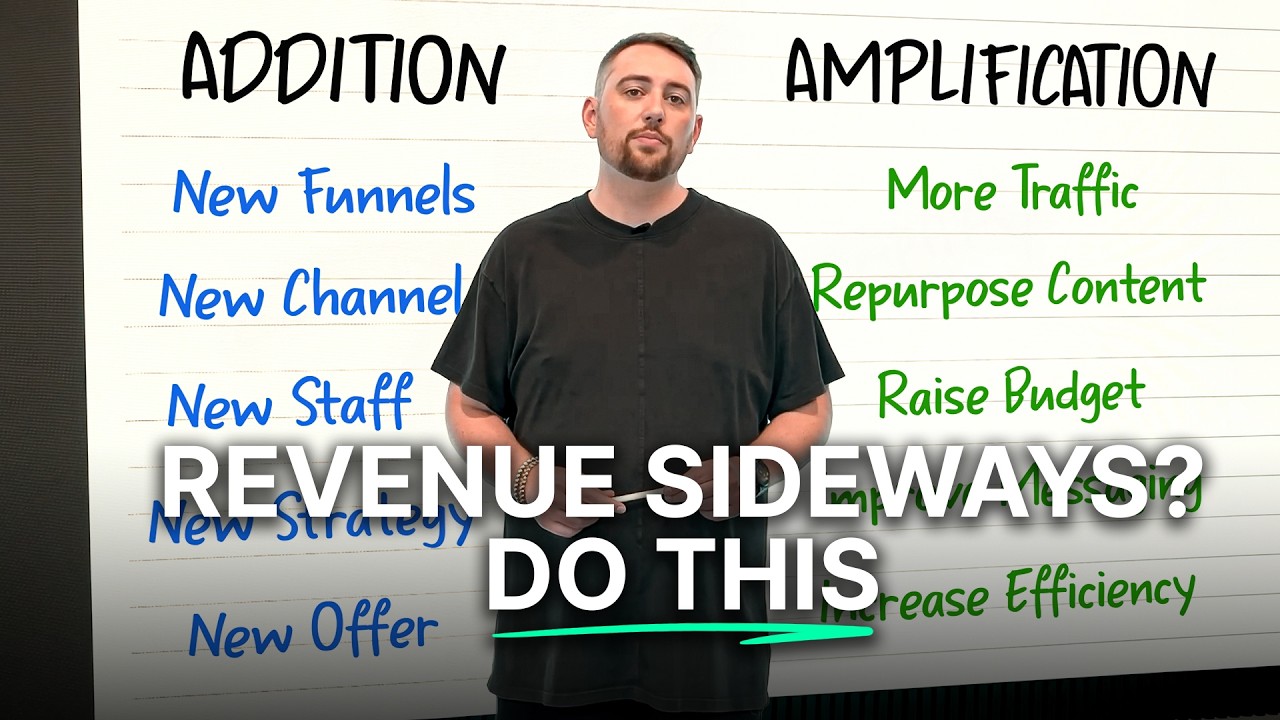
If your revenue has stalled, here’s what I’ve found actually moves the needle. It’s not another marketing tactic. It’s not another funnel. It’s not another hire.
It’s stepping back and rebuilding your business for the next level. That means looking at your offer structure and making sure it’s designed for operational leverage. It means looking at your infrastructure and making sure it can support the growth you’re trying to create. It means looking at your role in the business and making sure you’re not the bottleneck.
This is the work that most people avoid because it’s not sexy. It’s not exciting. It doesn’t feel like progress in the moment. But it’s the work that actually creates sustainable, scalable operations.
The businesses I’ve worked with that have worked through revenue plateaus did so by doing this foundational work. They restructured their offers. They built better systems. They hired strategically. They focused on attracting better buyers instead of more buyers.
And the result was that revenue started moving again. Not because they were working harder. Not because they found some secret tactic. But because they built a business that was designed to operate at a higher level.
If you’re reading this and your revenue has stalled, here’s what I’d recommend. Start by auditing your current business model. Look at your offer structure. Look at your infrastructure. Look at your role in the business.
Identify where the bottlenecks are. Identify what’s preventing you from scaling. Identify what needs to change for you to get to the next level.
Then make a plan to fix those things. Not all at once. Not overnight. But systematically, over time.
This is the work that separates businesses that stay stuck from businesses that work through plateaus. It’s not glamorous. It’s not easy. But it’s what the process looks like.
And if you want help with this, that’s exactly what we cover in the 7-week live comprehensive training. We work with established businesses that are ready to rebuild their infrastructure, restructure their offers, and create the systems that support sustainable operations.
Results are not typical. Your results will vary and depend entirely on your individual capacity, business experience, expertise, and level of desire. There are no guarantees concerning the level of success you may experience. The testimonials and examples used are not intended to represent or guarantee that anyone will achieve the same or similar results. We don’t believe in get-rich-quick programs. We believe in hard work, adding value and serving others. As stated by law, we can not and do not make any guarantees about your own ability to get results or earn any money with our information, courses, programs, or strategies.
The program is designed specifically for operators who are past the beginner stage and ready to build a business that operates at a higher level. It’s not about tactics. It’s about strategy, systems, and execution.
If that sounds like where you’re at, reach out. Let’s talk about what’s actually holding your business back and what it would take to address it.
Because the reality is, if your revenue has stalled, it’s not going to fix itself. You need to make a change. And the sooner you do, the sooner you’ll start seeing movement again.
Watch the video:

Jeremy Haynes is the founder of Megalodon Marketing. He is considered one of the top digital marketers and has the results to back it up. Jeremy has consistently demonstrated his expertise whether it be through his content advertising “propaganda” strategies that are originated by him, as well as his funnel and direct response marketing strategies. He’s trusted by the biggest names in the industries his agency works in and by over 4,000+ paid students that learn how to become better digital marketers and agency owners through his education products.

Jeremy Haynes is the founder of Megalodon Marketing. He is considered one of the top digital marketers and has the results to back it up. Jeremy has consistently demonstrated his expertise whether it be through his content advertising “propaganda” strategies that are originated by him, as well as his funnel and direct response marketing strategies. He’s trusted by the biggest names in the industries his agency works in and by over 4,000+ paid students that learn how to become better digital marketers and agency owners through his education products.



This site is not a part of the Facebook website or Facebook Inc.
This site is NOT /endorsed by Facebook in any way. FACEBOOK is a trademark of FACEBOOK, Inc.
We don’t believe in get-rich-quick programs or short cuts. We believe in hard work, adding value and serving others. And that’s what our programs and information we share are designed to help you do. As stated by law, we can not and do not make any guarantees about your own ability to get results or earn any money with our ideas, information, programs or strategies. We don’t know you and, besides, your results in life are up to you. Agreed? We’re here to help by giving you our greatest strategies to move you forward, faster. However, nothing on this page or any of our websites or emails is a promise or guarantee of future earnings. Any financial numbers referenced here, or on any of our sites or emails, are simply estimates or projections or past results, and should not be considered exact, actual or as a promise of potential earnings – all numbers are illustrative only.
Results may vary and testimonials are not claimed to represent typical results. All testimonials are real. These results are meant as a showcase of what the best, most motivated and driven clients have done and should not be taken as average or typical results.
You should perform your own due diligence and use your own best judgment prior to making any investment decision pertaining to your business. By virtue of visiting this site or interacting with any portion of this site, you agree that you’re fully responsible for the investments you make and any outcomes that may result.
Do you have questions? Please email [email protected]
Call or Text (305) 704-0094