I hope you enjoy reading this blog post. If you want my team to just do your marketing for you, click here.


I hope you enjoy reading this blog post. If you want my team to just do your marketing for you, click here.
Author: Jeremy Haynes | founder of Megalodon Marketing.
Earnings Disclaimer: You have a .1% probability of hitting million-dollar months according to the US Bureau of Labor Statistics. As stated by law, we can not and do not make any guarantees about your own ability to get results or earn any money with our ideas, information, programs, or strategies. We don’t know you, and besides, your results in life are up to you. We’re here to help by giving you our greatest strategies to move you forward, faster. However, nothing on this page or any of our websites or emails is a promise or guarantee of future earnings. Any financial numbers referenced here, or on any of our sites or emails, are simply estimates or projections or past results, and should not be considered exact, actual, or as a promise of potential earnings – all numbers are illustrative only.
You know, when you’re spending tens of thousands of dollars a day or even just thousands of dollars a day, you’d assume that you would know what you’re doing. But obviously, you don’t. And that’s why you’re here reading this blog.
Sure, you got some of it figured out, but you got a whole lot more to go to actually have it figured out in order to reduce the volatility of those performance swings.
If you are oblivious of what to do when you have a heightened cost per result, when you experience a large swath of qualified people followed by an absolute barrage of unqualified people and broke individuals that are just absolutely wasting your time.
If you deal with that level of inconsistency and the swings are wide, this blog is going to be perfect for you.
Even if you’re just looking to touch up your skill set and reinforce that you know the right things that you think you need to know. Again, this blog is going to be phenomenal for you.
My name is Jeremy Haynes. All we talk about is hitting million dollar months around here. Whether you’re looking to tack on the next million a month or you’re looking for your first million dollars a month, I’m your guy.
I don’t make any income claims. I’m not sitting here saying you’re going to read this blog or any content for that matter and hit million dollar months.
What we do around here is take all the top lessons from all the different businesses that we’ve worked with over the years that we’ve been there, done that with, and we hand them down to you right here.
So welcome in if you are new, and if you’re already following along, welcome back. It’s an absolute pleasure to have you per usual. I’ve got another banger for you here today.
If your business is already generating $100k+ per month, My Inner Circle is where you break through to the next level. Inside, I’ll help you identify and solve the bottlenecks holding you back so you can scale faster and with more clarity.
So without further ado, let’s dive in.
First of all, you have to understand machine learning if you are going to advertise on Facebook or any ad channel for that matter. Industry research shows that 82% of successful Facebook advertisers now rely on AI and machine learning automation, with those who understand the algorithm achieving up to 27% higher return on ad spend compared to traditional manual optimization.
I was at Facebook’s headquarters in 2019 at Menlo Park, the main headquarters. First of all, let me just take a side note and say the campus is designed by the founder, I should say the designer of Disney.
So the people who designed Disneyland and Disney World, that’s the person who designs Facebook’s campus. It’s a metropolis. It’s got a giant arcade. It’s got a ton of free food.
If you ever get the opportunity to go, go to the barbecue place. It’s phenomenal.
And one of the things that I learned while I was there, believe it or not, out of all places, taking a break in Facebook’s bathroom, just a random bathroom in the engineering department, which is pretty much every department there.
I go in, I can’t remember which one of the buildings I’m in. All the buildings are labeled with certain numbers.
So anyway, I’m in there and right in front of me, boom, just right there, there’s a piece of paper. And I thought this was super interesting, by the way. Not to sound like a weirdo, but the value on this piece of paper was so extreme.
I had then learned that in every stall and every other location, there was also a completely different piece of paper with another set of lessons on it. And you best believe I read those too.
But anyway, on this particular one that was right in front of me, it talked about how machine learning and their advertising algorithm coincide with one another.
And it just showed me this graph. This is what was interesting about this whole thing. So it showed this graph. And the graph was really simple. It looked like this. That’s what I saw.
And as I’m sitting there and I’m looking at it, I’m at first obviously pretty surprised. I’m like, what is this? And there was all this text written on the side here and written underneath it.
And I’m sitting there and I’m reading that text and I’m understanding something that I’ve never learned before right from Facebook’s headquarters in one of their building bathrooms.
And it talked about this concept of how every single campaign, every single ad account, technically every single ad set and ad are all like independent machine learning models that play into this larger account machine learning model.
And more importantly than anything else, it talked about the emphasis of campaign machine learning. And it talked about account simplification in conjunction with that lesson.
And at the time when you spend more than a million dollars a month on a specific account or accumulatively as an agency within a specific niche, you get the opportunity to have an actually valuable rep.
They have the regular rep down here. That’s like the ones that you get assigned to you that you know they’ll typically rotate every quarter. They have hundreds of clients. They’re very unhelpful in most instances.
Shout out to the few of you that might be reading this that actually are helpful though.
Then above that, you have this thing called an industry ad expert. This is what you get assigned in this example that you spend the big million a month for more than six months in a row with one account or with a handful of accounts that are all within the same niche.
Then above that, you have this thing called global partners. And global partners, I don’t think I’ll ever touch that. Who knows though? We’ll see.
Global partners are for like Pepsi, large corporate accounts. They do different advertising than us.
Anyway, the regular reps, again, most of the time nothing really valuable. However, the industry ad experts, I had one in particular at this specific time in 2019, and boy oh boy was it super helpful.
Obviously right after I leave the bathroom, I rush over to him and I say, his name was Corey. I go, “Corey, do you mind coming in here real quick? Do you mind coming into the bathroom?”
And obviously he was super concerned like what are you talking about?
And I go, “Dude, I got to show you something. This feels mindblowing to me.”
He’s obviously super concerned, but then I referenced I was so excited. I was like, “Dude, no, no, no. I’m talking about this thing you know, you’ve been here before.”
And he was from the Chicago office and they flew him into the Menlo Park. So I didn’t know if he’d actually seen this stuff or if they had it where he was located.
And I was like, Corey, they have this thing above the location that I was just reading and I just want to show it to you real quick.
So he kind of apprehensively goes into the bathroom with me and I go, “Look.” And I point at the piece of paper here and dude, he literally pulls it out of the little paper holder things and he pulls it out.
We leave the bathroom to observe it more. Good idea on his part. I guess I could have done the same thing, but I didn’t want to feel like I was stealing.
So anyway, Corey starts to read it and then he looks at me kind of like, you didn’t know this?
And I was like, didn’t know this. I was like, bro, not a person I know knows this. I know I think every high level advertiser that there is to know that’s willing to be known.
And I’ve never heard anybody talk like this about a campaign. I’ve never heard the word machine learning paired with campaign before, let alone in any way, shape, or form implied to how it implicates an ad account performance.
And he’s like, “Oh, dude, easy. Let’s go talk about it.”
So we go into this conference room and we sit down and we have the paper there and he starts breaking down this super it’s one of the most referenced foundational lessons.
And good on you for being here right now consuming such a lesson because it took a lot for me to see this piece of paper.
Anyway, he breaks down for me. He goes, “Yeah, so every campaign is a machine learning model.”
And the way that in the simplest way I can articulate it to you, Jeremy, like the way that machine learning works inside of our campaigns is, and let’s go back to just a clean area here that we can draw.
He goes, it’s every machine learning model is just a graph. Treat it like a line graph.
And during the initial performance of a campaign, this little window here, it’s like the whole goal of the campaign is just to go up and to the right. That’s it. It’s just to go up and to the right.
And I was like, “What does that mean, Corey?”
And he goes, “Yeah, pretty simple.” So he goes, “If this represents time and this represents result,” he goes, “Yeah, all our goal is is to just as time goes on continue to get more results.”
He goes, “But in order to get more results, we need more results to come in to reinforce who to go after next.”
And simply put, every time that you kind of move out a little bit, the machine learning model kind of loses a bit of its ability to perform because there’s lower and lower probabilities of people to convert as time goes on.
The only thing that really keeps it going up and to the right is a bunch of additional data coming into it consistently at a relatively similar rate in order to perpetuate the campaign going up into the right.
And I was like, “Okay, so that sounds pretty simple. I mean, I feel like everybody’s known that lesson, right? Like the more data you get into a campaign, the better the campaign continues to perform.”
And he goes, “Yes, yes, but,” he goes, “it’s not just about that.” He goes, “It’s much bigger than that.”
He goes, “Have you ever had a campaign that’s ran for years?”
And I go, “Yeah, it feels like few and far between nowadays, but yeah, absolutely.”
And he goes, “How does that work?” Right? He goes, “Do you duplicate the ad sets however many times you duplicate them and just make minor changes to the ads or the ad set every time you duplicate it?”
And I go, “Yeah, I mean, if I do it that way, yeah, sometimes.”
And he goes, “That’s a great example of how to continue to feed the campaign more data, more results.”
He goes, “The only thing that kind of lowers the probability of that campaign’s performance through time is all of that historical baggage.”
He goes, “The complications that you add to the account or you add to that campaign in particular can be what lowers the probability for it to go up into the right.”
He goes, “There’s all kinds of things that can lower the probability of the campaign going up into the right.”
And I was like, “Okay, like what else?”
I don’t know. I feel like this piece of paper was so profound to me with how it was articulated. And I feel like he started introducing pretty basic ad rep lessons to me at first, but then we got into the real sauce.
He just starts listing off all these things. And I’m not going to list off all of them to you here. Obviously, I withhold a lot of that information for the people who actually pay me.
You can check out the information available for my inner circle program or my master internet marketing program where I happily go through stuff like this and I obviously answer all my students questions and I go through this exact story in depth in one of my master internet marketing classes.
Anyway, I digress. I will give you a few of the pointers though that he provided to me that way you can walk away from this blog ideally getting richer too.
So anyway, he starts listing off a bunch of things. So he goes, “Yeah, there’s a bunch of things that make a campaign’s performance go up and to the right.”
And he goes, “But here’s the first thing you have to understand.” He goes, “The first thing you have to understand is it moves in waves?”
He goes, “So there’s wave one, wave two, wave three, wave four,” and he just listed like I think up to twelve waves.
And I go, “How long do you have between each wave and what’s the difference between each wave?”
And he goes, “So machine learning and probabilities, they go hand in hand.” He goes, “The tighter the wave is to the launch of the campaign.” He goes, “You’d think that that technically is when the campaign has its highest probability to perform best.”
He goes, “But in reality, in wave two through wave three and four, in some instances, that can be where you get the best performance because there’s more longevity in those waves as you get further out.”
He goes, “But every wave is kind of dynamic. It changes. Everything’s a little different relative to the audience sizes and the standard events you’re optimizing for and the hooks you use and how broad what it is that you’re talking about is relative to the audiences that you’re targeting and the consistency of data coming back into the account can dictate how long you’re in a specific wave versus another.”
He goes, “Don’t treat it like there’s just a static amount of people in each one of these waves is what he kept calling it.”
And when he was explaining it as waves, I had had this lesson I had always shared. I called it the bucket system.
And this is how I was always taught this concept, which was okay, like when you first launch a campaign, you have this bucket of people that you’re targeting. And call it bucket one.
And bucket one generally has the highest quality people. This is who the prediction machine predicts most is going to convert. These are the people that it deems most probable to actually go through your funnel and convert on whatever it is that you’re pushing the traffic to.
And anyway, long story short, just like he kind of described with the waves, there’s an unknown quantity of people that are within this bucket, but what we know for sure is when a campaign first launches, it’s going to hit this bucket more than any other bucket and try to milk it dry, assuming that it was right.
So the other interesting thing is there can be more than one bucket one. So treat it like this is bucket one point two and this is bucket one point three.
And simply put if your campaign isn’t getting data back to it in that results column then it’s going to switch to a different high prediction bucket that’s a different type of person completely.
So treat it like in this example I have bucket one, bucket one point two and bucket one point three. These are all high conviction predictions that the AI, this algorithm that’s behind the scenes of these ad platforms has made and said, “Okay, well, I’m going to double down at first on bucket number one, and if I guess successfully and I get data back into the results column, I’m going to keep going after more of that type of person.”
Now let’s use the example that it only gets like a handful of those types of people. It might dabble a little bit in bucket number one point two.
So instead of staying in bucket number one, it doesn’t necessarily know that it was totally right. So it switches a little bit and it goes into bucket one point two.
And again, what it’s waiting for is data to come back and hit the results column. People who you are targeting that it might be targeting nowadays with all this advantage audience stuff that’s happening and the lack of control that we get in broad targeting in general.
Anybody that converts on that standard event we’re optimizing the campaign for that comes back and hits that results column if they hit it in a high enough quantity and that’s what’s the variable here that’s what’s also important to understand that number is not a static number.
It’s not like those people out there who are like oh you need fifty conversions a week. People are airheads. You don’t need fifty conversions a week or a day or whatever it is.
Sure the more the merrier and the more that there are the more you’re likely to stay within that specific bucket but as soon as you run out of people in that bucket it moves anyway to wave two or in the way I articulate it bucket two and bucket three and bucket four.
So anyway, long story short, this is very important to understand. If you don’t get enough data back and enough data without exaggeration could be like five to ten people nowadays that hit that within a couple days or even a week, it’ll double down on that type of person.
So simply put, it kind of bounces around between these three buckets at first. And again, it’s not just a static three buckets. Without exaggeration, there could be upwards of like ten buckets.
And your budget also dictates how fast it moves between all these buckets and it dictates the quantity of people that you reach.
So as an example, if I have a campaign that can target let’s say ten million people and I launch it with a one hundred dollars a day budget, I might only reach like five thousand people before my frequency starts to go above a two.
That represents that I’m stuck in one of those buckets and it’s doubling down on that bucket.
And then here’s the thing that is kind of interesting. I could launch to the same ten million person audience. But if I launched with a ten thousand dollars a day budget, I might reach let’s say a million people before I actually start to see my frequency climb.
So budget is a huge part of this whole system that I’m articulating to. And this system matters a lot.
So anyway, long story short, when a campaign first launches and it’s in this first wave right here, all it’s really trying to do is predict successfully who’s probable to convert.
Once it sees conversions, it doubles down on that type of person. And it tries to stay within that vein of data points.
So there’s fifty two thousand data points on average per user on these platforms, specifically Facebook and Instagram. Research has documented that data brokers like Acxiom maintain information about 500 million active consumers worldwide with an average of 1,500 data points per person, which Facebook leverages through partnerships to enhance its targeting capabilities.
And again, people are just similar data points to this giant prediction machine.
So anybody that it predicts successfully, kind of like how a lookalike audience works, treat it like that. You’re familiar with that. And that’s how this works to a degree.
You’re going to see that once it successfully starts getting results back to that results column, it’s going to double down on that vein of person, which means people that are similar to that type of person that’s already converting in data point.
But it tries its absolute best for as long as it can to double down on that specific type of audience that’s coming back and hitting the results column until it runs out.
So once it runs out, that’s when it moves out of that first wave or in Corey’s words, out of the first wave. For me, it’s out of the first bucket.
So once you go out of the first bucket, you kind of spill over into the second set of buckets. And the logic applies very similarly.
So it’s like you have another handful of different types of people that technically from a data perspective are a little less similar, therefore a little less probable to convert.
That’s the main thing you got to understand. It’s like going from a one percent lookalike audience to a two percent lookalike audience.
Literally all you’re doing is you are no longer targeting people that have extremely similar data points to that original high quality predicted audience that was going to convert.
These are officially people who have a ton of similarities, a ton of very accurate and again similar data points, but they’re not as many of the exact same data points. And sometimes that’s good, sometimes that’s bad.
And it does the exact same thing here. So it’s like you got bucket two, bucket two point two, bucket two point three, and bucket two point four.
And treat these like there’s people who are in its best attempt similar to the first types of people that converted, but yet they’re a little different.
So let’s say that there’s people here that have data points A, data points B, data points C, and data points D.
And let’s use the example that all of these people have eighty percent of their data points similar to the first bucket of people.
However, it’s like bucket A, I’m just going to use a completely random metaphor here that tries to help you understand this in similar terms.
So it’s like in bucket A, let’s say these people like hot dogs. In bucket B, let’s say they like hamburgers. In bucket C, let’s say they like hot dogs, but only when they’re in macaroni. And in bucket D, let’s say that those people, they like wagyu burgers.
Technically, all those things can be grilled. And technically they’re all to a degree grill meats. But they can be cooked in different ways. Like you can boil hot dogs. Maybe that’s what the people who put it in macaroni did because they were already cooking macaroni on a stove.
You see what I’m saying? It’s like they’re different than one another.
One of my buddies, he loves hot dogs. And it’s shocking that he does, but he loves hot dogs. And it’s like I’m not a big hot dog guy. I prefer burgers. I love burgers.
But like again, my buddy who likes hot dogs, it’s not that we’re that different. We have a lot of similarities. We have a lot of characteristics and data points that are again pretty much the same.
But that one difference of him just loving hot dogs and me loving hamburgers comparatively, it’s like that’s a pretty wide difference in itself. You see what I’m saying?
So here’s the thing. Once you go from bucket number one down into bucket number two, which might start with the hot dog lover people, that might not be the type of person that you’re looking for.
So all of a sudden what you’re going to start to experience is a little bit of inconsistency. You’re all of a sudden going to be like, the quality of person coming through my funnel just changed like what happened, and you’re confused because you don’t understand the wave or the bucket system.
That’s what’s starting to occur.
But here’s how it works. You can withhold data. This is such an insane pro tip.
So as I’m sitting here with Corey and he’s articulating this to me, my industry ad expert, I’m having him explain the fact that like, okay, well, Corey, what happens if I start to get the wrong people that come through?
Technically, in the eyes of the ads, the ads manager, this giant AI ads thing, it thinks that I’m getting the right people because it’s still seeing people convert that are coming through to the results column.
And he goes, “Yes, yes, that’s exactly what it thinks.” And so it continues to double down on that type of person.
And I go, “Yeah, but what if it’s the wrong type of person? Like what if I’m doing lead gen as an example, and I know that they’re the wrong types of people, but it doesn’t know that they’re the wrong types of people. It thinks they’re the right types of people.”
He goes, “Oh, easy. Just intentionally withhold the data.”
What? I was like, “What? What do you mean?”
And at the time, this was, if I’m not mistaken, I’m pretty sure the conversion API was in an alpha test. I don’t even think it was a beta test at the time. Pretty sure it was an alpha test.
But when you spend that amount of money and you get an industry ad expert, you get all kinds of cool stuff that the general public of advertisers do not get and don’t even know about. Most of which you’re under NDA for.
So thankfully, that’s a rolled out feature and we could talk about it obviously because you can run it today yourself.
The conversion API changed the game.
Let me give you a great example of this. If you are using web based pixel events to fire off when somebody let’s say filled out an application and booked a call, you could do that all day long as long as they’re the right types of people.
But as soon as they’re the wrong types of people, pull off the standard event code from the confirmation page and run the conversion API and only fire off when somebody converts and belongs in that results column.
If they, as an example, showed up for a call with your salespeople and the sales people manually marked them as qualified.
I’m giving you an insane level of game right now for free. Imagine what I give you when you pay me money. I assure you it’s way better. Check out the information available. I’ll put you on crazy level of game. I promise you that.
But back to my point. Back to my point. Got too excited.
And if you withhold the data from firing from the pixel to instead you manually push the data back through the conversion API, you get to have more influence over which one of the buckets it’s actively in.
Because if it starts to see a slowdown in result, its whole goal is to continue attempting to go up and to the right.
It knows, and this is the craziest part, it knows that it has an eventual plateau and decline. And it wants to avoid that. It’s programmed to avoid that for as long as it possibly can.
And it doesn’t want to prematurely die. I don’t want to say it’s sentient by any means, but it knows that it doesn’t want to die.
It knows that its job is to go up and to the right for as long as possible, but most advertisers have no idea what they’re doing to help it go up and to the right. They have no idea.
So simply put, and this is what’s important to understand, if I withhold the data and I’m getting the wrong types of people, the hot dog lovers in bucket number two, and I want it to move to the next group of people that are going to like hamburgers instead of hot dogs, but are very similar to person type number one that I did like, I withhold the data, and I only feed it back the data of the good people through the conversion API.
Now once I do that and it starts to get more data again, I’m going to get a double down into that bucket again until it runs out of that person.
Once it runs out of that type of person, whether we’re withholding data or not, it kicks over to the next little bucket. That’s just how it works. That’s how it goes. It’s always going to do that.
And when you take it to Corey’s logic here with the waves, so while you are within this second wave here, it’s like it’s not moving around like fishtailing all over the place.
No, it’s just progressing up and to the right, either at a faster rate, at a sustainable rate, or it’s starting to stutter out and then once it flatlines, it’s pretty much over.
That is when you know a campaign is done. Your goal is to work in hand tandem with the campaign to help it sustain going up and to the right.
Your goal is to help it get more result and its goal is to help you get more results. It’s a joint effort.
This is how Corey starts to describe it when he starts going through all these other things that we could do to help influence the campaign going up and to the right.
Let me give you a few other key things. Again, I’m not going to give you all of them. I withhold all of them for the people that pay me rightfully so as I’m sure you can relate.
But again, I’m going to put you still on mastery levels of game because I appreciate you sitting here consuming this content. Again, thank you very much. Follow along if you’re not already. Let’s continue on.
Creative. So the big mistake that a lot of advertisers will make is they will interrupt the machine learning cycle.
So there’s three layers to essentially how this works. You got the campaign, you got the ad set, and then you got the ad.
So these things here, these are within the campaign obviously. So most people what they’ll do is they’ll make a mistake by changing things within the model and then that changes everything.
So as an example, if I go back to the line graphs, since that’s how they all are anyway, as this campaign’s going up and to the right, if I just shut off a bunch of ads and I launch completely new ads, all of a sudden, my line might be over here.
And that giant disconnect between that up into the right line and where it now is, that’s not a machine learning model.
And then the probability of that campaign immediately stalling out, plateauing, and then declining is so much greater. There’s such a significantly greater probability of that campaign flatlining and then dying if you mess with it wrong.
So you’ve probably heard things like I’ll give you a few more examples like scaling tactics. Yes, in certain scenarios you can scale up a campaign aggressively, but in a lot of scenarios if you scale the campaign too aggressively, you’re going to have a bad time.
You’re going to have a real bad time. Your probability of having this occur goes up tremendously if you scale too aggressively.
If you turn off a bunch of ads and launch a bunch of brand new ones, if you launch a ton of ad sets.
One of the things that this industry ad expert Corey thought was so dumb that he sees as one of the number one mistakes is doing essentially the same exact thing with ad sets.
He was like, “Listen, if you are going to launch like fifty of the exact same ad sets or even like a handful of the exact same ad sets that have the exact same ads that have everything the exact same and you’re just duplicating them to try to scale, that doesn’t make any sense either because then what ends up happening is it kind of looks like this.”
It’s like you end up having a bunch of stuff that goes up and to the right within it. It’s like you have the campaign and then you have all these little branches. It kind of looks like a disease.
And again that dramatically lowers the probability of the entire campaign being able to go up and to the right and it leads to a plateau and a decline.
Essentially the simplest way to articulate this is that the less variables active at one time that a campaign has the better.
I’ll give you a great example. There’s a reason that for dynamic creative, they only give you the ability, even if you spend five hundred thousand dollars a day, they still only give you the ability to have ten different images or videos, five different headlines, and five different pieces of body copy.
Why don’t they give you more as you spend more in budget?
A few years ago, I think at this point it was like four or five years ago, they had just randomly rolled out these limits on the total quantity of ads, ad sets, and campaigns you could have within one ad account.
You remember when those hard limits rolled out? Why did they roll out those hard limits?
Because there were some absolute airheads out there that were just duplicating an ad set hundreds of times or dozens of times within every campaign they were running that were just over complicating things out of the models and lowering the probabilities of their performance dramatically.
What does Facebook, what does every ad channel want? They want you to get results so you keep paying them more money. Meta’s own case studies demonstrate that advertisers who implement proper tracking and machine learning optimization see double-digit CPA reductions, proving the platform’s incentive to help advertisers succeed.
The more money they make you, the more money you can pay them. Think about that. They want you to win.
It’s like, yeah, are they the best at making content like this and just straight up telling you, hey, you’re being pretty dumb. Don’t do that. Do this.
It’s like, no. No. They put out best practices that have to be applicable to every single business that advertises on their platform.
It’s like, of course they’re never going to come out with content like this. Content like this, I’m making content for you who’s already doing a couple hundred grand a month or already at a million a month trying to tack on the next million.
I’m talking to you, the high ticket product or service business owner who’s trying to scale out of their business.
I’m not talking to somebody who’s spending like ten bucks a day on Facebook ads. See what I mean? I’m not talking to a salon or somebody selling tacos.
I’m talking to you. It’s like that’s the thing that they lack. They don’t have the ability. They don’t have the staff. They don’t have the manpower to deal with tens of millions of advertisers, probably soon to be a couple hundred million.
Think about that. They don’t have the manpower to give out these kind of tips.
But that’s the thing. What I’m trying to articulate to you is they do tell us. And then people like me, we tell you. You get what I mean?
And then you’ll probably take this. I guarantee some of you out there are going to take this exact content and copy it and make a course for your little thing that you’ve got.
That’s how it works. You see what I’m saying? That’s how it goes.
So anyway, my point is, account simplification, account simplification is your best friend.
So as an example, I don’t think that duplicating out ad sets is the devil, but it’s like when you leave the original ad set that you duplicated it from turned on, that’s the devil.
You see, it’s like when you duplicate it, it’s like that’s fine. It’s like that can help reset that little model for the ad set because the ad set has its own model too. I’m just not trying to go super advanced.
My point is it’s like, okay, listen, listen. Let’s calm it down a little bit. Deep breath.
When you launch a campaign, the less ad sets, the better. The less total individual ads, the higher the probability that you’re going to get reach on those and distribution.
The higher the budget, the more people you’re going to reach before you start to see frequency climb.
The total amount of dynamic creative variables that they give you if you break out individual ads instead of using dynamic should also be an upper limit that you think with.
This account simplification principle was one of the number one principles that amplified our results within accounts more so than anything else that we did.
And like I said, there’s plenty of ways to break down how account simplification works, but you’re going to pay me for that. Again, information down below. I’ll happily give you all the sauce and tell you exactly what to do.
But if you’re smart enough and you don’t want to pay me, you’ll figure it out. That’s what you’re paying me for. You’re just paying me for speed. That’s it.
You want to learn lessons on your own. You want to learn lessons the hard way. You want to be directionally guided towards lessons. My content’s going to be awesome for that.
You’re just buying speed when you buy from me. You’re buying the results that you’re otherwise going to get in the future anyway, just a lot faster. That’s it.
Again, information available to check that out.
I want to be super clear when I say this. I get so hyped up on this. There’s so much cool stuff I can talk about here. It’s one of my favorite things to talk about too.
You have to know what you’re doing. If you don’t know what you’re doing, you’re going to keep dealing with the swings you deal with. And they’re going to happen to you because you don’t know what you’re doing.
If you did know what you were doing, you wouldn’t have that wild of swings. You wouldn’t. That’s not how it goes when you actually know what you’re doing.
There are far fewer swings and the swings that you do experience are so less volatile.
So again, don’t blame the trillion dollar company that you advertise with that it’s their fault that their alien level technology isn’t working for you.
You just don’t know what you’re doing and you’re stubborn enough to not invest into yourself.
Or hey, maybe you’re finally going to take the leap, check out the information available, and actually invest into yourself to learn something.
What’s the worst that can happen? You get some results faster. Hey, sounds good to me.
At the very least, follow along. Check out some of my other content. I got a whole bunch of bangers, all dedicated to the top lessons from hitting million dollar months, and I’d love to teach them to you.
Go ahead and check out some of the other content as I just described. Follow along if you’re not already. And again, thank you so much for being here.
Go get richer.
The campaign is a machine learning model. It wants to go up and to the right. Your job is to help it do that.
Understand the waves. Understand the buckets. Know when to withhold data. Simplify your account.
Stop duplicating ad sets and leaving the originals on. Stop turning off ads and launching brand new ones. Stop scaling too aggressively.
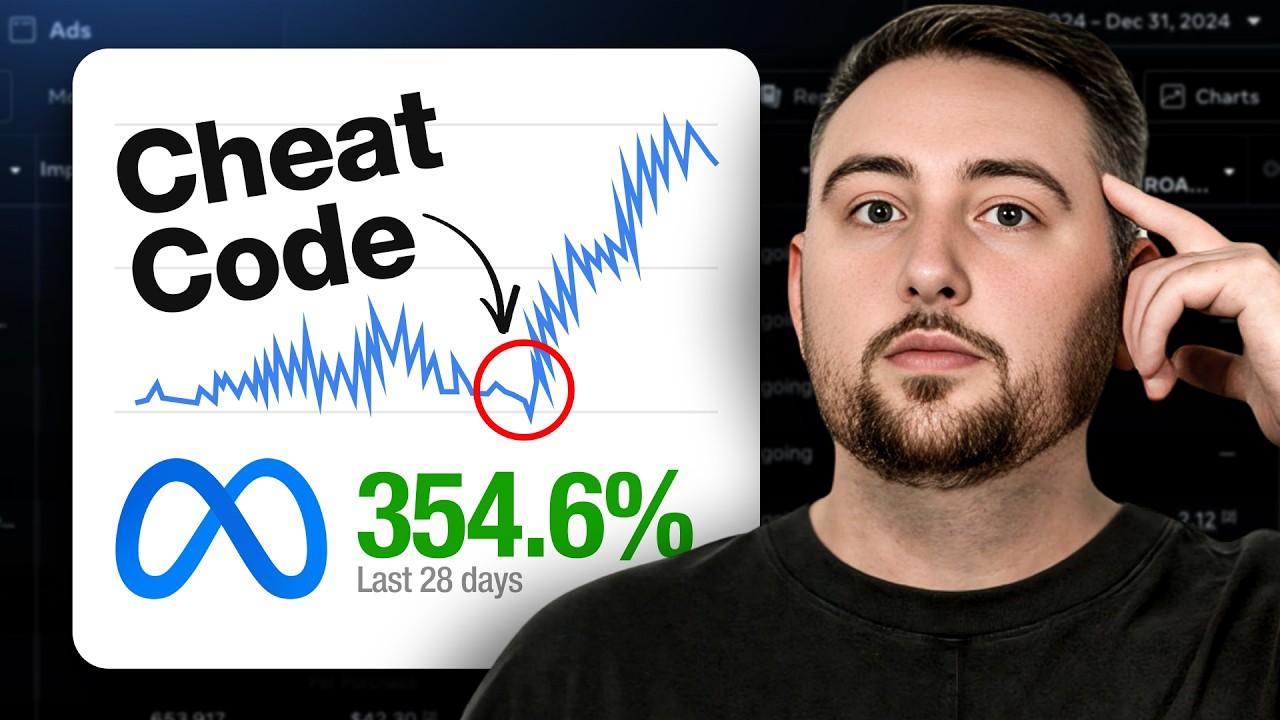
Work with the machine. Not against it. That’s the cheat code.
Most business owners waste years figuring out what actually works. In my Master Internet Marketing program, I compress that learning curve into 7 weeks, covering copywriting, funnels, ads, and more. If you’re ready to invest $5k and get serious about your skills, apply here.
Watch the video:

Jeremy Haynes is the founder of Megalodon Marketing. He is considered one of the top digital marketers and has the results to back it up. Jeremy has consistently demonstrated his expertise whether it be through his content advertising “propaganda” strategies that are originated by him, as well as his funnel and direct response marketing strategies. He’s trusted by the biggest names in the industries his agency works in and by over 4,000+ paid students that learn how to become better digital marketers and agency owners through his education products.

Jeremy Haynes is the founder of Megalodon Marketing. He is considered one of the top digital marketers and has the results to back it up. Jeremy has consistently demonstrated his expertise whether it be through his content advertising “propaganda” strategies that are originated by him, as well as his funnel and direct response marketing strategies. He’s trusted by the biggest names in the industries his agency works in and by over 4,000+ paid students that learn how to become better digital marketers and agency owners through his education products.



This site is not a part of the Facebook website or Facebook Inc.
This site is NOT /endorsed by Facebook in any way. FACEBOOK is a trademark of FACEBOOK, Inc.
We don’t believe in get-rich-quick programs or short cuts. We believe in hard work, adding value and serving others. And that’s what our programs and information we share are designed to help you do. As stated by law, we can not and do not make any guarantees about your own ability to get results or earn any money with our ideas, information, programs or strategies. We don’t know you and, besides, your results in life are up to you. Agreed? We’re here to help by giving you our greatest strategies to move you forward, faster. However, nothing on this page or any of our websites or emails is a promise or guarantee of future earnings. Any financial numbers referenced here, or on any of our sites or emails, are simply estimates or projections or past results, and should not be considered exact, actual or as a promise of potential earnings – all numbers are illustrative only.
Results may vary and testimonials are not claimed to represent typical results. All testimonials are real. These results are meant as a showcase of what the best, most motivated and driven clients have done and should not be taken as average or typical results.
You should perform your own due diligence and use your own best judgment prior to making any investment decision pertaining to your business. By virtue of visiting this site or interacting with any portion of this site, you agree that you’re fully responsible for the investments you make and any outcomes that may result.
Do you have questions? Please email [email protected]
Call or Text (305) 704-0094