Essential KPI Benchmarks and Metrics for Challenge Funnel Success
I hope you enjoy reading this blog post. If you want my team to just do your marketing for you, click here.
Author: Jeremy Haynes | Published October 13, 2025
Earnings Disclaimer: You have a .1% probability of hitting million-dollar months according to the US Bureau of Labor Statistics. As stated by law, we can not and do not make any guarantees about your own ability to get results or earn any money with our ideas, information, programs, or strategies. We don’t know you, and besides, your results in life are up to you. We’re here to help by giving you our greatest strategies to move you forward, faster. However, nothing on this page or any of our websites or emails is a promise or guarantee of future earnings. Any financial numbers referenced here, or on any of our sites or emails, are simply estimates or projections or past results, and should not be considered exact, actual, or as a promise of potential earnings – all numbers are illustrative only.
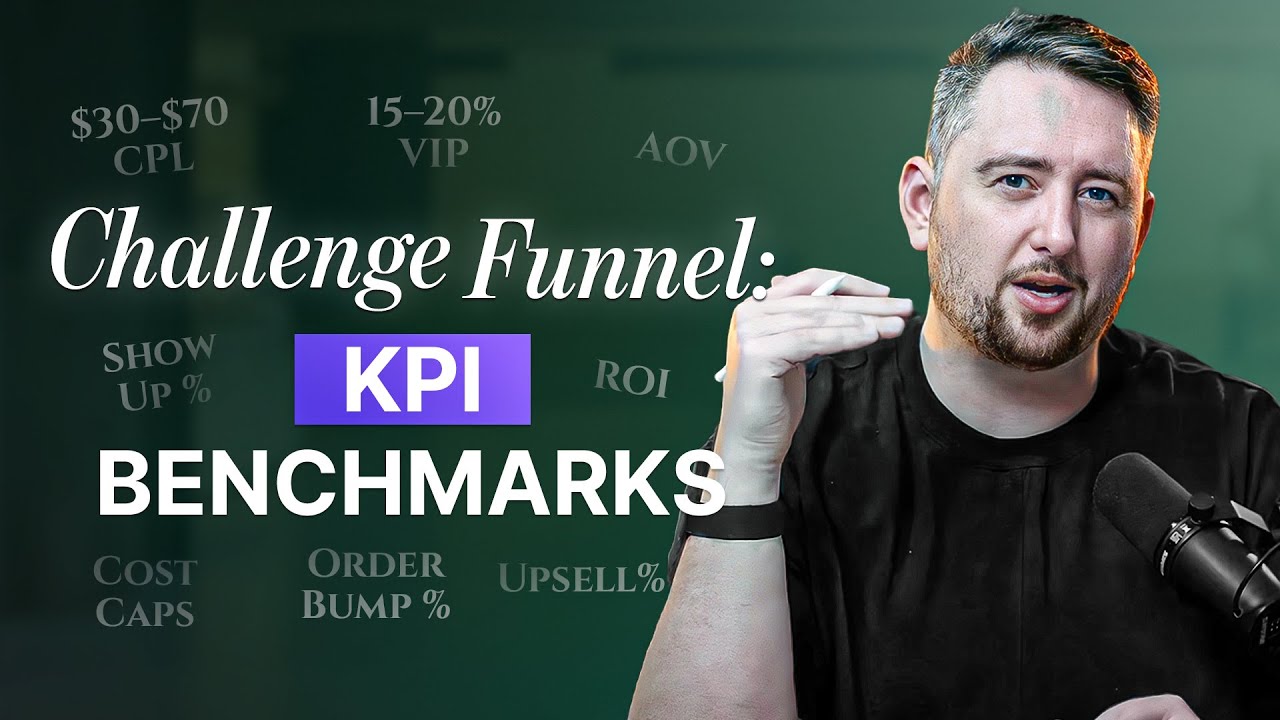
Welcome back to the challenge funnel/3-day virtual event series. In this particular piece, we are going to be going through what your KPI expectations should be throughout this virtual event.
We’re going to be talking about things like cost per purchase expectations, show rate expectations for each day of the challenge, total conversion rate expectations, rep pitch conversions. We’re going to go through the whole thing here today.
If you’re new here, welcome in. All we do is talk about hitting million-dollar months or if you’re already there, tacking on the next million a month.
We don’t make any income claims, though. We have no idea who you are and whether you have any possibility to make that possible for you.
All we know is what the US Bureau of Labor Statistics tells us, which is that 0.1% of all businesses on Earth ever hit the big 10 million a year, let alone the even smaller percentage of people that would do 12 million a year – aka million-dollar months.
So long story short, again, no income claims, no earnings expectations, no earning potential, just game that I’m putting you on.
Hopefully by this point, you’ve read a few of the other pieces within this particular series because this fits snugly in there if you’re going to commit to a virtual event.
If your business is already generating $100k+ per month, My Inner Circle is where you break through to the next level. Inside, I’ll help you identify and solve the bottlenecks holding you back so you can scale faster and with more clarity.
So without further ado, here’s what you need to know.
Free vs Paid Challenge Funnel Statistics and Show Rates
First of all, every virtual event that we do is paid.
We do not like free because free has a completely different set of statistics that are correlated to it.
Now, I’m going to give you a few little caveats when it comes to free that you can technically get away with. It depends on who you are and how big of an audience and following you have and how many people you can get into it in the first place to start to financially model out whether these statistics will make sense for you.
So one of my Inner Circle members – I’m not going to say these guys’ names because I don’t want to openly air out their statistics since they haven’t done so themselves already.
But anyway, these two guys, we have the front-facing personal brand and then we have the guy that’s responsible for the operations, sales, and marketing.
Now, these two boys, they have literally low-end hundreds of millions of people that look at their content in a month. It’s extreme.
There’s also a very high quantity of those people that click to their Instagram accounts, their TikTok accounts, navigate over to their YouTube page.
Again, these guys have scaled their personal brand content through clippers. That’s a whole different topic, but regardless, due to the quantity of viewership that they get, they took the route for their challenge funnel to do free rather than have it cost money.
Expected Show Rates for Free Challenge Funnel Events
Typically, when you do the route of free, you have a completely different set of expectations that you are going to experience.
First of all, your show rates are going to be terrible for the most part. You typically see about a 10 to 20% show rate.
Now, these two guys specifically what they’re trying to do to combat that is a raffle where they’re saying, “Hey, if you show up and comment something in the chat for 3 days that we’re doing the event, you are automatically entered into this raffle” and they’re giving out money.
I think they’re also going to give out a Rolex watch, little roly poly, and that might influence their show rate a bit, but I just want to be really clear when I say this.
When you generally fall into bribing people to get them to show up, it can work. Look at the time share model as a great example of that. That industry is a literal bribe to sit down and actually hear out their sales pitch.
They fly you out somewhere. They get you into some kind of resort. They allow you to go get a show or dinner or lunch or something like that on them usually. And all they want from you is just 90 full minutes of your attention to try to get you to purchase a time share.
So clearly bribing can work. I want to be very fair in saying that.
But generally when it comes to a free virtual event, I mean listen, the incentive is show up, comment something, and then bounce.
So naturally, if a system can be gamed, it will be gamed. Important to note.
Can they influence their show rate to be higher than that through things like my back-end selling systems, the hammer them strategy, setters potentially reaching out to these folks and trying to confirm and get them excited and make them show up, value dense email sequences, a proper well-built confirmation page?
Yeah, all these things can absolutely influence the show rate to be a little greater than that, but when it’s free, you’re typically going to have a bad time.
These guys are shooting for 150,000 registrants.
So even if they get a 10 to 20% show rate, they’re still going to be sitting at about 15 to 20,000 people that are going to show up live and watch them go throughout their content.
Now, we already have a piece in this dedicated series to these virtual events where we go through what the content flow should be. So make sure to check that out to get an idea of what these guys are going to flow through in terms of what they teach, when they make their pitch, when they make their rep pitch, etc., and how the actual outline of the content is.
Daily Attendance Decline Rates for Free Virtual Events
But here’s what I want to make really clear. When you do it free, you also see a bigger drop off rate for each subsequent day that follows.
So as an example, if I’m going to see – let’s give them the benefit of the doubt in this example and say that they for day one are going to get a full 20% show rate.
Well, day two is typically a lot worse and same with day three.
The good news is again, if you read the outline of when we do what in these challenges for the content, we make our pitch on day two.
Why Day Two Is Optimal for Challenge Funnel Sales Pitch
However, day two when it’s a free challenge is usually about half of whatever the total attendance was on day one.
If you do an incredible job, like I’m talking damn near perfect execution on day one, you can still have a relatively high show rate on day two, but it’s still going to get chopped at the knees comparatively to if people paid for it.
So it’s a big give and take when you choose to take action on whether it’s going to be free or whether you do it paid.
And the biggest part that makes the most substantial difference is the total quantity of registrants that you’re actually probable to drive into the challenge.
So if these guys do pull off a huge quantity of people, 150,000 people that register, that’ll typically exceed the amount that people would get there if they paid for it.
And that’s a very important distinction. It will have more people that are there.
The other very important thing to consider is how many of those people are actually going to be probable to buy.
Conversion Rate Expectations for Free Challenge Funnels
You’re typically going to see a lower overall conversion rate against the total amount of people that you got to opt into the challenge or depending on how you want to do the statistic, you can also do it based on the total quantity of people that showed up to the challenge.
This is going to be a pretty low statistic, but this is typically what we see.
We typically see a 1 to 3% conversion rate against the total quantity of registrants that opted in in the first place that end up buying whatever the thing is that’s pitched on day two.
So that’s where the actual money comes in in this case.
So these guys – huge organic presence. “Hey, sign up for the challenge. Sign up for the challenge. We got this challenge coming up.”
Assuming they get upwards of 150,000 people to register, they get 15 to maybe 30,000 people that actually show up to this thing on day one. They get 7,500 or maybe upwards of 15,000 to show up on day two.
That’s how many people they’re pitching to.
If they convert 1 to 3% of 150,000 people and they sell something that’s several thousand that’s direct to checkout and maybe they also get people who can do a call funnel who aren’t willing to buy then and there to clear out the rest and then they feed everybody else who showed up to the challenge to their setter team to reach out and try to milk some subsequent revenue from those guys – they’re still probable to have a good time right now.
Just to be clear, their hard costs go up a lot.
Anybody who’s executed any kind of significant event, which again, if you’re the right type of person reading this, you’ve likely come across this issue already and know about this – you got to pay Zoom a pretty substantial amount of money to do a Zoom webinar with more than several thousand people.
I believe the minimum is 5 to 10,000 people where all of a sudden you’re paying Zoom like 10 to 15,000 plus dollars.
Now, just to be clear, in the context of a challenge funnel or a virtual event, that’s just more cash you got to front. And in most instances, you’re doing these things to make a few million dollars at once or, you know, on a smaller level, high couple hundred thousand ideally.
So again, it’s worth the cost, but it still adds to the total upfront amount that you have to front for the whole thing.
It’s a lot more tech issues that can go wrong when you have too high of a quantity of people, as silly as that sounds.
But anyway, here’s the moral of the story. 1 to 3% conversion rate against 150,000 registrants is still awesome. I mean, that’s going to be a huge payday.
Imagine you convert 1,500 people on a $5,000 price. You know, you’re going to have a good time if you do that math.
Paid Challenge Funnel Performance Metrics and Advantages
Now, comparatively, when you look at the paid statistics, which are in most instances completely different and a little more favorable, every one of these stats changes.
So again, these stats here, this is for the free challenge.
And then when you look at a paid version of the challenge, the paid version is typically far more favorable.
So you’re going to get a lower total quantity of people that are going to buy the actual virtual event when you do a paid challenge. And you got to look at that first.
So you have the total clicks and then you have the total buyers of the actual challenge itself. So total buyers of the ticket.
Challenge Funnel Ticket Sales Page Conversion Benchmarks
This can typically range from anywhere as low as 5%. We’ve seen these as high as 15%.
And the 15%, by the way, just to give you an idea – I mean, that’s a phenomenal conversion rate on a sales page, phenomenal.
Just to be clear, that came from a very niche challenge that was executed geared towards the accounting niche. They had a dialed-in sales page that was aligned perfectly to the expectations and the desires of the accounting niche for the people that they were going after.
They were going after bookkeepers. They were going after CPAs. And man, the claims that they made, the messaging that they had, it’s one of the highest levels of responsiveness that we’ve seen in a while.
But you can typically convert about 5 to 10% of your total page.
And I just want to be really clear when I say this. I’ve consulted a lot of people on challenge funnels over the years, and I’ve seen a lot worse than this.
This statistic will wildly influence and dictate what your overall profitability is going to be going into the challenge itself.
And the stats that make up your cost per purchase of the actual ticket itself, they’re made up of a few stats. You’ve got CPMs, you’ve got your link click-through rates on the ad level itself, you’ve obviously got your page conversion.
Sales Page vs Webinar Strategy for Challenge Promotion
Some people also typically promote through a webinar. And by the way, we have a whole piece dedicated to the promotion cycle and how long that looks and what you do during the promotion cycle and what you need.
We also have a piece dedicated to sales page best practices within this series. And in that piece, we talk about long form sales pages. And we also talk about a webinar strategy that you can use.
Now, just to be clear, if you use the webinar strategy specifically, you obviously have a few more stats that are going to make up your cost per purchase, like cost per opt-in, and that’s dictated by CPMs, link click-through rate, the opt-in rate of your actual webinar.
You have the show rate to your webinar, and then of course, you have your actual conversion rate of the webinar of pushing people to buy tickets.
So if you do a long form sales page, which typically liquidates more of the spend profitably that you’re going to put out in order to get ticket buyers in the first place, you obviously have your page conversion rate to look at.
And that can sometimes be made up of other statistics too. Like as an example, let’s say you have a two-step order form. You have that stat – how many people fill out the first step, how many people actually register. That can be an example of another bottleneck.
So long story short, those are the stats that make up your cost per purchase. Those are the specific bottleneck KPIs that you would want to be mindful of and attentive to while you go out and try to get people to buy at a profitable rate.
If you convert somewhere in that range of that 5 to 15%, you’re typically going to have a good time. As long as your link click-through rate’s not bad and your CPMs aren’t sky-high, you’re typically, depending on what you charge for the actual event, going to be profitable.
Optimal Ticket Price Points for Challenge Funnel Profitability
Now, we have one of my Inner Circle members. His name is Zach, and he runs an event company called paidevents.com. Now, Zach’s awesome. Big fan of Zach. He’s been in the Inner Circle for a very long period of time.
He’s great with challenge funnels as well, but he does them completely differently than what I typically recommend. And this is a great example of why I love learning and hearing from our other Inner Circle members on what they specifically do.
Zach will charge single-digit numbers, like he’ll charge, as an example, $7 to $9 to get somebody to buy the challenge in the first place.
He’ll still have upsells and things like that on the back end to try to increase his AOV, but in that example, when you charge so little, you’re obviously going to go into the event at a much less profitable number, meaning you’re going to front a lot of cash.
And so therefore, you’re going to be limited on the overall amount of cash that you’re going to be able to front to try to get a ton of people into the challenge itself.
We typically charge a little more money.
But here’s the very interesting thing about what Zach found. He found that even if he only charges $7 to $9 as an example of his ticket pricing, he can still see the same show rates that I’m about to talk to you about if I charged somebody $47 to $97.
So it’s very important to consider. You can go as low as $7 to $9 on the actual ticket price.
However, I typically encourage people go about $47 to 97.
The reason being these are typically more qualified buyer leads. Depends on what you’re going to try to sell somebody.
If you’re typically going for something that might cost, let’s say, $3 to $5,000 or even less, you can get away with charging less upfront because they don’t have to be as qualified of a buyer lead.
When I charge somebody at least $47 to $97, from what we’ve seen in our testing, we can typically sell something that’s a lot more costly.
Like we have a guy that sells something at a $15,000 price. He sells his tickets to come to the virtual event for $247.
That difference of him charging more from his testing time in and time out of the challenge has proven that the people who buy at $247, they buy the actual high ticket product at a substantially higher rate than somebody who buys at 47 or 97.
So again, when you look at the $7 to 9 price or anything less than that, you might still average the same show rate that we’re about to talk about with these paid events.
But you got to remember – how you decide what the price of the event should be is a culmination of a few things.
How profitable do you want to try to be going into the event? Because remember, if you’re profitable just on ticket sales and the upsells you have on the front end, you have unlimited budget.
You can throw as many dollars as you can possibly throw at the ad channels to get as many people to buy the challenge as you possibly can, which obviously is going to influence the amount of people that upsell to the main product during the challenge that you’re going to pitch.
You want that. You want to be in that position.
If you charge the $7 to $9 comparatively, yeah, you might experience the same show rate as somebody who buys for 47 to 97. But again, the question becomes, are you going to get the same level of buyer lead?
And generally, what you have to do to actually figure that out is test it. And you have to do multiple challenges. And you have to see if there’s a difference in the types of people you get from what you charge.
You understand?
So again, I’m not in any way, shape, or form trying to demonize or make it sound bad to charge $7 or $9.
Typically, what my clients prefer when we run these challenges is to be profitable going into the challenge. That is the most ideal scenario for everybody.
And that also when I say it’s a culmination of a few things that decide what the price should be, that’s what typically biases us towards the $47 to $97 price point.
Now, obviously, if you charge less, you can typically see a higher conversion rate. If you charge more, you’re typically going to see a little lower conversion rate, but the additional dollars you collect typically offset and make you profitable.
Something to consider.
Using Complementary Upsells to Increase Average Order Value
Now, outside of the ticket price, you have upsells in both the free version and in the paid version that you have to consider.
We typically see, and you’ll notice this when I talked about sales page best practices for these long-form sales pages and even for the webinar strategy that you can run, you typically want to have at least two upsells on the back end of the ticket.
And these conversion rates can range wildly depending on what it is and what you charge.
One key lesson that we talk about time and time again when it comes to low ticket is whatever the main thing is that you’re actually selling for high ticket, this specific thing is made up of a bunch of smaller things. Research shows that complementary product upsells can significantly increase average order value.
So as an example, I was talking this weekend about book funnel mastery in my Inner Circle program where we do our weekly group calls, our twice a month one-on-one calls, our quarterly in-person masterminds, extensive course library that we have in there, and all kinds of other great stuff. Jeremy AI.
That’s our group for rich people trying to get a ton richer.
One of our members had asked, “Hey, can we go through book funnel mastery?” And we talked about this very common lesson when it comes to low ticket to high ticket ascension.
The main thing is typically made up of a bunch of smaller things.
And the lesson that I specifically used, I had this program that we marketed for a while called High Ticket Agency. And it’s an agency owner program that teaches you how to start and scale marketing agencies.
Now, that specific offer, the main thing is, well, I want to start, I want to scale a marketing agency. And there’s a bunch of smaller things that make up what that takes to do that.
And as an example of one of the low ticket book funnels that we had created to promote that high ticket thing, we selected what we call my Perfect Cold Video Pitch Bundle.
It comes with an SOP on how to execute my video pitches. And I’m not pitching right now, by the way. Pay attention to this.
Comes with the Perfect Cold Video Pitch SOP. It comes with what we call my Value Dense Email Sequences and it also comes with this thing that we call Value-Driven Follow-Up and a bunch of lead gen tools that we recommended.
We don’t sell this by the way. Don’t try to ask me to buy it.
Long story short, we bundled all those together into what we called the Perfect Cold Video Pitch Bundle and we sold it for about $150 to $197.
Now that thing as an example was one of the what we call breakout branches.
So if you cared about that, about how to get clients for an agency, there’s a high probability you’d care about all the other things that I can teach and talk to you about when it comes to starting and scaling a marketing agency.
That’s the same concept that you want to follow when you select what your upsells are going to be.
So the first upsell and the second upsell should ideally directly complement whatever it is that the theme of the virtual event is.
If you successfully do that, you’re going to have a very high conversion rate.
Without exaggeration, you can see upwards of a 20 to 50% take rate depending on pricing and what specifically you’re upselling.
As an example of this, if I buy a book and the first upsell is an audio book of that book, that’s going to have a really high take rate because it directly complements the book.
Whatever the theme and the topic is of my challenge, that specifically is what I want to select for upsell one and upsell two.
Now, the pricing of this relative to what your conversion rate is on these upsell steps is going to dictate what the price should be.
The higher the take rate, the lower and more favorable the price can be for the customer. The lower the take rate, the higher the price needs to be.
So I can weight my average order value higher because that’s going to significantly dictate how profitable I am going into the challenge.
The higher the AOV, the more probable I am to be profitable.
You understand?
So moral of the story is outside of the actual ticket prices, you ideally have something that’s your upsells that are going to convert at the lowest about 5%.
But again, if you do it right, this can be upwards of like a 20 to – I know it sounds ridiculous – a 20 to 50% conversion rate.
The price being lower is going to be indicative that you’re going to likely have a higher conversion rate. The conversion rate being lower is either because you’re priced too high or because whatever you’re selling just doesn’t make any sense for the person to buy.
It doesn’t actually directly complement.
It’s like you go sit down, you get a burger, right? And they’re like, “Hey man, you want fries?” You’re not like, “What? Why are you offering me fries?”
You know, you’re like, “Oh, it makes total sense for you to offer me.”
You know, if they say something like, “Hey, do you want to make it a large?” Again, you’re not confused. You’re like, “It makes total sense. Yeah, make it a large.”
Right? If they even say, “Hey, you want a milkshake or a soda or even a water?”
Again, you’re not confused about why they’re pitching you that. You’re like, “No, it makes total sense.”
But this is a huge thing that a lot of people break when it comes to the conversion rate percentages that they’re going to experience if the price is too high, even if it makes sense.
“Hey, you want fries with that? It’s going to be $20 extra.”
You’re going to have a low conversion rate on that because it’s priced too high, even if it’s the right thing.
So it’s a combination of these two things together that matter the most. The price and it being complimentary to whatever the main thing is.
You understand?
So you do that right, that’s what’s going to ultimately get you to that statistic. And now those specifically, that dictates your AOV being high.
Average Order Value Requirements for Profitable Challenge Funnels
You want your average order value to be as high as you can possibly get it because again, whatever your cost per purchase climbs up to, the AOV has to exceed that for you to be profitable.
And if you don’t exceed it, that means you’re burning whatever amount you aren’t able to liquidate.
So as an example, for every dollar that I spend, if I’m only able to liquidate 50% of it, because my AOV is half of whatever my cost per purchase is, I’m fronting 50 cents for every buyer I get in that example.
You understand?
So moral of the story is focus on the AOV, that matters a lot.
Identifying and Fixing Cost Per Purchase Bottlenecks
And then when you look at your actual cost, when you look at your actual cost per purchase, just to re-emphasize this, your cost per purchase is going to be influenced by what we talked about – your CPMs, your link click-through rate, your page conversion rate.
And your AOV is influenced by your conversion rate, the pricing strategy you pick, the upsell take rate, and how that influences your AOV.
But just keep in mind your cost per purchase in order to just drive it down. There’s all kinds of ranges that I’ve seen.
Like I’ve literally myself when I’ve run ads for clients gotten cost per purchases as low as like in the 40s or 50s and I had an AOV that was about double to triple that give or take the time of promotion.
I’ve had clients that we’ve run traffic for directly where our cost per purchase is around 150 to 200 and the AOV is just about at the same spot but we’re losing a little bit of money right now.
I can’t stress this enough. There’s no real static number that I can sit here and tell you for what your cost per purchase should be.
Here’s all I will tell you though in terms of expectations. So you walk out of this fully understanding what you should project onto your advertisers that are running this for you or what you should expect yourself if you’re running it for you.
You want to be profitable. It is very possible to get profitable and the more unprofitable you are, the more specific bottleneck statistics are bad within your advertising process.
Look at all those subsequent steps – the CPMs, the link click-through rate, your on-page conversion metrics.
If you’re doing that webinar strategy to promote this challenge funnel or this 3-day virtual event coming up, look at the webinar stats like opt-in rate, show rate, the overall conversion rate of the webinar, the AOV from who comes from one or the other, long form page or the webinar page, and try to fix those specific stats.
If you do that, you’re typically going to have a great time.
Daily Show Rate Expectations for Paid Challenge Events
So anyway, back to the point. When you look at the actual show rates of the paid versions of these challenges, they’re very different. Like very different.
Usually the expectation that we would project onto you is out of the total quantity of buyers that you’re able to produce, you get 70% of them to show up when you charge any amount of money. Industry data shows that paid events consistently achieve higher attendance rates than free events.
Like Zach had proved with his paidevents.com model, $7-$9 is possible to get a 70% show rate.
Us charging $47-$49 to that $97-$99 price point – again, that still has a very good show rate of 70 plus%.
We don’t see much variance between the two. We just see a difference in the types of buyer leads.
Now, day two, same exact logic. You’re typically going to see a far higher retention rate because people paid for this.
You’re typically going to see about a 60 to 65% show rate against total traffic on day two.
Day two, keep in mind, you make your pitch. You’ve officially aired out the fact that you’re trying to sell people and you’ve converted a lot of them.
Ideally, day three, you typically see a little lower. You typically see about 50% of your total buyers actually show up to day three.
Expected Conversion Rates for Paid Challenge Funnel Offers
Now, when it comes to the overall conversion metrics, your conversion rate against the total buyers, not just the total quantity of people that showed up, is typically about 3 to 7%.
With the average usually being about 5%.
So as an example of that, if I got 10,000 people in total to buy my challenge, I got 7,000 of them to show up, I’m going to convert about 5% of that 10,000 on average and walk away with a few hundred people buying my high ticket thing.
There’s a far smaller quantity of people that you’re typically going to get to a paid challenge.
Most of you don’t have hundreds of millions of viewers. I think without exaggeration, I’m probably literally talking to like five of you when I say you have hundreds of millions of viewers within a month that are actively looking at your content.
And in that example, like yeah, you could argue that a free challenge might be better for you.
But it’s also very important to note you could justify a paid challenge just as well.
It really comes down to the price of what you’re selling, how serious you want people to be when they show up, what you want your show rate to look like, what you want your overall conversion rates to look like.
Advanced Challenge Funnel Conversion Rates for Experienced Presenters
Now, hear this. On the above average side of things, we typically see conversion rates average out to about 10%.
These are the people who have done challenges. They’ve done webinars. They’ve been there, done that with live in-person events. They’re dialed in one-to-many sales machines.
They’ve perfected the art of the pitch, the presentation. They’ve dialed in this whole system, and they’ve worked out the kinks.
If it’s your very first 3-day virtual event or your very first challenge or like one of your very first ones, again, try to set your expectations somewhere between that 3 and 7% range, that’s more probable for you.
So anyway, moral of the story, there’s a handful of other statistics that we could sit here and go over, but per usual, we save a lot of that for our paid buyers.
Training Programs for Challenge Funnel Implementation and Strategy
So whether you’re somebody just looking to master internet marketing and go through my 7-week live class and get access to the challenge SOP, which we talk about in week one of that program, you can check that out with the link below.
We even give you week one of one of our past cohorts as an example for you to be able to go through and see if you like that learning style, the way I present, and see if that’s going to work for you to be able to master internet marketing.
On the other side of things, if you’re rich, you’re trying to get a ton richer, check out Jeremy’s Inner Circle. There’s a link for it to apply.
Four times a year right here at our facility in good old Miami, Florida, we do our in-person masterminds. Got a good couple hundred people that show up. It’s phenomenal. It’s very fun.
We do twice a month one-on-one calls, weekly group calls. You can select the topics of them as well if you want to throw out an idea if we don’t already have one.
We’ve got an extensive course library in both of these offers. We have access to Jeremy AI in both of these offers.
And in Jeremy’s Inner Circle, we have a group chat, extremely active inside of Telegram, full of rich people trying to get a ton richer.
So whichever one you are, feel free to apply and check out those links.
And at the very least, go check out some of the other pieces in this specific series on virtual events, challenge funnels, or go check out all the other content I have. They’re all very helpful to you.
Most business owners waste years figuring out what actually works. In my Master Internet Marketing program, I compress that learning curve into 7 weeks, covering copywriting, funnels, ads, and more. If you’re ready to invest $5k and get serious about your skills, apply here.
Thank you so much for being here. Go get richer.
Watch the video:
Get my content first on Google
Add jeremyhaynes.com as a preferred source and Google shows my articles more prominently in your search results, including AI Overviews and AI Mode.


Jeremy Haynes
Owner and CEO of Megalodon Marketing
Jeremy Haynes is the founder of Megalodon Marketing. He is considered one of the top digital marketers and has the results to back it up.