Cold Paid Advertising Strategy to Scale from $100K to Million Dollar Months
I hope you enjoy reading this blog post. If you want my team to just do your marketing for you, click here.
Author: Jeremy Haynes | Published October 30, 2025
Earnings Disclaimer: You have a .1% probability of hitting million-dollar months according to the US Bureau of Labor Statistics. As stated by law, we can not and do not make any guarantees about your own ability to get results or earn any money with our ideas, information, programs, or strategies. We don’t know you, and besides, your results in life are up to you. We’re here to help by giving you our greatest strategies to move you forward, faster. However, nothing on this page or any of our websites or emails is a promise or guarantee of future earnings. Any financial numbers referenced here, or on any of our sites or emails, are simply estimates or projections or past results, and should not be considered exact, actual, or as a promise of potential earnings – all numbers are illustrative only.
Most businesses struggle to scale because they never crack cold paid advertising. They stay comfortable with organic traffic or warm audiences, but that’s where the ceiling hits hard.
True unlimited scale comes from converting people who have absolutely no idea who you are. People who’ve never seen your brand before. Zero impressions. Zero familiarity.
But you can’t just crack in-market demographics when you go cold. You need to convert needs-convinced and mass-market demographics to have genuine scale.
There’s a process to this. A flow you need to follow.
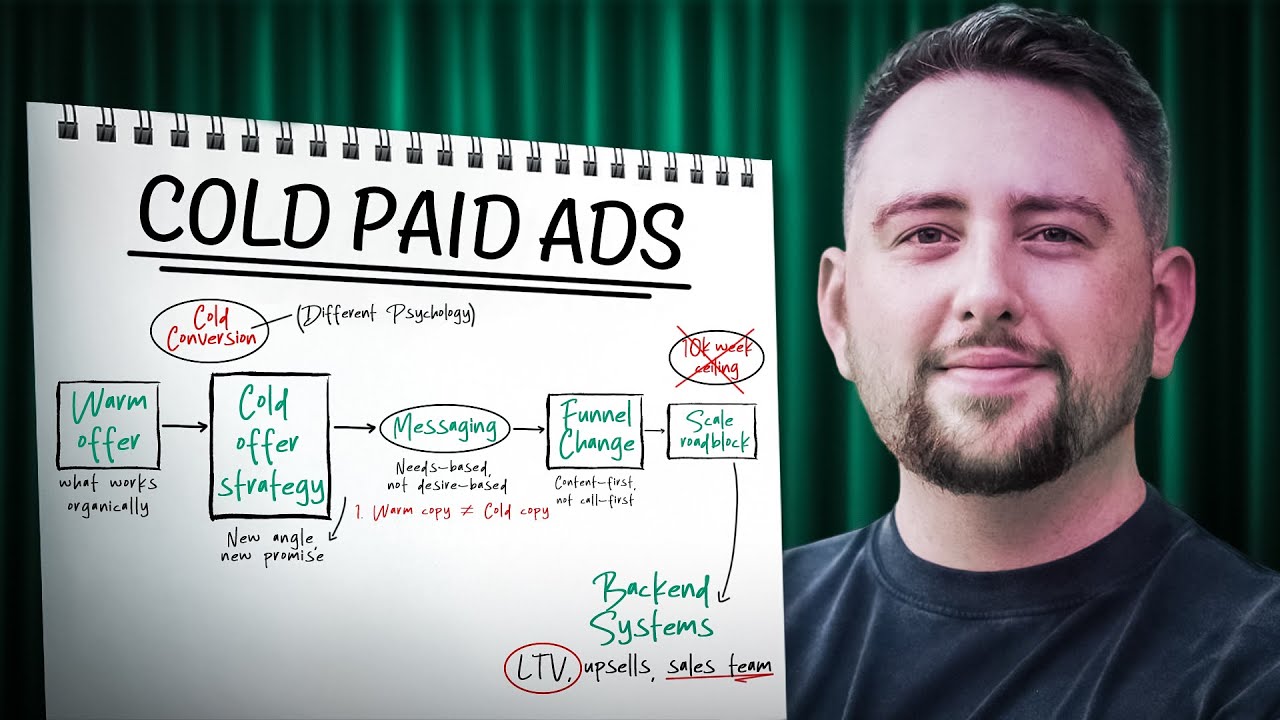
In this blog, we’re going through the different stages you need to test before launching cold paid advertising offers. We’ll cover dialing in messaging, the exact steps to take, what offer types work best, and the funnels that consistently perform.
Let me break it down for you.
Heads up, members of My Inner Circle are already scaling to $1M+ and beyond. This isn’t for beginners. It’s only for operators already at $100k+ per month who want proven strategies, speed, and focus. If that’s you, apply here.
Three Stage Traffic Progression from Organic to Warm to Cold Audiences
There’s typically a game of hopscotch you play before cold paid advertising makes sense. It’s not something you just immediately jump into in most cases.
Most people start with organic traffic first. Not everyone, to be fair. Some of you have bigger appetites for risk and might jump straight to paid advertising or even cold audiences right away. That’s great.
But let me talk to those who start with layup deals first.
With organic traffic, there’s an unbound amount of time and content consumption happening. This establishes strong familiarity bias in every lead you’re selling to.
Almost everybody selling organically has no idea how many videos prospects consume or over what timespan. All they know is people consistently show up saying they watched the videos and they’re ready to buy now.
These are layup deals. Your sales team loves these. They’re so simple to close they might as well be cashiers at a grocery store. They’re just collecting payments, not really selling. They answer a handful of questions, maybe do some follow-up, and boom. Sale closed.
The second step people generally take is warm paid advertising. Believe it or not, a lot of businesses die right here.
This is where businesses dabble. They hire an agency or two that either wasn’t good or didn’t crack it for them, and they gave up too fast. They didn’t have enough cash to see through the paid advertising cycle until it became profitable.
Warm audiences are typically just remarketing. Paid remarketing to organic audiences that are otherwise left unconverted. Your video views. Your warm social interactions like profile visits, DMs, messages, content consumption. Website visitors. Lists.
This can be especially cold when you do video views for some reason, but it’s still really close to organic. Less familiarity bias, but still enough to get you good return on ad spend and start the paid advertising process.
From there, cold officially makes sense.
This is where you need a clear line of sight to offers and opportunities that will convert people who have no idea who you are. Get them to buy profitably on those audiences.
That’s where the real scale lives.
Why Organic Marketing Offers Don’t Convert Cold Paid Traffic
The first principle you really need to understand is this: what works organically is generally not something you can roll over to cold paid audiences.
You need cold paid audience offers.
Let me give you a great example. On my organic content right now, I routinely pitch my inner circle program and my master internet marketing offer. All I know is when someone eventually converts on those offers, they’ve watched a lot of my content. They got value from it. Likely made some money with it. They like me as a person.
Then they say to themselves, alright, I’m ready to buy.
If I took the inner circle program, which is thousands of dollars a month with minimum revenue qualifications just to buy, and time commitments on top of that? That’s a very high friction offer to take to people who have no idea who I am.
So do I need to change the offer? Not necessarily. There are very important things to consider there.
Content Sequencing Strategy to Warm Up Cold Paid Audiences Before Selling
In my world, I’ve created several strategies called content first advertising strategies. The concepts are very simple.
I take content, literally like what you’re consuming right now in this blog, and I pay to distribute that content toward people who have no idea who I am.
In some of my strategies like the Venus Fly Trap or Venus Fly Trap 2.0, I sequence videos before putting direct response in front of an individual. I have entire breakdowns of these strategies available if you want the full in-depth process.
The Venus Fly Trap 2.0 adds more content to each step, increasing the probability people work through the sequence at a higher rate to eventually reach the direct response.
Just like what you’re doing right now. You’re getting value from me. You have a higher probability to like me. Higher probability to think I can actually help you. I’m putting my expertise on display and giving you opportunities to make money from what I’m talking about before you actually buy from me.
That’s an incredible strategy for info products as an example.
But if you have a physical product business, like my buddy who sells hyperbaric chambers, sure he could put content sequences in front of cold audiences who have no idea who he is.
Brian Johnson, the guy constantly talking about longevity and trying to live forever, fully endorses the potential benefits of hyperbaric chambers. Put content like that from a known authority figure in front of someone before running ads for hyperbaric chambers, and you obviously have a higher probability they’ll think it might be good for them.
Follow that up with content about the Miami Heat being customers. Several other large sports franchises across different sports. Rich people. Med spas. All kinds of businesses and individuals buying these products for the medical benefits.
If I didn’t know I wanted to buy a hyperbaric chamber, that kind of content would influence me and increase the probability I’d buy.
Could I do those same things inside direct response ads and drive people to purchase? Yeah, I could do that too.
In info, there’s a higher probability you need to run full content sequences before and after direct response to increase the probability people buy in shorter timeframes, especially when they don’t know you.
For physical products and services people already understand but don’t necessarily identify as buyers for, we need content and direct response ads that are very different in terms of optimization, messaging, and overall approach to get people to convert who don’t actively identify as wanting that product and being ready to buy.
In Market vs Needs Convinced vs Mass Market Buyer Demographics
If I cut myself right now and scrape my knee, I’m not going to just let it get infected. I’m going across the street to CVS, cleaning that thing with hydrogen peroxide, throwing some Neosporin on there, and bandaging it up.
I’m not really an in-market buyer until I have a cut and need those products.
The other day I went down to a beautiful little resort in the Keys called Little Palm Island. Beautiful place if you ever want to disconnect. Terrible wifi though.
I was laying around in the sun all day. Got quite a sunburn. I’m just a traditional person from the northeastern United States. Not built for this Miami sunshine that beats down every day.
As a result of getting burnt, I want aloe vera to make it feel better. I’m not just buying aloe vera unless I have a sunburn. Then I’m in the market for it.
That’s where most people fall short. Their direct response ads only scale to the demographic they’re currently optimized to sell to.
If I’m selling aloe vera and only selling to in-market demographics, I’m going to have a bad time. Limited quantity of buyers I’m capable of selling to at any moment.
What would be better is finding a way to convince people who aren’t actively thinking about buying to actually purchase.
Chet Holmes Stadium Selling Framework for Cold Audience Targeting
What works organically and what might even work with warm paid audiences is not always what works with cold. With cold, there are a few things you can choose to vary.
First, we have this concept from Chet Holmes in a book called The Ultimate Sales Machine. He introduces it in a concept called stadium selling.
He visualizes it where at any given moment you have a small demographic of people, about three to four percent which I generally find to be true, that he calls in-market customers. Research from Chet Holmes’ The Ultimate Sales Machine confirms that at any given time, approximately 3% of your audience is actively buying now, with another 7% open to the idea.
Like I just described, these are people who know they want to buy whatever you’ve got. They actively identify as having that problem. You offer the solution. They’re going to buy it. Or they have the desire for what you’re selling. They want to buy.
That’s an in-market demographic. Small percentage, but if you target one hundred million people, having three to four million people as in-market demographic buyers is really good. If you converted three to four million customers on your product, you’d have a big smile on your face.
However, the scale occurs when you crack these other two layers which are anywhere from thirty to thirty three percent.
This specific demographic is what’s called the needs-convinced demographic. Then there’s the next layer called mass market.
These two specifically are where you have true scale. This is where the real money is.
How to Adjust Messaging for Different Audience Awareness Levels
Now you have to have dialed in messaging. Dialed in messaging means you’re actively thinking of the demographic you’re talking to.
When I create content, I’m technically thinking of two different audiences at the same time. I’m thinking of taking this content and spending money on it to people who have no idea who I am, actively attempting to turn them into fans who eventually spend money with me.
I’m also thinking of you reading this right now, likely on my site, where you’ve watched a handful of pieces of my content or maybe you’re very new to me and you’ve never consumed anything from me before.
The point I’m making is I will change how I communicate relative to who I’m communicating to.
This weekend I’m going to speak at an event. One of my clients here in Miami, Miss Cody Sanchez, is flying in for an event she’s hosting. She has me speaking during a workshop to some of her higher ticket buyers.
To be clear, during that workshop I’m talking to people who have no idea who I am. All they know is I run ads for Cody. That’s the only context they have on me as an individual.
So I’m not going to talk like they already know who I am beyond that specific point. I have to introduce things. I have to do some soft authority building and work in specific examples from clients we’ve worked with over the years to establish strong authority bias beyond the fact they’re already customers of the client I’m helping.
I have to establish that I know what I’m talking about. I have to introduce things and concepts that are going to help them make money.
You have to talk relative to who you’re attempting to communicate to. The messaging being dialed in makes a significant difference.
Low Ticket Book Funnel Case Study with 12x to 19x ROAS Over Five Months
Let me give you a perfect example. I have a different client with a book funnel. The book funnel is a great example of an offer type that can be taken to cold audiences.
It’s low ticket. Low commitment. Doesn’t take much money to transact. Gets somebody in the door. We liquidate some of the ad spend it takes to get them in the door.
Listen to this. On average, it takes a good four to five weeks to see anywhere from a break-even return on ad spend to upwards of four to one. One week might be four to one, the next week might be barely break even. The next week is a four to one, then a three to one.
It averages out typically to about two to one return on ad spend within a four to five week window.
Now we’re fronting cash in that example for four to five weeks. We’re a little outside the credit card cycle window. We’re technically fronting cash, which I don’t like to do.
I typically like to have the cash back by the time credit cards are due. You can switch to things like Facebook invoicing or other ad channel invoicing options that enable you to operate on net thirty. That helps a lot when you have sales cycles this long because we’re fronting cash.
We’re making back some of that ad spend with the book sale and some upsells associated with the book. Long story short, four to five weeks, twelve thousand dollar average order value.
But listen to this. Over the course of the book being purchased to about five months later, average return on ad spend ends up being anywhere from about twelve to one all the way up to nineteen to one. While these high ROAS figures are exceptional, industry data shows that the average ROAS across most sectors is 2.87:1, with successful eCommerce operations typically targeting 4:1 or higher to remain profitable after accounting for all costs.
But there’s a lot of inconsistency in the short term. Much higher return on ad spend over a broader duration of time, but that kind of situation isn’t ideal.
It’s not a funnel we get to regularly scale up. Not a funnel the organization has extreme confidence in. Not something as an advertiser we perpetually put more dollars into.
Sometimes that two to one return on ad spend in a four to five week window isn’t there because it’s not one hundred percent of the time we’re seeing that four to one return. It’s either under break-even or above four to one.
As a result, it makes you lose confidence in fronting the cash even though with really high probability, they’re upwards of minimum ten to one after five months.
But who wants to front cash for five months at a time? There are some businesses that operate like that, but it’s not ideal.
Front End Offer Strategy vs Backend Lifetime Value for Cold Traffic
What’s much more ideal is having two different things factored into your consideration: front end and back end.
Front end, you need to be thinking with strategies. Strategies are things like content ad strategies. Strategies are also things like offers.
As an example, if somebody who doesn’t know you is considering your content ad strategies and back-end selling systems but doesn’t want to spend five grand yet on your lowest ticket product, they’d rather spend maybe like a hundred bucks.
Well, I could have a low ticket thing that’s easy to consume, fast to get a result with, make somebody consume it fast so the upsell cycle can be fast. That would be win-win.
Win for us because we liquidate the ad spend to get the buyer. Win for us because we’re going to upsell them fast because they get a result quick. Obviously a win for them too because they’re getting a big result quick.
I can’t stress this enough. The right offers with cold make or break everything.
If I tried to take my five thousand dollar master internet marketing program and just market it to people who have no idea who I am, I could likely do that to be fair. But rather than the offer changing, it’s the funnel, the conversion mechanism.
In that case it might be a call funnel if I have a strong offer, but it’s more probable to be something like a webinar. More probable to be something like a challenge funnel. I could even do a low ticket to high ticket ascension offer.
These are the three things I can really consider. Front-end strategies like content ad strategies or direct response. Do I want to tweak my offer that I’m presenting to cold audiences? Or do I want to change the funnel type I’m putting those people through without changing the offer itself?
Then I have the backend to consider.
Backend can be things like our lifetime value. This is where we look at acquiring a cold audience buyer at break even or a little profitable and getting our money back.
Well okay, how long is it going to take to increase the lifetime value of that individual? That could justify fronting cash and being break even or just a little profitable, then focusing more on lifetime value, just upsells, and the speed at which I can get people to upsell.
In addition to backend stuff, we have all the backend selling systems. The backend selling systems are things like taking all the information that leads to action and priority in the individual’s mind and getting it to them through breakout videos, the hammer them strategy, value dense email sequences, manual outreach from salespeople.
I’ll tell you one thing I’ve seen time and time again that always works: a strong dialed-in sales team.
There is truly nothing better than a dialed-in sales team with all the best practices of backend selling systems tied together. It’s so good what it does for increasing the probability you actually convert cold audiences who have no idea who you are at scale consistently.
Three Ways to Adapt Your Marketing for Cold Paid Audience Conversion
The point I’m trying to make is rather than just sometimes rolling out what’s currently working for you on one mechanism like your organic or warm audiences, you have to consider what you’re going to change.
Are you going to change the strategy? Are you going to try to replicate your organic sales process with paid ads through content ad strategies?
Or are you going to change things like the offer? Are you going to change your direct response to have messaging that relates to the specific demographics you’re attempting to sell to?
All of these things independently of each other can create monumental change that helps drive conversions at scale profitably for cold paid audiences.
Why Cold Paid Advertising Is Required to Scale Past $200K Monthly Revenue
The main thing, the absolute main thing, one of the most important things you must walk away with from this blog is that cold paid audiences are where the money is at scale.
You’re trying to crack million dollar months. You likely already know this.
It’s relatively easy. I’m not making an income claim. Very few people get to ten million a year according to the US Bureau of Labor Statistics. Research confirms that less than 1% of businesses reach the $10 million annual revenue mark, with only about 9% of small businesses even achieving $1 million in revenue within their first five years. I don’t even know how few people get to a couple hundred grand a month. Obviously not a ton of people out here do.
The point I’m making is simple. When I say it’s easy, it’s for those of you that are smart, have great offers, dialed in systems, and are actually going to take consistent scaled actions.
It’s relatively easy to get to a couple hundred grand a month.
Once you get to a couple hundred grand a month, that’s where you start getting friction. That’s when you experience your first layer of realizing what you’re doing now isn’t probable to scale up to that next level.
What do you need to change?
This set of lessons we just talked about is what you’re extremely probable to need to change to get the results you’re after.
Cold paid advertising isn’t just another marketing channel. It’s the difference between hitting a revenue ceiling and achieving true unlimited scale. But you can’t just take what works for your warm audience and expect the same results.
You need cold-specific offers, dialed-in messaging, the right funnels, and backend systems that convert strangers into customers profitably.
Most business owners waste years figuring out what actually works. In my Master Internet Marketing program, I compress that learning curve into 7 weeks, covering copywriting, funnels, ads, and more. If you’re ready to invest $5k and get serious about your skills, apply here.
Master this, and million dollar months stop being a goal. They become your baseline.
Watch the video:
Get my content first on Google
Add jeremyhaynes.com as a preferred source and Google shows my articles more prominently in your search results, including AI Overviews and AI Mode.


Jeremy Haynes
Owner and CEO of Megalodon Marketing
Jeremy Haynes is the founder of Megalodon Marketing. He is considered one of the top digital marketers and has the results to back it up.