
How to Run a High-Ticket Sales Call Over Video Without Losing Close Rate

I hope you enjoy reading this blog post. If you want my team to just do your marketing for you, click here.
Author: Jeremy Haynes | Published August 3, 2026
Earnings Disclaimer: You have a .1% probability of hitting million-dollar months according to the US Bureau of Labor Statistics. As stated by law, we can not and do not make any guarantees about your own ability to get results or earn any money with our ideas, information, programs, or strategies. We don’t know you, and besides, your results in life are up to you. We’re here to help by giving you our greatest strategies to move you forward, faster. However, nothing on this page or any of our websites or emails is a promise or guarantee of future earnings. Any financial numbers referenced here, or on any of our sites or emails, are simply estimates or projections or past results, and should not be considered exact, actual, or as a promise of potential earnings, all numbers are illustrative only.
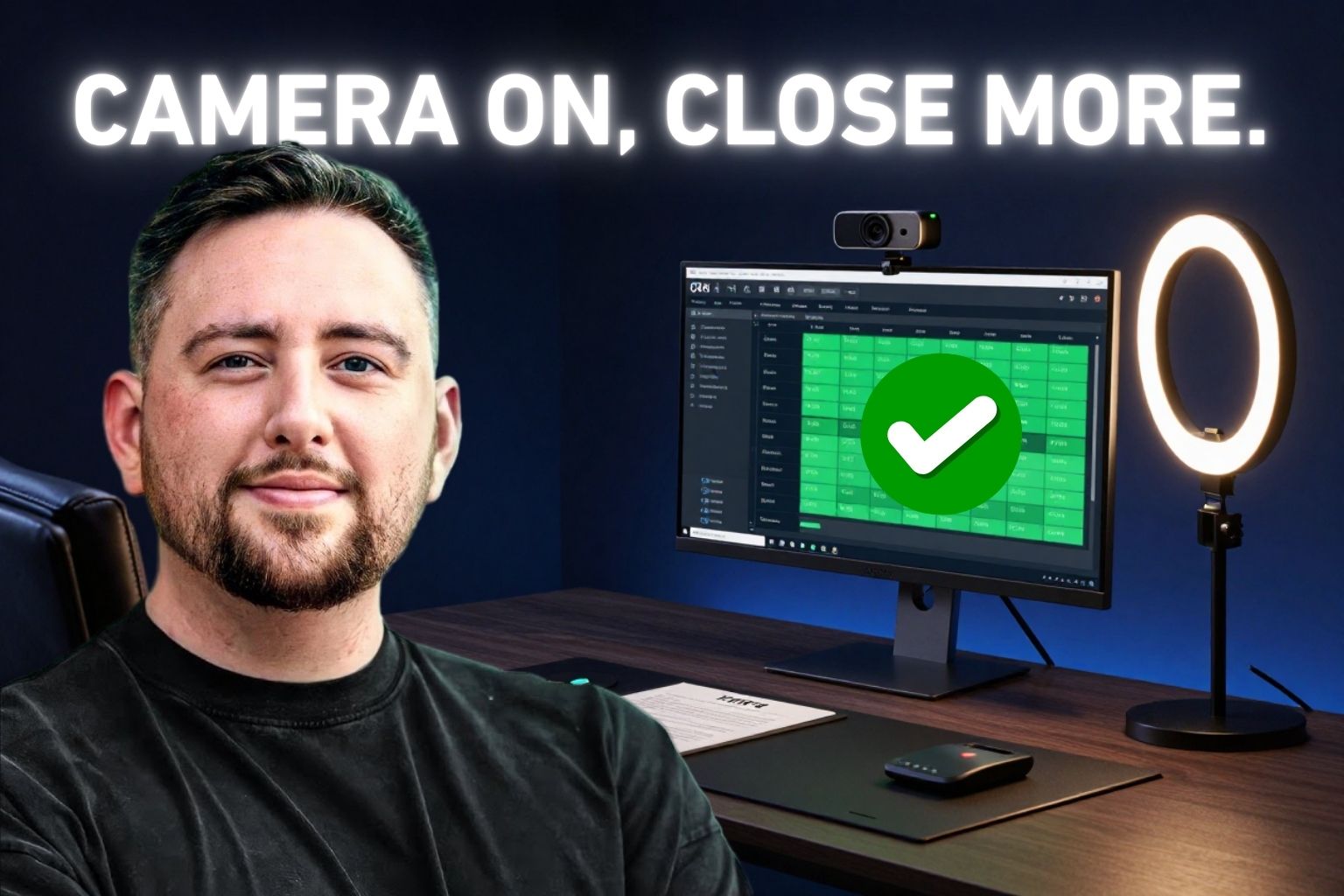
Keeping the webcam on can materially change the outcome of a remote sales call. Gong reviewed 121,828 web-based sales meetings and found webcam use was 41% more common in closed deals than lost ones. High-ticket teams often treat video as an inferior version of an in-person meeting. In practice, it is a separate selling environment with its own advantages, distractions, and technical requirements.
7 weeks. Real frameworks. Covering copywriting, funnels, paid ads, and conversion systems.
Why Skilled Closers Can Struggle on Camera
A closer may spend years learning how to read posture, match a prospect’s energy, and control the pace of a conversation across a table. Put that same person on a webcam and several of those instincts become less reliable.
Eye contact works differently because looking at the prospect’s face means looking away from the camera. A pause can feel longer when neither person shares the same physical space. Leaning forward may communicate urgency in a room, while the same movement can make a face loom uncomfortably large on a screen.
Reusing in-person habits without adjusting them creates a subtle mismatch. The script may be sound, but the delivery feels rushed, distant, or overly intense. The answer is to train video selling as its own discipline rather than expecting a good room closer to adapt automatically.
What the Sales Data Says About Webcam Use
Gong’s analysis found more than a simple correlation between cameras and successful meetings. Reps who used video at some point in the sales process were 127% more likely to close, and sellers with their cameras on recorded win rates that were 94% higher.
Video adds information to the conversation. Facial expression, timing, and visible attention all influence how the prospect interprets the words. The research connects part of that effect to the McGurk effect, where visual input changes how a person hears speech.
Turning on the camera only creates the opportunity. A poorly framed, distracting, or technically unstable video call can work against the seller. The fundamentals of closing high-ticket sales consistently still govern the conversation. Video changes how those fundamentals are delivered.
How to Make the Environment Look Deliberate
The prospect sees the room before hearing the pitch. A dark face, cluttered background, or low camera angle can make the call feel improvised even when the closer knows the offer inside out.
A dependable setup needs four things:
- Camera at eye level. Raise the laptop or use a separate camera so the lens does not point up from the desk.
- Light in front. Face a window or lamp and keep bright windows out of the background.
- A quiet visual field. Use a simple background that does not compete with the conversation.
- A stable connection. Use wired internet when possible and test it before the calendar starts.
These changes require little money. Their value comes from removing reasons for the prospect to question the operation. Someone considering a $10,000 or larger purchase is constantly gathering evidence about how carefully the company handles details.
Why Face Size and Eye Contact Affect the Call
Stanford professor Jeremy Bailenson’s research on video-call fatigue identified two problems that matter in sales. Faces can appear at a size normally associated with intimate personal space, and people experience the impression of continuous staring. Together, those conditions make a routine conversation feel unusually intense.
The easiest adjustment is to leave full-screen mode and reduce the size of the video window. That gives each face a more natural scale and lowers some of the visual pressure for the closer. The prospect controls their own display, but a calmer seller will usually handle the conversation better.
Video also requires more deliberate nonverbal communication. Small nods and brief expressions are easier to miss through a compressed image. Slow the pace slightly, let important pauses breathe, and make reactions visible without turning them into a performance.
Results are not typical. Your results will vary and depend entirely on your individual capacity, business experience, expertise, and level of desire. There are no guarantees concerning the level of success you may experience. The testimonials and examples used are not intended to represent or guarantee that anyone will achieve the same or similar results. We don’t believe in get-rich-quick programs. We believe in hard work, adding value and serving others. As stated by law, we can not and do not make any guarantees about your own ability to get results or earn any money with our information, courses, programs, or strategies.
How to Screen Share Without Surrendering Attention
The strongest performers in Gong’s dataset spent more time face to face and less time behind a shared screen. A proposal, demonstration, or pricing page can clarify an idea, but it should have a defined purpose.
Open the relevant material, make the point, and return to the camera. When the prospect spends ten minutes studying a deck, the seller loses facial feedback and much of video’s advantage over a phone call. Long screen shares can also turn a conversation into a presentation at the exact moment the closer needs engagement.
Narrate the material instead of reading it. Give the prospect a reason to look at each number or section, then connect it to something they said earlier. The language patterns that increase close rate are especially useful during these slower logistical portions of the call.
What a Weak Connection Does to Perceived Trust
Technical problems cost more than the seconds lost to reconnecting. Research from Cornell reported in Nature found that brief video glitches changed how participants judged another person’s competence, trustworthiness, and likability. In one experiment, candidates experiencing connection problems were about 20% less likely to receive a favorable outcome despite giving the same responses.
The prospect may understand intellectually that the internet caused the interruption. Their emotional experience is still a conversation filled with frozen expressions, broken timing, and speech that arrives out of sequence. That friction can attach itself to the person delivering the message.
Test the microphone, camera, platform, and connection before the first call. Keep a backup connection available when the calendar carries high-value conversations. Reliable video belongs to the sales process because the buyer experiences it as part of the company.
How to Read Intent With Limited Body Language
An in-person closer can watch posture, movement, eye direction, and the reactions of other people in the room. A webcam captures only a narrow frame, and sometimes the prospect keeps their camera off entirely.
Language has to carry more of the diagnosis. Pay attention to the direction of the questions. “How would onboarding work?” places the prospect mentally after the purchase. “Can you explain that again?” may signal confusion, hesitation, or a missing piece of trust.
Response timing matters too. Listen to how quickly and directly the prospect answers questions about budget, decision-making, and schedule. Evasive answers deserve another question instead of a rushed transition into the pitch. Our guide to sales-room language patterns covers the verbal cues that become more important when the physical room is unavailable.
The underlying objections remain familiar. Price, timing, uncertainty, authority, and trust do not disappear on Zoom. The framework for handling high-ticket objections still applies. The closer simply needs to surface concerns more directly because fewer visual signals are available.
Already making money? See what it takes to make a lot more.
How to Structure the Video Close From the Start
Use the first minute to confirm that both people can see and hear clearly. Handle an audio problem before the substance begins. Otherwise, the prospect may spend the opening minutes adjusting settings while the closer believes discovery has already started.
Once the connection is settled, follow a preparation-based structure:
- Understand the prospect’s current situation and desired outcome.
- Identify what has prevented progress so far.
- Put a number or consequence on leaving the problem unresolved.
- Present the offer only after the fit is clear.
- Address the decision while the full context remains fresh.
Our guide to closing six-figure deals through preparation covers that structure in depth. On video, execution needs three extra controls: keep the face visible for most of the conversation, slow down enough for reactions to register, and remove technical uncertainty before the call.
Video can outperform audio-only selling when the closer knows how to use the medium. Gong’s data shows the advantage, while the practical setup determines whether a sales team captures it.
Operators work through teamwide improvements like these inside my private mastermind, Inner Circle. Master Internet Marketing, our 7-week live comprehensive training, covers the broader high-ticket sales framework, including how to carry it into remote calls.
Results are not typical. Your results will vary and depend entirely on your individual capacity, business experience, expertise, and level of desire. There are no guarantees concerning the level of success you may experience. The testimonials and examples used are not intended to represent or guarantee that anyone will achieve the same or similar results. We don’t believe in get-rich-quick programs. We believe in hard work, adding value and serving others. As stated by law, we can not and do not make any guarantees about your own ability to get results or earn any money with our information, courses, programs, or strategies.
Get my content first on Google
Add jeremyhaynes.com as a preferred source and Google shows my articles more prominently in your search results, including AI Overviews and AI Mode.


Jeremy Haynes
Owner and CEO of Megalodon Marketing
Jeremy Haynes is the founder of Megalodon Marketing. He is considered one of the top digital marketers and has the results to back it up.