I hope you enjoy reading this blog post. If you want my team to just do your marketing for you, click here.


I hope you enjoy reading this blog post. If you want my team to just do your marketing for you, click here.
Author: Jeremy Haynes | founder of Megalodon Marketing.
Earnings Disclaimer: You have a .1% probability of hitting million-dollar months according to the US Bureau of Labor Statistics. As stated by law, we can not and do not make any guarantees about your own ability to get results or earn any money with our ideas, information, programs, or strategies. We don’t know you, and besides, your results in life are up to you. We’re here to help by giving you our greatest strategies to move you forward, faster. However, nothing on this page or any of our websites or emails is a promise or guarantee of future earnings. Any financial numbers referenced here, or on any of our sites or emails, are simply estimates or projections or past results, and should not be considered exact, actual, or as a promise of potential earnings – all numbers are illustrative only.
On your way to million-dollar months, one thing is clear. Your mindset, what you do day-to-day is going to make a huge difference to the overall outcomes, results, revenue that you will produce or fail to produce.
Today, I’m going to tell you some of the number one characteristics that are top-of-mind, consistently behaved through and held as key beliefs for all the million-dollar month earners that we’ve worked with.
If you’re new around here, welcome in. All we do is talk about cracking million-dollar months. Whether it’s the first million or the next million a month, we got you covered here with lessons from people who have been there, done that.
This is by no means a set of income claims, though. There is no earning potential in reading this. After all, we have no idea who you are, whether you have any probability to turn money into more money.
There’s a 0.1% probability of making $10 million a year. That’s not even a million a month according to the good old US Bureau of Labor Statistics.
So get it through your head. You have a very low percentile chance of ever making this kind of stuff possible for yourself.
But hey, there should be something in here that’s still good for your business that can help you get richer.
If your business is already generating $100k+ per month, My Inner Circle is where you break through to the next level. Inside, I’ll help you identify and solve the bottlenecks holding you back so you can scale faster and with more clarity.
Long story short, if you’re already following along, welcome back. Pleasure to have you. Without further ado, let’s dive in.
So this week, one of my newer Inner Circle members, his name’s Josh, and Josh sells – he’s pretty much a low ticket master historically, and now he’s starting the game of ascending people up to high ticket.
He’s going to make a ton more money from being with us. We’re really excited to help Josh out.
Josh earlier this week was dealing with a very specific problem. He had said, “Hey, so I’m in the process right now of just wondering what to do next. I’ve got all these staff in place. They’re doing XYZ. Everything’s pretty much handled. As a matter of fact, I’m just kind of kicking back at this point over this most recent couple weeks because I feel kind of like everything that I could otherwise be doing is already being done.”
I told him a very simple thing initially.
I said, “Josh, it’s not tough. All you got to do is do what everybody who makes a million dollars a month does. They focus on the highest revenue driven actions.”
That’s all they think with at all times.
There’s always something that they could put their time, effort, attention into.
And you know how it is. Like you as a guy who does whatever you make, couple hundred grand a month, maybe you’re already cracking a million a month – like you already get it.
Whatever you specifically put your time and attention on, you’re the best at by far. It’s going to get done extremely quick. It’s going to get done to an incredible level of execution — and research links focused, high-impact work to better productivity and business outcomes among high-performing entrepreneurs. It has a high probability to get a result.
And usually over a broad duration of time of repeating a specific behavior pattern, we habitualize it. And as a result of habitualizing it, literal neural pathways in our brain solidify, makes it easier for us to repeat that behavior.
And whenever you go to do something new, like in Josh’s case, where everything that he had been doing, he had successfully replaced himself out of – and the question becomes, what do you do next?
Really simple. You intentionally use that new time and attention that you freed up for yourself, and you place it on the highest revenue-driven action possible.
And then I gave them an example of what today looks like for me.
I said, “Listen, man, really simple. I’m going to first of all catch up on communication. It’s a lot of revenue in communication. Two, I’m going to make sure I sit down and I film my two weekly pieces today over the course of two hours. Three, I’m going to bang out a new SOP that’s going to benefit clients, Inner Circle members, Master Internet Marketing students, and Jeremy AI. And in addition to that, I’m going to do some client work because we have rev shares in every client account that we use. From there, I’m going to check in with staff, make sure all the bigger projects we have in motion.”
As an example, right now we’re duping out a tool called Manis. Specifically, it’s a Gen AI mode, and we are calling it Utari. And Utari is going to be an incredibly powerful tool. We’re in the process of just getting done with it.
We have their alpha testers that are officially testing stuff, making sure that it’s good. We’re working out all the fine kinks.
Back to my point, all I’m trying to say is my specific day today is full of things that out of anything else I could do are the things that are going to make me the most money out of anything else I could have otherwise put my time and attention on.
Are there other things that I could do? Yeah, of course there are.
You know how it is. There’s always infinite stuff to do. As a matter of fact, the to-do list generally never ends, right? You wake up every day and there’s more things you could technically put attention on.
But you’ve also gotten to the point if you’re rich enough and smart enough now to ignore the whole bottom half of the list.
So Josh just kind of fell into this pattern of like, well, what do I do next?
I told him all that and he kind of went back to the same loop. He went back to the top of his original question, aka that didn’t really answer what he was looking for.
And then I realized it. I said, “Oh, he doesn’t understand what he’s asking.”
And so he’s asking it in a relatively indirect way, but I can pick it up. I think he’s more so asking about the people side of things because now he’s got all these people in place. Maybe he’s asking more about some leadership based questions.
And that prompted me with an absolute banger of a set of lessons that I’m bringing you today.
What every single one, and I don’t think we’ve talked about this before – what every single one of these million-dollar month earners do with all of their staff, right?
It’s not a normal regimen. It’s not a normal set of staff. It’s not like a normal day-to-day routine.
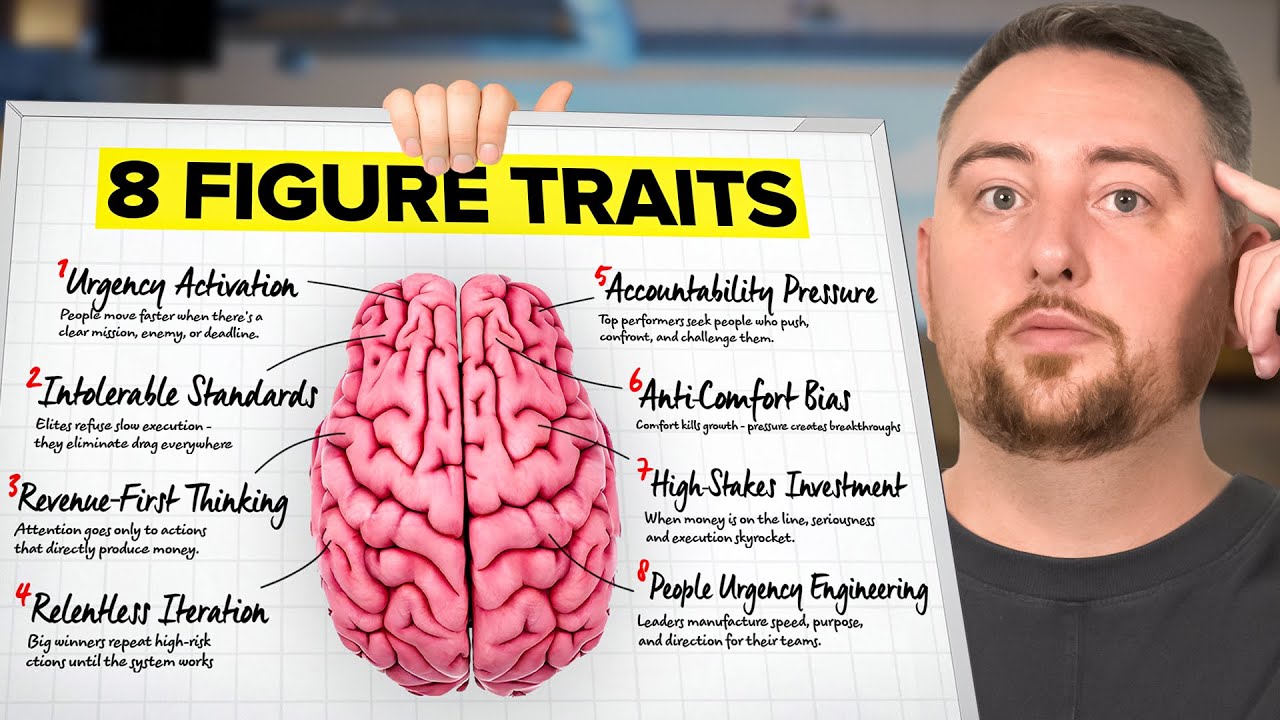
What these people generally do is they incite urgency and to a degree chaos.
Not in a way that would create instability. Not in a way that would do anything other than just insinuate there’s a need to do something fast, right?
There’s some kind of – it could be a classic like how movies are ripped. Could be an enemy that they’re trying to defeat. Could be some grand heroic mission or scheme that they’re on. Could be that something is like chasing them and they’re consistently bringing that up to their staff which keeps their staff on edge and it gets everybody in this position where they got to do a ton more stuff faster.
The Snowflake CEO, respectfully that guy, I don’t remember his name. They at the time that I looked this up literally yesterday when I was talking to Josh about it, they currently as a market cap are worth about $87 billion. A respectful $87 billion.
And this Snowflake CEO, he said the same thing in a recent article I was reading about what he thinks of his staff’s culture and like what his job is as the lead executive, you know, and he cited the exact same lesson.
It’s like my job is to create urgency.
And the example that he used in the article was look no further than your local DMV to get an idea of how human productivity can look if there is no incited urgency. There is no insinuated urgency. There is nothing that manufactures why we got to do things faster.
Humans naturally fall to the most baseline low level of energy conservation and to a degree laziness that they could do, right?
The only reason that we all work at an aggressive pace is because there’s a reason or a set of reasons to do so.
So I told Josh, I shared this set of lessons with him and I was like, “Bro, your job, you have to go out there and you have to generate this urgency. You have to remind them of the reasons. You know, you have to make them extremely clear on why they’re doing what they’re doing and consistently press them on that.”
He was like, “Bingo. That’s exactly what I was looking for.”
And now, just to be clear on this, so you really understand it and can have a strong takeaway.
In practice, this should be an example where you’re filming some ad content, right? And the ad content that you filmed, it took you like three, four weeks, whatever amount of time it took, some ridiculous audacious amount of time.
When in reality, it should have been as simple as get the ad ideas executed, go film the ad ideas literally that day, and then get those ad ideas edited and back to you the following day or maybe the day after, because urgent, time-bound execution often drives faster output and helps avoid the inefficiency and delay common when tasks stretch out.
And that’s with Andromeda practices factored in where you’re filming like 25 to 50 ads at a time instead.
And I’ve seen this a lot too inside of businesses that do like a mid-range couple hundred grand or low couple hundred grand. They just tolerate it. It’s just tolerable.
Oh, it’s going to take this long because of who cares, right?
Your job in that example in practice is to be like, “No, it literally can’t take that long.”
It can’t. I have heroic mission. I have this thing we’re trying to run away from. I have this thing we’re trying to defeat.
You got to have like a grand set of reasons that aren’t frivolous things that when you bring them up, your people believe in them too and it insinuates a need for speed.
You’ve got to become intolerable. No more of this lolly gagging stuff that you just deal with, right?
That you try to act like it’s some normal thing. You’re trying to be cool. You work with these people. You become friends with these people. You like these people. You respect these people.
But at the end of the day, you have to be the one to press these people to get things done far faster, right?
And you don’t have to be a jerk while you do it. That’s the coolest part about reasons to do things.
Think about the level of human risk and sacrifice that has been endured over a broad duration of time since we’ve existed as a result of strong reasons to do so.
You know, back in the day when we discovered good old America, and by discovered I mean we took some boats from Western Europe over to the good old Eastern United States, those people – they went on wood boat with whatever they took, like alcohol and tea and who knows what kind of food, right?
They had terrible living conditions. You ever been on a boat with big old Atlantic like 20-foot waves in a rickety wood boat? No.
In the 1700s, who knows what kind of diseases were going on back then. Think about it. That level of risk wasn’t taken just because – it was taken because they had some strong reasons to do so, right?
And think about what happened when they showed up. This is very important. You understand this, right?
And once we colonized and once we started some settlements, right? And taken over a little bit – people started heading out west.
Most of America in between the eastern Appalachian Mountains and the Rocky Mountains is pretty flat. It’s relatively flat. Not a lot going on.
Let’s say from like eastern Colorado all the way over to Tennessee before the mountains start in that range, right? You’re heading out west is pretty chill.
And then all of a sudden, bam, you got the Rocky Mountains. You have to cross big old 14,000 ft rocks with messed up conditions and let alone who knows what else. You’re dealing with a whole another type of animal probably preying on you back then again.
What is the point? What is the point of them going out that far? Why did they do it? Why did they endure that?
They did it by the way on wagons with horses, dog.
You understand the level of risk they took?
Meanwhile, you have your editors tell you, “Oh yeah, I can’t get the content done for like I can only do one piece a day.”
You know, and by the way, you besides the fact that you may be pressing them and they may be slow, your tolerance to still hire that type of person goes back to the same point.
If you were just an intolerable dude that didn’t let anything at all hold you back, you wouldn’t have those editors in the first place, dude, you’d be ripping at much faster speeds.
You understand? It’s like, and this goes across the board. It’s every single person in your team.
That’s your job is to be the intolerable person running around pointing your finger and be like, “You forget why we’re doing this.”
You know, that’s what culture is. Culture is a shared set of beliefs with some person at the top talking about some mission that we’re on and genuinely and deep belief that that’s real.
That’s the thing. It’s like nobody does anything, nobody does anything without some serious reasons to do so.
And guess what? Everybody is cracking million-dollar months – you know how much work it takes in most instances.
There are a few extremely lean and rather efficient models I’ve seen, but again, it’s like it still takes a ton of work. It’s just amplification.
It’s like you figured something out in the couple hundred grand range. Every time you’ve tried to scale it or amplify it, it fails because you really don’t know what you’re doing and you haven’t invested.
I mean, but to be fair to you, you know, like you’re sitting here and you’re learning new stuff and you’re trying to educate yourself. You figured it out. You know, you don’t know what you don’t know. Those things are hurting you. Those things are holding you back and you’re right at the cusp – like you’re pursuing information like this but you haven’t figured out the next level of it yet which is the investment part of it.
Whatever you spend a serious amount of money on you’re much more likely to take extremely serious.
So as an example, you being stuck at a couple hundred K a month, you’ve probably tried to do things like that are smart like optimize for profit. And you’re trying to pocket as much as you can down there in that range, but you’ve also kind of become a problem by doing so.
And you’re not throwing your chips on the table at a high enough frequency to grow dramatically or to seriously leg up on your revenue over a rather short duration of time.
You’re not taking big swings anymore. You’re taking like little swings.
I’ll give you a great one. So I hate stories like these, but I come across them rather frequently, especially with newer Inner Circle members.
Most of the guys in the Inner Circle that stay between $100K and $300K a month, like especially when they first join in, when I see those guys without even remembering what their revenue is, like they’ll start talking to me about some stuff and I’ll ask them, I’ll be like, “Are you still between $100K and $300K a month?”
And they’ll be like, “Yeah.”
And I’m like, “Dude, man, you guys, dog.”
You know, it’s like clear as day, the patterns they have. They all have relatively the same things that they do and the same patterns they fall into.
And here’s one of the number one culprits, and it still falls under this tolerance umbrella.
They’ll try something at a small level. It’ll barely work. They’ll either run out of risk money and so they can’t necessarily take that risk again. So they revert back to some kind of safety thing they’ve been doing. That’s kind of like a consistent strategy that generates some amount of money.
They recoup a little bit of that risk capital and then they try it again. And they tried it at such a slow frequency and most of them unfortunately just stop. They just stop. They just stop taking the risk. They stop trying it again.
And this in practice would look like you try a webinar out, you did an absolutely terrible job – instead of trying another webinar weekly for like three months in a row until you crack it, you either don’t have enough money to do that or two, you’re just scared out and you’re like, “Ah, whatever. I’m just going to go back to doing this other thing instead.”
It’s like, dude, the million-dollar a month earners, they would never do that. They would never do that.
We had a client, he did $25 million a year before he hired us in another business and another offer he had. He goes, “Hey, I want to hire you to do this specific offer that I got.”
I’m like, “Yeah, dude. Let’s let it rip. Let’s go.”
This guy did three months of weekly cold webinars, either breaking even or losing a little bit of money every single week until show rate was dialed, webinar was dialed, call booking rate was dialed, show rate for the calls was dialed, close rate for the calls was dialed.
This is a brand new offer. Zero social proof. Nothing to lean on. Just iterating in real time, right?
By the third month, all of a sudden, 4:1 ROAS. We’re scaling it, right?
It’s like, dog, that guy endured for three months. And yeah, you’re probably sitting here like, “Well, yeah, he had $25 million a year he was making. Why do you think he was making $25 million a year?”
You flash back to way before that. He was doing the same thing, throwing his chips on the table, letting them sit there waiting. God forbid they get smashed by a sledgehammer, but instead they get gold coins tossed at them.
You get what I mean? It’s like, you have to keep them on the table. You got to endure. You got to keep trying. You got to be intolerable to loss. You got to be intolerable of it failing. You got to be intolerable to slowness.
You get what I’m saying?
Here’s the other thing that I want to really point out. There is a really important type of character that you got to learn to demonize.
We call it demonizing the corpo.
One thing that we’ve seen time and time again, and I want to be fair and saying that there’s plenty of big businesses, like I’m talking substantial businesses that are very corporate, that are extremely like professional in the traditional sense. You know, people show up in like suits and that is not what I’m talking about.
You know what I’m talking about. I’m talking about people like you and I. People that sit here that do the things that you and I do that have some kind of high ticket product or service business, leverage a personal brand, leverage social media, like leverage new day and age business lessons and ways of doing this.
Like, you’re not like them.
And when people try to take like this super corporate character type and apply it to like your type of business, oh my goodness, does it hurt them, right?
Just recently, we actually had an Inner Circle member who’s no longer an Inner Circle member from how often we’d call him out on this behavior pattern.
This guy had one problem and one problem only. His problem was he was stuck at $600K a month for like a year, dude. Like a year at best. In his best months, he’d crack $800K. And whenever he’d tell you a story about his revenue, he’d make sure to mention that. But in his reality, $600K was his pocket.
This guy in the Inner Circle chat would ask questions about the things that didn’t relate to his one problem. His one problem being, why is he stuck at that revenue level?
And why he was stuck, he just needed more qualified calls. That was it. He had enough sales capacity. He just didn’t have enough qualified calls coming in per day to fill that calendar capacity.
Instead he would ask questions. Have you ever heard about EOS?
EOS, no offense to EOS, because I’ve seen it in practice and it’s cool when you have that type of business and you’ve reached that set of problems to implement. Sure.
But to be clear, this guy is not smart for focusing on EOS at this given time.
Like he came in the group, he asked a question like, “Hey, I need like one marketing metric to track for our marketing meetings as it relates to this like EOS system.”
I hard check him out of them. And I’m like, “No, dude. That’s not what you need to focus on. You focus on getting more qualified calls. Like, get back in the trenches and figure out what is preventing those from coming in. Is it your messaging is bad? Is it you’re not spending enough money? Is a specific metric within your current funnel inefficient? So that’s losing you confidence. You need to fix that first so you can then just spend more money. Like, what is it?”
You know what he says instead? He messages me, hey, I don’t think it’s a good like coaching fit/style. And he drops out prematurely.
It’s like good. We demonize that type of person. We don’t want that type of person because guess what?
From my pattern recognition of what I’ve seen so many times over, helping people crack million-dollar months, working with the people cracking million-dollar months – and keep in mind, there are such a small percentage of businesses on Earth that crack those numbers.
You can get all professional and corporate later if you want. The first thing you got to do is get bigger. You got to get bigger before you do that kind of stuff.
And in almost all instances, what getting bigger looks like is being extremely tapped in to whatever is holding you back in the trenches — because entrepreneurs’ actions and consistent effort (with awareness of bottlenecks) have been empirically linked to higher venture success and growth.
Whatever is, and in his case, in this specific example I’m articulating to you, the qualified calls, getting your show rate up, getting the sales team expanded.
We’ve had guys in the Inner Circle, one comes to mind, he joined in a couple months ago, talks a lot of hot stuff like, “Dude, I can’t believe this guy, or this guy’s making a million dollars a month. Like, I think those guys aren’t smart. Like, I can do it, too.”
I’m like, “Well, prove it, bro. Prove it. What’s holding you back?”
He says, “Oh, my sales team capacity is currently full.”
And I’m like, “Hire more salespeople?”
Took this guy three months to hire more salespeople. Three months. Why? He wasn’t tapped into any reasons. He didn’t have any urgency himself, let alone the ability to impress upon the organization that they needed urgency, too.
Just lolly gagged.
And that guy was around $300K to $400K a month. That guy now, he’s around $600K a month because he finally did exactly what he needed to do.
Get back in the trenches. Hire some salespeople. Don’t make the problem sound more complicated than it is. Just bias towards an aggressive level of action, become intolerable, and demonize the corporate stuff that sometimes comes up along the way.
That kind of stuff is like a facade. It’s an illusion. It makes you think like, “Oh, I need to implement like I have staff now. Like, I need to implement EOS into my business when I’m only doing a couple hundred grand a month and there’s like a handful of us that I need to talk to.”
It’s like, “No, you don’t, bro. You need more qualified calls onto that calendar. And you need more sales people. And you need ways that you can consistently produce more of that day in and day out so you can comfortably and consistently risk building your team out further for your sales team and spending more cash. That’s what you actually need. You don’t need one metric to track inside of your marketing sales team calls because that’s not going to give the picture of what actually needs done in real time. You need to stay tapped in in the trenches to all those stats.”
You get what I’m saying?
And I want to be really clear. And this is also really important. I’ll close it out with this.
There is an extreme level of accountability that all these big dogs welcome into their lives. They love accountability — and studies show entrepreneurs with higher self-efficacy and stronger internal motivation, supported by accountability and self-discipline, tend to achieve better business performance.
Men, I can’t tell you enough how much a high earner appreciates somebody being on their case about going harder, getting more done, accomplishing more, being more, going faster, calling them, hey, this is silly. Don’t know why you’re doing this. Think it’s a little not smart. Do this instead.
They’re like, perfect, dude. Thank you. You know, they need a push. They need a push.
And one thing that happens when you are at the lower levels of the game, usually you got yourself there and you didn’t start buying that accountability. You didn’t start making the investment into yourself to take things much more seriously than you do now.
And as a result of that, you’ve kind of gotten complacent to a degree.
You know, recently I personally hired an amazing coach and she’s actually a girl. And this specific coach brought me some awareness around my mental state that I just hadn’t considered before.
And as soon as she brings me that awareness, not only am I appreciative of it, I seek more of it because the expansion of self when you’re rich and trying to get a ton richer is one of the most important things to stay tapped into.
You can’t forget that what got you to the couple hundred grand a month or what got you to that first million a month is in almost all instances an extremely long-term personal development journey started with you just taking action started with you increasing your awareness.
Could have been books, mentors, courses, an event, some random set of content like this online that just kicked you into gear.
And the consistent consumption and application of that information improved your circumstances time and time again until you finally got to the opportunity you’re at where you’re at.
And then you got complacent. You got comfortable. You stopped improving. You got to the point where you forgot what got you here.
And I’m telling you now, life has a funny way of rug-pulling you and putting you in a position where you take that time and attention and put it right back onto personal development again so you can continue improving.
You got to remember, this is extremely important to remember. If you feel complacent, if you feel like you’ve been stalling, it’s generally from two things.
You have not pursued new information. New information loads your brain up with new ways to think. And when you have new ways to think, you quite literally have new possibilities, new options, new literal things to think with that weren’t previously in your brain.
You have to consume new information to think with new options. And when as a result, you pursue that new information and you have those new options, you can do more literally. More is available for you to think with.
When you do not pursue new information, you’re left with whatever’s in your head to think with. And that can only get you as far as it can get you. That may be a reason you’re stuck.
In addition to that, the other reason is what I’m talking about right now when it comes to accountability. You have nobody in your life that’s just kicking you into high gear.
And whichever one of those two reasons it is, or maybe it’s both, I got you. That’s my job to help rich people get richer.
I’ve dedicated my life, I’ve dedicated my business to that pursuit. You know why? Because I get richer when I help rich people get richer. And I love money. And I don’t virtue signal about it.
My job is to take you to a greater point than you’re at now. And what I encourage you to do beyond just reading my content, step up and throw some money at me.
Watch how much more impressed you’ll be about what I can help you accomplish when you pay for the information that I have available to you. When you pay for that accountability that I have for you on the other side of my products.
Ideally, you’re sitting here reading this at a couple hundred grand. Maybe you’ve already cracked that first million a month.
What I can teach you isn’t theory. It’s the exact playbook my team has used to build multi-million-dollar businesses. With Master Internet Marketing, you get lifetime access to live cohorts, dozens of SOPs, and an 80+ question certification exam to prove you know your stuff.
Twice a month, one-on-one calls, weekly group calls. We do quarterly masterminds right here at our venue in good old Miami, Florida. Four times a year, we do that.
Pretty much every speaker nowadays is somebody in the group that just got a million dollar a month trophy or a $5 million a month trophy sharing their lessons about what they did to accomplish it.
We have an extremely active group chat full of high performers, dude. High performers. There’s no broke people in that group. They’re all high performers. They’re also all very active.
There’s a big old course vault of incredible information. Each piece is meant to be that one thing that helps pay for the entire year.
You get what I’m saying?
And in addition to that, we have unlimited access to Jeremy AI. Jeremy AI is an incredible resource. You’ll appreciate it just as everybody in that group does.
You also have what’s called Master Internet Marketing, an incredible program. One-time transactional cost. We’ll still vet you and make sure you’re the right person. There’s no income restrictions. You don’t have to be in there for a certain amount of time. You get lifetime access.
And coolest part is we update the class on an annual basis. We give you the best, freshest, most up-to-date information we can. And it is extremely in-depth.
Whichever program is best for you, go take the action because here’s this closeout lesson.
And this is really important you understand this for why I’m encouraging this. I know it sounds basic. I’m trying to pitch you my own stuff, but this is extremely true.
What you spend a good amount of money on is what you’ll take most seriously.
When you finally step up and start spending some serious cash on ad spend again, you are going to take improving that funnel so much more seriously than you do right now.
When you get to the point where you have enough payroll going out, you are naturally going to evolve as a leader and become far more of a man or far more of a woman than you are right now.
In addition to that, you have a dramatically higher probability to get far more results when simply put, you invest a ton more money than you make right now. A ton more than you’re comfortable with.
You know why? Because you have to.
And at the end of the day, every time that your back’s been against the wall, you’ve managed to do a ton more than you ever would when you’re in some comfortable position.
You’ve accumulated cash. You built your cash flow to the point that you’re at. And again, you’ve just become stagnant and comfortable because you’re not taking big swings anymore, man. You’re not taking big swings.
And guess what? If you do finally step up and you are ready to take a big swing or you’re in the middle of a big swing, when is the best possible time to invest into additional help and additional accountability and additional awareness?
Right before, during it, or even right after.
Most business owners waste years figuring out what actually works. In my Master Internet Marketing program, I compress that learning curve into 7 weeks, covering copywriting, funnels, ads, and more. If you’re ready to invest $5k and get serious about your skills, apply here.
It’s always a pleasure to help you in your journey of getting richer.
Talk soon.
Watch the video:

Jeremy Haynes is the founder of Megalodon Marketing. He is considered one of the top digital marketers and has the results to back it up. Jeremy has consistently demonstrated his expertise whether it be through his content advertising “propaganda” strategies that are originated by him, as well as his funnel and direct response marketing strategies. He’s trusted by the biggest names in the industries his agency works in and by over 4,000+ paid students that learn how to become better digital marketers and agency owners through his education products.

Jeremy Haynes is the founder of Megalodon Marketing. He is considered one of the top digital marketers and has the results to back it up. Jeremy has consistently demonstrated his expertise whether it be through his content advertising “propaganda” strategies that are originated by him, as well as his funnel and direct response marketing strategies. He’s trusted by the biggest names in the industries his agency works in and by over 4,000+ paid students that learn how to become better digital marketers and agency owners through his education products.



This site is not a part of the Facebook website or Facebook Inc.
This site is NOT /endorsed by Facebook in any way. FACEBOOK is a trademark of FACEBOOK, Inc.
We don’t believe in get-rich-quick programs or short cuts. We believe in hard work, adding value and serving others. And that’s what our programs and information we share are designed to help you do. As stated by law, we can not and do not make any guarantees about your own ability to get results or earn any money with our ideas, information, programs or strategies. We don’t know you and, besides, your results in life are up to you. Agreed? We’re here to help by giving you our greatest strategies to move you forward, faster. However, nothing on this page or any of our websites or emails is a promise or guarantee of future earnings. Any financial numbers referenced here, or on any of our sites or emails, are simply estimates or projections or past results, and should not be considered exact, actual or as a promise of potential earnings – all numbers are illustrative only.
Results may vary and testimonials are not claimed to represent typical results. All testimonials are real. These results are meant as a showcase of what the best, most motivated and driven clients have done and should not be taken as average or typical results.
You should perform your own due diligence and use your own best judgment prior to making any investment decision pertaining to your business. By virtue of visiting this site or interacting with any portion of this site, you agree that you’re fully responsible for the investments you make and any outcomes that may result.
Do you have questions? Please email [email protected]
Call or Text (305) 704-0094