
Why Your AI Market Research Keeps Giving You Generic Answers

I hope you enjoy reading this blog post. If you want my team to just do your marketing for you, click here.
Author: Jeremy Haynes | Published November 10, 2026
Earnings Disclaimer: You have a .1% probability of hitting million-dollar months according to the US Bureau of Labor Statistics. As stated by law, we cannot and do not make any guarantees about your own ability to get results or earn any money with our ideas, information, programs, or strategies. We don’t know you, and your results in life are up to you. We’re here to help by giving you our greatest strategies to move you forward, faster. However, nothing on this page or any of our websites or emails is a promise or guarantee of future earnings. Any financial numbers referenced here, or on any of our sites or emails, are simply estimates or projections or past results, and should not be considered exact, actual, or as a promise of potential earnings – all numbers are illustrative only.
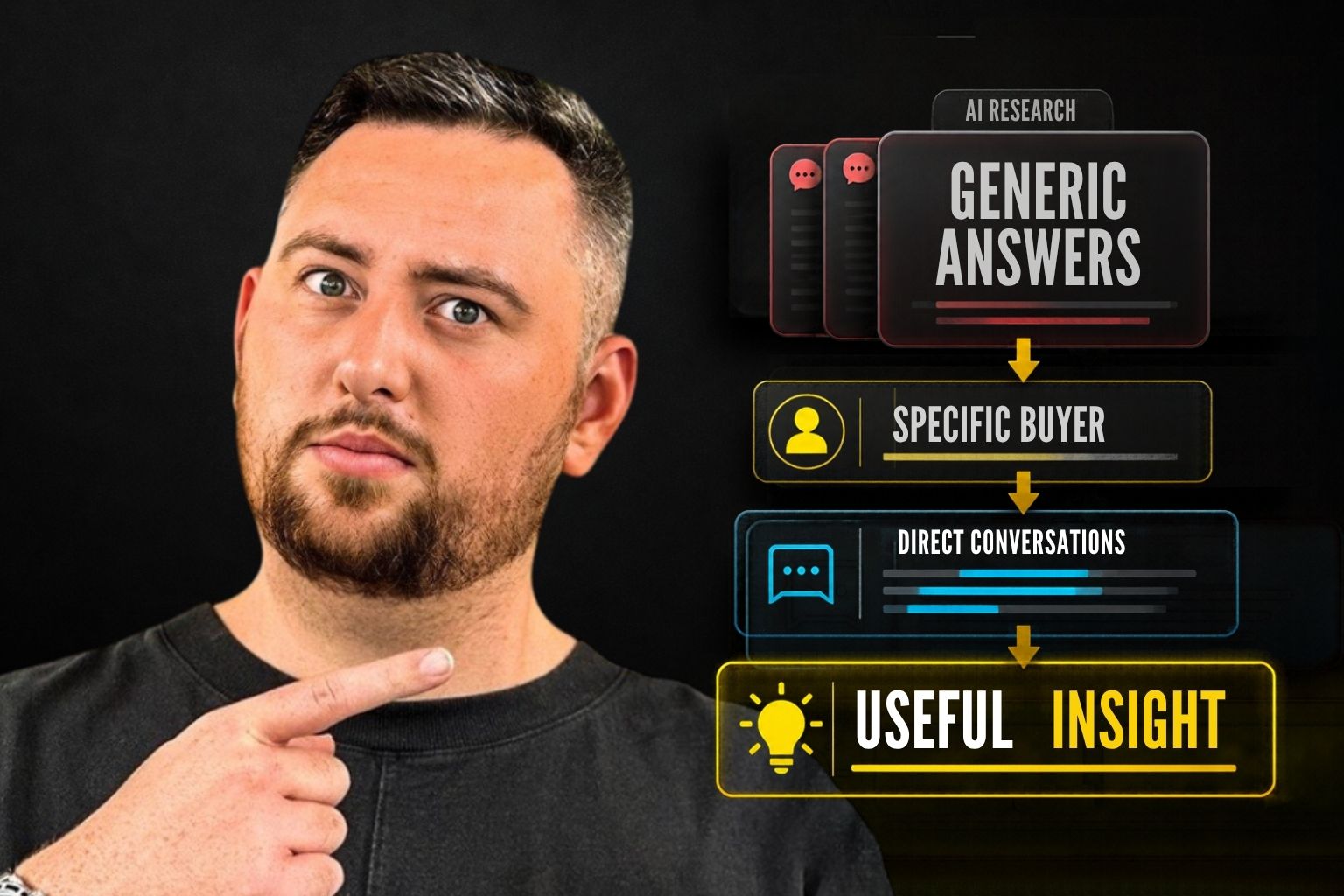
If your AI market research could describe almost any business, look at what you gave it. A broad industry name and a request for pain points usually leave you with familiar answers. More leads. More time. Less stress. You still have very little you can use to persuade the person you actually want to sell.
I want you to get specific about that person, their circumstances, and the outcome they care about. Then use AI to help investigate real material from that market. You need to understand why somebody would want your offer enough to act, and what might make the offer wrong for them.
Already making money? See what it takes to make a lot more.
Tell AI Which Buyer You Actually Want to Understand
Start with the customer you are trying to reach. Business owners is too broad for a useful research assignment. A new operator looking for a first customer faces different problems from an established operator whose team cannot handle the demand already arriving.
Give the model the differences that matter to your offer. What does this person sell? How does the business get customers? What have they already tried? What resources do they have, and what work are they willing to do themselves?
Keep known information separate from your assumptions. If you believe your best buyers already have a sales team, say whether that comes from actual customer conversations or whether it is something you still need to check. Otherwise, the answer can quietly build on a condition you have never established.
The desired outcome needs the same precision. Someone may say they want to scale while caring most about steadier collections, fewer delivery problems, or a business that requires less of their attention. Those are different reasons to buy, even when the person uses the same broad language.
This is the research underneath building an offer for cold traffic. Stay with understanding the buyer here. Choosing the price, delivery, and complete offer comes after you have better information about what the person wants.
Give the Model Something Real to Investigate
There is a big difference between asking AI to imagine customer problems and asking it to examine actual conversations about those problems. Public discussions can give you material to investigate before you speak directly with potential buyers.
Look where the audience talks. Reddit, X, Instagram, and TikTok can surface questions, frustrations, and competing explanations. The useful location depends on the buyer. A pile of posts from people who cannot or would never buy your offer can send the research in an unhelpful direction.
Keep the original material available. If the tool can access a page, confirm what it actually retrieved. If it cannot, provide the relevant text you are allowed to use. A model saying it reviewed a discussion is worth checking before you accept its conclusions.
Ask it to identify the problem being described, the circumstances surrounding it, the attempted solution, and the outcome the person wanted. Those questions keep the task close to the evidence. You can then inspect whether the proposed themes reflect what people actually said.
The SBA’s market-research guidance distinguishes existing sources from research conducted directly with consumers. Published information can provide useful context. Conversations with your own intended buyers help answer questions specific to your business.
Public posts are a place to begin learning. Their visibility does not tell you how common a problem is across your whole market or how much someone would pay to solve it.
Ask What Happened Before Accepting a Broad Pain Point
Suppose the answer says agency owners need more leads. That might be relevant, but it leaves the most important part unanswered. Why do these particular owners think they need more leads?
Imagine one owner has a new sales hire with an empty calendar. Another has plenty of inquiries and very few suitable buyers. A third loses opportunities because nobody follows up. They can all ask for more leads while needing help with very different parts of the business.
Ask the model which statements in the supplied material support each interpretation. Then look for the missing question. If the discussion never mentions lead quality, you still need to ask about it. Filling the silence with a confident explanation would give you a cleaner answer and less reliable research.
Follow the chain into the consequence. What does the problem stop the buyer from doing? What have they spent trying to fix it? Why did the previous approach disappoint them? What would make another attempt feel worth the effort?
You are looking for detail that changes the marketing decision. A customer saying the previous provider needed too much of their time might affect how you explain the work required from them. It does not automatically mean they want every part of the service done for them.
That extra question can save you from building a delivery promise around your own interpretation of a complaint. Let the buyer explain what would have made the experience useful.
Keep Customer Language Attached to Its Context
AI can make a messy conversation easier to read. It can also smooth away the part that made the statement useful. A buyer describing a specific failed attempt can become a generic sentence about wanting efficiency.
Keep the original wording beside the summary while you review it. Look at what happened immediately before and after the statement. A complaint about a service may really concern how that service was introduced, the expectations it created, or the work the customer discovered later.
Ask for exact passages only when they exist in the material. Check them yourself. If the model offers a polished sentence that nobody actually said, treat it as proposed copy. Keep it out of the customer evidence.
NIST identifies confidently stated false content as a generative AI risk. A realistic quotation, source link, or market statistic can still need verification. Read the source before letting the apparent precision change your offer.
You also need to know whose language you collected. Buyers, unqualified inquiries, competitors, and people giving general advice can all discuss the same subject. Their comments have different value when you are deciding how to reach your next customer.
A useful summary makes those differences easier to inspect. If it blends everybody into a single audience profile, go back to the source material before writing the ads.
Use Buyer Conversations to Challenge the AI Summary
Talk to the people you want to sell. That is where you can ask the follow-up question a public thread leaves unanswered. Show interest in what actually happened instead of trying to get someone to agree with the answer AI produced.
Ask about the last time the issue showed up. What did they do? What alternatives did they consider? Why did they choose one? What happened afterward? A specific experience gives you more to examine than a general statement that a better solution sounds appealing.
If you have existing customers, look at why the right ones bought and what they value after using the service. Keep room for evidence that challenges your preferred explanation. Someone may have bought for a reason you barely mentioned in the pitch.
Do the same with suitable people who declined. A refusal can concern timing, trust, price, or the way the work is delivered. Ask enough to understand which objection actually mattered. Do not let the model assign a convenient reason to a person you never asked.
That helps when deciding what the offer needs to make clear. The research should narrow a real uncertainty. If every conversation ends up confirming your original idea, look at whether the questions gave people much opportunity to disagree.
Before uploading any customer material, remove unnecessary identifying and sensitive details and use an approved tool with appropriate permissions. The FTC’s guidance on protecting business-held information recommends keeping only the information a business needs. You can investigate buying concerns without giving a research tool someone’s private payment details.
Turn the Findings Into One Clear Marketing Decision
A long research document can still leave you unsure what to do. Choose the decision the information is supposed to help you make. Perhaps you need to explain who the service is for, answer a recurring concern, or understand why a suitable buyer keeps choosing another option.
Ask AI to connect each suggested change to the evidence you supplied. Which buyer statement supports it? What remains uncertain? What would you need to hear or observe before making a bigger change?
For example, if qualified prospects repeatedly misunderstand how much work they must do, you might test a clearer explanation of their responsibilities on the page. That is a limited response to a specific finding. Redesigning the whole offer would require more information.
Keep the research conclusion and the test result distinct. People expressing interest in an idea helps you choose something to try. Their later response to the actual offer tells you more about whether the change helped.
This is also where research differs from using AI to produce more funnel tests. Speed is useful once you have a worthwhile question. Generating variations of a vague assumption can keep the team busy while teaching you very little.
In my Inner Circle, bring the buyer evidence and the decision you are weighing when you want other operators’ perspectives. A concrete disagreement between what you expected and what customers said gives peers something useful to challenge.
Results are not typical. Your results will vary and depend entirely on your individual capacity, business experience, expertise, and level of desire. There are no guarantees concerning the level of success you may experience. The testimonials and examples used are not intended to represent or guarantee that anyone will achieve the same or similar results. We don’t believe in get-rich-quick programs. We believe in hard work, adding value and serving others. As stated by law, we can not and do not make any guarantees about your own ability to get results or earn any money with our information, courses, programs, or strategies.
7 weeks. Real frameworks. Covering copywriting, funnels, paid ads, and conversion systems.
Stop Asking AI to Know a Buyer You Have Not Studied
You can ask a model for another version of the same broad analysis all afternoon. If the missing information is why your intended buyers rejected the last solution, eventually you have to go find that out.
Use the tool to organize what you have learned, expose gaps, and prepare sharper questions. Keep asking whether the answer is specific to the person you want to reach and whether the supporting material actually says what the answer claims.
The same discipline matters when using AI to help with business work. Give it a clear task and relevant information. Review the result before letting it drive decisions the underlying evidence cannot support.
Master Internet Marketing, my 7-week live comprehensive training, is an option for developing the marketing skills you apply after the research. Your understanding of the buyer still has to come from paying attention to the market you actually intend to serve.
Results are not typical. Your results will vary and depend entirely on your individual capacity, business experience, expertise, and level of desire. There are no guarantees concerning the level of success you may experience. The testimonials and examples used are not intended to represent or guarantee that anyone will achieve the same or similar results. We don’t believe in get-rich-quick programs. We believe in hard work, adding value and serving others. As stated by law, we can not and do not make any guarantees about your own ability to get results or earn any money with our information, courses, programs, or strategies.
Start with one question your business needs answered. Find real material, talk with suitable buyers, and use AI to help you make sense of what you found. You should finish knowing something more specific about the customer than you knew when you opened the tool.
Get my content first on Google
Add jeremyhaynes.com as a preferred source and Google shows my articles more prominently in your search results, including AI Overviews and AI Mode.


Jeremy Haynes
Owner and CEO of Megalodon Marketing
Jeremy Haynes is the founder of Megalodon Marketing. He is considered one of the top digital marketers and has the results to back it up.