
Which Ads I Would Pause When Cash Collections Fall Behind

I hope you enjoy reading this blog post. If you want my team to just do your marketing for you, click here.
Author: Jeremy Haynes | Published October 13, 2026
Earnings Disclaimer: You have a .1% probability of hitting million-dollar months according to the US Bureau of Labor Statistics. As stated by law, we cannot and do not make any guarantees about your own ability to get results or earn any money with our ideas, information, programs, or strategies. We don’t know you, and your results in life are up to you. We’re here to help by giving you our greatest strategies to move you forward, faster. However, nothing on this page or any of our websites or emails is a promise or guarantee of future earnings. Any financial numbers referenced here, or on any of our sites or emails, are simply estimates or projections or past results, and should not be considered exact, actual, or as a promise of potential earnings – all numbers are illustrative only.
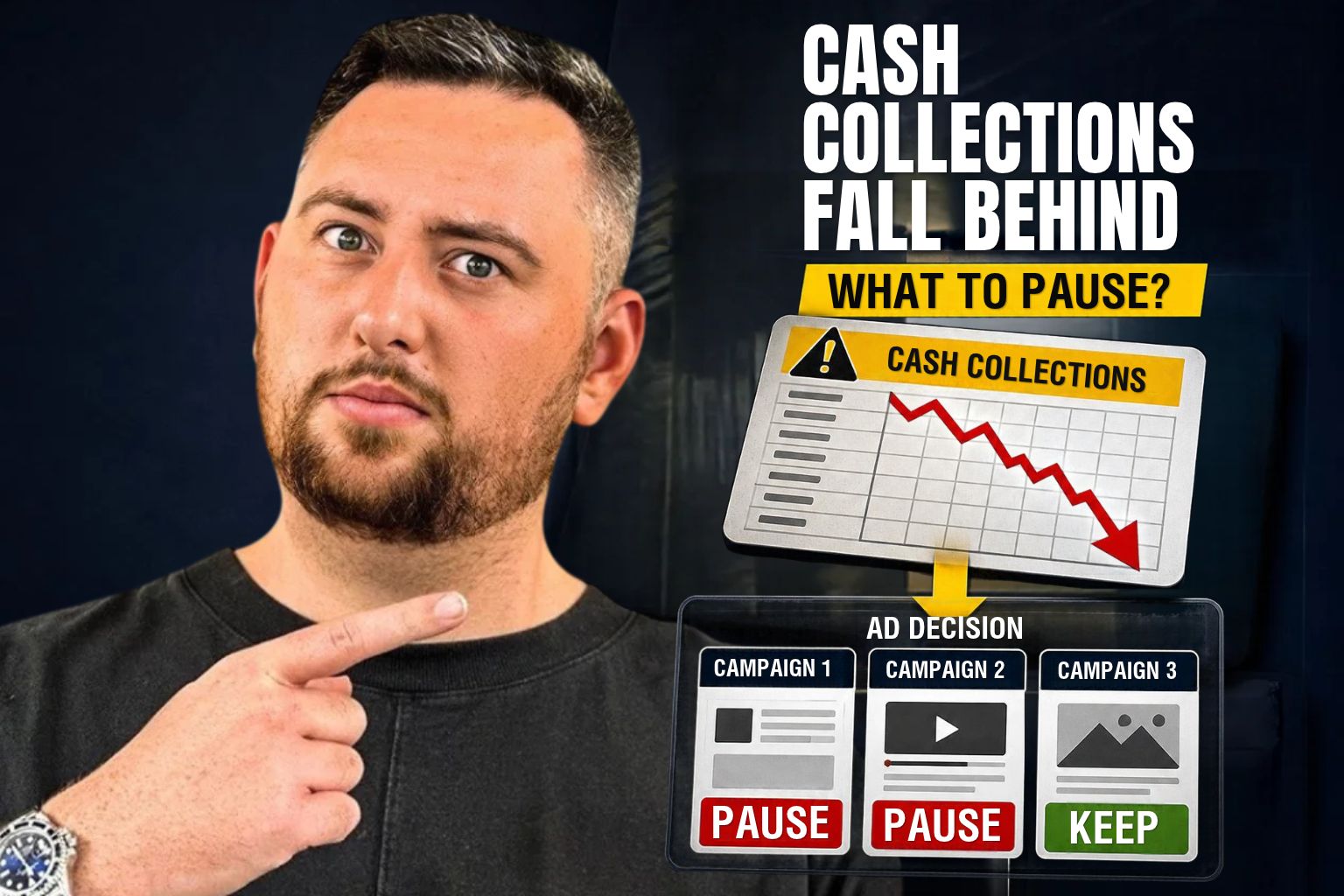
If ad spend has been ahead of cash collected for a month, another good-looking sales report will not settle the problem. Money is leaving now, while part of what you sold may still be a promise to pay later. Before shutting everything off or increasing the budget to force a turnaround, work out which campaigns are earning their place and which spending the business can no longer support.
I want the advertising decision made with collected cash in front of me. Contract value can help explain what was sold, but it cannot pay the bill before the buyer pays. A campaign can generate interest, booked calls, and signed agreements while the business keeps funding the gap.
The next move depends on why that gap exists. You might have a collection delay, a weak step in the sales process, or acquisition that does not work at the current cost. Those situations need different responses. Cutting every campaign together hides the distinction just as easily as leaving every campaign running.
7 weeks. Real frameworks. Covering copywriting, funnels, paid ads, and conversion systems.
Find Out Whether the Gap Is Timing or Performance
Start by tracing the spend through the actual sales and payment process. Find the point where the expected money stops becoming real money.
What did the traffic produce? Which leads booked and attended? Which conversations became sales? What did those buyers actually pay? If you skip those questions, you can blame an ad for a collection problem or excuse a weak campaign as a temporary delay.
I use cash collected per sale in my funnel math. A call funnel’s budget depends on what the sales process can produce at a cost the business can support. The full advertised price does not belong in the collected-cash column unless it was collected.
A timing gap has evidence behind it. You can identify completed sales, agreed payment dates, and the reason the money has not become available yet. A performance problem shows up earlier, such as paid bookings that do not attend or sales conversations that fail to close.
Sometimes you have both. An offer can close poorly and collect slowly from the buyers who do purchase. Be willing to say that rather than choose whichever explanation makes the account look better.
The time between acquisition spend and usable collections matters here, but knowing that a delay exists is only the start. You now need to decide what to do with the spending already running.
Match Each Campaign to the Money Its Buyers Paid
Compare a campaign with the payments from the buyers it brought in. The total deposits for the business can hide what current acquisition is doing.
Older customers may be paying installments while newer campaigns generate sales that collect very little upfront. The bank balance receives both. If you give all that cash to the latest campaign in your report, you can convince yourself it is paying back faster than it is.
Keep the purchase date and acquisition source attached to the customer record. Then compare what was spent to acquire those buyers with the money received from them so far. Separate remaining scheduled payments from money that has arrived.
You also need fair comparison periods. A recent group of buyers has had less time to pay than an older group. Comparing their total collections without looking at age can make the new campaign look worse simply because its payment dates have not passed yet.
Old collections can fund current spending without proving that current spending works. That distinction becomes especially useful when you need to choose which campaigns deserve the available cash.
Use the best source information you can verify. If a buyer touched several channels and attribution is uncertain, keep that uncertainty visible. Assigning a confident campaign label to every sale makes the spreadsheet neater while making the decision less reliable.
This is also why payment-plan collection quality deserves its own attention. A signed agreement and a record of reliable payments answer different questions.
Check Payout Delays Before Blaming Acquisition
Find out whether buyers have paid but the money is still moving through the payment system. That is a different problem from buyers failing to pay.
Stripe separates settlement timing from the payout schedule and notes that a bank can take additional time after receiving a payout. Look at your account’s actual status and expected deposit dates.
That distinction changes what needs attention. A pending payout calls for checking the processor and bank information. A past-due installment calls for checking billing and contacting the customer through the agreed process. A promised sale still waiting on a decision belongs with the sales team.
Do not count all of those as cash arriving tomorrow. Ask what evidence supports the expected date. A payout recorded in the processor gives you different information from a closer saying someone sounded ready to buy.
If the business cannot cover obligations before the payout arrives, bring that timing to the person responsible for finance. An explanation for the delay does not automatically solve the funding need.
Keep that review short enough to produce a decision. You need the relevant dates and amounts, the obligations due before them, and the spending authority that remains. Building a larger dashboard can wait if it delays answering those questions.
Decide Which Campaigns Have Earned the Available Cash
Review existing campaigns individually before applying a blanket cut. A campaign with verified collections and a workable cost structure deserves a different discussion from a test that has not established either.
Look at the money received from each campaign’s buyers, the costs attached to selling and delivering, and how long collections took. Ask whether the recent traffic is still producing the same kind of buyers. An old winning period cannot answer every question about today’s spending.
Next, identify spending that is still trying to establish a result. A new audience, a new offer, and an expansion test may all need learning time. They also need a loss the business can absorb. Cash pressure can change how much room remains for that learning.
I would ask a direct question of every unproven commitment. What are we trying to learn, what have we learned so far, and can we afford the next part? If the answer depends on payments that are already late, revisit the commitment.
Keep the maximum loss for the test visible. A campaign should not keep consuming money because the team feels close to figuring it out. The remaining cash has other jobs.
Maintaining proven acquisition can still require a lower spending level. The business may be unable to fund the level that made sense earlier. Protecting a channel means evaluating its role honestly, including what happens to future collections when its traffic changes.
The marketing education in Master Internet Marketing, my 7-week live comprehensive training can help you understand the funnel decisions. Have the person responsible for your finances assess what the company can actually commit.
Results are not typical. Your results will vary and depend entirely on your individual capacity, business experience, expertise, and level of desire. There are no guarantees concerning the level of success you may experience. The testimonials and examples used are not intended to represent or guarantee that anyone will achieve the same or similar results. We don’t believe in get-rich-quick programs. We believe in hard work, adding value and serving others. As stated by law, we can not and do not make any guarantees about your own ability to get results or earn any money with our information, courses, programs, or strategies.
Fix the Step Holding Up Cash From Existing Leads
Before paying for more leads, check whether the opportunities you already paid for are being handled properly. The weak step may be something the existing team can address.
If appointments do not turn into attended calls, inspect the confirmation experience, follow-up, and relevance of the offer. If attended calls do not become sales, listen to the conversations and compare the buyers with the people the campaign was supposed to attract.
If sales happen but collections fall short, look at what the team is presenting and what buyers authorize. Does the payment structure leave less cash upfront than the acquisition model assumes? Are the reported sales actually completed purchases?
A lower cost per booking does very little for cash when the people booked never attend. More attended calls do very little when the offer is wrong for the audience. Follow the actual sequence before deciding which metric to improve.
The next ad dollar should have somewhere useful to go. If the current process is leaving paid opportunities unhandled, increasing volume adds to that work.
For a VSL call funnel, the VSL calculator can help compare your cost, attendance, closing, and collected-cash assumptions. Enter the numbers you can support and keep the modeled outcome separate from what has actually happened.
You may discover that the campaign is doing its job while a later step needs attention. Give that step an owner. The media buyer cannot repair a missed follow-up or an unresolved billing issue by changing the ad headline.
Recover Missed Payments Without Changing the Deal
Check failed payments through the billing process you already agreed with the customer. Cash pressure should not turn into improvised collection terms.
Stripe’s revenue recovery tools include retries, customer notifications, and recovery analytics for supported recurring billing. Check which features apply to your setup before assuming the software is handling the problem.
The team still needs to know who follows up and what they are authorized to say. A failed card payment may require an updated method. A question about the service may require a delivery conversation. Treat the actual issue rather than guessing at the customer’s motives.
Keep the recovery status visible in the cash review. An amount being retried remains uncertain until it is collected. A customer saying they will update a card is useful information, but it is still a next action.
Do not shorten existing payment schedules just because advertising got ahead of collections. Changing the deal requires the appropriate agreement and professional review. Improving future terms is a separate offer decision, and it needs to work for both sides.
Also check refunds already due. Stripe’s refund documentation explains that refunds use the available balance rather than pending funds. Those obligations belong in the money decision before you allocate everything to acquisition.
Give the Media Buyer a Clear Spending Decision
The media buyer needs a specific decision about what can continue, what should wait, and what would justify another change. Telling them to be careful leaves too much interpretation.
Name the campaigns that can continue within the available authority. Name the tests or increases being held. Explain whether the constraint is collection timing, campaign performance, or sales capacity so the team can work on the right thing.
Then account for the effect of the cut. Fewer ads may mean fewer bookings. Fewer bookings may affect closer workload and the next period’s collections. Look at those consequences before treating the reduction as a complete fix.
A repeated budget ramp needs its own approval. When cash is already behind, remove the assumption that yesterday’s permission to increase spend still holds. Use the updated collection and operating position.
Give the next review a reason. It might follow an expected payout, a resolved payment problem, or enough new sales information to reassess a campaign. A review date alone should not automatically restore the higher budget.
You can maintain confidence in paid acquisition while changing the current commitment. The useful conversation is what the business can support now and what needs to improve before that changes.
Already making money? See what it takes to make a lot more.
Resume Expansion When the Missing Evidence Arrives
Resume expansion when you can explain what changed in the collections, costs, or sales process that caused the gap. A better-looking bank balance needs context before it becomes spending permission.
Check whether the money came from the campaigns under review or from older buyers. Check the obligations it still needs to cover. If you used reserve cash, reserve recovery remains part of the picture.
The month-long gap is a reason to investigate, not a universal rule for shutting off ads. Your actual payment structure and costs determine whether the current commitment is workable. A business with evidence of delayed collections faces a different decision from one still hoping the sales will appear.
Bring the actual campaign and collection records when discussing these decisions with other operators. That is a more useful conversation than arguing over whether paid ads are good or bad. You can review my Inner Circle if that peer setting is relevant to where your business is now.
For the spending decision, finish with a plain answer. Which acquisition can the business fund, which commitment is waiting, and what evidence would change that answer? Then keep the team working from those same facts.
Results are not typical. Your results will vary and depend entirely on your individual capacity, business experience, expertise, and level of desire. There are no guarantees concerning the level of success you may experience. The testimonials and examples used are not intended to represent or guarantee that anyone will achieve the same or similar results. We don’t believe in get-rich-quick programs. We believe in hard work, adding value and serving others. As stated by law, we can not and do not make any guarantees about your own ability to get results or earn any money with our information, courses, programs, or strategies.
Get my content first on Google
Add jeremyhaynes.com as a preferred source and Google shows my articles more prominently in your search results, including AI Overviews and AI Mode.


Jeremy Haynes
Owner and CEO of Megalodon Marketing
Jeremy Haynes is the founder of Megalodon Marketing. He is considered one of the top digital marketers and has the results to back it up.