
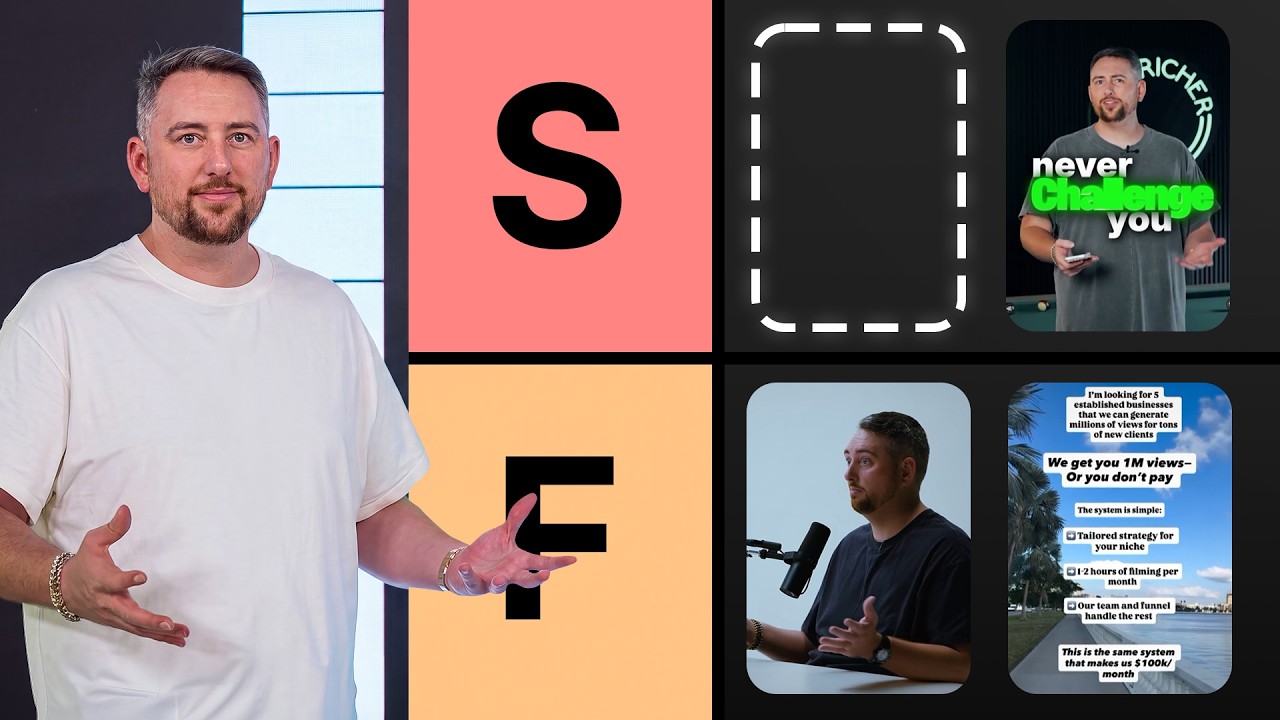
My Ad Creative Format Tier List From S Tier to Bottom

I hope you enjoy reading this blog post. If you want my team to just do your marketing for you, click here.
Author: Jeremy Haynes | Published August 17, 2026
Earnings Disclaimer: You have a .1% probability of hitting million-dollar months according to the US Bureau of Labor Statistics. As stated by law, we can not and do not make any guarantees about your own ability to get results or earn any money with our ideas, information, programs, or strategies. We don’t know you, and besides, your results in life are up to you. We’re here to help by giving you our greatest strategies to move you forward, faster. However, nothing on this page or any of our websites or emails is a promise or guarantee of future earnings. Any financial numbers referenced here, or on any of our sites or emails, are simply estimates or projections or past results, and should not be considered exact, actual, or as a promise of potential earnings, all numbers are illustrative only.
Some ad creative formats can absorb serious budget more consistently than others. My top two are static reels and talking-head videos. Both combine native execution, clear messaging, and enough production speed to support volume. Static images, AI-generated creatives, and carousels sit one tier below. Context-heavy formats lose rank when they cannot reach enough cold traffic or hold performance as spend rises.
This ad creative tier list is based on scale. An isolated win is not enough. I care about spend capacity, useful life, traffic quality, and whether a team can produce enough variations to find winners. Offer, funnel, audience, and execution can still move an individual ad up or down.
7 weeks. Real frameworks. Covering copywriting, funnels, paid ads, and conversion systems.
My Complete Ad Creative Format Tier List
| Tier | Ad creative formats | What the placement means |
|---|---|---|
| S | Static reels, talking-head videos | My most dependable formats for production volume and serious spend |
| A | Static images, AI-generated creative, carousels | Strong scaling formats with an important execution or funnel condition |
| B | Content ads, real UGC, green-screen organic, testimonials | Useful formats whose reach, authenticity, or buying-stage role can limit scale |
| C | VSL ads, podcast ads, meme ads, retargeting ads | Situational formats that depend on editing, context, or a smaller audience |
| Bottom | Completely unedited ads | The one execution I would place at the bottom when no real editing or adaptation happens |
The tier reflects the version of each format I am evaluating here. A short, tightly edited VSL can outrank a long page video dropped into Ads Manager without changes. A testimonial carousel can outperform a slow testimonial video. The format sets the starting conditions, and the execution decides whether the ad earns its placement.
Why Static Reels Earn My S-Tier Ranking
A static reel uses moving B-roll as the visual bed. Text carries the argument. The background might rotate through ten clips, but the viewer follows a sequence of written points. It gives you motion without requiring a founder or creator to deliver every line on camera.
The best versions feel like they were made inside the feed. I like using the platform’s own text treatment when possible instead of placing a polished graphic over generic stock footage. One operator used lifestyle B-roll with the copy rising from the bottom like movie credits. The format was familiar enough to read quickly and unusual enough to interrupt the scroll.
Meta’s guidance for Reels ads recommends vertical 9:16 creative, audio, and key elements placed inside the safe zone. TikTok’s performance creative guidance makes a similar case for platform-first vertical assets, sound, safe-zone visibility, and people on camera. Those details explain why a reel built for the placement feels different from a horizontal ad that was cropped later.
The production model also scales. A team can change the written argument, opening frame, clip sequence, or visual rhythm without reshooting the entire ad. That makes static reels easier to iterate when the account needs more shots at a winner.
Static reels earn S tier because native presentation and repeatable production can live in the same asset.
Why Talking-Head Videos Also Belong in S Tier
Talking-head ads are the other format I return to constantly. Pull out a phone and deliver a specific script. Add captions and a few useful cuts, and the ad is ready for a real test. Production can be simple while the message stays precise.
The advantage is volume. Your creative hit rate matters more than the emotional attachment you have to one script. I am looking for the small percentage of ads that produce a return, remain consistent, and accept more budget. A format that can be produced only once a month gives the account fewer chances to find those ads.
Talking heads let a team test different hooks, objections, proof points, offers, and calls to action. The production process does not need to be rebuilt each time. The on-camera requirement is real. A stiff delivery can flatten a strong script. A speaker who looks like they are remembering lines will lose credibility quickly. That is an execution problem worth solving because the format itself supports a high testing volume.
My guide to scaling one creative family through daily micro-tests shows how controlled variation can expand a promising argument. Talking-head footage fits that model well. Hooks and sections can be replaced without discarding everything that already works.
Inside Master Internet Marketing, my 7-week live comprehensive training, I connect this creative volume to the offer, campaign structure, funnel, and measurement plan. Production volume matters when the account can turn those assets into readable tests.
Results are not typical. Your results will vary and depend entirely on your individual capacity, business experience, expertise, and level of desire. There are no guarantees concerning the level of success you may experience. The testimonials and examples used are not intended to represent or guarantee that anyone will achieve the same or similar results. We don’t believe in get-rich-quick programs. We believe in hard work, adding value and serving others. As stated by law, we can not and do not make any guarantees about your own ability to get results or earn any money with our information, courses, programs, or strategies.
Why Static Images Start My A Tier
Static images can absorb substantial spend, and I have seen their costs remain stable as budgets rise. They miss S tier because the click is only one part of the job. The funnel has to educate the person after a low-context image earns their attention.
An image driving a webinar registration can work extremely well because the webinar carries the education. An image driving directly to a high-ticket VSL call funnel creates a different problem. The CPM, click-through rate, and cost per call may all look healthy. The people arriving may still lack the sales context they need.
That gap moves the burden to the backend. Follow-up, qualification, setters, and closers have to create context the ad never supplied. A business with a disciplined sales process may handle that traffic well. Another business may read the ad as a success while its sales team experiences weak intent.
Static images remain A tier because they are fast to produce, easy to vary, and capable of taking budget. Their final value depends on what waits after the click. My creative-testing strategy across different spend levels covers how the account’s budget changes the number of concepts and variations it can read.
When AI Creative Can Move From A to S Tier
AI-generated creative is a broad category. It includes AI UGC and cinematic scenes built with tools such as Google’s Veo. It also includes full story-driven videos that once required a much larger production budget.
I place it in A tier today because the output depends heavily on the operator. Someone with a strong prompting and editing process can produce remarkable work. A one-line prompt often creates something synthetic or disconnected from the offer. Visual continuity can disappear just as quickly.
The format is close to S tier because it can expand the number of ideas a team is physically capable of producing. It can create locations, demonstrations, characters, scenes, and transitions that would be impractical to shoot for every test. The same speed can also fill an account with expensive-looking assets that carry no useful hypothesis.
Google Ads’ creative performance guidance recommends supplying a range of quality assets and describes its generative tools as a way to produce more variations. That is the useful role for AI. It increases the team’s creative surface area, while the operator still owns the message, selection, and final edit.
AI creative reaches S tier when the production process becomes repeatable, not when one generation looks impressive.
Why Carousels Complete the A Tier
Carousels are underused because many advertisers treat them like a product catalog. The format can carry a much richer argument.
One sequence can introduce a pain point, challenge an objection, show a feature, and present proof. The final card can move into a call to action. Testimonial carousels can turn several short quotes into a swipeable proof stack. A written social thread can also become a carousel, with each idea receiving its own card.
Meta’s carousel format page notes that advertisers can use up to ten images or videos, each with its own link. It also identifies product showcases, feature explanations, stories, and step-by-step processes as distinct uses. The format gives you room to test more than one information order without asking the viewer to commit to a long video.
Carousels stay in A tier because they require someone to exploit that space deliberately. Ten cards of disconnected information do not become persuasive because a person can swipe them. The sequence needs a job, and each card needs to earn the next one.
The same briefing discipline appears in my system for briefing UGC around a clear hypothesis. Format changes should support the argument rather than replace it.
Why Four Useful Formats Land in B Tier
B tier contains content ads, real UGC, green-screen organic, and testimonials. Every one of them can produce winners. Their common limitation is that a good result does not always translate into broad, repeatable spend.
Content Ads
Content ads start as organic posts that already earned attention. Testing the paid version makes sense because the idea has a market signal. The sponsored label changes the context. An organic winner may reach a spend ceiling sooner than creative built for a paid conversion objective.
I still test these. I simply avoid assuming organic engagement predicts paid scale. Google Ads even separates organic and advertising performance in video analytics, which is a useful reminder that the same asset can behave differently across the two contexts.
Real UGC
Real UGC becomes difficult for high-ticket offers because paid creators often sound like paid creators. If the person has no lived connection to the problem, the script can feel borrowed. Strong casting and a looser brief can raise the format substantially. Those people take work to find, and production can cost more than AI UGC.
Green-Screen Organic
Green-screen creative can explain a screenshot, article, product, or visual proof while a speaker stays present in the frame. It has a recognizable feed-native look. I place it in B tier because most teams do not produce enough strong versions for the format to contribute many scale winners.
Testimonials
Testimonials move more than any other format on this list. A sharp carousel with short proof points can reach A tier. A long video with no captions, pace, or editing can fall near the bottom. The typical testimonial lands in B because it speaks to a buyer who is already comparing options. That bottom-of-funnel relevance can produce a strong return at modest spend without opening a huge top-of-funnel audience.
My system for turning testimonials into usable sales assets focuses on capture, categorization, and placement. The raw customer story matters, but the way it is shaped for the buyer determines how far it can travel.
Why Context-Heavy Formats Fall Into C Tier
C tier contains VSL ads, podcast ads, meme ads, and retargeting ads. These can work. Each depends on a narrower condition that can keep it from absorbing the same broad spend as S- or A-tier formats.
VSL Ads
A VSL that normally sits on a landing page can run as the ad itself. The length changes my ranking. A tight two-to-five-minute VSL can combine education and the click in one asset. A ten-to-twenty-minute VSL asks far more from a cold viewer. It is also harder to produce in enough volume for regular testing.
The format is worth testing when the business has limited creative inventory or a concise VSL with a strong opening. My guide to scaling a VSL call funnel covers the broader funnel conditions that still matter after the video earns attention.
Podcast Ads
A full podcast inherits the same length problem and usually makes it worse. Organic listeners choose a long conversation because they expect several moments of insight. A paid viewer did not make that commitment.
The better execution is a condensed cut. Remove the setup between useful moments and place the insights close together. That can turn a low-ranked full episode into a stronger content ad. The ranking belongs to the unedited full-podcast version, not every clip that originated in a podcast.
Meme Ads
A niche-specific meme can create an enormous click-through rate because the reference feels instantly familiar. The risk is curiosity traffic. People click because they understood the joke, while the business interprets the click as buying intent.
I judge the format on downstream behavior. If the meme creates qualified conversations, it can earn another cycle. If it creates cheap clicks and weak calls, the account learned that attention was the product.
Retargeting Ads
Retargeting ads speak to people who already watched, clicked, visited, or engaged. They can show excellent return because the audience has context. They remain in C tier for a scale ranking because the audience size is constrained by the traffic that entered before it.
A retargeting ad also needs to add something. Repeating the original message gives the person little reason to reconsider. The retargeting grid I use for warm traffic separates audiences by behavior so the next message can respond to what they already saw.
In my private mastermind, Inner Circle, operators can compare these creative decisions against actual spend, sales quality, production capacity, and funnel performance. A tier list becomes useful when it informs what a specific team should make next.
Results are not typical. Your results will vary and depend entirely on your individual capacity, business experience, expertise, and level of desire. There are no guarantees concerning the level of success you may experience. The testimonials and examples used are not intended to represent or guarantee that anyone will achieve the same or similar results. We don’t believe in get-rich-quick programs. We believe in hard work, adding value and serving others. As stated by law, we can not and do not make any guarantees about your own ability to get results or earn any money with our information, courses, programs, or strategies.
What I Would Put at the Bottom of the List
I do not have a broad creative category that I would tell every advertiser to avoid. Offers and audiences create too many exceptions. The execution I would put at the bottom is a completely unedited ad.
Unedited does not mean visually raw. Raw ads can feel direct, credible, and appropriate for a high-ticket offer. My article on why raw ads can beat polished video explains that distinction. Completely unedited means the team uploaded footage without shaping the opening, pace, captions, argument, or ending for paid attention.
A natural phone recording can still have a deliberate hook. A simple testimonial can still remove dead space. A podcast clip can still compress several useful moments. Editing is the decision to respect how quickly the viewer needs a reason to stay.
Raw can be a creative choice. Unfinished is the absence of one.
Already making money? See what it takes to make a lot more.
How to Use This Tier List in Your Account
Start with the tier and then apply your constraints. If you need more volume quickly, static reels and talking heads give you repeatable production paths. If your funnel can educate after the click, static images may deserve a larger share. Strong AI prompting or carousel design can also move those A-tier formats upward in your account.
Keep the test conditions readable. Launching one example of six formats at once tells you very little when the messages, audiences, and offers also change. My weekly campaign testing cadence explains how I set decision windows and carry useful learning into the next cycle.
Then judge scale, not a lucky first result. Ask how much the winner spent and how long it stayed stable. Check its traffic quality and how easily the team can create the next version. A high-return retargeting ad and a moderate-return talking head may both be doing their jobs. Only one may be able to consume a large share of the budget.
The ranking is a production priority, not a law. Static reels and talking heads begin at the top because they give me the best combination of native delivery, message control, testing volume, and spend capacity. Everything below them can move when the offer, funnel, audience, and execution create the right conditions.
If you want the full system for connecting creative formats to offers, funnels, campaign structure, and sales quality, Master Internet Marketing, my 7-week live comprehensive training, walks through how those pieces work together.
Results are not typical. Your results will vary and depend entirely on your individual capacity, business experience, expertise, and level of desire. There are no guarantees concerning the level of success you may experience. The testimonials and examples used are not intended to represent or guarantee that anyone will achieve the same or similar results. We don’t believe in get-rich-quick programs. We believe in hard work, adding value and serving others. As stated by law, we can not and do not make any guarantees about your own ability to get results or earn any money with our information, courses, programs, or strategies.
Get my content first on Google
Add jeremyhaynes.com as a preferred source and Google shows my articles more prominently in your search results, including AI Overviews and AI Mode.


Jeremy Haynes
Owner and CEO of Megalodon Marketing
Jeremy Haynes is the founder of Megalodon Marketing. He is considered one of the top digital marketers and has the results to back it up.

