I hope you enjoy reading this blog post. If you want my team to just do your marketing for you, click here.


I hope you enjoy reading this blog post. If you want my team to just do your marketing for you, click here.
Author: Jeremy Haynes | founder of Megalodon Marketing.
Earnings Disclaimer: You have a .1% probability of hitting million-dollar months according to the US Bureau of Labor Statistics. As stated by law, we can not and do not make any guarantees about your own ability to get results or earn any money with our ideas, information, programs, or strategies. We don’t know you, and besides, your results in life are up to you. We’re here to help by giving you our greatest strategies to move you forward, faster. However, nothing on this page or any of our websites or emails is a promise or guarantee of future earnings. Any financial numbers referenced here, or on any of our sites or emails, are simply estimates or projections or past results, and should not be considered exact, actual, or as a promise of potential earnings – all numbers are illustrative only.
I’m going to be going through advertising compliance training. If you’re tired of getting disapprovals, ad accounts shut down, you think that you’ve studied everything there is to know on compliance but nobody’s really put you on game to what actually happens to get things shut down on these ad platforms and how to work within the rules, this is perfect for you.
I work with businesses focused on aggressive scaling through paid advertising and strong backend systems. Every piece of content here is dedicated to that topic, how to scale in a predictable, structured way using what actually works in the market.
In my previous content I was talking about bridging strategies to go from relying solely on organic traffic to scaling further by adding paid advertising and how to finally get it to work.
One of the main points that I made was you got to learn how to be compliant.
If your business is already generating $100k+ per month, My Inner Circle is where you break through to the next level. Inside, I’ll help you identify and solve the bottlenecks holding you back so you can scale faster and with more clarity.
There’s a lot of hearsay when it comes to compliance and compliance updates on an every couple month basis in some instances, especially given the different ad channels.
There are a lot of core principles and strategies shared for how to be compliant regardless of the channel that you’re spending money on. That’s the set of lessons that we’re going to cover here specifically.
We get a lot of people who help in one way, shape or form with business growth. You have got to learn what the ad channels like and dislike specific to this whole business growth category.
It could be a training program. It could be some type of product. Sometimes people just save people time and then they technically say oh you could go make money with that time and it becomes a make money thing.
There are all different kinds of products and services out there that are high ticket that have some type of dollar value outcome from investing into it and using that product or service.
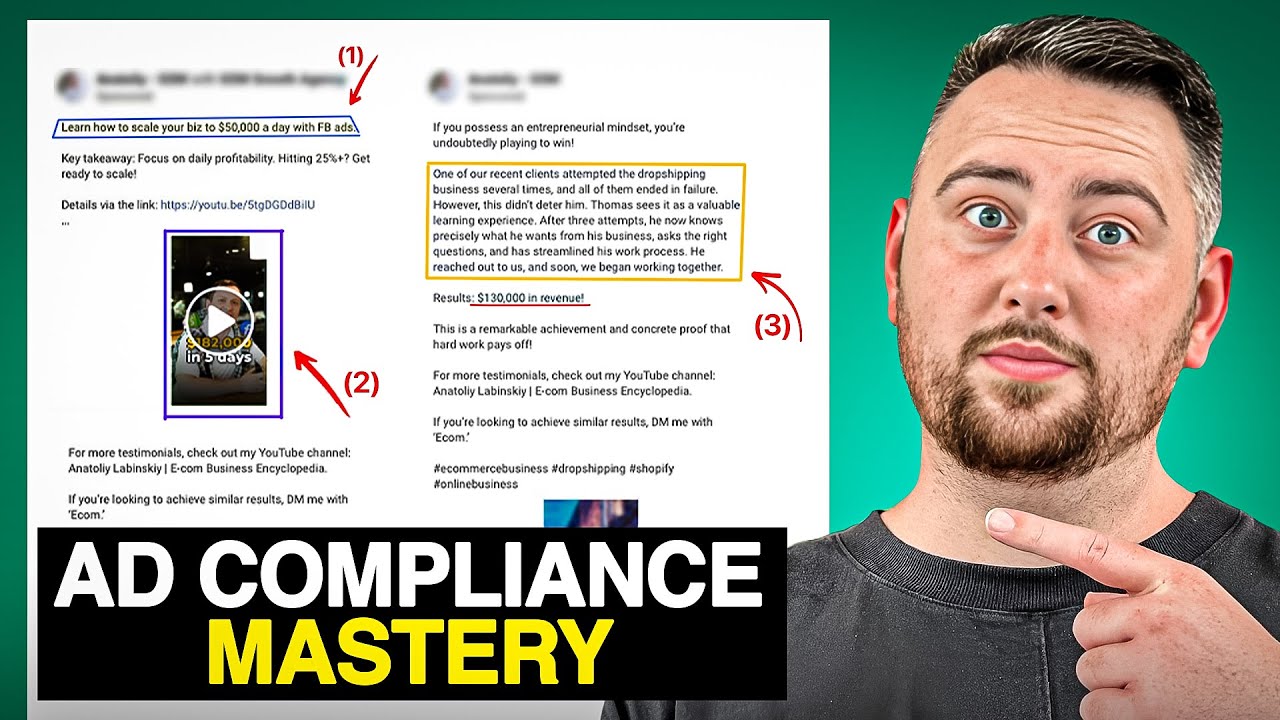
Golden rule number one: you can never ever say an amount plus a time frame — FTC truth‑in‑advertising rules require claims to be truthful and evidence‑based, and pairing specific earnings with a timeframe is a common red flag for deceptive advertising.
This is where you get shut down more than anything else when it comes to these business growth offers.
We just had a guy just yesterday, he’s in our Inner Circle program, he sent us over his ad copy and his content to review to give him some perspective on what was getting him shut down.
He had said to me, I’ve watched everything under the sun, I just can’t figure out what’s going on here.
I’m not exaggerating, I click on the first piece and the guy was saying something along the lines of we help you through job stacking set up to 50% more salary for yourself in under 90 days.
Even if you don’t have an exact dollar value like saying I help you make an extra 10K a month in the next 30 days.
There’s plenty of people that you can look up. There’s a very infamous sales trainer that got shut down by the FTC recently. There’s also a very well-known person partnered with Tony Robbins that got shut down by the FTC recently for his real estate offer.
In both of these examples, the sales training offer and the real estate offer, they were both making income claims with specific timelines.
So it’s different to say a dollar amount versus a month. It’s very important to note that if you say I’m going to help you get to blank in blank time frame, that’s really what it is.
Make X in Y. Y being time frame.
That’s a big no-no and I can’t stress it enough, the ad platforms will shut you down for this because it all comes down to FTC compliance — the FTC requires that advertisers have a reasonable basis for claims and that ads must be truthful and non‑deceptive before they run.
Whether you operate internationally, whether you operate in the United States, the one golden rule is very simple to follow and that is FTC compliance standards.
That’s all the ad platforms do when it comes to their compliance in almost all instances. There are some fringe examples I’ll give you.
With Facebook specifically, and all the ad channels do this by the way, I’m just giving you the Facebook specific example here, never use what they call branded assets — Meta’s ad policies prohibit unauthorized use of trademarks and brand assets that imply partnership, endorsement, or affiliation without permission.
Branded assets includes words like Facebook, Instagram, WhatsApp, Messenger. These are all owned words, trademarked terms by these organizations and companies and they genuinely hate when you use those words so they disapprove your ads for it.
These could even be as simple as like the abbreviations like FB, IG, etc.
TikTok, TT on TikTok can potentially, not as strict as Facebook to be fair. Facebook’s the strictest amongst these for the branded assets category.
The point I’m trying to make, almost all the compliance standards are genuinely just FTC compliance standards. There are some fringe ones like the branded assets ones.
If you look at the FTC, their entire website has every single case that they publicly post about what the business did wrong, why it was non-compliant. On top of that generally they obviously post about fines and the people and companies involved and their consequences.
One of the easiest things to do is first of all go to the FTC’s website and literally look up all of their press releases that they have and just sit there and scroll through them.
Sometimes we have people that reach out that say hey I’ve got this credit offer and it’ll be a credit offer that has something to do with credit repair. That’s one of the most notorious biggest set of takedowns in the FTC’s modern history.
They’ve taken down companies for 200 plus, 300 plus million that have low ticket couple dollars a month subscription plans where the FTC is doing is preventing consumer harm — the FTC regularly enforces penalties and settlements to protect consumers from deceptive or unfair business practices.
So they deemed consumer harm was happening in that example, shut it down.
What do the people at these ad platforms do? Pretty simple. They look at the FTC’s website and they say oh well they don’t like us doing that obviously. Let’s update our algorithm to ensure that we don’t have any of that going on because they are trying to reduce fines.
This is the main thing to understand about why they leverage FTC compliance standards and best practices.
It is solely because first of all they don’t want any problematic content on their platforms. They don’t want scams and obviously they want to make sure that people have a good user experience on the platform.
Nobody wants to get notoriety around oh everything I’ve ever bought on this platform was low quality.
TikTok’s starting to get this rep on certain social platforms from content I’ve been seeing recently where people just buy a product off TikTok shop and they’re like this product was low quality, didn’t do what was promised.
To be fair I’ve had a mixed set of interactions and experiences myself as a TikTok shopper. Some of them I’m like this isn’t great, others I’m like this is really good.
I’m not agreeing or disagreeing whether that’s true or not. I’m just simply trying to give you a perspective. When that starts to happen, when what you’re starting to see is an example of just product quality, TikTok will step in and they’ll say there’s got to be some type of standard that’s executed here otherwise we’ll become notorious for this and people will stop buying with us.
That’s why these companies do it. They are trying to avoid losing money. That’s really all it comes down to.
When you think with that you have a master plan for what to do to be compliant. They’re trying not to lose money. That’s the moral of the story. You master that you pretty much master compliance.
Sometimes it’s very demoralizing and sad because sometimes you look at some of these FTC examples for companies they’ve taken down and you read them and you’re like wow, that really is unfortunate.
It puts a lot of things in perspective for you in terms of just what’s going on out there in the world and then how those individual instances can plague an entire industry of people that are operating legitimately. The standards increase and that’s all to be clear created from the perspective of ensuring consumers don’t get harmed.
From that perspective it’s great. Just from the perspective of making business operate, I don’t want to say harder to be fair, just a higher standard is a better set of terms.
The issue is though a lot of businesses kind of like when new laws are passed and citizens might not be aware of them. Let’s use the example there’s some kind of new traffic law where here in Florida the left lane is sacred as it is in almost all places.
If you drive in the fast lane slow, it’s an infraction. You can get pulled over and get ticketed for that. I’ve seen people literally witnessed somebody driving slow in the fast lane and then boom they get pulled over which is great obviously if you want to speed in the left lane.
But if you don’t know about the law and then you do that, you accidentally break the law. That’s problematic.
That’s what happens with compliance in a lot of instances. That’s why it’s so consistently updating and they don’t just have a static this is the set of rules. They change because there’s constantly new cases and constantly new companies that get shut down and compliance standards that are set by these organizations.
By the way here in the United States it’s not just the FTC, it’s also the SEC which handles a different set of financial regulations, more securities laws. But even that there’s a tremendous amount of compliance issues that you can come across in the raising capital space that relate more to the SEC comparatively to the FTC.
Looking at the FTC’s website, sometimes not as often though to be fair, more so FTC than anything else, but sometimes you can look at the SEC’s website, look at what they specifically are doing, what kind of press releases they’re going after, shutting down and you can watch them in real time kind of chase specific industries.
You know what’s getting hit the most and what has a high probability as a niche to start experiencing issues.
Just recently as an example there’s been a lot of this new set of meta restrictions coming in 2025. I made content on it talking about how health and wellness, some investment services that included credit repair as an example and all kinds of other programs and far-reaching examples that could potentially be hit by this.
That comes from a whole chain of mainly weight loss medication and peptide related companies that were just freely advertising on the ad platforms that started having adverse health effects, that started getting sued, that then started getting pursued by the FTC, that then got shut down and fined by the FTC.
That then ripple effect impacts ad compliance and all of a sudden there’s a whole new set of compliance standards that get rolled out, whole new features and tools and issues that you have to deal with as an advertiser as a result of that.
If you’re in those niches and operating totally fine you still have to deal with those things simply put.
The main thing I’m trying to emphasize here for why this matters so much, almost all compliance standards are set by the FTC besides the little ones that are platform specific like hey don’t use our trademarks.
I gave you a very specific example to start: never ever ever say some kind of income claim with a time frame especially.
There are what we call creative workarounds. Creative workarounds are really useful.
I’m a big fan of anything where you can kind of work within the system and doesn’t necessarily flag it a particular way.
I like to have this frame. It’s me versus some people across the world who work at these ad channels that just sit there and develop stuff. I’ve got to think okay so how are they specifically flagging or triggering that disapproval reason.
I’ve got to consider well it’s not random obviously. It’s got to be something that’s either a typed word, a spoken word, or a combination of words that were said throughout different points in a sentence or that were potentially some words said in the ad copy and some words said on the landing pages.
AI in these companies, these trillion dollar, multi hundred billion dollar ad companies, is quite sophisticated.
We could trust the fact that there’s a high probability that it’s smart enough to not be too basic, just like two random words that mean nothing together that it all of a sudden connects.
It used to be like that to be fair but it’s gotten more sophisticated through time.
I’ve just simply got to think what are the specific words.
I’ll give you a great example. I won’t give you all of them to be fair. I go into much more detail on this stuff in my Inner Circle program.
I do twice a month one-on-one calls with members, weekly group calls, we have quarterly masterminds here in person in Miami Florida. We do our networking up here in the penthouse. We have a big movie theater style room for the presentations and the content throughout the day at the masterminds and we have our group chat on Telegram.
This topic specifically I go much more in depth. As an example we did it on a weekly group call recently, how to say non-compliant things compliantly.
I’m only going to give you a few rather than the entirety because at the end of the day I’m only going to give away so much of the strategy for free. Eventually, if you want deeper implementation and feedback, that’s what paid programs are for.
I digress, let’s continue.
Creative workarounds. Passive income is one of my favorites.
Passive income is an abused word out there and it’s not even that sophisticated. It’s a pretty used out word. Without sitting here and going on about just how beaten it’s been and the real perception in the mind of consumers who hear that term now, let me just give you the compliant version of how to say that.
You would say passive returns.
The key here is you want to take the non-compliant word. If these two words are said together, the word passive and the word income, they already have a flag for that. They say oh nope that’s not compliant and they disapprove it. They’ll tell you no you can’t say that.
Versus in comparison if it’s passive returns that passes with flying colors and you have no issues.
It’s a great example of one of them and it’s what I’m talking about there where if two words are conjoined together, boom, non-compliant. If one word is used and a different word is used in place of it, compliant.
All of a sudden you see that’s the perspective you want to use if you find yourself getting disapprovals.
It’s very important to note you can say things in ways where people can still do the math and come to the same conclusions.
I’ll give you one more and again you got to invest in training if you want to learn all this stuff because it’s definitely worth paying for, not getting shut down and knowing how to advertise in a compliant way.
You’ll still pull a lot. I want to be fair and saying not trying to sit here and say you won’t be able to figure this out on your own. I’m truly putting you on serious game here. But you got to be smart enough to connect the dots on everything I’m saying without exact and literal rules and having someone like me be able to review all of your copy and all of your content.
I’m trying to teach you how to think here. The bonus of just being in that Inner Circle offer, I can look at all your stuff. I can review everything and I can just straight up tell you oh that’s it.
That is a faster way to learn too. With this you’ve obviously got to invest a lot more time. Although yeah you know what you’re doing now, you still got to invest a ton of time in order to actually figure it out.
Either way, investing for speed is what a lot of the Inner Circle members value.
I’m going to show you one more in this case of creative workarounds.
This one’s also pretty good. We want to learn how to make claims without using dollars. Make claims without money involved, meaning direct dollar stated.
I’ll give you an example. I could say learn how to produce, and let’s just use the example we’re selling something to somebody who’s going to go out and generate more customers as a result of investing in it.
Learn how to produce 20 new clients.
This is the key part right here. This is specifically what we want to swap in place of a dollar value.
A lot of you who are unsophisticated with compliance, that’s what you’ll do. You’ll just say learn how to produce and then you’ll put the value, the value of the 20 deals. That’s where you mess up.
You say like oh learn how to make an extra $100,000 a month. That’s problematic.
We want to say learn how to produce 20 new clients and we could then say something about like also while also increasing your rates or while also charging more. Or learn how to produce 20 new clients for your high ticket product or service business.
Instead of saying learn how to produce an extra 100K a month with your product or service business. That’s what makes it compliant.
I want to continue on to my next point. Substantiate claims.
Along the lines of the FTC compliance stuff, we got to substantiate claims. We can’t be out here, I’ll give you a perfect example.
I do this on Twitter quite frequently where somebody in the Inner Circle program who hits their first million dollar a month or a client that hits a million dollars a month or just even somebody who shares with me hey I hit my first million dollar a month, thank you so much for all your information.
When I use that specific testimonial and I obviously want to post about that, I want to share it, that’s what my whole content is dedicated to.
I would love nothing more than to share every single deal we help hit million dollar months for.
But it’s super non-compliant because that percentage of people, keep in mind the US Bureau of Labor Statistics says that .1%, that means you have a 99.9% chance of not doing a million a month because the 0.1% is how many businesses hit $10 million a year.
You can’t make a claim of oh look at this cherry-picked testimonial of a person who just hit a million dollar a month without saying all of the important information.
As an example literally I’ve done this like I don’t know three times just this month as an example. This passes FTC compliance with literal 100 out of 100 on an FTC compliance AI tool that you can use as an example.
It includes things like me sitting there saying okay this is not the average result that our student base hits. As a matter of fact you have this percentage of a probability to ever hit this number. Are you special enough to enter into that? Probably not. You have a 99.9% probability to not do that.
On top of that as I continue in my example there I’m also sitting there saying things like you have to look at our average. We have businesses inside the Inner Circle operating at very different stages, some already doing significant revenue, others earlier in the process. Results vary widely depending on experience, execution, and market.
Does that mean that you’ll do 200 to 300K a month in the instance that you join in? No it doesn’t even mean you’ll do that if you’re below that. That’s just the average of the student base inside of that group.
And by the way that part cannot be made up. That has to be the literal example. It has to be true.
This is the issue. When people pick testimonials you’re essentially making huge unsubstantiated claims because you’re not openly disclosing what the actual odds are of doing that.
Yeah sure listen to this, even if I said something like look out of every client that’s ever worked with us, literally every single transaction that we’ve ever done, the statistical quantity of people that have hit million dollar months against the amount that have given us money if that was their goal.
If it’s above 1% which it is by the way, but I’m not going to make up a statistic because I don’t actually know that number off the top of my head, I haven’t done that math, although to be fair probably would be pretty good math to do.
It’s above .1% I know that and this is my point. Even that just demonstrates yeah it’s better odds when businesses learn from us, from taking all the lessons that people have hit million dollar months have done and consuming this content or joining programs where those people are and they share their lessons on top of all the lessons I share from those people behind the scenes.
Sure you have better odds but you still don’t have greater than 0.1% odds in the eyes of the FTC. That’s what you have to disclose in that example.
It’s not like people interpret it poorly. That’s the thing that always boggles my mind when it comes to just making income claims and doing these non-compliant unsubstantiated testimonials.
It’s not getting you high quality people. It gets you a lower quality demographic.
If you’re selling to high net worth individuals, which I obviously advocate on this content, I talk about that all the time. I have an entire collection dedicated to helping you sell, advertise and make offers to wealthy demographics.
How to craft VSLs for high net worth individuals, all of it. You’ll hear me constantly emphasize that lesson.
I won’t ever teach you something that’s going to be bad to do with a wealthy demographic. This specific set of advice holds true so much with that niche.
If you sell to wealthy people they dislike, it’s a huge red flag to them when they hear you make a massive income claim or when you just cherry-pick a specific testimonial.
Wealthy people want to know the truth. They want to know the real statistical probabilities even if those probabilities are small.
Well guess what, they’re wealthy. They’re already likely in the top 1 to 3% of planet Earth, potentially even greater than that.
I get people that come to me sometimes that already make a million dollars a month. They’re in 0.1% of the population on Earth when it comes to business revenue.
They know their odds already are already very small and they have confidence in themselves but they want to know the true odds against them.
It’s not like they seek things that just sound too good to be true. It’s quite the opposite.
When you sell to wealthy people they seek things that are real, honest, transparent about what it takes. They don’t want any kind of fluff because then they’re going to get even more frustrated if they buy into something that takes more time than what you otherwise stated.
I’ll give you a great example. I was just building another website with our development team and I found myself on WP Engine buying another website.
On my plan it said something about I have to call so I call in WP Engine. I see online it said something about like oh it might be upwards of $400 to $1,200 a month and I was like I don’t care, these websites will make far more than that, I’ll pay that right now online, I don’t need to talk to somebody, matter of fact I don’t want to talk to somebody.
I get on the phone and I’m talking to the sales department that I got routed to and I’m like hey man, this is all my information, I just need to upgrade this plan, I’m trying to, my development team’s right now asking me for this new production environment and I’m limited to create it because I don’t have enough sites, can you just upgrade my plan.
He’s like oh you know as a matter of fact you have this account manager that you got to talk to in order to upgrade your plan and I’m like an account manager? What are you talking about? I signed up online, I don’t know any account manager.
He goes yeah matter of fact you’re right you never met this person but earliest I can get you upgraded is tomorrow morning at 11:30 a.m.
I said out loud so you’re telling me I can’t just spend money, you guys are also making me spend time. I was like that’s not what I signed up for. I’ll just go sign up under another new email right now and create a new account before I ever do that. Just let me give you money.
For another 5 minutes just got the runaround. I couldn’t believe it. It was genuinely shocking to me that a company would make it so hard to give them money and make me spend time with the money.
That was the expectation that was set originally so it really frustrated me.
Now if initially they would have set the expectation hey this is what you’re buying now and if you ever need to upgrade you need to talk to somebody, just the expectation being set would have made it tremendously better. I wouldn’t have felt as bad.
It was the expectation failure that created the disconnect there and the friction.
I don’t bring that up randomly. That’s my point. When you do unsubstantiated claims, you cherry-pick testimonials, you aren’t compliant, you’re just making a ton of income claims and who knows what else you’re doing non-compliantly.
My point being is the more you do that stuff the more distrust it creates and the more general of a demographic you sell to.
Wealthy people get taken advantage of a lot and they therefore are on edge about being taken advantage of again and they try to keep an eye out for it. They’re just more on edge and on their toes.
Not necessarily skeptical, they’re willing to take risks but they keep their eye out for problems. Their radar is through the roof. Sharp eye on intuition with red flag identification.
One of the fastest ways to turn off a highly financially qualified demographic is to just do a bunch of non-compliant things, make income claims, cherry-pick testimonials without proper risk disclosures. They dislike that.
They have a high probability to buy from you when you actually do the right things.
I can sit here and I could talk about this on and on and I do inside of my Inner Circle program, inside of my 7-week live training Master Internet Marketing.
There’s information for both of those available if you want some additional help and training from us.
Either way my content is full of very highly valuable pieces that are all intended on just passing down a tremendous amount of lessons I’ve learned from working with businesses scaling their paid acquisition and operations.
If you want to learn some more of those lessons go check out the rest of my content. I also put together some great collections recently full of some curated pieces.
I picked some specific ones that I thought went very well together. I titled them in ways that I thought would be helpful to you. There’s an entire content marketing and propaganda machine section. There’s an entire section on some of the top advertising lessons to million dollar months. There’s that example I provided of how to sell, advertise, make offers, create VSLs for wealthy people.
Who knows maybe there’s more by the time you check out additional content.
Most business owners waste years figuring out what actually works. In my Master Internet Marketing program, I compress that learning curve into 7 weeks, covering copywriting, funnels, ads, and more. If you’re ready to invest $5k and get serious about your skills, apply here.
Go get richer.
Watch the video:

Jeremy Haynes is the founder of Megalodon Marketing. He is considered one of the top digital marketers and has the results to back it up. Jeremy has consistently demonstrated his expertise whether it be through his content advertising “propaganda” strategies that are originated by him, as well as his funnel and direct response marketing strategies. He’s trusted by the biggest names in the industries his agency works in and by over 4,000+ paid students that learn how to become better digital marketers and agency owners through his education products.

Jeremy Haynes is the founder of Megalodon Marketing. He is considered one of the top digital marketers and has the results to back it up. Jeremy has consistently demonstrated his expertise whether it be through his content advertising “propaganda” strategies that are originated by him, as well as his funnel and direct response marketing strategies. He’s trusted by the biggest names in the industries his agency works in and by over 4,000+ paid students that learn how to become better digital marketers and agency owners through his education products.


This site is not a part of the Facebook website or Facebook Inc.
This site is NOT /endorsed by Facebook in any way. FACEBOOK is a trademark of FACEBOOK, Inc.
We don’t believe in get-rich-quick programs or short cuts. We believe in hard work, adding value and serving others. And that’s what our programs and information we share are designed to help you do. As stated by law, we can not and do not make any guarantees about your own ability to get results or earn any money with our ideas, information, programs or strategies. We don’t know you and, besides, your results in life are up to you. Agreed? We’re here to help by giving you our greatest strategies to move you forward, faster. However, nothing on this page or any of our websites or emails is a promise or guarantee of future earnings. Any financial numbers referenced here, or on any of our sites or emails, are simply estimates or projections or past results, and should not be considered exact, actual or as a promise of potential earnings – all numbers are illustrative only.
Results may vary and testimonials are not claimed to represent typical results. All testimonials are real. These results are meant as a showcase of what the best, most motivated and driven clients have done and should not be taken as average or typical results.
You should perform your own due diligence and use your own best judgment prior to making any investment decision pertaining to your business. By virtue of visiting this site or interacting with any portion of this site, you agree that you’re fully responsible for the investments you make and any outcomes that may result.
Do you have questions? Please email [email protected]
Call or Text (305) 704-0094