How I Run Google Search Ads From Query to Qualified Opportunity

I hope you enjoy reading this blog post. If you want my team to just do your marketing for you, click here.
Author: Jeremy Haynes | Published September 23, 2026
Earnings Disclaimer: You have a .1% probability of hitting million-dollar months according to the US Bureau of Labor Statistics. As stated by law, we cannot and do not make any guarantees about your own ability to get results or earn any money with our ideas, information, programs, or strategies. We don’t know you, and your results in life are up to you. We’re here to help by giving you our greatest strategies to move you forward, faster. However, nothing on this page or any of our websites or emails is a promise or guarantee of future earnings. Any financial numbers referenced here, or on any of our sites or emails, are simply estimates or projections or past results, and should not be considered exact, actual, or as a promise of potential earnings – all numbers are illustrative only.
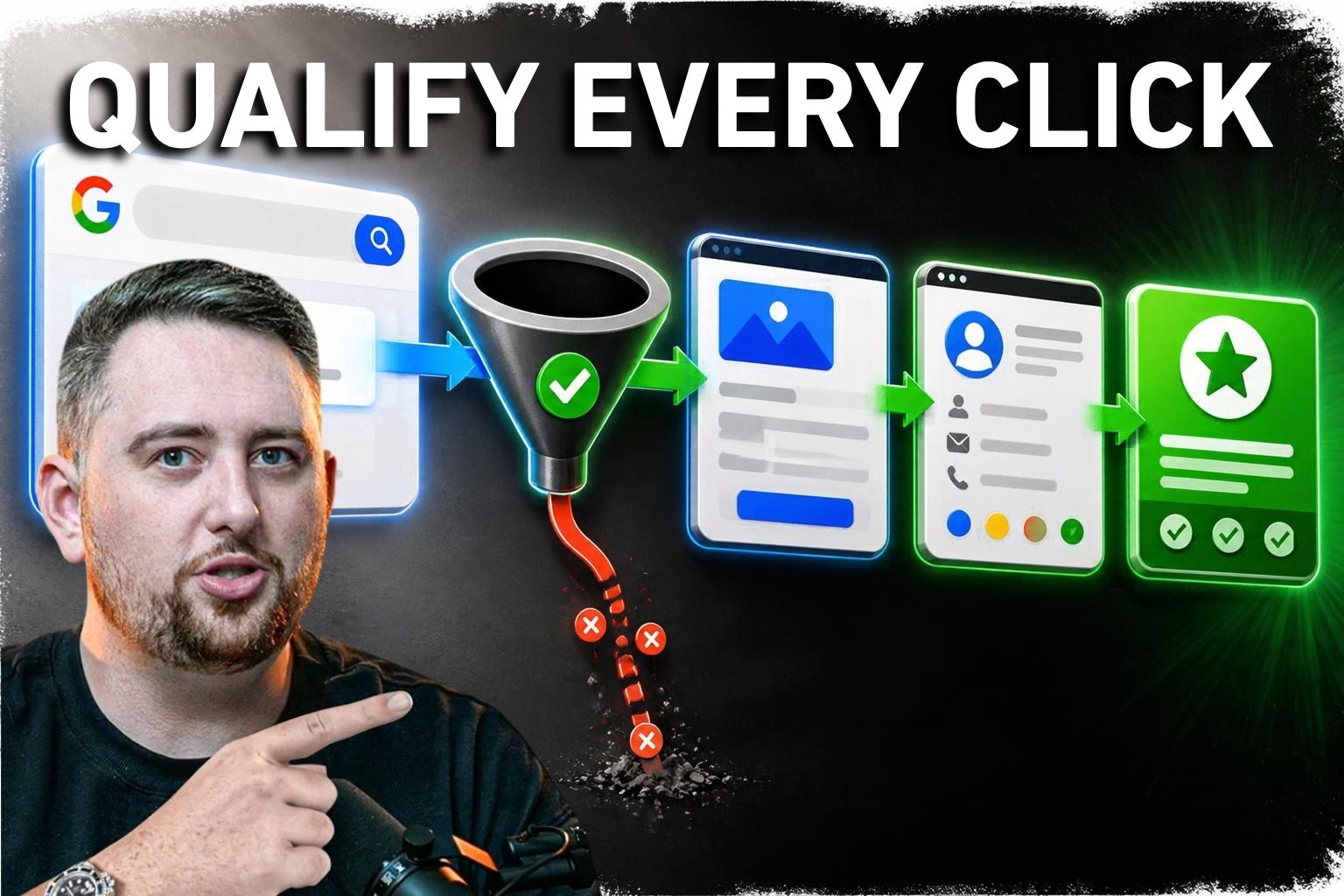
Running Google Search Ads for high-ticket offers without wasting budget requires one connected path from the search query to a qualified sales opportunity. The keyword starts that path, but the ad, landing page, form, sales handoff, and conversion feedback determine whether the click creates useful pipeline or another misleading lead.
I would not grade this system on cheap clicks or raw form volume. I would ask whether the campaign reaches buyers with commercial intent, filters them honestly, continues the same promise after the click, and shows Google which leads the sales team would actually want more of.
The search campaign works when every layer protects buyer intent instead of diluting it.
Already making money? See what it takes to make a lot more.
Start With the Qualified Opportunity
Before opening the account, define what a qualified opportunity means. It should be a sales stage the business can identify consistently, not a positive feeling about a lead.
The definition may include the problem the buyer needs solved, the service area, business type, authority to make a decision, timing, ability to afford the offer, and willingness to follow the actual sales process. Use only the criteria that genuinely determine fit.
This definition gives the campaign a destination. A form submission may be an early signal. A booked call is stronger. An attended call that meets the agreed qualification standard is stronger again. The account should eventually be evaluated against the deepest reliable event the business can measure often enough to use.
My article on building a buyer-ready funnel explains why qualification begins before the application. Search gives you another opportunity to start that work in the query and ad.
Build Campaigns Around Searcher Decisions
People search because they are trying to make a decision. Some want a definition. Some want instructions. Others are comparing providers, checking prices, or trying to hire someone now.
Group campaigns and ad groups around those decisions. A provider search should not share the same message and budget lane as a tutorial search. A branded search should not be judged as if it created the same demand as a nonbrand category search.
Google describes Search campaigns as a way to reach people actively looking for specific products and services. Its current Search campaign setup guidance also recommends matching ad headlines and descriptions to the keywords inside an ad group.
That relevance becomes easier when each group represents one recognizable buying decision. The ad can speak plainly, the landing page can continue the same idea, and the team can see which type of demand produces qualified conversations.
A large account is not automatically a mature account. Start with the smallest structure that keeps intent, geography, offer, and budget control clear. Add complexity only when it answers a real operating question.
Use Search Terms as the Budget Truth
A keyword is an instruction inside the account. A search term is what the person typed. The difference matters because keyword matching can reach variations and related meanings beyond the literal keyword.
Google’s search terms report documentation explains that the report shows searches that triggered ads, the keyword involved, and the resulting performance. It also notes that some low-volume searches can be omitted or grouped for privacy.
Review the report against intent first. Mark searches that clearly describe the wrong service, a job search, free help, education, support, login access, or another use of the same phrase. Add negatives carefully enough to block the wrong meaning without blocking a qualified variation.
Then follow meaningful queries downstream. A term that produced a form is not proven. Check whether the lead answered, booked, attended, qualified, and moved through the sales process. That is where apparent relevance becomes commercial evidence.
The companion article on matching funnel friction to buyer intent goes deeper on why different starting intent requires a different path.
Write the Ad as an Honest Filter
The job of a high-ticket search ad is not to attract every possible click. It is to help the right buyer recognize fit and give the wrong buyer enough information to keep searching.
Mirror the service and buyer context expressed in the query. State the category clearly. Explain the next step accurately. Use a qualification detail only when the business is willing to stand behind it on the page and during the call.
Price can be a useful filter when the offer has a clear and stable entry point. Business size, geography, service scope, or required use case may work better for another offer. Test the detail that separates a real prospect from the most common wrong click.
A lower click-through rate is not automatically a loss if the ad removes people who would have failed qualification. Compare the ad through held calls and qualified opportunities rather than forcing it to win a surface-metric contest.
Avoid borrowed authority. Do not add logos, client names, results, certifications, or guarantees unless they are accurate, approved, and supported on the destination page. The strongest filter is a specific promise the business can actually fulfill.
Continue the Search on the Landing Page
The landing page should feel like the next sentence after the search and ad. If a person searches for a specific service, clicks an ad about that service, and lands on a generic homepage, the continuity disappears.
Repeat the central problem and offer in fresh language. Explain who the service fits, what the process includes, what happens after the form, and which proof supports the decision. Give the buyer enough context to decide whether the conversation is worth taking.
The page does not need to be long for the sake of appearing comprehensive. It needs to answer the questions created by the query and the size of the commitment. A complex service may require more explanation, but every section should move the buyer toward or away from fit.
Keep one clear conversion path. If the ad promises a strategy call, the page should explain that call and lead naturally to the application or scheduler. Competing buttons, unrelated offers, and broad navigation can turn a high-intent visit into a browsing session.
My breakdown of building a high-ticket sales funnel covers the broader message and qualification structure behind that page.
Make the Form Protect Sales Capacity
A short form can produce more submissions while sending more cleanup work to the sales team. A long form can create unnecessary abandonment. The right form asks for the minimum information needed to route, prepare for, or reject the opportunity responsibly.
Use the qualification definition created before launch. Ask questions the team will genuinely use. If nobody reads a field or acts differently because of the answer, remove it.
Explain why sensitive business questions matter. A buyer may answer more accurately when the form makes clear that the information determines fit or prepares the conversation. Avoid hidden tests and trick wording.
The handoff after submission matters as much as the form. Pass the original source, campaign, keyword when available, landing page, and qualification answers into the customer relationship management system. The salesperson should not have to reconstruct the buyer’s path during the call.
That same data makes the account easier to diagnose. If one intent group produces fewer forms but far more qualified calls, the campaign may be doing exactly what the business needs.
Connect Search Ads to the Sales Record
Google Ads can report the click and online conversion. The customer relationship management system records what happened after the lead entered the sales process. Those records need to meet.
Capture the relevant click and campaign identifiers with the lead. Keep qualification stages consistent. Mark attended calls, qualified opportunities, closed deals, collected cash, cancellations, and refunds according to definitions the sales and marketing teams both understand.
Google’s current offline conversion guidance recommends qualified or converted leads as goals for enhanced conversions for leads. It also explains that a customer relationship management system is not strictly required if another lead system can store the necessary information.
Do not send every internal status back as a primary optimization goal. Decide which event is reliable, meaningful, and available at a useful cadence. Test the data flow before trusting automated decisions built on it.
My article on feeding qualified-lead signals back to an ad platform covers the principle in more depth.
Inside Master Internet Marketing, my 7-week live comprehensive training, I teach operators to connect traffic, funnels, sales stages, and backend economics instead of treating the ad account as a separate business.
Results are not typical. Your results will vary and depend entirely on your individual capacity, business experience, expertise, and level of desire. There are no guarantees concerning the level of success you may experience. The testimonials and examples used are not intended to represent or guarantee that anyone will achieve the same or similar results. We don’t believe in get-rich-quick programs. We believe in hard work, adding value and serving others. As stated by law, we can not and do not make any guarantees about your own ability to get results or earn any money with our information, courses, programs, or strategies.
Keep Bidding Aligned With the Real Signal
A bidding strategy cannot repair a weak conversion definition. If the primary event rewards easy form submissions, the campaign can become better at producing easy form submissions while the sales team sees no improvement.
Before changing bids, audit the event being optimized. Confirm that it fires once, maps to the intended stage, carries the right value when values are used, and excludes tests or duplicate records. Check how long the sales cycle delays the deeper outcome.
Accounts with limited qualified volume may need to use an earlier event while building measurement history. Choose an action that still correlates with buyer quality, such as an attended call or a reviewed application, rather than a soft engagement event chosen only because it happens more often.
Keep secondary events available for diagnosis without letting all of them steer bidding. Page visits, form starts, and bookings can explain where the funnel changes. The primary goal should tell the system what the business values most among the outcomes it can measure reliably.
Review Waste Across the Entire Path
A weekly review should move from the query to the sale. Start with spend and search terms, then inspect ads, landing-page behavior, applications, show rate, qualification, sales follow-up, and closed outcomes.
This prevents a common misdiagnosis. A campaign may appear wasteful because few leads close, while the actual issue is slow contact or inconsistent follow-up. Another campaign may look efficient at the lead level while generating people who never meet the offer’s basic criteria.
Record every meaningful change and the reason for it. If the team adds a negative, rewrites the ad, changes the form, switches the primary conversion, or adjusts the landing page, the next review should be able to connect that change with the evidence that followed.
The cold-to-close system for high-ticket sales shows why lead generation, follow-up, qualification, and the sales conversation have to be read together.
7 weeks. Real frameworks. Covering copywriting, funnels, paid ads, and conversion systems.
Let Qualified Pipeline Decide the Budget
Google Search Ads deserve more budget when the business can trace spend to qualified opportunities and the economics support another cycle. They deserve correction when the query mix, filtering, page, or handoff breaks that path.
Do not scale because clicks became cheaper. Do not shut the channel down because one surface metric became expensive. Read the whole sequence from search intent to collected revenue, while allowing enough time for the actual sales cycle to mature.
Operators in my private mastermind, Inner Circle, can bring the account and sales evidence into the room and work through whether the real constraint sits in traffic, qualification, follow-up, closing, or fulfillment.
Results are not typical. Your results will vary and depend entirely on your individual capacity, business experience, expertise, and level of desire. There are no guarantees concerning the level of success you may experience. The testimonials and examples used are not intended to represent or guarantee that anyone will achieve the same or similar results. We don’t believe in get-rich-quick programs. We believe in hard work, adding value and serving others. As stated by law, we can not and do not make any guarantees about your own ability to get results or earn any money with our information, courses, programs, or strategies.
The budget stops being a guess when every layer answers the same question. Did this search create a sales opportunity the business was equipped to serve?
Results are not typical. Your results will vary and depend entirely on your individual capacity, business experience, expertise, and level of desire. There are no guarantees concerning the level of success you may experience. The testimonials and examples used are not intended to represent or guarantee that anyone will achieve the same or similar results. We don’t believe in get-rich-quick programs. We believe in hard work, adding value and serving others. As stated by law, we can not and do not make any guarantees about your own ability to get results or earn any money with our information, courses, programs, or strategies.
Get my content first on Google
Add jeremyhaynes.com as a preferred source and Google shows my articles more prominently in your search results, including AI Overviews and AI Mode.


Jeremy Haynes
Owner and CEO of Megalodon Marketing
Jeremy Haynes is the founder of Megalodon Marketing. He is considered one of the top digital marketers and has the results to back it up.