
How One Business Built an AI Setter System with Zero Employees

I hope you enjoy reading this blog post. If you want my team to just do your marketing for you, click here.
Author: Jeremy Haynes | Published April 13, 2026
Earnings Disclaimer: You have a .1% probability of hitting million-dollar months according to the US Bureau of Labor Statistics. As stated by law, we can not and do not make any guarantees about your own ability to get results or earn any money with our ideas, information, programs, or strategies. We don’t know you, and besides, your results in life are up to you. We’re here to help by giving you our greatest strategies to move you forward, faster. However, nothing on this page or any of our websites or emails is a promise or guarantee of future earnings. Any financial numbers referenced here, or on any of our sites or emails, are simply estimates or projections or past results, and should not be considered exact, actual, or as a promise of potential earnings – all numbers are illustrative only.
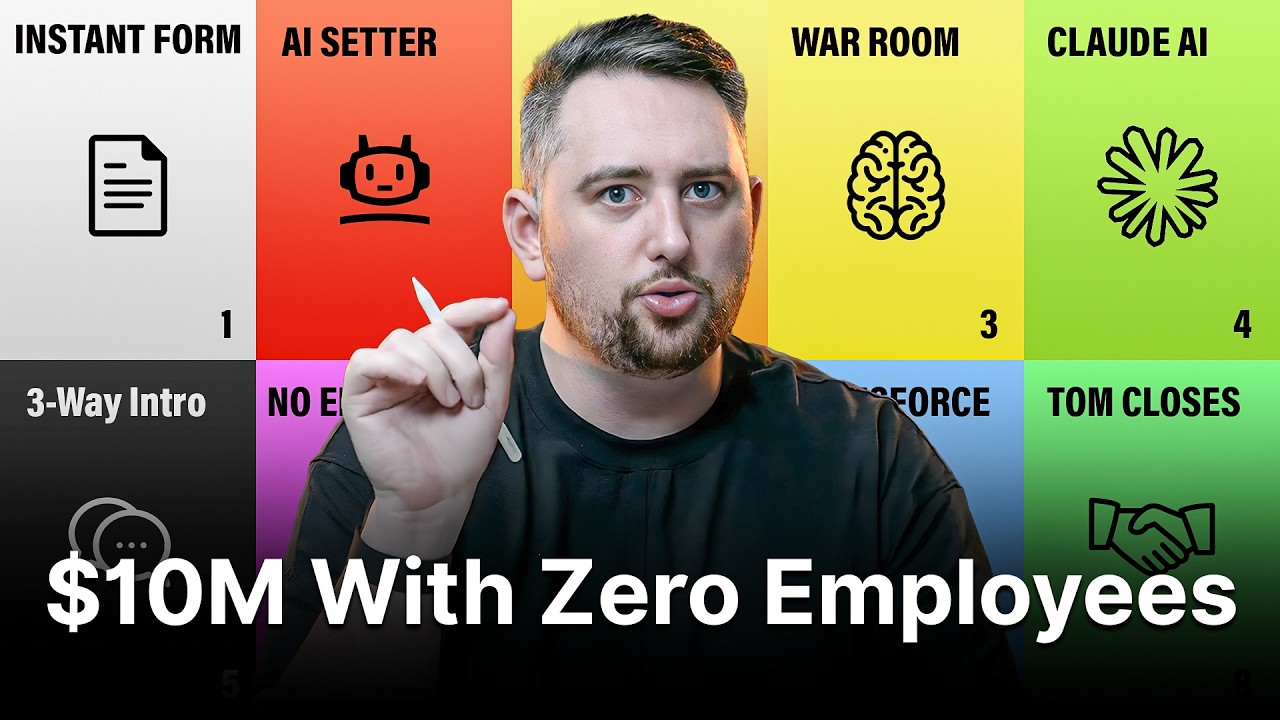
One of the most interesting operational breakdowns from a member of my Inner Circle involves a business selling hyperbaric chambers that scaled significantly with no full-time employees, just a few contractors and AI infrastructure.
Results are not typical. Your results will vary and depend entirely on your individual capacity, business experience, expertise, and level of desire. There are no guarantees concerning the level of success you may experience. The testimonials and examples used are not intended to represent or guarantee that anyone will achieve the same or similar results. We don’t believe in get-rich-quick programs. We believe in hard work, adding value and serving others. As stated by law, we can not and do not make any guarantees about your own ability to get results or earn any money with our information, courses, programs, or strategies.
Building a system like this requires significant technical knowledge, capital investment, and operational discipline. One Inner Circle member built this infrastructure from scratch. The breakdown of how it operates reveals what’s possible when AI handles the entire front-end sales process.
What the Core AI Setter System Looks Like in Practice
The entire operation runs through a Facebook lead form, technically called an instant form within Meta’s platform. That form feeds into an AI setter that qualifies leads and handles initial conversations. When the AI determines a lead meets specific criteria, it creates a three-way text introduction to the business owner, who handles the final conversation.
The operator essentially generates qualified conversations for himself using one of the simplest ad formats available. The AI setter handles two primary functions through text and phone calls. It engages mainly through text message, but can also run phone conversations using technology from Eleven Labs.
The operator originally tested another platform called Bland AI, which performed better for one specific reason: Bland AI had far less latency compared to Eleven Labs. When you had a phone call with Bland, it felt like a real conversation. You could say something, it would respond, you could say something back, it would respond. With Eleven Labs, there is noticeable latency that makes people aware they’re talking to AI.
However, the operator found that Eleven Labs had better overall answer quality compared to Bland AI, even though both had access to the same training material. The answers from Bland were acceptable, but Eleven Labs delivered superior responses.
How the AI Qualification Process Works Compared to Human Setters
The qualification step is more sophisticated compared to what most human setter operations achieve. Most human setters only qualify financially. These are typically young people in their early 20s, sometimes even teens. They are not the most sophisticated when it comes to compliance and following all the technical regulations required in regulated industries.
Human setters typically lack the skill set to be compliant with everything you’d want them to do (things like following up with everybody consistently and giving accurate answers based on training data instead of potential lies or half-truths. This AI qualification step is more than financial qualification, although that’s part of it. It engages with the lead and answers questions based on documented training material.
The business owner is the last and final step where the conversation gets completed. The AI step answers questions about hyperbaric chambers: pricing, delivery details, configuration options. This bot connects in real time to all of their manufacturing delivery times, warehouse inventory, and current configurations of the specific hyperbaric chambers they have.
They offer models ranging from a single seat to one you lay down in, to multi-person chambers with various configurations. The sizes and colors vary. They have physical inventory on hand and inventory that would take months to manufacture. All of that data is referenced in this qualification step.
When the lead officially meets the criteria the operator has set, a three-way text intro is made. The operator uses a few different pieces of technology for the text and phone functions: Send Blue and one called Blue Bubbles. He’s also tested locally hosted models. The operator has tweaked this process many times over. All of it has been done with no employees, just third-party contractors that helped set some of it up on a one-and-done project basis.
How to Structure Instant Forms with Conditional Logic for Lead Qualification
On Meta, instant forms represent a simple in-platform strategy. The operator uses conditional logic right away within this form, which is a best practice. It starts with questions that establish budget alignment upfront.
If the person answers no to the primary budget question, another conditional logic question appears with a different price range.
If the person answers no again, the form stops. Everything is over and they get booted out of the form.
If they answered either one with yes, it asks some follow-up questions. These are open-ended free-form questions that give the AI more context.
One notable advantage of AI analysis is it can actually examine the answers people provide in free-form questions. Historically, qualifiers were specifically multiple choice in almost all instances. That’s still how they function in the Meta platform itself. You ask a qualifying question. If they don’t meet the criteria, you boot them out of the form because you don’t want that person hitting that results column. You only want people who answer the qualifiers correctly to actually get collected as a lead and sent to that results column. That way, your algorithm consistently gets you in front of more of the right people.
For all of the free-form analysis, where you ask a short-form question, that data doesn’t get used by the platform. That data gets used by the AI setter. The AI setter actually examines the application data and uses that in the text and phone conversation it has with leads.
Character count length can correlate with engagement levels. When the AI setter is trained properly on data like that, it uses all of that information in what it actually discusses with your leads.
What Training Data Infrastructure Looks Like for AI Setters
Once a lead is captured with name, email, phone, a couple free-form questions, and some multiple-choice questions, you need documentation and resources or training material. The operator chose to use Notion for this. In Notion, the operator has what he refers to as the war room.
The war room is essentially a collection of sales calls. All these sales calls are broken down into different categories like good, bad, and average. In addition to that, the operator has extensive material on hyperbaric chambers, what we’ll call product training. The product training is extensive and very technical because the AI, unlike a human setter in almost all instances, can actually train on literally every single thing that you upload into it.
He has numerous SOPs. He has inventory that is referenced in real time. He has delivery times and ETAs. Everything you would need to train somebody in a sales role to answer questions is documented in this training data hosted inside Notion.
According to Gartner’s research on AI in customer engagement, organizations implementing AI-powered customer interaction systems require strong knowledge management infrastructure as the foundation for any deployment.
How the Agent Accesses Business Systems and Creates Dynamic Follow-Up
The operator gives the tool access to systems just like any good agent would need. His agent has Salesforce for the specific CRM, and it works just like a real human being would inside the CRM. It moves leads through different pipeline stages.
One of the most compelling features is that inside the operator’s CRM, this agent will dynamically create emails and email sequences to follow up with leads in a personalized way. Most humans when they set up email sequences create one large generic sequence. Contextual, personalized emails have always worked well, but they take significant work to create. The agent does that work automatically.
Beyond that, it also has access to QuickBooks. In QuickBooks, this is done to provide quotes and invoices to leads because the agent will also act in that three-way conversation with the operator in an administrative capacity. It can go out and actually do things to support the sales process.
The operator also has the agent use Asana for agent task management. The operator can originate tasks: things he wants the agent to train on or do. This is essentially all agent task management, and the agent goes in and actually moves tasks just like you normally would in a project management system.
McKinsey’s research on AI agents in business operations indicates that agentic AI systems with access to multiple business tools represent the next wave of operational automation, though implementation complexity varies significantly by use case.
The actual setter uses Claude, specifically the Opus model. The operator also tested some other locally hosted models that he chose to put on a Mac Studio. He chose a Mac Studio because he got tired of all the Mac Minis he had. He had six total agents configured across his Mac Mini fleet, and he chose to consolidate them all into a singular device.
He found more efficiency in that. In the operator’s words, Claude is everything. That’s one quote he had when breaking this down for our Inner Circle members.
In the actual text and phone side of things, Bland AI had less latency over Eleven Labs for the voice function. The operator tested between Send Blue and Blue Bubbles. He tested Blue Bubbles because he linked it to a physical iPhone with his Mac Studio. He ended up saying this was a little finicky, so he still preferred to use Send Blue even though Send Blue has its own quirks.
The operator’s current stack is Send Blue and Eleven Labs, but the setup he tested with Send Blue and Bland AI had better conversational flow based on direct observation.
The simple version of how this all flows together:
A lead fills out the instant form.
The form data gets analyzed by the AI.
The AI immediately texts the person and tries to call them as well.
The AI starts a conversation like any salesperson would.
If the lead is not responsive, the agent continues to follow up. It pivots how it follows up and references data it got from the instant form to continue outreach. If it has a conversation, the operator picked a male voice with a slightly British accent.
Once the lead is qualified and determined to meet the operator’s criteria (which are configured with additional parameters in the war room Notion file), the lead gets qualified and handed off via a three-way text conversation with the operator.
From there, the operator takes the conversation to the finish line. The agent also has access to QuickBooks to send invoices and follow up on cash collection, delivery ETAs, and it can act as a customer service agent as well.
This represents what’s currently happening in terms of AI infrastructure for sales operations. This is not something in the idea stage. This is a documented system that’s been built and refined over time.
There are specific details and nuances that are part of this whole implementation. The overview provided here covers the major components, but there’s naturally more depth to each element. Businesses that implement systems like this focus heavily on the training data, the qualification criteria, and the handoff process.
This represents an AI-first approach to sales operations. The operator built this from the ground up with this specific flow in mind. He did not know if it would be possible at first. Like any entrepreneur, he decided to give it a shot himself and figure it out as he went.
He had somebody specifically referred to him from the Send Blue team who helped set some of this up. The key takeaway is that this is a documented system that exists and operates.
If you’re looking to understand how AI can fit into your existing business operations, start by documenting your current sales process, your product knowledge base, and your qualification criteria. Those become the foundation for any AI implementation. The technology exists. The question is whether you’re willing to put in the work to implement it properly.
For operators who want to go deeper on building systems like this, my 7-week live comprehensive training covers the foundational frameworks for implementing AI into your business operations, and the Inner Circle is where we break down case studies like this in real time.
Results are not typical. Your results will vary and depend entirely on your individual capacity, business experience, expertise, and level of desire. There are no guarantees concerning the level of success you may experience. The testimonials and examples used are not intended to represent or guarantee that anyone will achieve the same or similar results. We don’t believe in get-rich-quick programs. We believe in hard work, adding value and serving others. As stated by law, we can not and do not make any guarantees about your own ability to get results or earn any money with our information, courses, programs, or strategies.

Jeremy Haynes
Owner and CEO of Megalodon Marketing
Jeremy Haynes is the founder of Megalodon Marketing. He is considered one of the top digital marketers and has the results to back it up.