How I Launched an AI Clone: What Worked and What I Changed

I hope you enjoy reading this blog post. If you want my team to just do your marketing for you, click here.
Author: Jeremy Haynes | Published April 9, 2026
Earnings Disclaimer: You have a .1% probability of hitting million-dollar months according to the US Bureau of Labor Statistics. As stated by law, we can not and do not make any guarantees about your own ability to get results or earn any money with our ideas, information, programs, or strategies. We don’t know you, and besides, your results in life are up to you. We’re here to help by giving you our greatest strategies to move you forward, faster. However, nothing on this page or any of our websites or emails is a promise or guarantee of future earnings. Any financial numbers referenced here, or on any of our sites or emails, are simply estimates or projections or past results, and should not be considered exact, actual, or as a promise of potential earnings – all numbers are illustrative only.
I recently launched my AI clone as a standalone product. The breakthrough wasn’t the technology itself. It was overcoming my own limiting beliefs about what people actually needed to extract value from it.
What follows is the complete breakdown of what happened, what worked, and what I’m changing based on the limitations I discovered.
How I Got Past the Mental Roadblock That Kept Me From Launching
A single belief held me back for months: people needed all my training material and SOPs to truly maximize the AI clone. The logic seemed sound. You don’t know what you don’t know, right?
I even explained this on a call once. Someone asked why they’d need to buy anything when ChatGPT exists. My answer was simple: if you can’t ask the right questions, you won’t get the answers you actually need.
That same limitation was stopping me from selling my AI clone standalone. I kept bundling it with other products because I assumed people would struggle without the full context.
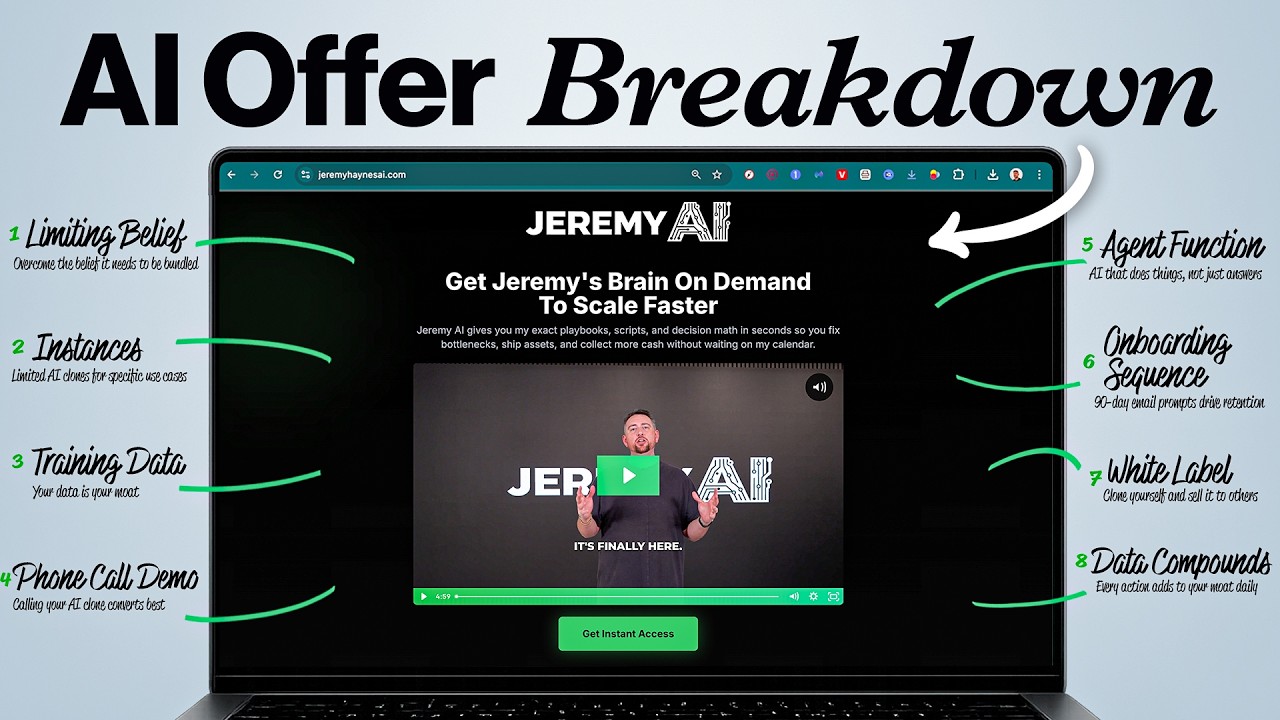
The reframe was straightforward. I’d create a 90-day onboarding email sequence packed with valuable prompt ideas: the best, most insightful questions I’ve asked my own AI and seen others ask. I’d occasionally promote it on stories and my channel to guide people toward asking better questions.
That mental shift opened up everything.
If you want to learn how I structure product launches and AI implementation strategies, check out my 7-week live comprehensive training where we cover these systems in depth.
The Promotion Strategy I Used to Launch the AI Clone Product
We used the product to create all the marketing assets. That’s the benefit of having a well-trained AI clone: it can write its own sales copy.
I set up two main promotion paths.
Agent skills on my main site
We took YouTube videos and how-to blogs and converted them into downloadable agent skill files. These are MD files that add specific capabilities to existing AI agents.
The agent skills were email-gated. When someone downloaded one, they’d get moved to a sales page with a video message explaining that if they liked that one tiny slice, they’d probably want the full AI clone with extensive training data.
If they said no thanks, we’d drop-sell them to my agentic AI software platform. Either way led to a checkout page, then a confirmation sequence.
Standalone sales page built with Bolt.new
My AI clone wrote all the copy. I filmed a simple video in front of my whiteboard.
For the actual rollout, I posted one reel promoting the agent skills as a lead magnet, then two direct reels: one straight pitch and one demonstration of the phone call feature.
The phone call demonstration performed well. People responded to the idea that they could actually talk to the AI whenever they wanted. We even had a feature at launch where you could do a video call with it. One operator kept it up on a screen with a mic so his staff could walk up and talk to it anytime.
I also did four Instagram stories. Some were just images, others were talking-head content or pointing at the AI logo. Very direct, very simple.
That was it: three reels total, four stories. Straightforward execution.
How to Use AI Clone Instances for Webinars and Challenges
This is where most people miss the opportunity. Instances are separate versions of your AI clone, each trained on specific subsets of your full knowledge base.
For my upcoming webinar, I’m giving attendees limited-time access to an instance trained exclusively on that webinar content. It’s a tiny fraction of what the full AI knows, but it’s enough to provide value and demonstrate what the complete system looks like.
One client used this exact strategy. He created an instance for his 3-day challenge, limited the knowledge it could access, and used it to support retention while preventing people from exploiting it.
We’re also building an instance for the main sales page. It’ll be hosted right on the site, trained on more data, but protected. Visitors enter their email, get a code, and can use it for a limited number of messages or talk time. We have IP blocking that can detect VPN rotation attempts.
Consider what this does: someone on your sales page can interact with your clone before buying. Someone who opts into your webinar can get answers immediately.
The applications are broad. We’ve brought instances into live sales calls to demonstrate functionality. We’ve used them as setters. We’ve deployed them in Telegram and Slack channels.
This approach works especially well for businesses built around a specific individual: insurance agencies, real estate brokerages, info businesses, even ecommerce brands with a recognizable face. According to Gartner’s research on AI in customer experience, conversational AI adoption continues to grow as businesses look for ways to scale personalized interactions.
Why Your Training Data Is the Most Important Part of Building an AI Clone
The quality of your clone depends entirely on your training data. This is the most critical piece that most people completely overlook.
I’ve been documenting everything since 2017: training content, SOPs, internal documents. We’ve exported data from Telegram, Slack, and Facebook. Recorded client calls, consulting calls, one-on-one sessions. All the communications across every channel we’ve used.
But the actual actions matter just as much as the explanations. Many platforms have admin logs that show exactly what was done, who did it, and when.
In Facebook’s ads dashboard, you can see every action taken. Change the date range to maximum, click the clock icon on the right side, and you’ll see a complete log. That’s training data.
I’ve exported logs from every platform where I’ve taken actions people want to learn about. Not just training videos on those actions, but the raw logs themselves.
This creates what’s called a moat in business. Someone could take all my YouTube content and feed it into another AI. They’d still only have a fraction of what I actually know because I keep most of it behind paywalls and in one-on-one interactions.
Even if they accessed my paid content, it wouldn’t be current. We update constantly with new client calls, internal documentation, messaging data, and action logs. My digital footprint compounds daily.
We export everything I do and update the platform the following morning with the previous day’s data. This approach aligns with what McKinsey has documented about proprietary data becoming increasingly valuable as AI capabilities expand.
How to Use Your Organized Data for More Than Just AI Clones
Your organized data becomes powerful for far more than just your AI clone.
We recently created a Claude project for email marketing. We uploaded handwritten emails I’d written so it could learn my style and voice. Then we added my email matrix SOP on writing value-dense sequences, and my master messaging SOP.
Three things we already had organized and ready to use. We took that Claude project and had it write emails in a Google Doc, proofread itself, then create the actual sequences in our CRM with all the conditional logic.
The training data makes this possible. If you haven’t started this process, start now. Do what education companies do: create SOPs, record how-to videos, document everything.
If you’re taking an action on a computer, record your screen and yourself. Talk through every single thing you’re doing and thinking. You don’t have specialized knowledge. You have a series of if-then scenarios in your head about how you process information.
Articulate it out loud: “I looked at this, it made me think this way. Then I looked at it like this. That made me think this other thing. Now I’m going to change it.” That level of articulation becomes profoundly powerful. It’s what enables use cases across every AI tool that exists or will exist. According to Harvard Business Review’s analysis, organizations that systematically capture and structure their institutional knowledge are better positioned to leverage AI capabilities.
New AI capabilities roll out every single day. Your organized data lets you take advantage of all of it.
Platform Limitations I Discovered and What I’m Changing
I’ve been frustrated with the current platform hosting the AI clone. I received numerous emails saying the clone couldn’t answer specific questions.
People were trying to upload files. The platform doesn’t allow it. There’s a character count limit, so pasting long scripts for analysis doesn’t work. Some people churned because they wanted to use it in more advanced ways.
The biggest limitation is no agentic function. Right now it’s essentially a sophisticated chatbot. It answers like I would. I tested it by uploading an ad account screenshot with no context except “analyze this and tell me what I could do better.” It gave an answer largely similar to what I’d said.
But it can’t actually do anything. If I want it to build webinar slides, craft a landing page, or execute tasks at the computer level, it can’t. It can only talk you through it.
I asked the CEO if they’d add agent functionality. He said no.
So I’m rebuilding it on my own agentic AI platform. Same training data and more, but with the ability to actually execute tasks. Not just answer questions, but go build things, check your CRM, update pipelines, create sequences.
Agentic function costs more because of API calls and token usage, but the value increase is substantial.
What This AI Clone Launch Means for My Business Moving Forward
The next evolution combines digital clone technology with agentic AI capabilities: white-labeled instances that businesses can deploy for their students or clients.
Your clone can talk on the phone, communicate via text, and actually execute tasks for the people who buy from you. Use it as a lead magnet. Use it as a standalone product. Use it to demonstrate value before someone ever talks to you.
The data you’ve been creating for years becomes the foundation. The better your training data, the better your clone performs.
This isn’t about shortcuts. It’s about using systems and documented expertise to create additional ways to serve people at scale.
The businesses I work with that are already generating revenue understand this. They’re not looking for quick fixes. They’re looking for execution-focused systems that compound over time.
That’s exactly what this is. Document your knowledge, organize your data, deploy it strategically. The technology exists. The only question is whether you’ll actually do the work to take advantage of it.
Results are not typical. Your results will vary and depend entirely on your individual capacity, business experience, expertise, and level of desire. There are no guarantees concerning the level of success you may experience. The testimonials and examples used are not intended to represent or guarantee that anyone will achieve the same or similar results. We don’t believe in get-rich-quick programs. We believe in hard work, adding value and serving others. As stated by law, we can not and do not make any guarantees about your own ability to get results or earn any money with our information, courses, programs, or strategies.
If you want to go deeper on AI implementation, data organization, and building systems like this, apply for my Inner Circle where we work through these frameworks together.
Get my content first on Google
Add jeremyhaynes.com as a preferred source and Google shows my articles more prominently in your search results, including AI Overviews and AI Mode.


Jeremy Haynes
Owner and CEO of Megalodon Marketing
Jeremy Haynes is the founder of Megalodon Marketing. He is considered one of the top digital marketers and has the results to back it up.