I hope you enjoy reading this blog post. If you want my team to just do your marketing for you, click here.


I hope you enjoy reading this blog post. If you want my team to just do your marketing for you, click here.
Author: Jeremy Haynes | founder of Megalodon Marketing.
Earnings Disclaimer: You have a 0.1% probability of hitting million-dollar months according to the US Bureau of Labor Statistics. As stated by law, we cannot and do not make any guarantees about your own ability to get results or earn any money with our ideas, information, programs, or strategies. We don’t know you, and besides, your results in life are up to you. We’re here to help by giving you our greatest strategies to move you forward, faster. However, nothing on this page or any of our websites or emails is a promise or guarantee of future earnings. Any financial numbers referenced here, or on any of our sites or emails, are simply estimates or projections or past results, and should not be considered exact, actual, or as a promise of potential earnings – all numbers are illustrative only.
If you’re serious about building a predictable sales process, call funnels should be the cornerstone of how you operate. I’ve built my entire business around them, and they remain one of the most direct systems for converting high-ticket offers.
Call funnels are simple, direct, and align with how financially sophisticated buyers prefer to purchase. When executed correctly, they allow you to educate prospects thoroughly and frame them properly before and after the call.
A lot of operators use webinars or multi-call closes because they fail to properly educate and frame prospects through their call funnel. When you nail the fundamentals below, you won’t need those inefficient workarounds.
If you want to go deeper on these systems, I cover the complete frameworks in my 7-week live comprehensive training and inside of my Inner Circle.
Results are not typical. Your results will vary and depend entirely on your individual capacity, business experience, expertise, and level of desire. There are no guarantees concerning the level of success you may experience. The testimonials and examples used are not intended to represent or guarantee that anyone will achieve the same or similar results. We don’t believe in get-rich-quick programs. We believe in hard work, adding value and serving others. As stated by law, we cannot and do not make any guarantees about your own ability to get results or earn any money with our information, courses, programs, or strategies.
Let me get you on the same page with what a properly structured call funnel looks like. I always default to this exact setup before trying anything else.
Start with a headline that clearly states what the offer is about and who it’s for. Nothing fancy — just direct and to the point.
Next comes either a mini webinar or a VSSL. The mini webinar is a templated presentation that I give to students in my Inner Circle and 7-week live comprehensive training. It’s a deck you build out, screen record, and narrate over. The mini webinar 2.0 is my current go-to template.
Results are not typical. Your results will vary and depend entirely on your individual capacity, business experience, expertise, and level of desire. There are no guarantees concerning the level of success you may experience. The testimonials and examples used are not intended to represent or guarantee that anyone will achieve the same or similar results. We don’t believe in get-rich-quick programs. We believe in hard work, adding value and serving others. As stated by law, we cannot and do not make any guarantees about your own ability to get results or earn any money with our information, courses, programs, or strategies.
The VSSL is similar but typically shot as a talking-head video. Not everyone can pull this off effectively, which is why the templated approach works so well.
Here’s a critical best practice: the more financially qualified your demographic, the shorter and more direct your video should be. I’m talking anywhere from 2 minutes on the low end to about 15 minutes maximum. Busy buyers don’t have time for 45-minute presentations.
This is where most people create friction in their funnel.
The traditional setup looks like this: VSSL, then application page, then scheduler page, then confirmation page. The problem? You typically see significant drop-off between the application and scheduler steps.
People fill out the application thinking someone will call them, but they never actually schedule. Your sales team either doesn’t follow up effectively, or your setters can’t connect. Either way, you’re losing applicants who showed intent.
I use Typeform integrated with Calendly to address this drop-off. The scheduling step is built directly into the application itself. No separate scheduler page. No additional friction point.
According to HubSpot’s research on form optimization, reducing the number of steps in a conversion process directly correlates with completion rates. This integration approach applies that principle to call booking.
Every time I mention this, someone brings up some justification for why they need to use GoHighLevel or ScheduleOnce for “reporting purposes” or “scalability.” That’s usually coming from your head of sales or operations person, not you as the business owner. Evaluate what actually reduces friction in your booking process.
Here’s how the flow works with proper pixeling: you have your main funnel page with the headline, VSSL, and integrated application. From there, qualified people go to one confirmation page, and disqualified people go to a separate DQ (disqualified) page.
Only pixel the qualified confirmation page. I optimize for either “schedule” or “complete registration” as the standard event.
When qualified people hit that confirmation page, the pixel sends that data back to the ads manager to find more people similar to them. The pixel is a prediction machine. When you send it data about qualified buyers, it looks for more qualified buyers.
Never send disqualified people to your pixeled confirmation page. You’ll train your pixel to find more unqualified leads. Send them to a drop-sell page instead to liquidate ad spend. You can even have setters call the disqualified folks since people lie on qualification questions all the time, but don’t pixel that page.
This is fundamental. Your pixel should only learn from qualified prospects. Meta’s documentation on conversion optimization emphasizes that the quality of conversion data directly impacts campaign performance.
This is a pro tip I learned from Tai Lopez back in 2017. I watched him film an ad at one of his Beverly Hills properties, and he was very specific about incorporating certain elements into the background: a basketball hoop, German Shepherds, some women, plants, the compound itself.
I asked him why he was so intentional about including all that stuff. His answer changed how I think about ad creative forever.
The algorithm analyzes everything in your video or image — not just what you say, but how you look, what’s in your environment, and what physical items are visible. When you incorporate things that your target demographic cares about, your distribution changes and you reach more of the right people.
These platforms are engineered to keep people engaged by showing them content related to their interests. When your environment and the physical items in your content align with what your prospects care about, the algorithm serves your ads to them more effectively.
You have to play the character. Better yet, you have to BE the character.
I’m not filming these blogs from a one-bedroom apartment. I’m at the top of one of the most iconic buildings in downtown Miami. I have a tree behind me that I paid someone to install. I drive a Rolls-Royce, two Ferraris, and a Range Rover SVR.
I am the character you’d expect to deliver this information. That alignment matters more than most people realize.
Think about your own ads. Are you the character your prospects expect you to be? Is there alignment between who you are, how you present yourself, and what you’re selling?
I’ve had agency owners pitching lawyers who wore regular clothes to sales calls. I suggested they try wearing suits. Their engagement on calls shifted noticeably.
Businesses I’ve worked with that pitch doctors have bought doctors’ coats to wear during calls and in ads. Some have even paid dentists to use their offices for 15 minutes to shoot ad content in the actual environment.
This adds synergy. You become the character in the environment where that character belongs.
This is where you separate yourself from everyone else running basic call funnels.
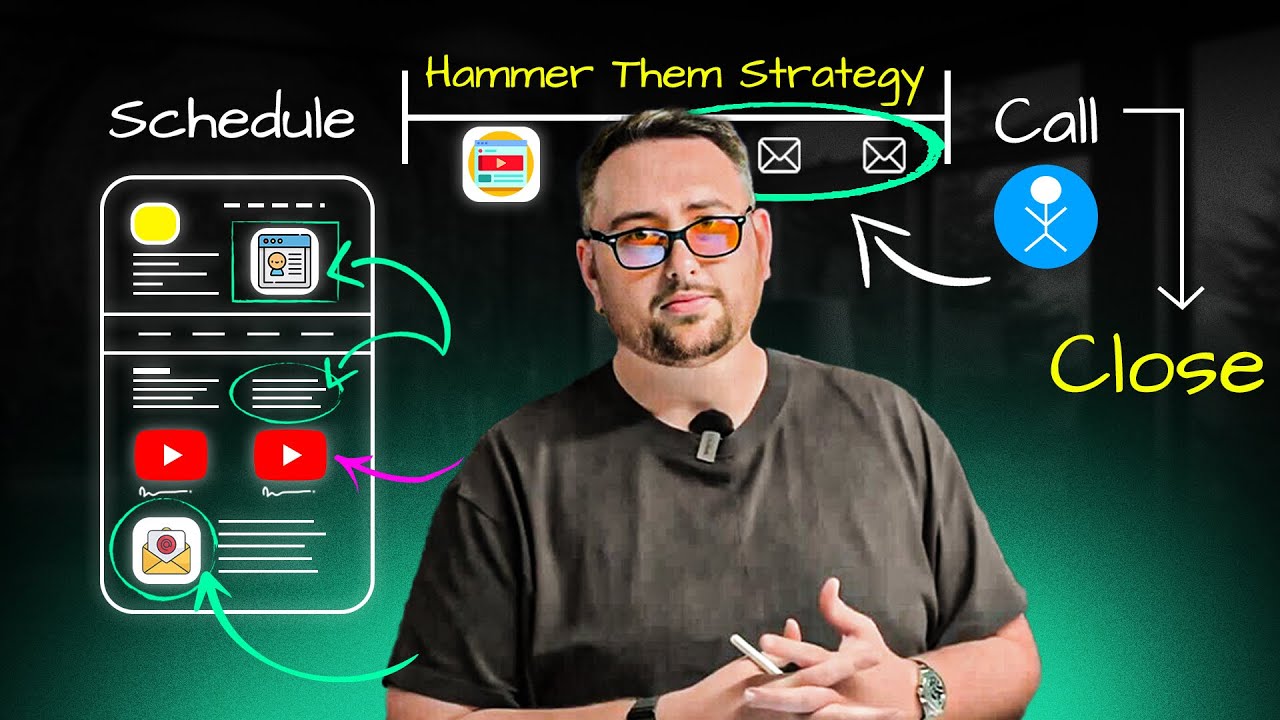
The typical process looks like this: direct response ad leads to funnel, funnel leads to call, call leads to close.
What I call the “Hammer Them” strategy injects contextual content at different stages of this process. When you use all of them at once, I call it the “Tornado.” When you focus on one specific stage, that’s the Hammer Them approach.
Before the direct response ad, you can run content to cost-effectively build warm audiences. For very low costs, you’re adding people into retargeting pools. CPMs tend to be lower when there’s previous page interaction from your advertising pages to those people.
Between the direct response ad and the funnel, you can retarget people who saw your ad but didn’t take action. Show them content that further explains why they should move forward.
Between booking the call and the call itself, this is where sophisticated content makes the biggest difference. Answer the most common questions. Address objections. Set expectations for success with your offer. Create content around the questions that come from the original questions getting answered.
According to Gartner’s research on B2B buying behavior, buyers spend only about 17% of their time meeting with potential suppliers. The rest is spent on independent research. Your content between booking and the call feeds that research phase with information you control.
These four quadrants of content can influence show rates, engagement on calls, and overall sales process efficiency. They help replicate the organic sales process where prospects have multiple touchpoints with you before making a decision.
In my experience, businesses that implement this approach see meaningful improvements across their sales metrics.
Sales teams require three critical things that often get overlooked.
Repetition of the same lessons. This might sound obvious, but salespeople need to hear the core fundamentals over and over again.
I’ve told sales teams to send selfie videos to prospects before calls. Just pull out your phone and record: “Hey, really excited to connect with you. My name’s Jeremy, we have our call at 3 PM tomorrow. This is my personal cell; if you have questions let me know. I saw your application and noticed you mentioned this specific thing. I have a great video that addresses that. Can you let me know if you have 10 minutes to watch it? Looking forward to our call.”
Sales reps who do this consistently see their engagement rates improve. People are more responsive on calls when they’ve already had a personal touchpoint.
Three weeks later, I’ll notice their show rate dropping. I’ll ask if they’re still sending selfie videos. They stopped.
This happens constantly. Sales teams need repetition of what actually works. You can have a 2–3 week training cycle and just repeat it continuously. That’s more effective than constantly adding new material on top of the proven fundamentals.
Hire consistently as you scale. Don’t wait until your calendar is completely full to start recruiting. If it takes 3–4 weeks to recruit, hire, train, and get someone on the phones, you need to start that process when you’re at partial capacity, not when you’re already maxed out.
Businesses that wait to hire until they’re at full capacity end up scaling in bursts instead of consistently. That creates unnecessary constraints on growth.
Proper sales management. This includes consistent training, repetition of lessons, hiring coordination, and analytics reporting.
Your sales manager should be tracking show rates, close rates, rebooking rates, and cancellation rates. More importantly, they need to implement dispositions.
When a salesperson says leads are “bad,” that’s useless feedback. Dispositions tell you WHY they’re bad. Were they financially unqualified? Uncertain about the offer? Did they have too many objections? Need to talk to a spouse?
That specific feedback allows marketers to make adjustments. It informs what content to create. It helps overcome obstacles systematically.
When you combine proper funnel structure with strategic advertising and sophisticated sales processes, you create a more predictable, scalable system.
The businesses I’ve worked with that implement these practices see consistent growth because they’ve addressed the inefficiencies most operators accept as normal.
Your call funnel should educate thoroughly, frame properly, and convert efficiently. Your advertising should reach the right people cost-effectively by using environment, character alignment, and strategic targeting. Your sales team should operate with consistent training, proper management, and data-driven optimization.
These aren’t theoretical concepts. These are systems designed to compress timelines and address obstacles faster.
If you’re still using webinars, multi-call closes, or inefficient funnel structures, you may be creating unnecessary friction in your sales process. The path to consistent growth runs through optimized call funnels executed with precision.
The operators who understand this and implement it systematically are the ones who break through ceilings while everyone else stays stuck.
If you want to implement these systems with direct guidance, check out my 7-week live comprehensive training or apply to my Inner Circle flagship program.
Results are not typical. Your results will vary and depend entirely on your individual capacity, business experience, expertise, and level of desire. There are no guarantees concerning the level of success you may experience. The testimonials and examples used are not intended to represent or guarantee that anyone will achieve the same or similar results. We don’t believe in get-rich-quick programs. We believe in hard work, adding value and serving others. As stated by law, we cannot and do not make any guarantees about your own ability to get results or earn any money with our information, courses, programs, or strategies.
Watch the video:
Jeremy Haynes is the founder of Megalodon Marketing. He is considered one of the top digital marketers and has the results to back it up. Jeremy has consistently demonstrated his expertise whether it be through his content advertising “propaganda” strategies that are originated by him, as well as his funnel and direct response marketing strategies. He’s trusted by the biggest names in the industries his agency works in and by over 4,000+ paid students that learn how to become better digital marketers and agency owners through his education products.
Jeremy Haynes is the founder of Megalodon Marketing. He is considered one of the top digital marketers and has the results to back it up. Jeremy has consistently demonstrated his expertise whether it be through his content advertising “propaganda” strategies that are originated by him, as well as his funnel and direct response marketing strategies. He’s trusted by the biggest names in the industries his agency works in and by over 4,000+ paid students that learn how to become better digital marketers and agency owners through his education products.


This site is not a part of the Facebook website or Facebook Inc.
This site is NOT /endorsed by Facebook in any way. FACEBOOK is a trademark of FACEBOOK, Inc.
We don’t believe in get-rich-quick programs or short cuts. We believe in hard work, adding value and serving others. And that’s what our programs and information we share are designed to help you do. As stated by law, we can not and do not make any guarantees about your own ability to get results or earn any money with our ideas, information, programs or strategies. We don’t know you and, besides, your results in life are up to you. Agreed? We’re here to help by giving you our greatest strategies to move you forward, faster. However, nothing on this page or any of our websites or emails is a promise or guarantee of future earnings. Any financial numbers referenced here, or on any of our sites or emails, are simply estimates or projections or past results, and should not be considered exact, actual or as a promise of potential earnings – all numbers are illustrative only.
Results may vary and testimonials are not claimed to represent typical results. All testimonials are real. These results are meant as a showcase of what the best, most motivated and driven clients have done and should not be taken as average or typical results.
You should perform your own due diligence and use your own best judgment prior to making any investment decision pertaining to your business. By virtue of visiting this site or interacting with any portion of this site, you agree that you’re fully responsible for the investments you make and any outcomes that may result.
Do you have questions? Please email [email protected]
Call or Text (305) 704-0094