Why Running Multiple Conversion Mechanisms Works Better Than Relying on One Funnel

I hope you enjoy reading this blog post. If you want my team to just do your marketing for you, click here.
Author: Jeremy Haynes | Published March 10, 2026
Earnings Disclaimer: You have a 0.1% probability of hitting million-dollar months according to the US Bureau of Labor Statistics. As stated by law, we cannot and do not make any guarantees about your own ability to get results or earn any money with our ideas, information, programs, or strategies. We don’t know you, and besides, your results in life are up to you. We’re here to help by giving you our greatest strategies to move you forward, faster. However, nothing on this page or any of our websites or emails is a promise or guarantee of future earnings. Any financial numbers referenced here, or on any of our sites or emails, are simply estimates or projections or past results, and should not be considered exact, actual, or as a promise of potential earnings – all numbers are illustrative only.
Not every business operates with one specific conversion mechanism. In my experience, more than half the time when a business reaches substantial monthly revenue, they’re doing it with a single funnel.
That could be a webinar funnel, a call funnel, or, most commonly, DM ads. I’ve even seen it work with Instagram shoutouts leading to DMs, an organic mechanism rather than pure paid advertising.
But what matters for you: the other half of businesses at that level are doing it with what I call the chunk method. And it might be exactly what you need.
7 weeks. Real frameworks. Covering copywriting, funnels, paid ads, and conversion systems.
The chunk method explained
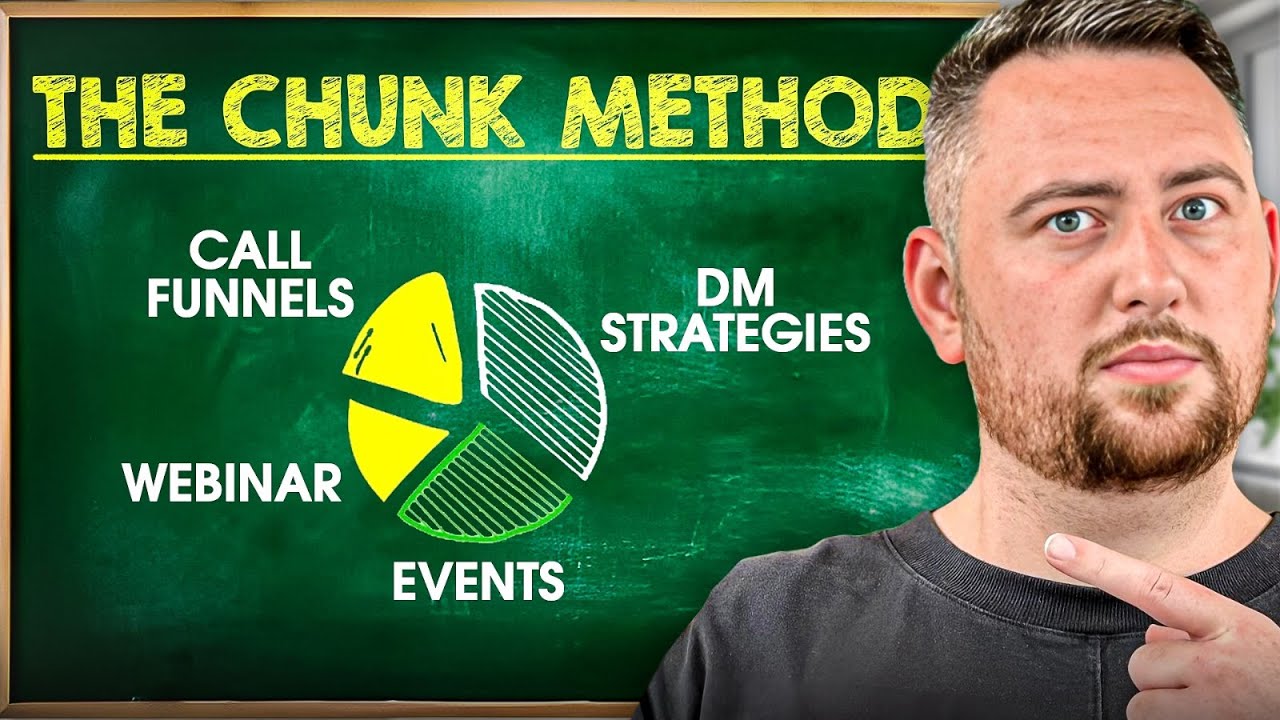
The chunk method is simple. Rather than having one specific conversion mechanism responsible for your entire monthly revenue, you have two or three different things actively converting. Some might be dominating, some might be a minority, but you’ve got more than one way driving customers into the business.
If you already have multiple ways of driving customers in, you might be thinking there are businesses out there that literally have all their revenue come from singular funnels. Yeah, absolutely.
Let me give you the common funnel strategies being used right now:
Call funnels (we talk about these frequently)
Webinars, whether live or on-demand
DM strategies and DM ads, driven organically or via paid advertising
These are the big three nowadays, with call funnels commonly dominating and webinars still making a solid contribution. Challenge funnels deserve a shoutout too.
HubSpot’s multichannel marketing guide emphasizes consistent messaging and integrated tracking across the channels a business uses.
If you’re looking for structured frameworks on building multiple conversion mechanisms, Master Internet Marketing, my 7-week live comprehensive training covers these systems in detail.
Results are not typical. Your results will vary and depend entirely on your individual capacity, business experience, expertise, and level of desire. There are no guarantees concerning the level of success you may experience. The testimonials and examples used are not intended to represent or guarantee that anyone will achieve the same or similar results. We don’t believe in get-rich-quick programs. We believe in hard work, adding value and serving others. As stated by law, we cannot and do not make any guarantees about your own ability to get results or earn any money with our information, courses, programs, or strategies.
How revenue distribution actually looks when you stack multiple funnels
Some months businesses have results where one dominating variable dwarfs the others. That dominating variable might be a major event.
I’ve worked with businesses that have substantial virtual registrant counts. That can cause a significant month.
You might have a good month or two where you’re driving traffic to these conversion mechanisms and build a substantial backlog. You may sacrifice some revenue in prior months, but that can lead to a conversion day that drives more than half of the revenue.
But not every business can do that every month, especially given the market you’re operating in. It might not be realistic, and that’s why it’s inconsistent.
In the model I am describing, each month has two to three specific conversion mechanisms contributing meaningful portions of revenue.
In practice, this might look like one funnel contributing a smaller portion, another contributing the majority, and a third filling in the gap.
If you struggle to scale one specific campaign and fail to see big leaps of progress in that funnel in a month or quarter, you likely need the chunk method. Rather than trying to scale one specific funnel, add more mechanisms.
When you’ve got the chosen one and you’re milking it, it sometimes just doesn’t stop producing. But usually there are ceilings that occur, dependent upon a few variables.
How market size creates a ceiling on your funnel performance
One of those variables is market size. Every market reaches a point of diminishing returns. The broader you go, the less in-market somebody is, the more they need convincing, and the less they identify with the problem you solve.
Proximity to purchase changes the economics. People already in market are easier to close, while people further from a buying decision require more education and can cost more to convert.
I talked to business partners who were spending a substantial portion of their revenue on advertising. They milked one specific funnel. They even had a method that worked well previously, but it died as time went on. The amount of people available to convert diminished for that original mechanism.
They were smart enough to pivot. They took this lesson and moved into mass market where the most people usually are.
At any given time, a small percentage are in-market and ready for your solution. They identify with the problem and are actively looking to buy.
Some markets are massive: take the sales industry or real estate as examples. Those markets continuously replenish participant pools through recruitment and other mechanisms.
Platforms like ClickFunnels, TikTok, Instagram, and YouTube help people build personal brands and businesses. These platforms allow individuals to find a passion, grow a following, and monetize through products, info products, or services.
Most info product creators are getting traction from these social channels.
What happens when your market has no replenishment source
Some markets don’t have anyone refilling the pool of potential buyers. Treat it like a lake in the middle of a desert: if there’s no rain, the lake eventually goes dry.
If your market lacks a replenishing source, you might have to be the one to replenish it. That’s called mass marketing.
There is a broader market of borderline prospects who need convincing. These folks are less warm than in-market buyers. They could be sold, but it takes more work.
This commonly happens with supplement brands and impulse-considered appliances. For example, Ninja created demand for the Ninja Creami ice cream maker through content that convinced people they needed it. People didn’t start out thinking they needed it, but after repeated exposure they became convinced.
Beyond borderline buyers is the mass market. This audience is huge and includes people who may not identify as likely buyers. They cost more to convert and require many more impressions and varied content angles.
Google’s omnichannel lifecycle guidance notes that customers often engage with several channels during a purchase journey, which supports building more than one useful path into the business.
How to find the right hook that finally converts cold traffic
Hooks can take many forms. In my experience with real estate investing, I encountered many verticals: residential rentals, commercial properties, house flipping, wholesaling, and development.
I saw a TikTok creator repeatedly pitching Section 8 real estate with the phrase “guaranteed rental income.” At first I was skeptical. I ignored it. But after seeing the message 20–30 times from the same creator, the angle finally landed and made sense.
In mass market, instead of relying on organic high impression counts, you must create those impressions with paid advertising, direct response, and content.
When you hit a cap, there are reasons:
The percentage of people ready to convert is too small.
That pool isn’t replenishing because no one is responsible for growing it.
You experience diminishing returns over time.
Those caps vary by niche. If you’re selling to chiropractors or surgeons, the audience is small. Broader industries like sales have a larger pool, and the cap is further out.
Ask yourself: how big is your market, and what percentage is probable to convert? That could explain your cap.
Three ways to break through your revenue ceiling
Mass market. Cut into ROAS and test scaling into a mass market offer. This requires money, testing, and endurance. The upside is a far larger market, but it will likely be less profitable per conversion and require heavy testing and impressions.
Add conversion mechanisms. If you capped out with a call funnel, add a webinar funnel, DM strategies, an event, or a low-ticket to high-ticket funnel feeding setters and closers. The chunk method is about adding mechanisms that each contribute chunks of revenue, creating a more even distribution over time.
Find the majority hook. This isn’t a mechanism but a messaging strategy. The majority hook resonates with the largest portion of your audience. Minority hooks are smaller and convert fewer people. When you identify and use a majority hook, you can significantly raise your conversion ceiling.
Think with Google’s lead-quality guidance recommends mapping the customer journey and assigning values to the conversion steps that carry real downstream impact.
Already making money? See what it takes to make a lot more.
How to identify a majority hook
Look at clickthrough rates and thumb-stop rates. The hook is what you say at the start of a video ad, what you use in copy, and what you use in static image ads.
If you see strong unique link clickthrough rates on a conversion campaign, not on a link click or traffic campaign, you likely found a powerful hook. High single-digit unique link clickthrough rates are rare but indicate an excellent majority hook.
Milk a majority hook. It’s resonating with the most people you’re targeting. Minority hooks will show lower rates; the smallest hooks will fall below the minimum threshold.
Keep in mind many people remain unresponsive even when you reach a large audience. Observing market behavior is more reliable than customer feedback alone, because what people say and what they do can differ.
Customer feedback is useful, but if your current customers were converted by minority hooks, their reasons may not reveal the majority hook. Use market research and behavioral observation to find the messaging that moves the largest group.
I go in-depth on market research and hook testing inside Inner Circle, which includes twice-monthly one-on-one calls, weekly group calls, quarterly masterminds, and an active Telegram group focused on serious growth.
Results are not typical. Your results will vary and depend entirely on your individual capacity, business experience, expertise, and level of desire. There are no guarantees concerning the level of success you may experience. The testimonials and examples used are not intended to represent or guarantee that anyone will achieve the same or similar results. We don’t believe in get-rich-quick programs. We believe in hard work, adding value and serving others. As stated by law, we cannot and do not make any guarantees about your own ability to get results or earn any money with our information, courses, programs, or strategies.
The chunk method applies to adding new conversion mechanisms, pivoting to a mass-market approach, and testing new hooks until you find the majority hook that lifts the ceiling.
Whether you’re adding funnels, finding new hooks, or going mass market, the goal is to build a business that isn’t dependent on a single mechanism.
For a deeper look into building these systems, check out Master Internet Marketing, my 7-week live comprehensive training or apply for Inner Circle if you want direct access to work through these frameworks together.
Results are not typical. Your results will vary and depend entirely on your individual capacity, business experience, expertise, and level of desire. There are no guarantees concerning the level of success you may experience. The testimonials and examples used are not intended to represent or guarantee that anyone will achieve the same or similar results. We don’t believe in get-rich-quick programs. We believe in hard work, adding value and serving others. As stated by law, we cannot and do not make any guarantees about your own ability to get results or earn any money with our information, courses, programs, or strategies.
Get my content first on Google
Add jeremyhaynes.com as a preferred source and Google shows my articles more prominently in your search results, including AI Overviews and AI Mode.


Jeremy Haynes
Owner and CEO of Megalodon Marketing
Jeremy Haynes is the founder of Megalodon Marketing. He is considered one of the top digital marketers and has the results to back it up.