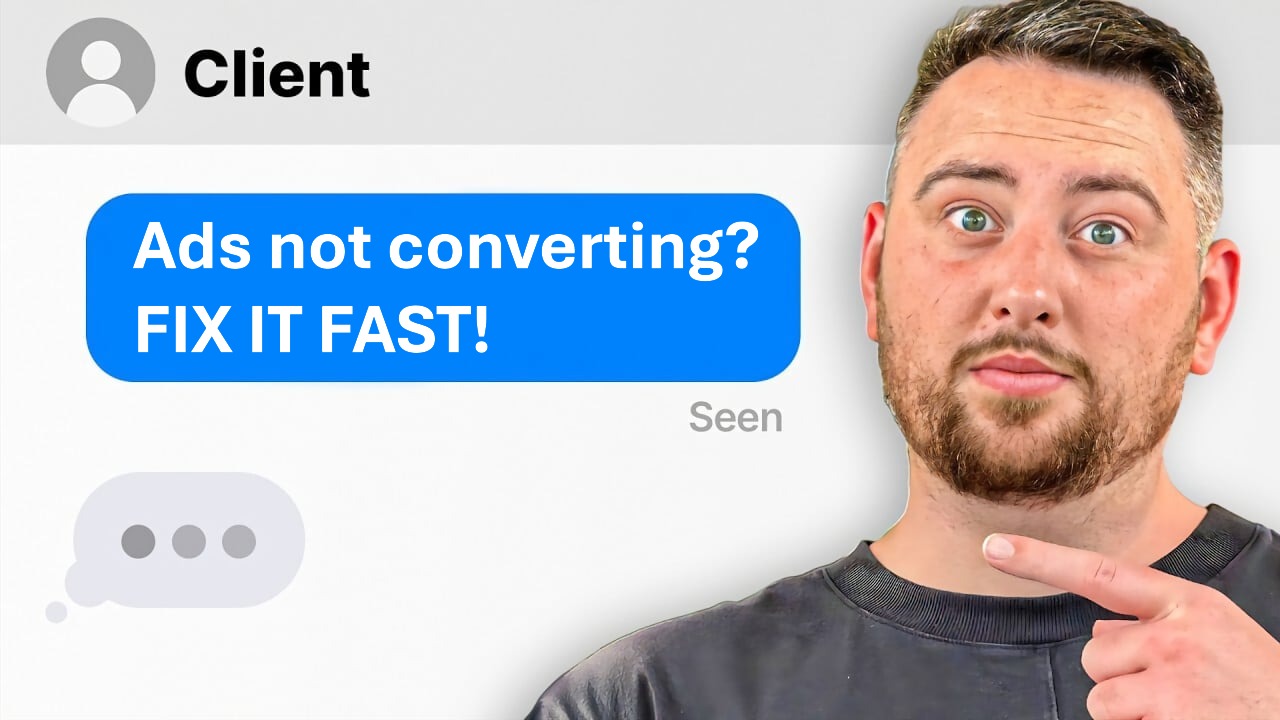
Why Your Paid Ads Get Clicks But No Clients, and How to Fix Your Conversion Rate
I hope you enjoy reading this blog post. If you want my team to just do your marketing for you, click here.
Author: Jeremy Haynes | Published December 8, 2025
Earnings Disclaimer: You have a .1% probability of hitting million-dollar months according to the US Bureau of Labor Statistics. As stated by law, we can not and do not make any guarantees about your own ability to get results or earn any money with our ideas, information, programs, or strategies. We don’t know you, and besides, your results in life are up to you. We’re here to help by giving you our greatest strategies to move you forward, faster. However, nothing on this page or any of our websites or emails is a promise or guarantee of future earnings. Any financial numbers referenced here, or on any of our sites or emails, are simply estimates or projections or past results, and should not be considered exact, actual, or as a promise of potential earnings – all numbers are illustrative only.
You’re spending thousands on paid ads and getting clicks but no clients.
The traffic is coming in. People are seeing your ads, clicking through to your landing pages, even watching your videos or reading your content. But then they disappear. No bookings, no applications, no sales. Just ad spend going out the door with nothing to show for it.
I see this constantly with coaches and consultants who decide to scale with paid advertising. They’ve built a decent organic presence, they’re ready to pour gas on the fire with ads, and then they discover their ads just don’t convert the way they expected. They blame the platform, they blame their targeting, they blame their ad creative, but the real problem is usually something else entirely.
Here’s what most operators miss completely. Paid ads that don’t convert aren’t usually failing because of the ad itself. They’re failing because of misalignment between what the ad promises, who it’s targeting, and what happens after someone clicks. Your ad might be great, but if it’s sending the wrong people to the wrong place with the wrong expectation, conversion rates will tank regardless of how compelling your creative is.
I’m going to walk you through exactly why paid ads fail to convert and how to fix each failure point fast. This isn’t theory from someone who’s never run ads, this is what I’ve learned spending hundreds of thousands on paid traffic for my own offers and for clients in the coaching and consulting space.
If your business is already generating $100k+ per month, My Inner Circle is where you break through to the next level. Inside, I’ll help you identify and solve the bottlenecks holding you back so you can scale faster and with more clarity.
Now, let’s break it down.
Why Your Landing Page Doesn’t Match Your Ad Promise and Kills Your Conversion Rate
The single biggest reason paid ads don’t convert is message mismatch between your ad and your landing page. Experts in conversion rate optimization consistently find that ad-to-landing page message alignment is among the top determinants of landing page performance.
Your ad makes one promise or creates one expectation, then your landing page delivers something completely different. This disconnect kills conversion immediately.
Here’s how this typically happens. Your ad talks about solving a specific problem like “struggling to close high-ticket clients” because that’s a pain point that gets attention. Someone clicks because yes, they struggle with that exact thing. But then your landing page is generic messaging about “growing your coaching business” without specifically addressing the high-ticket closing problem they clicked to solve.
The prospect feels bait-and-switched even if that wasn’t your intention. They came for a specific solution to a specific problem, and you’re showing them something broader or different. Their brain registers this as “not what I was looking for” and they bounce.
Message match means your landing page needs to continue the exact conversation your ad started. If your ad promises a framework for closing high-ticket clients, your landing page headline should reference that exact promise. Something like “The framework for closing high-ticket clients without pushy sales tactics” immediately confirms they’re in the right place.
The copy on your landing page needs to expand on what the ad promised, not shift to a different topic. If the ad highlighted the problem of prospects going dark after discovery calls, the landing page needs to acknowledge that specific pain point and speak directly to it before broadening to your full solution.
Visual consistency matters too for message match. If your ad has certain colors, imagery, or design elements, your landing page should carry those through so there’s visual continuity. When everything looks completely different, it creates subconscious friction that impacts conversion even if the messaging is aligned.
The fix for message match problems is simple but requires discipline. For every ad you run, create or customize a landing page that specifically continues that ad’s message. Don’t send all ads to one generic landing page and hope it works. Customization is what makes paid ads convert at high ticket because you’re creating a cohesive experience rather than a disjointed one.
Why You’re Targeting the Wrong People With Your Ads Even If They Fit Your Ideal Client Profile
The second major reason ads don’t convert is you’re targeting the wrong people. Not wrong in the sense that they’re outside your niche, but wrong in the sense that they’re not actually qualified to buy what you’re selling or they’re too cold to convert from paid traffic.
Most operators make one of two targeting mistakes. Either they target too broadly trying to reach as many people as possible, which brings in lots of curiosity clickers who were never going to buy. Or they target too narrowly based on demographics or interests without considering buying intent, which brings in people who fit your ideal client profile on paper but aren’t actually in buying mode.
At high ticket, buying intent matters more than demographic fit. Someone who matches your ideal client profile perfectly but isn’t actively looking for a solution won’t convert from cold paid traffic. They might be a great prospect someday, but right now they’re not in problem-aware or solution-aware mode, so your ad just bounces off them.
The people who convert from paid ads are the ones already experiencing pain from the problem you solve and actively seeking solutions. These are problem-aware and solution-aware prospects who are in buying mode, not people who might theoretically benefit from what you do someday.
This means your targeting needs to focus on signals of buying intent, not just demographic or psychographic fit. Targeting people who’ve visited your website recently is high intent because they’re already engaging with you. Targeting people who follow your competitors or engage with content in your space is higher intent than targeting broad interests.
Lookalike audiences based on your buyers or your highest-engaged leads tend to convert better than lookalikes based on page likes or generic website visitors because you’re finding people similar to those who’ve demonstrated intent, not just interest.
The fix is narrowing your targeting to focus on intent signals rather than trying to reach everyone who might theoretically fit your audience. Start with warm audiences like website visitors and email lists, then expand to cold audiences that show intent signals like engaging with competitor content or belonging to groups focused on solving the problem you address.
Why People Click Your Ad Expecting One Thing But Your Landing Page Asks for Something Else
The third major conversion killer is the gap between what people expect based on your ad and what you’re actually asking them to do. Your ad makes them think they’re getting one thing, but when they arrive on your landing page, you’re asking for something completely different.
This shows up most commonly when ads promise information, training, or resources but the landing page immediately asks for a discovery call booking or application. Someone clicked expecting to get a guide or attend a webinar, and instead you’re trying to get them on a sales call. That’s too big a commitment jump for most people, especially from cold traffic.
The prospect isn’t ready for a sales conversation yet. They just discovered you thirty seconds ago. They need to build trust, consume some of your content, understand your approach, and decide you’re credible before they’re willing to invest time in a call. Asking for that commitment immediately creates resistance.
The other version of this problem is when ads promise something free but the landing page reveals it costs money or requires significant commitment. Your ad might say “get my framework for scaling to seven figures” and people click expecting something free, but the landing page is asking them to buy a course or book a paid consultation. Again, it feels like bait and switch even if you didn’t intend it that way.
The fix is aligning what you promise in the ad with what you deliver on the landing page. If your ad promises a training, actually deliver a training via webinar, video, or written guide. If your ad promises a framework, deliver that framework as a lead magnet. Give people what you promised, build trust and demonstrate value, and then move them toward a sales conversation after they’ve engaged with your content.
The goal of most high-ticket ads shouldn’t be driving people straight to a sales call anyway. It should be moving people into your consideration funnel where you can build trust over multiple touchpoints before asking for commitment. The ad gets them to opt in for something valuable, then your nurture sequence moves them toward a call when they’re actually ready.
Why Your Ad Value Proposition Isn’t Strong Enough to Get People to Opt In or Book Calls
Another major reason ads don’t convert is your value proposition isn’t compelling enough to overcome the friction of taking action. You’re asking people to give you their email, their time, or their attention, and what you’re offering in return doesn’t feel valuable enough to justify the cost.
This happens when your ads focus on features or process rather than outcomes and transformation. An ad that says “learn my five-step framework for client acquisition” is focusing on the mechanism, not the result. Someone reading that thinks “okay, but what do I actually get from learning this framework?”
Compare that to “the five-step framework my clients use to consistently close five-figure deals without aggressive sales tactics.” Same framework, but now the value proposition is clear. You’re going to learn how to close five-figure deals without being pushy. That’s a concrete, desirable outcome that justifies giving you an email address or thirty minutes to watch a training.
Weak value propositions also show up when what you’re offering is too generic or too similar to everything else in the market. If your ad promises “strategies to grow your coaching business,” that’s not differentiated enough to compel action. Every coach and consultant is promising strategies to grow businesses. Why should someone choose yours?
The fix is strengthening your value proposition to be specific about outcomes, differentiated from alternatives, and credible based on proof. Instead of generic promises, your ads should communicate exactly what transformation someone will experience, what makes your approach different or better, and why they should believe you can deliver.
Specificity makes value propositions stronger. “Add thirty thousand in revenue in ninety days” is more compelling than “increase revenue.” “Cut your sales cycle from sixty days to thirty” is more compelling than “close deals faster.” The more specific you can be about outcomes, the more believable and valuable your offer becomes.
Proof elements like case study numbers, client results, or testimonial quotes in your ads dramatically strengthen value proposition because they demonstrate you’ve actually delivered what you’re promising. An ad that shows “helped Sarah go from fifty K to two hundred K in eight months” is way more compelling than one that just claims you can help people scale.
How Slow Loading Pages and Poor Mobile Experience Kill Your Ad Conversion Rates
Even if your message match is perfect, your targeting is dialed in, your offer expectation is aligned, and your value proposition is strong, conversion can still fail if your landing page experience is poor, because slower page speeds and bad user experience dramatically increase bounce rates and reduce conversions.
This is about the usability and persuasiveness of the page itself.
Load speed is one of the most overlooked conversion killers. If your landing page takes more than three seconds to load, you’re losing a significant percentage of traffic before they even see your content. Research shows that pages loading in under three seconds convert up to three times more often than slow pages. People are impatient, especially on mobile, and a slow page signals low quality before you’ve said a word.
Mobile optimization is critical because most paid traffic comes from mobile devices. If your landing page doesn’t display properly on phones, if text is too small to read, if buttons are hard to tap, if forms don’t work smoothly, you’re destroying conversion for the majority of your traffic.
Page length and information hierarchy matter too. Long-form sales pages work for some offers, but for high-ticket coaching where you’re trying to get someone to book a call or download a resource, shorter pages often convert better. People need enough information to understand what they’re getting and why it’s valuable, but not so much information that they get overwhelmed or bored.
Your call to action needs to be absolutely clear and prominent. If someone reads your page and decides they’re interested, it should be immediately obvious what to do next. The button should stand out visually, the text should be action-oriented and specific, and there should be no confusion about what happens when they click.
The fix for page experience problems is testing and optimization. Run your landing pages through speed testing tools and optimize anything that’s slowing them down. Check every page on multiple mobile devices to ensure the experience is smooth. Use heatmaps and session recordings to see where people are getting stuck or dropping off, then fix those friction points.
Why People Don’t Trust You Enough to Book a Sales Call After Clicking Your Ad
High-ticket offers require high trust, and most paid ads don’t build enough trust before asking for commitment. Someone who just discovered you through an ad doesn’t trust you yet, and if you’re asking them to book a call or submit an application before you’ve established credibility, most won’t do it.
Trust building requires social proof, demonstration of expertise, and risk reduction. Your landing page needs to show that other people like them have worked with you and gotten results, that you actually know what you’re talking about, and that there’s minimal risk in taking the next step.
Social proof on landing pages needs to be specific and credible. Generic testimonials like “working with Jeremy was great” don’t build much trust. Testimonials that include specific outcomes, the person’s full name and business, and ideally a photo are far more credible. Even better are video testimonials where people can see and hear real clients talking about their experience.
Case study numbers build trust because they’re concrete evidence of results. Showing that clients have added specific revenue amounts, closed specific numbers of deals, or achieved specific milestones in specific timeframes gives prospects confidence you can deliver what you promise.
Credentials and social proof indicators like media appearances, speaking engagements, number of clients served, years in business, certifications, or other authority markers help establish that you’re legit. These don’t need to dominate your page, but having some evidence of credibility matters for trust.
Risk reduction is about making the next step feel low-risk. If you’re asking for a discovery call, clarify it’s free, no-pressure, and focused on determining fit rather than being a hard pitch. If you’re asking for an application, explain what happens next and that applying doesn’t commit them to anything. The less risky the next step feels, the more people will take it.
The fix is adding trust elements throughout your landing page and ad creative. Include testimonials, case study results, credibility indicators, and risk reduction messaging so prospects have reasons to trust you before you ask them to act.
Why Your Leads Book Calls or Opt In But Disappear Before You Can Close Them
Sometimes ads actually do convert in the sense that people opt in, book calls, or submit applications, but then the follow-up process fails and you lose them before closing. This isn’t technically an ad conversion problem, but it’s so common that it deserves attention because it makes your ads appear not to convert when really your follow-up is broken.
If someone books a discovery call but you don’t have automated reminder emails, a significant percentage won’t show up. If someone downloads your lead magnet but doesn’t immediately get sent to a thank you page with next steps and doesn’t receive nurture emails, they’ll forget about you. If someone submits an application but doesn’t hear back for three days, they’ll move on to other solutions.
The fix is building a complete follow-up system that takes over immediately after someone converts on your ad. Automated email sequences that deliver what was promised, nurture the relationship, provide value, and guide people toward the next step. Calendar reminders for booked calls. Rapid response to applications and inquiries. Follow-up sequences for people who engage but don’t immediately move forward.
Your ad spend is wasted if you generate leads but lose them in follow-up. The cost to acquire a lead is already spent by the time they opt in, so failing to convert that lead into a client through poor follow-up is throwing money away.
How to Test Your Paid Ads Systematically to Find What Actually Converts
The only way to truly fix conversion problems is through systematic testing of the variables that impact performance. You can’t just guess at what’s wrong and hope a change fixes it, you need data that shows you what’s actually happening and what actually works.
Start by establishing baseline metrics for your current ads and landing pages. What’s your click-through rate from ad to landing page? What’s your conversion rate from landing page to lead or booking? What’s your cost per lead? What’s your cost per booked call? What’s your close rate on calls? You need these numbers to know whether changes improve or hurt performance.
Test one variable at a time so you can isolate what’s impacting results. If you change your ad creative, your landing page copy, and your offer all at once, you won’t know which change caused any improvement or decline in performance. Change one thing, let it run long enough to get statistically significant data, evaluate results, then test the next thing.
The variables that typically have the biggest impact on conversion are your offer, your value proposition, your ad creative, your audience targeting, and your landing page headline. Start by testing these before you worry about button color or page layout or other minor elements.
Run tests long enough to get meaningful data. At high ticket where conversion volume is lower, you might need to run a test for several weeks or even months to have enough conversions to evaluate performance. Don’t make decisions based on three conversions, wait until you have at least twenty to thirty conversions per variation before drawing conclusions.
Step by Step Action Plan to Fix Your Paid Ad Conversion Problems in 60 to 90 Days
Stop running ads that don’t convert and hoping they’ll magically start working. Fix the underlying problems that are killing your conversion rates.
Start by auditing message match between your ads and landing pages. Do they continue the same conversation or are you creating disconnect? Fix any misalignment by customizing landing pages to match each ad’s specific message.
Review your audience targeting and narrow to focus on buying intent signals rather than broad demographic targeting. Start with warm audiences and expand to cold audiences that demonstrate interest in solving the problem you address.
Strengthen your value proposition to be specific about outcomes, differentiated from alternatives, and credible based on proof. Add case study numbers, testimonials, and specific transformation promises that make your offer compelling.
Audit your landing page experience for load speed, mobile optimization, clear calls to action, and trust elements. Fix any friction points that make it hard for people to convert.
Build or improve your follow-up system so leads generated from ads get nurtured effectively rather than falling through cracks.
Implement systematic testing of the variables that impact conversion most. Track your baseline metrics, test changes one at a time, and optimize based on actual performance data rather than guesses.
Within sixty to ninety days of implementing these fixes, your ad conversion rates should improve significantly. The same ad spend that was generating leads but no clients will start generating qualified prospects who actually book calls and close.
The operators who make paid ads work at high ticket aren’t running magic campaigns, they’re running campaigns where every element is aligned and optimized to move qualified prospects toward conversion. Fix the misalignments, strengthen the weak points, and test systematically to find what works for your specific offer and audience.
Most business owners waste years figuring out what actually works. In my Master Internet Marketing program, I compress that learning curve into 7 weeks, covering copywriting, funnels, ads, and more. If you’re ready to invest $5k and get serious about your skills, apply here.
Now go audit your current ads and landing pages, identify which of these problems is killing your conversion, and fix it fast before you waste any more ad spend on traffic that doesn’t turn into clients.
Get my content first on Google
Add jeremyhaynes.com as a preferred source and Google shows my articles more prominently in your search results, including AI Overviews and AI Mode.


Jeremy Haynes
Owner and CEO of Megalodon Marketing
Jeremy Haynes is the founder of Megalodon Marketing. He is considered one of the top digital marketers and has the results to back it up.