I hope you enjoy reading this blog post. If you want my team to just do your marketing for you, click here.


I hope you enjoy reading this blog post. If you want my team to just do your marketing for you, click here.
Author: Jeremy Haynes | founder of Megalodon Marketing.
Earnings Disclaimer: You have a .1% probability of hitting million-dollar months according to the US Bureau of Labor Statistics. As stated by law, we cannot and do not make any guarantees about your ability to get results or earn any money with our ideas, information, programs, or strategies. We don’t know you, and your results in life are up to you. We’re here to help by giving you our greatest strategies to move you forward, faster. However, nothing on this page or any of our websites or emails is a promise or guarantee of future earnings. Any financial numbers referenced here, or on any of our sites or emails, are simply estimates, projections, or past results, and should not be considered exact, actual, or as a promise of potential earnings — all numbers are illustrative only.
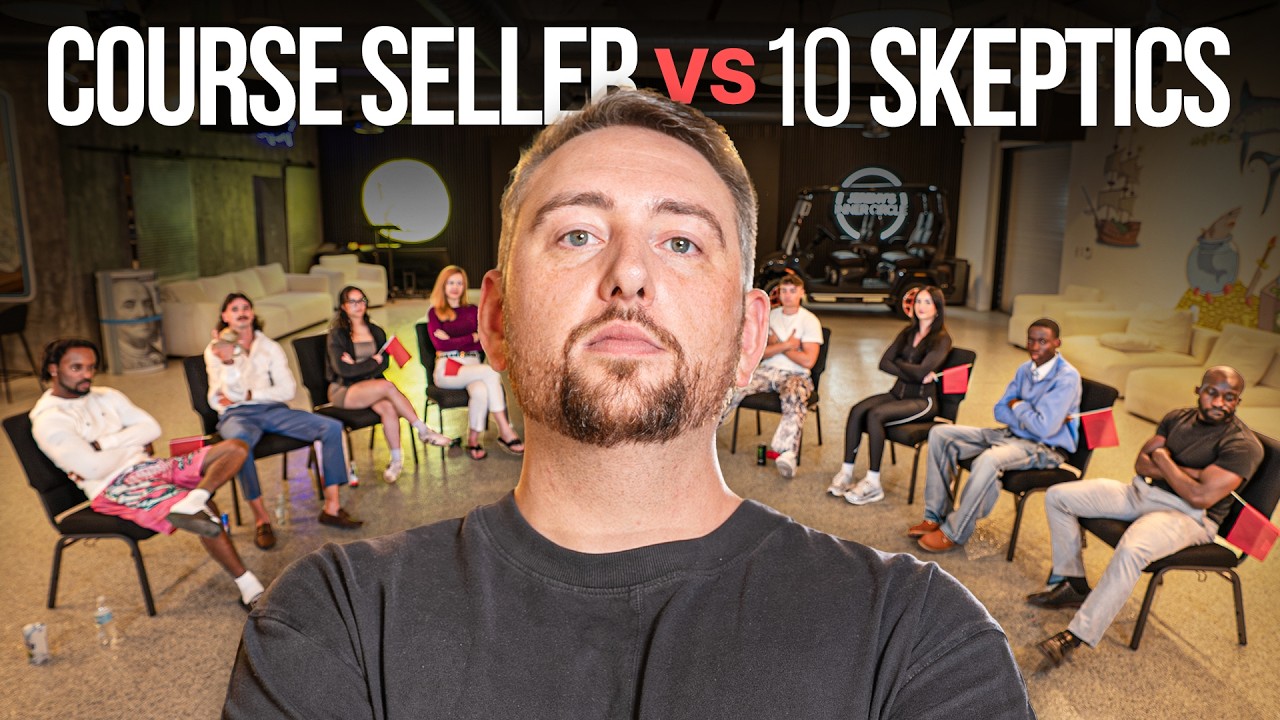
I recently made a bet on a video concept that catastrophically failed. The video was titled “One Core Seller vs 10 Skeptics,” and if you were waiting for it to drop, it’s not happening. What you’ll get instead is more valuable: a walk-through of the exact reasons that bet was a poor choice for someone like me, and how you can use the same format if you sell to the right audience.
Here’s the thing: if you sell to the general public, this would be an incredible video format to replicate. But if you sell to high-net-worth individuals like I do, it’s one of the worst types of content you could create. It all comes down to understanding who your content actually attracts.
If you’re looking to go deeper on content strategy and audience targeting, my 7-week live comprehensive training covers the frameworks I use to build content systems that attract the right people.
Anonymous accounts and disengaged viewers are the biggest signals that something is wrong with distribution. These are the folks who hide behind anime characters or movie personas online. They’re aggressive, angry, envious, and spiteful. Most importantly, they’re skeptics who won’t stand behind their opinions with a real identity.
This video format attracted those demographics exclusively — not the kind of people I want to convert or bring into my world.
The format itself was straightforward. I paid a YouTube growth strategist from the UK to execute this concept. His team flew in, went to local college campuses like the University of Miami and FIU, and recruited 10 people to participate. We had quite the cast show up at my office: a guy with a mullet and a snake, a woman teaching financial domination strategies, random people grabbed off the street, and even a sick older woman.
We set up a table with 10 chairs in a half circle, two chairs at the table with microphones, and a moderator who used ChatGPT to create scripts based on my content and beliefs.
The concept was simple: the moderator would state something like “money doesn’t buy happiness.” Whoever disagreed would rush to the table to debate me. The video was entertaining from a production standpoint, but my intention was completely different.
I wanted to use this hidden VSSL concept as an example of how to sell to the general public. I didn’t anticipate that this format would exclusively attract the wrong demographic — about 95% of the audience that watches this kind of content.
This format originated from a YouTube channel called Jubilee. They do this with political ideas and random belief systems. But here’s the issue: wealthy people aren’t watching that content. Even the general public isn’t necessarily consuming it. People with excessive time on their hands are the primary audience. Research from the Pew Research Center shows that content consumption patterns vary dramatically by demographic, with debate-style content skewing toward younger, less affluent audiences.
So that format? Not good for me.
I could take the same format and structure it differently. For example:
Me versus 10 business owners who use traditional advertising, showing why digital marketing makes more sense.
A debate with 10 people sold on direct response marketing, focusing on my content marketing strategies.
Same format, but at a more sophisticated level to attract a more ideal demographic.
But the way this bet was executed exclusively attracted the wrong people. Nobody in my ideal buying pool was watching.
Here’s what really frustrated me: the strategist I hired apparently sold the exact same concept to others simultaneously. One of my top Inner Circle members started promoting essentially the same video concept just days before mine was supposed to drop.
Results are not typical. Your results will vary and depend entirely on your individual capacity, business experience, expertise, and level of desire. There are no guarantees concerning the level of success you may experience. The testimonials and examples used are not intended to represent or guarantee that anyone will achieve the same or similar results. We don’t believe in get-rich-quick programs. We believe in hard work, adding value, and serving others. As stated by law, we cannot and do not make any guarantees about your ability to get results or earn any money with our information, courses, programs, or strategies.
Their video was called “One Entrepreneur vs 10 Workers.” When I saw it on Instagram, it had the same characters — four out of the 10 people in their episode were the same people from mine.
I immediately contacted the UK strategist and asked what was going on. Now I faced two problems: I would look like a copycat, and I would exclusively attract the wrong audience. That’s when I decided to pull the plug.
The strategist refunded my money and promised not to use our name or footage anywhere. So the footage is vaulted and hopefully deleted. It’s a shame because the video itself was pretty good; it just attracted the completely wrong demographic.
Here’s another critical lesson. We ran this test multiple times, and YouTube Shorts exclusively attracted those same demographics.
We took clips from the longer episode and dropped them on YouTube Shorts to hype the main video. I also posted the same content on Instagram Reels. Same result: anonymous accounts, disengaged viewers, and enraged commenters.
The content showed me debating regular people about money-centric topics. One person literally told me that sitting in traffic was okay. I was explaining that sitting in a Sprinter van is better, and he insisted that driving for an hour with his buddy was fun — completely different worldviews.
This format attracted the wrong people, and the platforms we posted on made it worse. According to Social Media Examiner, short-form video platforms tend to attract broader, less targeted audiences compared to long-form content. YouTube Shorts has a very different audience composition than long-form YouTube. Instagram Reels can include some wealthy viewers, and we’ve seen success there, but this specific format? Bad timing.
We recently did a podcast with a guy named Grant. The long-form version was phenomenal — it’s in the collab section of my YouTube channel. White background, long table, him on one side, me on the other.
The long-form version performed well. We had the right types of people reaching out saying they saw me on the channel and found it valuable.
But Grant chose to create short-form versions. These took out-of-context lessons from the longer video and chopped them up in a way that looked terrible without context. Again, all that attracted was the wrong demographic and provoked anger.
Some of those shorts scaled to mid-range views, a few hundred thousand, and a couple hit a couple million. But long-form attracts the right folks — people who sit and consume full-length content. Those viewers are more aligned with my ideal demographic, especially when my channel centers around lessons from people who’ve achieved significant business growth.
The wrong audience is the polar opposite of who I’m trying to attract.
I’ll drop the full video inside my Inner Circle program and my 7-week live comprehensive training. It’s an incredible example for students who sell to regular people. I won’t publish it publicly online because of who it attracts, but I will use it as an example inside my course library.
Results are not typical. Your results will vary and depend entirely on your individual capacity, business experience, expertise, and level of desire. There are no guarantees concerning the level of success you may experience. The testimonials and examples used are not intended to represent or guarantee that anyone will achieve the same or similar results. We don’t believe in get-rich-quick programs. We believe in hard work, adding value, and serving others. As stated by law, we cannot and do not make any guarantees about your ability to get results or earn any money with our information, courses, programs, or strategies.
Let me explain the concept of a hidden VSSL. Markets have varying awareness levels. As awareness increases, skepticism typically rises. As skepticism grows, the effectiveness and conversion rates of your sales vehicles decline because people become aware you’re trying to sell to them.
Simple lesson: when people know you’re trying to sell to them, they consume content differently. When they aren’t aware of a sale, the same concepts presented in a hidden VSSL format can slip past conscious defense mechanisms and go straight into the subconscious. This can reshape beliefs and worldviews, which is powerful for increasing buyers when you’re selling information. HubSpot’s research on content marketing supports the idea that educational content builds trust before the sales conversation begins.
You must find a format that allows you to talk to people without triggering the “this guy’s trying to sell me” response.
The easiest way to replicate this is to study top channels and their content. Jubilee’s approach is simple: set up a large rectangle or arena with lines representing neutral, strongly agree, strongly disagree, agree, disagree, etc. Vocalize a statement like “does money buy happiness?” Everyone starts neutral, then moves based on their opinion. People who strongly disagree move far left; those who agree move right.
That’s a format that gets many views. You can manufacture that style of video for selling.
Let me give you examples from my Inner Circle:
Jacob, a dog trainer, already creates great talking-head content demonstrating training processes. He could replicate this format by having owners respond to statements like “you can’t train an old dog,” then have owners take turns explaining their positions while Jacob reinforces his regular lessons.
Another member sells a medtech shockwave device used by physical therapists and chiropractors. He could host 10 practitioners or patients and ask something like “there’s no such thing as a medtech device that can abruptly interrupt a muscle spasm.” A disagreement would lead to on-camera debate, and the professional could be persuaded.
This is a hidden VSSL you can adapt for cost-effective production. Participants were paid a small amount each; add a production crew, three cameras, and LED lights from Amazon, and you’ve got a hidden VSSL.
This format has an inherent bias because it’s already a format that gets large viewership, which helps you get more views. It slips past viewers’ guards because they think they’re simply watching content, not a sales page or VSSL.
You can replicate this beyond these examples. I can replicate it moving forward in ways that benefit me and attract my audience type. The main lesson: hidden VSSL makes sense to execute, but you must be mindful of how you do it. There are sophisticated ways and terrible ways like the one I executed.
In my experience, we do not sell to disengaged viewers, anonymous accounts, or the general public. We sell to wealthy or very wealthy individuals exclusively. For us, high view counts are an inverse signal: large viewership often means we’re attracting the wrong people. We don’t want to be famous; large audiences often equal poor targeting.
If you do this format correctly, you can still get many views while attracting the right people based on topic and execution.
The topic determines which demographic you attract. Months ago someone reached out wanting a one-on-one debate with me; I was too busy then but would revisit a competent challenger format geared toward wealthy folks. A well-executed challenger video can make me explain ideas from perspectives different than my usual talking-head content.
Remember: “One Core Seller vs 10 Skeptics” attracted the most skeptical people on Earth. Anonymous accounts are extremely skeptical and typically not buyers. The video name alone was a poor choice; it signaled the wrong audience and made the mistake worse.
My Inner Circle student who replicated the concept with four of the same characters titled his video “One Entrepreneur vs 10 Workers.” That phrasing naturally moves the demographic up a bit: instead of exclusively attracting the wrong people, it pulls in a more middle-of-the-road audience. You see the difference.
Also consider that chopping content into out-of-context shorts can change the demographic completely. The Grant podcast long-form version attracted the right people; the short out-of-context versions attracted the wrong demographic entirely.
I want to apologize for hyping this video. We were genuinely excited, but I’m not going to release content that damages my brand or fills my warm audience with people I never want to sell to.
I believe deeply in the value of what I’ve shared here. You should walk away with actionable insights you can apply to your brand or business.
If you want to go further, consider my paid programs. My Inner Circle includes quarterly masterminds in Miami, twice-monthly one-on-one calls, weekly group calls on Saturdays, an active group chat, dozens of SOPs, a large course library, and AI tools to make execution simple.
Results are not typical. Your results will vary and depend entirely on your individual capacity, business experience, expertise, and level of desire. There are no guarantees concerning the level of success you may experience. The testimonials and examples used are not intended to represent or guarantee that anyone will achieve the same or similar results. We don’t believe in get-rich-quick programs. We believe in hard work, adding value, and serving others. As stated by law, we cannot and do not make any guarantees about your ability to get results or earn any money with our information, courses, programs, or strategies.
There are income qualifications and time commitments. My 7-week live comprehensive training covers digital marketing and AI. It’s currently a one-time cost for lifetime access, though we may move to annual pricing. If you’re on the fence, enroll sooner rather than later.
Results are not typical. Your results will vary and depend entirely on your individual capacity, business experience, expertise, and level of desire. There are no guarantees concerning the level of success you may experience. The testimonials and examples used are not intended to represent or guarantee that anyone will achieve the same or similar results. We don’t believe in get-rich-quick programs. We believe in hard work, adding value, and serving others. As stated by law, we cannot and do not make any guarantees about your ability to get results or earn any money with our information, courses, programs, or strategies.
Both programs require a conversation with us to ensure you’re the right fit.
Watch the video:

Jeremy Haynes is the founder of Megalodon Marketing. He is considered one of the top digital marketers and has the results to back it up. Jeremy has consistently demonstrated his expertise whether it be through his content advertising “propaganda” strategies that are originated by him, as well as his funnel and direct response marketing strategies. He’s trusted by the biggest names in the industries his agency works in and by over 4,000+ paid students that learn how to become better digital marketers and agency owners through his education products.

Jeremy Haynes is the founder of Megalodon Marketing. He is considered one of the top digital marketers and has the results to back it up. Jeremy has consistently demonstrated his expertise whether it be through his content advertising “propaganda” strategies that are originated by him, as well as his funnel and direct response marketing strategies. He’s trusted by the biggest names in the industries his agency works in and by over 4,000+ paid students that learn how to become better digital marketers and agency owners through his education products.


This site is not a part of the Facebook website or Facebook Inc.
This site is NOT /endorsed by Facebook in any way. FACEBOOK is a trademark of FACEBOOK, Inc.
We don’t believe in get-rich-quick programs or short cuts. We believe in hard work, adding value and serving others. And that’s what our programs and information we share are designed to help you do. As stated by law, we can not and do not make any guarantees about your own ability to get results or earn any money with our ideas, information, programs or strategies. We don’t know you and, besides, your results in life are up to you. Agreed? We’re here to help by giving you our greatest strategies to move you forward, faster. However, nothing on this page or any of our websites or emails is a promise or guarantee of future earnings. Any financial numbers referenced here, or on any of our sites or emails, are simply estimates or projections or past results, and should not be considered exact, actual or as a promise of potential earnings – all numbers are illustrative only.
Results may vary and testimonials are not claimed to represent typical results. All testimonials are real. These results are meant as a showcase of what the best, most motivated and driven clients have done and should not be taken as average or typical results.
You should perform your own due diligence and use your own best judgment prior to making any investment decision pertaining to your business. By virtue of visiting this site or interacting with any portion of this site, you agree that you’re fully responsible for the investments you make and any outcomes that may result.
Do you have questions? Please email [email protected]
Call or Text (305) 704-0094