
Why Your Sales Funnel Isn’t Converting and How to Fix the Real Problem

I hope you enjoy reading this blog post. If you want my team to just do your marketing for you, click here.
Author: Jeremy Haynes | Published May 28, 2026
Earnings Disclaimer: You have a .1% probability of hitting million-dollar months according to the US Bureau of Labor Statistics. As stated by law, we can not and do not make any guarantees about your own ability to get results or earn any money with our ideas, information, programs, or strategies. We don’t know you, and besides, your results in life are up to you. We’re here to help by giving you our greatest strategies to move you forward, faster. However, nothing on this page or any of our websites or emails is a promise or guarantee of future earnings. Any financial numbers referenced here, or on any of our sites or emails, are simply estimates or projections or past results, and should not be considered exact, actual, or as a promise of potential earnings – all numbers are illustrative only.
If your numbers don’t make sense, you’re not operating in reality. And if you’re not operating in reality, every optimization decision you make is worthless.
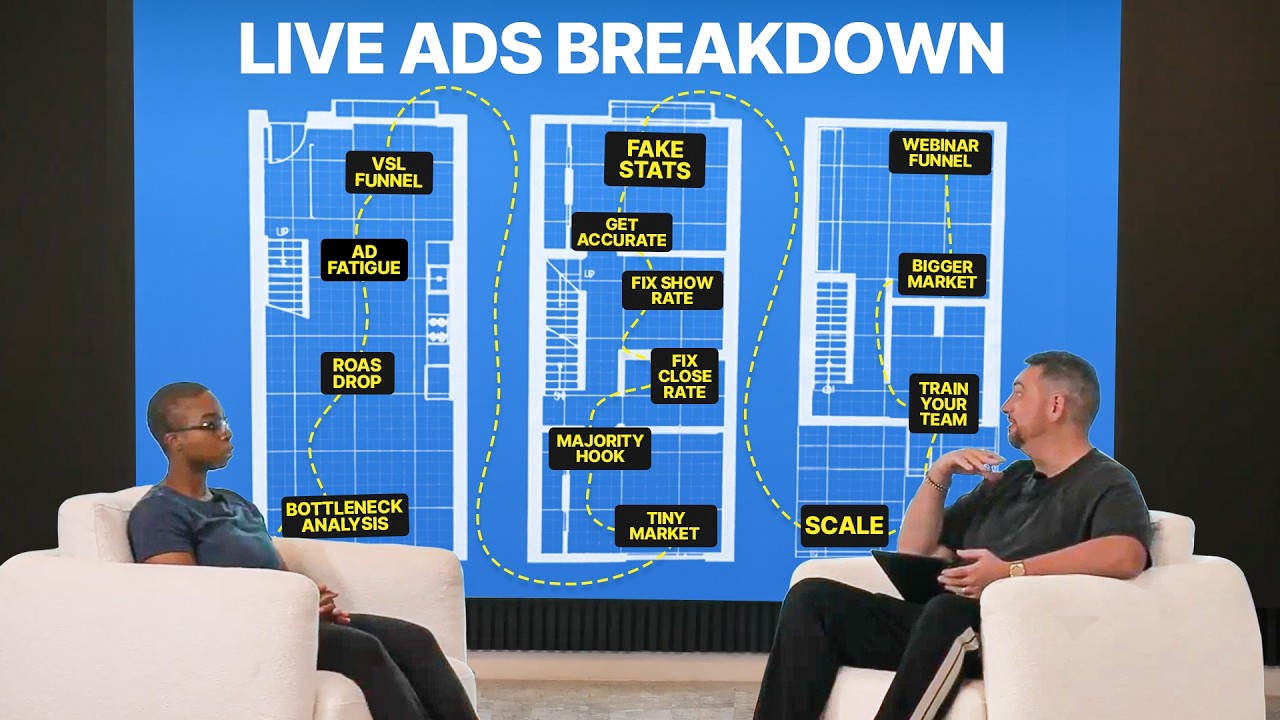
A recent conversation with one of my Inner Circle members perfectly demonstrates this principle. She runs a data analytics training business. Her VSSL call funnel performed well in March. By May, it had dropped significantly.
Results are not typical. Your results will vary and depend entirely on your individual capacity, business experience, expertise, and level of desire. There are no guarantees concerning the level of success you may experience. The testimonials and examples used are not intended to represent or guarantee that anyone will achieve the same or similar results. We don’t believe in get-rich-quick programs. We believe in hard work, adding value and serving others. As stated by law, we can not and do not make any guarantees about your own ability to get results or earn any money with our information, courses, programs, or strategies.
She suspected ad fatigue. The real problem was completely different.
Already making money? See what it takes to make a lot more.
What Ad Fatigue Actually Looks Like
Most people diagnose ad fatigue incorrectly because they focus on frequency instead of performance patterns.
Ad fatigue presents itself in two distinct ways, and frequency isn’t one of them.
The first is what I call the death cross. Your result volume starts high and costs start low when a campaign launches. As time progresses, you enter a fatigue cycle where result volume dips consistently and cost per result climbs consistently.
Once that cross happens, it never recovers. It perpetually worsens. Here’s why paid ads stop scaling and what to do before it’s too late.
The second way ad fatigue manifests is when cost remains stable but audience quality degrades. One operator ran the same campaigns since October. His cost per result stayed identical the entire time, but his lead quality collapsed. Credit scores dropped, income levels dropped. Everything deteriorated even though his cost per lead looked fine.
We don’t judge ad fatigue based on frequency. I’ve had campaigns with a frequency of eight that still performed well. I’ve had campaigns with poor link click-through rates that were still profitable.
The actual indicators are when that death cross occurs or when we see consistent degradation in audience quality. One or the other. According to research from AdEspresso on Facebook ad performance, frequency alone is not a reliable indicator of campaign fatigue without corresponding changes in performance metrics.
How to Run a Bottleneck Analysis That Reveals Where Your Funnel Actually Breaks
A bottleneck analysis is straightforward. You examine every step of your process and determine where the actual choke point exists (not where you think it is, but where it actually is based on the numbers).
For this member running a VSSL call funnel, we examined CPMs, link click-through rate, application-to-scheduler drop-off rate, show rate, closing percentage, and AOV. Each one of these stats can negatively influence everything that follows it.
She reported 117 qualified scheduled calls in the past 30 days at $117 cost per call. She had a 62% show rate, 30% close rate, and $5,500 AOV.
When I plugged those numbers into the financial model with her monthly ad spend, the math didn’t match her reported performance. Something was manipulated. The numbers weren’t real.
Why Your Team Reports Inaccurate Numbers
Your team isn’t necessarily lying on purpose. Generally, it’s a difference between what gets reported versus what the stat actually represents. It gets manipulated in a way where it’s not accurate.
Consider this from a sales manager’s perspective. If your close rate looked poor, that looks bad. You’d want to keep your position and your additional pay. So you might manipulate the stats knowingly to be more favorable, or you might just report them differently than what they actually represent.
Show rates get manipulated constantly. Sales teams will book calls onto calendars, then self-cancel or let people cancel themselves.
Sales teams will book calls onto calendars, then they’ll self-cancel or let people cancel themselves. When they report the show rate, they only count the people who stayed on the calendar after cancellations. That’s not a real show rate. That’s a manipulated show rate.
If you and I ran a military operation together and we had to rely on data from soldiers in the field to make commanding decisions, we’re only as good as the data that gets relayed to us. If we make decisions based on data that isn’t accurate, we’re not making valuable decisions. Our people in the field aren’t operating in reality.
You need brutal honesty and truth across these statistics so you can make real decisions based on what’s happening.
Why Stats Get Manipulated and What Leaders Do About It
There’s a set of patterns that happen in every revenue range. When you’re operating at a certain level, this exact problem shows up constantly. You think your stats are one thing, but they’re actually something completely different. You’re making optimization decisions based on false information.
Leaders across larger organizations implement something that might sound simple but is extremely practical at scale.
You might think your job is to train your people and then train them on the next set of more advanced lessons. You might view training as an escalating process where you get something out of the way and then advance to the next thing.
The reality is, especially for sales teams, you teach a fundamental set of lessons that have proven effective in your organization again and again and again. You never really teach much beyond that.
I’ve had sales teams where I’ll teach them to send a selfie video right after a call gets scheduled. Show rate improves. They make more money that week. Three or four weeks later, I look at their stats and show rate is down again. I ask what happened. They stopped doing the video texts.
You have to repeat the same exact thing to these folks repeatedly until they finally integrate it.
Why Webinar Funnels Fail and What the Booking Rate Reveals
This member also tried running webinars. She spent $2,500 per webinar and lost money on all three attempts.
Her cost per lead was $7.22, which is actually solid. She had a 20% show rate to the webinar, which is about average. Ideally you want 30%, but 20% is middle of the road.
Then I asked about booking rate. Out of the people who stayed until the pitch, how many booked a call?
3%.
There’s your issue.
Most people will break even when they’re not profitable on webinars. It’s very rare to actually lose money. The waste is usually just time and effort. But that 3% booking rate is excessively below average.
In my experience, you’d be at 10% for your booking rate at the low end. Middle of the road is 20%. You’d want to strive for 30%.
Her retention rate to the time of the pitch was 53%. Ideally, that’s at least 80%. Here’s how to run profitable webinar funnels that actually retain and convert attendees.
She was only getting about half the people who showed up to stay until the pitch.
These are some of the lowest booking rate and retention stats I’ve ever seen in webinars.
The problem wasn’t her ad spend or her traffic source. It was her presentation and how she was positioning the opportunity to a cold audience.
How to Present to Cold Audiences and Why Market Awareness Matters
There’s a substantial difference in presentation when you’re actively presenting to people who know you versus a cold audience who doesn’t know you.
This member was trying to sell data analytics training. She was pitching it to people who already knew what a data analyst was and already wanted to become one. That’s a tiny part of the market.
The majority of people willing to change careers have no idea what a data analyst is or why they should become one. They need education first.
That’s what a webinar is perfect for. It’s a content-first mechanism that forces consumption and makes people come to a conclusion that you frame for them through the presentation.
But if you only do webinars once a week, you only get four reps in a month. If I only worked out four times in a month, could I expect much improvement? Nothing. I’d expect nothing.
If you have the financial endurance, add a second webinar each week. That way you end up getting eight reps in the month instead of only four. That’ll make you improve twice as fast to the point where these become profitable.
Market awareness matters more than most people realize for front-end messaging. When you look at Google Trends for artificial intelligence in the United States from 2004 to now, there’s a massive volume of interest spike recently. But when you look at AI agents specifically, very few people are actually aware of what they are. According to data from Gartner on emerging technology adoption, awareness of specific AI applications lags significantly behind general AI interest.
Someone will join my Inner Circle and show me their landing page. The headline says something like “Have AI agents build your ecom store for you.” And I ask them if they think people know what AI agents are. They say of course they do.
They don’t.
Same thing applies here. Do people actually have awareness of what a data analyst is? What that job entails? And more importantly, do they view it as a safe profession to transition into in the world of AI?
This member said she’s definitely seen objections uptick recently about AI replacing data analysts. But she hasn’t updated the messaging on the front end of her creatives yet.
If you believe deeply that the profession is safe from AI (which it probably is because these people are just using AI to do their jobs better), then sell that on the front end. But remember: do people even know what a data analyst is?
7 weeks. Real frameworks. Covering copywriting, funnels, paid ads, and conversion systems.
How to Choose the Right Funnel and Where to Focus Your Resources
When you look at the market as a whole, there are millions of people per year actively willing to change careers.
But this member’s buyer has to have awareness that they want to be a data analyst. They already have to be very framed that this is an opportunity they want to take advantage of.
If a majority of people who are going to click to your page fit into the “majority hook” bucket and have no idea what it is but are willing to change their career, what type of funnel would be better for that type of person to open you up to a larger market?
A webinar funnel.
The way she was currently operating only works until you go to scale. Then it has a very low ceiling before it starts to decline. Costs escalate. Result volume stays the same. You’re essentially appealing to a very tiny part of the market.
You can do that until you hit that ceiling and realize you need other messaging angles. You need to find other hooks you can use. That forces you to augment all things: the messaging, the funnel, the emails, the sales team.
The difference that allows you to tee up the same type of lead you get now into your closing calendars would definitely be a webinar funnel.
Priority number one is getting accurate analytics inside the VSSL funnel. From there, prioritize putting attention onto the contraction that reveals itself when you have accurate analytics.
Every organization has a different amount of what I call testing bandwidth: how much time and effort an organization can put toward figuring something out.
My bet is the webinar testing is unknowingly taking away from her ability to fix what’s going on in the VSSL call funnel. If that’s true, take attention off the webinar because it’s an unprofitable endeavor currently. Put all attention into that VSSL call funnel and fixing it.
Focus intensely on the problems within it (the contractions). Once it’s opened back up again and you’re able to pull some profit off of that and subsidize the webinar, put attention into that following.
It’s really a money decision and a testing-bandwidth decision that determine whether you do webinars once a week or twice a week.
I had to ask this member something for accountability. She’s a part of my 7-week live comprehensive training and the Inner Circle. She has access to massive SOPs on mastering webinars. We’ve done recent calls on objection handling, the onion pitch, risk reversals, rep pitches, and how that flow looks.
Results are not typical. Your results will vary and depend entirely on your individual capacity, business experience, expertise, and level of desire. There are no guarantees concerning the level of success you may experience. The testimonials and examples used are not intended to represent or guarantee that anyone will achieve the same or similar results. We don’t believe in get-rich-quick programs. We believe in hard work, adding value and serving others. As stated by law, we can not and do not make any guarantees about your own ability to get results or earn any money with our information, courses, programs, or strategies.
Why hadn’t she consumed the information she has available that she pays for, specifically for webinars?
She said she must have overestimated her ability to present live. She thought because she teaches live all the time and does lives, it would be easier. She overshot the level of difficulty of converting.
She should be training hard on watching as many webinars as she can. At the masterminds we do, many people at different stages got there through webinars. At the most recent mastermind, several operators got there through having webinars as part of their process.
Every one of those people you can look up and watch their webinars. Everyone in the group is very open with one another. I haven’t seen her go into the group chat and ask a single question about her webinar stats and how they can be improved.
She could even post her webinar in there. Or take the entire webinar transcript, post it into the AI tool we have, and say these are my stats, what am I doing wrong? She’ll get a ton of feedback.
Put your priority attention on the VSSL: get accurate analytics and stats. Be more transparent and vulnerable inside the group. There’s a lot of value in other people’s perspective beyond just my own.
When I plugged this member’s stats into the financial model, it showed she should be performing at a certain level. But she was actually performing at a much lower level.
To get from the projected performance down to the actual performance, we had to cut the close rate significantly. Or we had to cut the show rate in half and the close rate in half. Multiple numbers had to be dramatically different from what was being reported.
That means as a business owner, you have to put your attention on those specific things. It could be one or the other. Maybe your show rate is poor. Maybe your close rate is poor. Maybe it’s a combination.
Until you get accurate, you can’t actually put attention where it literally needs to go.
That’s the value of a bottleneck analysis. We get the numbers from our team or we go look ourselves. We then make reality-based decisions by focusing our attention on the specific number that’s the most contracted and easiest to improve compared to anything else.
Numbers don’t lie. But people do. And sometimes they don’t even realize they’re doing it.
Get accurate. Get real. Then get to work.
If you want help building these systems in your business, my 7-week live comprehensive training walks through the entire framework for diagnosing funnel problems and implementing tracking systems that give you accurate data. We cover bottleneck analysis, webinar optimization, and how to structure your team’s reporting so you’re operating from reality instead of manipulated stats.
Results are not typical. Your results will vary and depend entirely on your individual capacity, business experience, expertise, and level of desire. There are no guarantees concerning the level of success you may experience. The testimonials and examples used are not intended to represent or guarantee that anyone will achieve the same or similar results. We don’t believe in get-rich-quick programs. We believe in hard work, adding value and serving others. As stated by law, we can not and do not make any guarantees about your own ability to get results or earn any money with our information, courses, programs, or strategies.
Get my content first on Google
Add jeremyhaynes.com as a preferred source and Google shows my articles more prominently in your search results, including AI Overviews and AI Mode.


Jeremy Haynes
Owner and CEO of Megalodon Marketing
Jeremy Haynes is the founder of Megalodon Marketing. He is considered one of the top digital marketers and has the results to back it up.