Why You Get Inconsistent Results from Facebook Ads and How to Fix It

I hope you enjoy reading this blog post. If you want my team to just do your marketing for you, click here.
Author: Jeremy Haynes | Published December 23, 2025
Earnings Disclaimer: You have a .1% probability of hitting million-dollar months according to the US Bureau of Labor Statistics. As stated by law, we can not and do not make any guarantees about your own ability to get results or earn any money with our ideas, information, programs, or strategies. We don’t know you, and besides, your results in life are up to you. We’re here to help by giving you our greatest strategies to move you forward, faster. However, nothing on this page or any of our websites or emails is a promise or guarantee of future earnings. Any financial numbers referenced here, or on any of our sites or emails, are simply estimates or projections or past results, and should not be considered exact, actual, or as a promise of potential earnings – all numbers are illustrative only.
If you’re getting inconsistent results, pay attention to this.
Inconsistent results in the context of what I’m about to talk about are you get booked calls, you get webinar leads, you get low ticket buyers, you get DMs for whatever kind of ad strategy you’re running and you get pockets of really good people.
And all of a sudden you become enthused. You start scaling, people are closing, and then out of nowhere, all of a sudden, everybody’s coming through unqualified.
You’re in a pocket of poor leads all of a sudden.
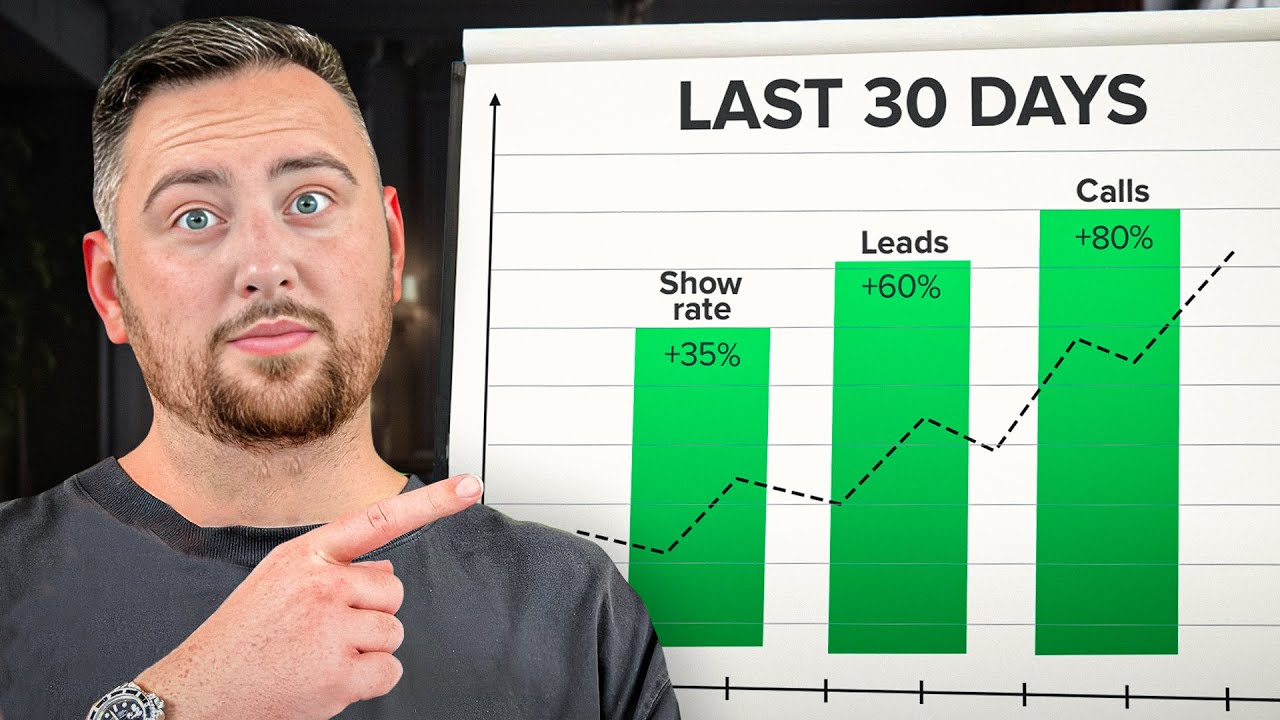
You might have done something like implement a bunch of best practices to help improve your show rate and then boom, all of a sudden you’re seeing a huge lift in your show rate and went right back down.
If you get a lot of inconsistency in what you’re doing, pay attention.
I’m going to help you out with what we do in the businesses that we help hit million-dollar months with.
I’m not in any way, shape, or form inferring you’re going to hit a million a month. At the end of the day, 0.1% of all businesses that exist hit $10 million a year, let alone the big $12 million a year, according to the US Bureau of Labor Statistics.
So again, there are no income claims.
I simply take the top lessons from the currently 40 different businesses that we’ve helped get there, just had some form of influence in the process to be clear, and I hand them down to you in little bite-sized lessons like what we’re going to cover here today.
So welcome in if you’re new. If you’re already following along, welcome back. It’s a pleasure to have you.
If your business is already generating $100k+ per month, My Inner Circle is where you break through to the next level. Inside, I’ll help you identify and solve the bottlenecks holding you back so you can scale faster and with more clarity.
Let’s not ramble on anymore. Let’s dive in.
What Are Pocket Audiences and Why They Cause Inconsistent Facebook Ad Results
Inconsistency generally comes from a slew of different variables that we’re going to talk about today.
The first thing I want to start off with is this concept that we call pocket audiences.
This is really important to understand and you not understanding it is generally indicative that there is a whole lot more that you need to know that you do not currently know about the advertising process.
Pocket audiences is a really simple concept.
When you generally launch a campaign, you ideally want to see the campaign’s performance go up and to the right. And so does the platform that you are spending money on.
They also want you to consistently get results.
This first little window right here, this very first phase is generally when you have the highest probability to get the right type of people through, if you’ve already historically gotten the right type of people through.
A lot of your inconsistency problems come down to the fact that you have an inconsistently seasoned pixel.
If you have a bunch of poor leads sprinkled into the really good people historically on whatever standard event you are currently optimizing for in your campaigns, you my friend run a dramatically higher probability to experience randomness.
Randomness is not technically random in this case. As silly as that sounds, it comes from the fact that you have two to upwards of who knows how many different types of people that you’ve allowed to hit your pixel.
So some of you then ask the question like, hey, if I have been exposed to that, should I create a new pixel?
Yeah, I mean there’s a good reason that you should consider that.
But two, you could also just pick a different similar standard event for the outcome that you ideally want. Depends on what you’ve historically done up to this point.
I have a great extremely in-depth piece on this site, a mastery piece on pixel conditioning that you can go and check out after you read this one if you want an extensive amount of information on how to condition a pixel properly and how to recondition a pixel in the instance that it messes up.
Back to my point though.
When you first launch a campaign, if it’s on a pixel that historically has been conditioned with really good people, just launching a new campaign right away dramatically increases the probability you go back into a good target audience.
What Signals You’re Sending Facebook That Make Your Ad Results Inconsistent
There are a lot of different ways that you communicate with these ad channels that you’re likely also oblivious to because you’re undereducated on the platforms you’re trying to go big on.
These platforms, they don’t pick up the phone and call you in most instances to make their decisions in real time algorithmically.
What do they do instead? They monitor your behavior and the signals that you provide to it.
I’m going to give you a handful of signals as an example.
If I increase ad spend, is that a good signal or a bad signal? Does it reinforce that I like what’s happening or does it signal that I don’t like what’s happening if I increase the budget?
What about if I decrease the budget? What about if I just turn off the campaign and then turn it back on again? What if I overcomplicate the campaign?
You know, one of the number one variables that these platforms love more than almost anything else is simplification.
So if I go in there to an existing campaign that has performed well, and I start duplicating a few of the ad sets within it, letting the original ad sets run or I do the same thing on the ad level.
Maybe I add a bunch of new variables or I remove a bunch of variables.
And again, I just signal to it a bunch of things that you don’t think mean anything, but to the AI that you’re working with mean everything.
They’re indications of what you think. Those signals make a big difference to what it does next.
The data coming back to it makes a big difference of what it’s going to do next.
How to Use Conversion API to Only Send Qualified Leads Back to Facebook Pixel
I’ll give you a great example.
We had a client recently. They were like, “Hey, we’re getting a lot of really good qualified people, like exceptionally qualified people.” And then we get some people that are just good in general.
Is there any way to try to find more of these really qualified people to bring through?
And I was like, “Yeah, let’s try something.”
And this is a super pro tip. I’m really surprised I’m going to give this one to you for free because generally I withhold the absolute best stuff that’s going to make you the most for my paid programs.
Like my Inner Circle program where we do twice a month one-on-one calls, weekly group calls, quarterly in-person masterminds, and we have a group chat full of rich people trying to get a lot richer.
The point that you would join into that program is to accelerate your progress.
You’re a smart person. You’re likely already doing a couple hundred grand or maybe you hit the lowest current qualification for income threshold, which is $100K a month, and you’re just looking to make a lot more a lot sooner.
The Inner Circle is intended to accelerate progress. That’s what its intention is. To be clear, there’s a link for that available if you want to check that out.
Back to my pro tip.
What we chose to do instead of allowing the pixel placed on a website to be what signals the standard event that reports back into the results column, which again, anything that reports into the results column is typically who it’s probable to go after next.
So we withheld the data being sent back through the pixel.
We still pixeled the sites, but we withheld the standard event from firing on something like a confirmation page through a call funnel.
What we chose to do instead is create a conversion API event that was manually triggered when a salesperson would signal really qualified versus just qualified.
We would send both back but to different standard events.
So the standard event that we were actually optimizing the campaign for, the only data, literally the only data that that results column in that pixel would ever see for that specific standard event we were optimizing for were the most qualified people. Meta’s Conversions API allows advertisers to send conversion data directly from their servers to Facebook, bypassing browser limitations and improving attribution accuracy by up to 20%.
All the salesperson had to do, nothing fancy, was just do what they would normally do and move a person into a specific deal pipeline stage.
And in some deals that we’ve done this with since, they just add a tag or they have a little drop-down field that we add that manually triggers off this specific marketing automation event that is generally set up through platforms like Zapier as an example.
The conversion API then takes that data, sends it back to the pixel, reports it into that results column, and then that biases who the platform and the AI is probable to go after next.
Pretty simple, right?
Well, that tip single-handedly from a pixel conditioning perspective could also create a tremendous amount of additional consistency that you currently lack.
Remember, just from this first point, I’m attempting to make two points technically.
At the very beginning of a campaign, if a campaign’s ad account that it’s operating within and that standard event that you’re optimizing that campaign for have a bunch of historical data to leverage, it’s going to leverage that type of person for who it definitively goes after.
Nowadays with advantage detailed targeting and advantage audiences essentially just defaulting almost everything to broad, if you’re in an account like that you need to have pixel conditioning best practices in top of mind consideration for again just to be clear helping you navigate the waters of inconsistency and turning it into predictable people that consistently come through.
Why You Need to Control Who Reports Back to Your Pixel Results Column
Point number two I was attempting to make is you have to control the data.
You have to control who reports back to that results column. It’s important. It’s critical.
There’s also this concept we call buckets.
So on that same note that I was just talking about where I’m saying, hey, when you first launch a campaign, it typically goes after a very probable to convert type of audience.
If it’s wrong, or if it just runs out to be fair, it moves over to the second group of people, which are typically less probable to convert than the first group of people.
Or if it just runs out of people, it goes after people. Acts almost like a lookalike audience.
It tries to find people from the over 52,000 different data points on average that they have per user. According to research, Meta collects an extensive range of user data across its platforms, with estimates suggesting thousands of data points per user to power its targeting capabilities.
It also factors in the people who have historically, this is very important to understand, converted on the standard events that you are currently optimizing your campaign for.
And it factors in all the stuff you’re talking about on the ad level, on the landing page level, like throughout the entirety of the funnel.
All assets are considered and factored into who it’s probable to go after next.
It obviously wants to continue going after people who are probable to convert for you.
But here’s the thing. As you scale through time, what generally happens is you get this curve that starts to occur.
There’s kind of two phases to this. The first phase is when it starts to flatline.
So in this phase right here in particular, how this will start to feel is as though you’re starting to see some initial signs that there’s going to be some consistency problems.
That, believe it or not, is typically the best phase to relaunch the campaign.
And also, at the same time, just treat it like it’s ad fatigue.
We have an entire piece, it’s actually one of the first pieces I posted on my site after committing to just distilling all the lessons of million-dollar months on what to do when things go wrong inside of refreshing creatives.
There’s a big protocol called ad fatigue, and I talk about it at length inside of that piece. I’d encourage you to go check it out after this one.
But my point being, if we just simply relaunch a campaign sometimes, and if we’re going to do that, we might as well relaunch it with some fresh creatives.
We pull it right back to the first phase again, because the campaign performance immediately goes back to bucket number one, which are the people who are most probable to convert.
What to Do When Your Facebook Campaign Starts to Plateau and Decline
So if you don’t understand that, you’ll have a bad time because then what starts to occur is you get this flatline window and then an eventual decline.
Some people, believe it or not, ride their campaigns straight into the ground until they, as a business, become unprofitable. Studies show that 63% of businesses struggle with properly managing their ad campaign performance, often continuing to spend on underperforming campaigns due to lack of proper tracking and analysis.
Then they’ll pull the spend all the way back. They’ll blame the platform and act like it’s their fault instead of their fault as the user.
They’ll blame the platform.
Terrible, terrible approach to blame the multi-hundred billion dollar, sometimes trillion dollar organizations on your lack of advertising awareness on how to create consistency.
Like just reflect with me real quick. Do you know anything about what we’re talking about so far?
If not, that’d be a great time to consider investing into yourself for some proper education.
Remember, my goal is to take you as a winner and help you win more sooner. I’m here to help you accelerate your progress.
If you’re somebody that’s rich and trying to get a lot richer, check out the links available.
At the end of the day, you don’t know what you don’t know. And I’m here to help put you on game to create additional results for you that yeah, you’re likely going to experience, but man, what’s your probability of giving up?
What’s your probability of getting there at the speed I could help you get there on your own?
I’m not sitting here saying you’re not smart enough to figure it out.
But why spend the money, the time, the stress, the resources, and the potential burnout to figure it out on your own?
It just doesn’t make that much sense.
Again, if you’re rich and trying to get a lot richer, check out the Inner Circle program.
You have to be making a minimum of $100K a month and you have to be able to commit for an extended duration of time to be amongst the people that are within that community.
It’s a phenomenal well-preserved resource that we all cherish and hold dear to us.
We don’t allow random outsiders who aren’t probable to get results in there. We take the people that we allow in extremely seriously.
And it’s not just some marketing tactic. We genuinely vet you as much as you’re probable to vet us to see if it’s a good fit.
So I encourage you check out the link for the Inner Circle offer or check out the link for my Master Internet Marketing program.
Extremely in-depth amounts of information over the course of seven full weeks where we talk at length for 3 to 5 hours per class with worksheets and dozens of content pieces in between each one of the classes, those big 3 to 5 hour classes for the homework libraries.
It’s a great community, extremely active. There’s a link for that available as well.
Real Example of Inconsistency
Back to my point though, think about this.
If you don’t know this, that’s a big part of why you’re experiencing inconsistency.
I’ll give you a great example.
There was a recent Inner Circle member who implemented every best practice that there was to implement to help improve his show rate.
His show rate went from the 40s, one point high 30s to be clear, all the way back up into the 60s, almost 70% for his show rate.
It was dramatic for what that did to his revenue, to the morale of the sales organization, and just the business period.
It was high-spirited and very optimistic.
And then out of nowhere, inconsistency.
But when you dug into it, to no surprise, the campaign had reached that phase where it started to plateau and then after the eventual plateau, it started its eventual decline.
How Facebook’s Bucket System Moves from High Quality to Low Quality Audiences
Here’s the thing that occurs that is very important for you to understand.
This bucket system is relatively never-ending. And sometimes it can move into buckets that are in the 50s or even 60s as an example of late stages of these particular campaigns.
And what happens every bucket that moves away from the first concentrated group of people that it deemed the most probable to convert, they become less probable to convert.
So keep in mind the longer a campaign is running in most instances, okay, there are outliers to this but in most instances the longer a campaign runs the less probable it is to consistently perform.
And there’s not a static answer for this.
It’s not like, oh, an average campaign can last like 3 to 5 weeks and then it’s done.
No, I’ve had friends and myself that have had campaigns run for literally a year plus and just milked the daylights out of it, scaled it.
But these are big markets with large quantities of addressable potential customers.
When you operate in a more niche vertical, depending on also how you have the campaign set up, depending on a lot of the other variables we’ve already discussed, like pixel conditioning, depending on the creatives and the hooks that you’ve chosen to deploy, these all dictate how long a campaign’s probable to perform before it experiences that plateau and then the eventual decline.
Again, there’s not a static answer, but you have to be able to know.
You have to be able to start to see when these different things statistically start to present themselves because that’s typically where you see it first.
How to Spot Early Warning Signs That Your Campaign Is About to Get Inconsistent
There are leading indicators that you can point your finger to and say, “Oh, I can see it coming.”
I live here in Miami as an example. I live in a beautiful penthouse. I can see very far into the ocean. Over here at the Atlantic Ocean, I can look out there and I can see storms brewing miles and miles off the coast.
And I can also just go stand on my balcony and get blasted by wind in a particular direction.
Am I then shocked in addition to all the other weather tools that are available to me in modern day when it starts to rain in a few hours from then?
No. I can see the initial signs of life, the leading indicators that I’m about to get drenched if I go outside.
My point being you have to be able to see the initial signs of life, those leading indicators for when you are going to start experiencing the inconsistency.
There’s also something really important to understand with these buckets. And with data restriction, being able to withhold data from the pixel and only allowing the right people through that can also correct the course.
If I’m driving a car like I just got this new McLaren 750S Spider, it is insane. I traded my Ferrari 458 for it and it’s a rear-wheel drive vehicle.
It’s like twin turbo V8. It’s got 700 something odd horsepower. And when you punch this thing, it gets a little squirrely.
Just because it gets a little squirrely doesn’t mean I need to stop the car and redo from 0 mph in my direction.
It’s like, no. You can just correct the car, let off the gas just a little bit, and then punch it again in order to continue going fast after having a little bit of a correction occur.
How to Course Correct Ad Campaigns Without Relaunching from Scratch
You don’t always just need to relaunch a campaign. You don’t always just need to overcome ad fatigue.
Sometimes you just have to withhold a little bit of data.
The equivalent of letting off the gas a little bit, correct it, and then punch the gas again.
So when I sometimes in campaigns start to see a little bit of inconsistency, remember what I mentioned with signals?
I will signal to the platform that I don’t like what it’s currently doing and I’ll withhold data going back to the pixel column for the wrong people.
I will step up the data restriction and who I allow to touch that pixel while I am also pulling back spend a little bit, not a huge amount, but remember pulling back spend signals to it I don’t like what’s currently going on.
So as soon as I don’t like what’s currently going on, tell it that you don’t like what’s going on, signal to it that you don’t like what’s going on.
And in addition to that, super mega pro advertiser tip, withhold the data that goes back to it.
Those times specifically, you can kick up the data restriction a little bit and use that conversion API tip that I talked about towards the beginning of this piece to get you to a position where that pixel course corrects.
And then you punch the gas if and when you do that tactic.
It’s very important you execute this correctly.
Like I said, you don’t have to slow the car down to zero miles per hour when you start to get a little squirrely. You have to know how to correct it.
When it starts to correct, just like in the car, I’m punching the gas again.
You do the same thing in those ad accounts.
Soon as you start to see a high quantity of the right people come through again, let the data flood back to the pixels so it gets a ton of those type of people hitting it and punch the gas out.
Spend more money immediately because what’s it do?
It triples down on that target demographic that it’s currently in. It leans into that pocket audience more.
This is really important to understand.
Why Most Businesses Are Too Lazy to Get Consistent Results from Paid Ads
One thing that I commonly find in businesses, and honestly, it’s kind of sad, but it’s also a huge competitive advantage for those that are willing to put in the work. Research indicates that only 22% of businesses are satisfied with their conversion rates, yet most fail to implement advanced optimization strategies that could significantly improve performance.
You have to understand that most businesses are so inherently lazy.
Like, they hear the level of tip that I just gave them and they say, “I just don’t want to be that involved, you know? I don’t want to have to do all that. I want to just set up some stuff and just have it work.”
That’s why it’s so easy to out-compete people and make so much more money.
Because the people who are just inherently lazy, you’re going to run circles around those people when you do these little things.
Imagine how much you’ll be able to blow your competitors out of the water if you have access and actually do the things that I’m talking about right here, right now.
And in addition to that, implement all the crazy extremely revenue-driven-oriented actions I can encourage you to take inside of a program like my Inner Circle offer.
The links for that are available. I’d really encourage you to join in if you’re rich and trying to get a lot richer.
There’s so much more I can do for you in there comparatively to what I can do for you here.
But either way, I put you on a lot of game here today.
I hope you enjoyed it. Do me a favor, share this with somebody who needs to hear it. Help your friends stop complaining about consistency. Send them this piece.
Most business owners waste years figuring out what actually works. In my Master Internet Marketing program, I compress that learning curve into 7 weeks, covering copywriting, funnels, ads, and more. If you’re ready to invest $5k and get serious about your skills, apply here.
Go check out some of the other pieces that I just recently posted that you may have missed so you can go out there and get richer.
Get my content first on Google
Add jeremyhaynes.com as a preferred source and Google shows my articles more prominently in your search results, including AI Overviews and AI Mode.


Jeremy Haynes
Owner and CEO of Megalodon Marketing
Jeremy Haynes is the founder of Megalodon Marketing. He is considered one of the top digital marketers and has the results to back it up.