How I Time Backend Offers After a Workshop Purchase

I hope you enjoy reading this blog post. If you want my team to just do your marketing for you, click here.
Author: Jeremy Haynes | Published September 25, 2026
Earnings Disclaimer: You have a .1% probability of hitting million-dollar months according to the US Bureau of Labor Statistics. As stated by law, we cannot and do not make any guarantees about your own ability to get results or earn any money with our ideas, information, programs, or strategies. We don’t know you, and your results in life are up to you. We’re here to help by giving you our greatest strategies to move you forward, faster. However, nothing on this page or any of our websites or emails is a promise or guarantee of future earnings. Any financial numbers referenced here, or on any of our sites or emails, are simply estimates or projections or past results, and should not be considered exact, actual, or as a promise of potential earnings – all numbers are illustrative only.
A workshop business can make the first sale and still wait too long for cash to arrive. It can also collect that cash while customers finish the workshop and wonder what to do next. When I look at a backend funnel, I keep those problems separate. One is about collecting money from a sale already made. The other is about earning a new purchase by helping someone with the next problem.
That distinction matters for cash velocity. A scheduled installment may make this month’s bank balance look better, but it does not tell me whether the customer wants another offer. And a clever follow-up sequence cannot repair an offer that arrives before the customer has used what they bought. I want to see the payment schedule and the customer journey side by side before I change the backend.
Already making money? See what it takes to make a lot more.
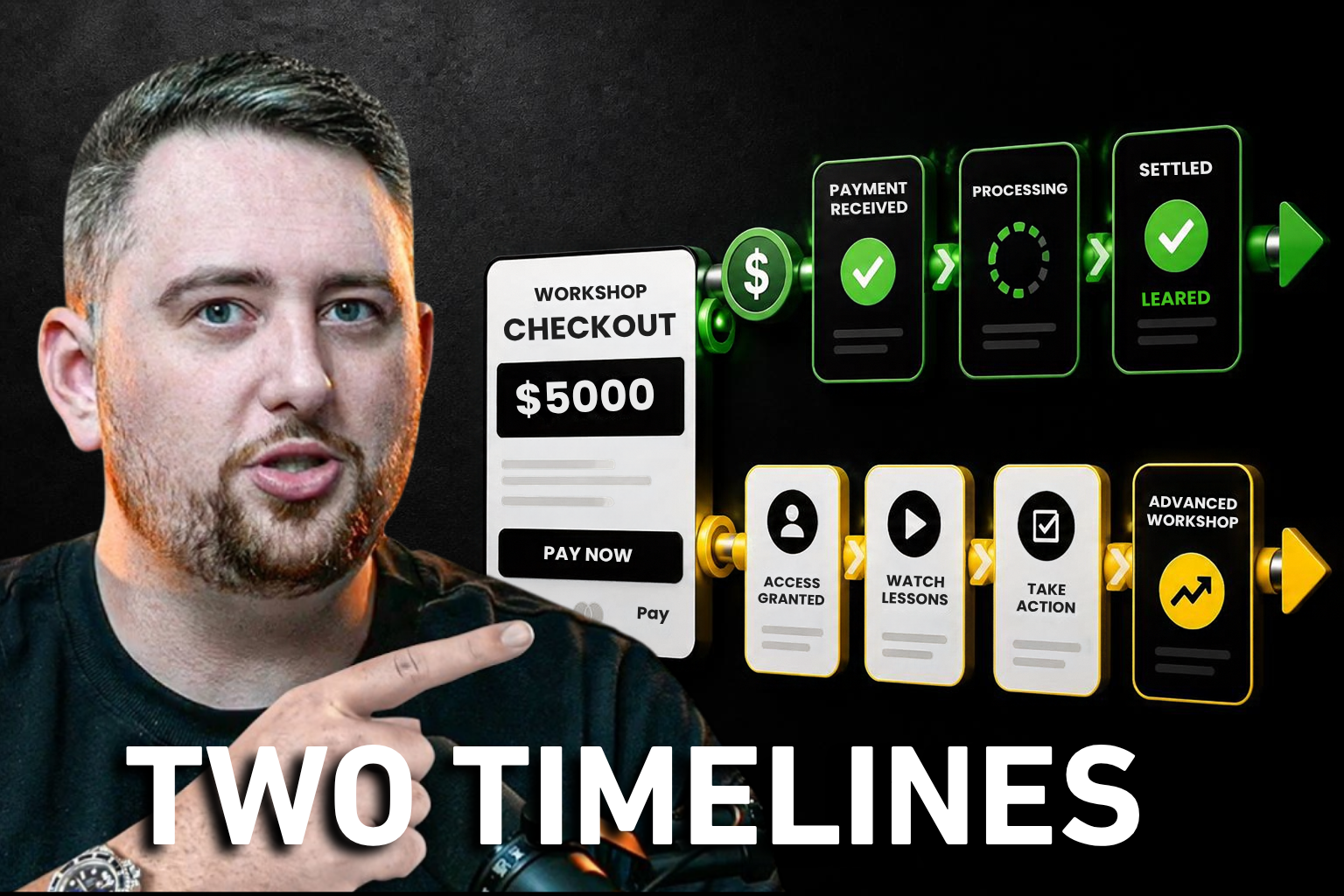
After the Workshop Sale, Track Two Different Timelines
The first timeline starts when a customer buys. When is the payment due, when does it actually clear, and how much remains to collect? The second starts when the customer begins the work. What did they buy the workshop to solve, what progress have they made, and where do they need help now?
Those timelines rarely move at the same speed. Someone can pay in full and need months before an advanced service makes sense. Someone else may reach a genuine implementation problem while still paying installments on the original purchase. Neither situation tells me to pitch automatically.
I would put these on one simple view. For every workshop customer, record the purchase date, agreed payment schedule, actual payments, attendance, first useful action, and any clear request for further help. The point is to see the sequence. A revenue report alone cannot show why the next offer landed too early or too late.
My article on cash flow timing in service businesses covers the wider business issue. Here I am looking at one tighter handoff. The first purchase has its own collection path, while the next purchase depends on a new reason to buy.
An Installment Collection Is Part of the First Sale
If a customer pays for a workshop over time, later payments can support cash flow. They are still collections on the original sale. I would never put them in the same bucket as a second purchase or a renewal and then say the backend is working.
Give each movement of money a plain label. There is cash collected from new workshop sales, cash collected from earlier workshop sales, recurring payments for an ongoing offer, and cash collected from separate follow-on offers. Then look at the dates money actually reaches the business. The labels will expose whether growth is coming from customer progression or from old receivables arriving this month.
Stripe’s invoicing documentation distinguishes an invoice’s status from payment collection. That operational detail matters here. Issuing an invoice, scheduling an installment, and receiving cleared funds are separate events. Your own agreement and accounting setup determine how to recognize revenue, but the collection dates are worth tracking on their own.
If collections lag, fix the collection path before celebrating a new backend funnel. Confirm the terms were clear at checkout. Check which payments failed, which reminders went out, and who follows up when a customer needs help. Stripe documents recovery workflows for failed recurring payments, but software only handles part of the job. The business still needs a fair, clear process.
The Next Offer Needs a Real Customer Milestone
Once the money is labeled correctly, I look at the customer’s work. What have they done with the workshop? What decision or implementation task comes next? The backend offer should answer a problem the customer can already recognize.
Say the workshop teaches a founder how to plan a campaign. They may later need help reviewing creative, training a team to run it, or troubleshooting the first launch. Those are different jobs. I would listen to workshop questions and follow-up conversations before choosing which one deserves its own offer. This is an illustration, not a claim about any particular workshop or customer.
A calendar-only upsell can miss that moment. Sending everyone the same pitch a fixed number of days after purchase is easy to automate. It is also easy to ignore. The customer may still be working through the first lesson, or may have moved past the next problem you assumed they would face.
In my piece on building an ascension path that feels guided, I explain why the next offer should follow progress rather than pressure. For this workshop handoff, I would use a specific signal, such as a completed assignment, a stated obstacle, or an explicit request for help. A signal opens a conversation. It does not obligate the customer to buy.
Use the Workshop Handoff to Learn What Comes Next
The handoff begins before the workshop ends. I would ask participants what they plan to do first, what might stop them, and what help they already know they need. Someone on the team should record those answers in a place that can be used later, not leave them buried in a call recording.
Follow-up should start by helping the customer do the thing they paid to learn. Send the promised materials. Make the first action clear. Answer the question they actually asked. If a later conversation reveals a problem the workshop cannot solve, that is the time to discuss another offer.
The client-success system I have written about treats early useful action as a real part of delivery. That same principle protects a backend sale. Customers are more likely to understand the next step when the original purchase has helped them make progress. There is no need to interrupt that progress with a pitch every time an automation fires.
There is a sales benefit to asking good questions, but I would not turn the workshop into a disguised qualification call. The customer should get the experience they bought. The business learns from that experience and can make an appropriate offer when there is a fit.
Build the Backend Offer Around Work You Can Deliver
It is tempting to create an expensive next step because the first sale produced demand. Before putting it into a funnel, I would write down what the customer receives, when they receive it, who delivers it, and how we know it is useful. A new offer also commits the team to delivery.
Some customers may need continuing access and support. Others need a short, specific implementation service. A few may be ready for a closer peer setting. The form of the offer should follow the job, the team’s capacity, and the customer’s willingness to pay for that particular help. My article on high-ticket recurring offers explains why ongoing billing needs ongoing value.
Before promising anything, test the offer in real conversations. Ask what the customer is trying to accomplish after the workshop and what help they would value. Record objections. Check whether delivery can be repeated without pulling the whole team away from the front-end program. Then write the sales page around what you can actually fulfill.
Inside Master Internet Marketing, my 7-week live comprehensive training, I teach operators to connect the offer, sales process, and delivery. A backend offer has to make sense in all three places.
Results are not typical. Your results will vary and depend entirely on your individual capacity, business experience, expertise, and level of desire. There are no guarantees concerning the level of success you may experience. The testimonials and examples used are not intended to represent or guarantee that anyone will achieve the same or similar results. We don’t believe in get-rich-quick programs. We believe in hard work, adding value and serving others. As stated by law, we can not and do not make any guarantees about your own ability to get results or earn any money with our information, courses, programs, or strategies.
Measure New Backend Sales Apart From Old Collections
I would review the backend with a few separate questions. How much cash from the original workshop has cleared? How much is still due? How many customers have reached a clear next-step milestone? How many of those customers asked about, were offered, and chose a follow-on product? How much cash from that separate purchase has actually arrived?
That view can be built with a basic customer record and a payment report. It does not require a large dashboard. It does require consistent definitions. If an installment shows up as a backend conversion one week and as a collection the next, the team cannot learn from the numbers.
If you sell genuine recurring access, track that separately too. Stripe’s subscription lifecycle includes invoices, payment attempts, status changes, and cancellations. Those events tell you what is happening with billing. Customer conversations and product use tell you whether the offer is earning the next payment.
Review the same measures across a group of workshop buyers, then look at individual cases where the sequence broke. Did the person receive the promised workshop help? Was the next problem obvious? Did anyone follow up? Did the offer fit, and did the money clear? The answer tells you what to improve. A single blended backend revenue number does not.
7 weeks. Real frameworks. Covering copywriting, funnels, paid ads, and conversion systems.
Fix the Handoff Before Building Another Funnel
If the workshop already sells, I would start with the gap after purchase. Make collections visible. Help the customer use the first offer. Notice the milestone that makes the next service relevant. Then give that customer a clear choice and track the new sale on its own terms.
This is narrower than a full business teardown. That broader analysis may include traffic, conversion, team ownership, and many other decisions. The backend question is whether the business can collect what it has already sold and earn a separate next purchase without confusing the two. My piece on upsells and ascension covers how later offers fit into the wider customer path.
Operators in my private mastermind, Inner Circle, can work through that handoff with peers who understand the tradeoff between a better customer journey and a busier sales calendar. The goal is to build a next step that customers need and the business can deliver.
Results are not typical. Your results will vary and depend entirely on your individual capacity, business experience, expertise, and level of desire. There are no guarantees concerning the level of success you may experience. The testimonials and examples used are not intended to represent or guarantee that anyone will achieve the same or similar results. We don’t believe in get-rich-quick programs. We believe in hard work, adding value and serving others. As stated by law, we can not and do not make any guarantees about your own ability to get results or earn any money with our information, courses, programs, or strategies.
Get my content first on Google
Add jeremyhaynes.com as a preferred source and Google shows my articles more prominently in your search results, including AI Overviews and AI Mode.

Jeremy Haynes
Owner and CEO of Megalodon Marketing
Jeremy Haynes is the founder of Megalodon Marketing. He is considered one of the top digital marketers and has the results to back it up.