Treat Your Team as Revenue Assets Instead of Overhead

I hope you enjoy reading this blog post. If you want my team to just do your marketing for you, click here.
Author: Jeremy Haynes | Published April 15, 2026
Earnings Disclaimer: You have a .1% probability of hitting million-dollar months according to the US Bureau of Labor Statistics. As stated by law, we can not and do not make any guarantees about your own ability to get results or earn any money with our ideas, information, programs, or strategies. We don’t know you, and besides, your results in life are up to you. We’re here to help by giving you our greatest strategies to move you forward, faster. However, nothing on this page or any of our websites or emails is a promise or guarantee of future earnings. Any financial numbers referenced here, or on any of our sites or emails, are simply estimates or projections or past results, and should not be considered exact, actual, or as a promise of potential earnings – all numbers are illustrative only.
Most operators treat employees like line items on a P&L. They’re costs to minimize, overhead to manage, expenses that eat into margins. That’s the wrong framework.
If you’re running an established agency, you need to flip this thinking completely. Your people aren’t cost centers. They’re revenue assets. And when you build radical accountability into your operations, every person on your team becomes a lever you can pull.
The goal is to build systems where employee contributions directly tie to revenue outcomes. Adding the right person in the right role creates capacity you didn’t know you had and turns your team into an engine of scale.
I cover operational frameworks like this inside Master Internet Marketing, my 7-week live comprehensive training where we break down exactly how to structure teams for agency growth.
Results are not typical. Your results will vary and depend entirely on your individual capacity, business experience, expertise, and level of desire. There are no guarantees concerning the level of success you may experience. The testimonials and examples used are not intended to represent or guarantee that anyone will achieve the same or similar results. We don’t believe in get-rich-quick programs. We believe in hard work, adding value and serving others. As stated by law, we can not and do not make any guarantees about your own ability to get results or earn any money with our information, courses, programs, or strategies.
Let me walk you through exactly how this works.
How to Reframe Your Team Members as Revenue Assets Instead of Overhead Costs
The shift that needs to happen in your head first.
Traditional businesses look at employees and see salary, benefits, taxes, training costs. They see what goes out. In my experience, operators who think differently look at the same employee and see collections, throughput, capacity multiplication, and margin expansion. They see what comes in.
The difference is everything.
When you hire someone as a cost center, you’re trying to get the cheapest labor that can execute the task. When you hire someone as a revenue asset, you’re calculating ROI. You are asking what multiple of their cost they can generate in collections. You are designing their role to create revenue that would not exist without them.
Harvard Business Review’s research on high-trust organizations found that employees at high-trust companies reported 50% higher productivity and 76% more engagement.
This shift changes hiring decisions completely. You stop looking for the cheapest VA or the lowest-paid assistant. You start looking for people who can handle a significant portion of what you do at a fraction of your cost. That is not a cost. That is a return on every dollar you invest in that person.
The math is simple, but most operators never run it.
How Extenders Expand Your Capacity in Practice
Getting specific on the highest-ROI play in turning employees into revenue generators: the extender model.
In medical practices, this looks like physician assistants or nurse practitioners. In agencies, it’s project managers, account executives, junior strategists, anyone who can deliver a substantial portion of the value you deliver at a fraction of the cost.
Why this works: You are currently the bottleneck in your business. Every hour of your time caps your revenue. If you can only serve 20 clients a week, you can only generate revenue from 20 clients. Period.
But what if you could clone a significant portion of your capability? What if an extender could handle the routine cases, the lower-complexity work, the tasks that don’t require your full expertise?
Suddenly you are not capped at 20 clients. You are handling the high-complexity, high-margin cases yourself, and your extender is handling another set of routine cases. Your agency just expanded its capacity without expanding your personal hours.
The kicker: that extender costs you a fraction of what you collect per case, but they’re generating a meaningful portion of the revenue per case that you would. The spread is where the opportunity lives.
That is not a cost. That is a revenue asset.
How Efficiency Multipliers with Support Staff Free Up Your Revenue-Generating Time
The second lever is support staff who multiply your efficiency.
These are not people who replace you. They are people who make every minute you spend in revenue-generating activity more productive.
In an agency, this is your administrative support, your project coordinators, your client success managers. They handle onboarding, manage timelines, queue up deliverables, and handle documentation and reporting.
Without them, you’re doing all of that yourself. You’re spending half your time on administrative work that doesn’t generate revenue.
With them, you’re spending your time on high-value strategic decisions and client-facing work that only you can do.
Same hours worked. More clients served. All incremental revenue at marginal cost because your fixed costs are already covered.
In my experience, well-structured support systems outperform teams where high-value personnel continue handling administrative tasks themselves.
This is where most operators miss the opportunity. They think support staff are nice to have. They are not. They are force multipliers that turn your time into increased revenue output.
Why Infrastructure Leverage Matters for Protecting Your Margins
The third lever is infrastructure optimization.
You’ve already got fixed costs: software, systems, office space, equipment. Most operators only extract a fraction of the value those fixed costs could generate.
The play: Extend your capacity with staffed extenders. You don’t need to be there for every deliverable. Your project manager or account executive can handle client calls or deliverable reviews. Same infrastructure. Same overhead. Zero additional owner time.
That is marginal revenue at high margins because your fixed costs are already covered.
Or repurpose unused capacity. If your team has bandwidth, add services that use the same systems you’re already paying for: white-label work for other agencies, additional service tiers, retainer expansions.
Every one of these moves turns a fixed cost into a revenue generator. Your overhead goes from being a line item you minimize to being an asset you optimize for every dollar of output.
The operators who approach this well are obsessive about utilization. They look at every system, every hour of team capacity, every piece of infrastructure, and ask what revenue it could generate that it’s not generating now. Then they staff it with extenders or support personnel who can operate it without requiring owner time.
How Stacking Levers Creates Compounding Returns in Your Agency
Where it gets interesting:
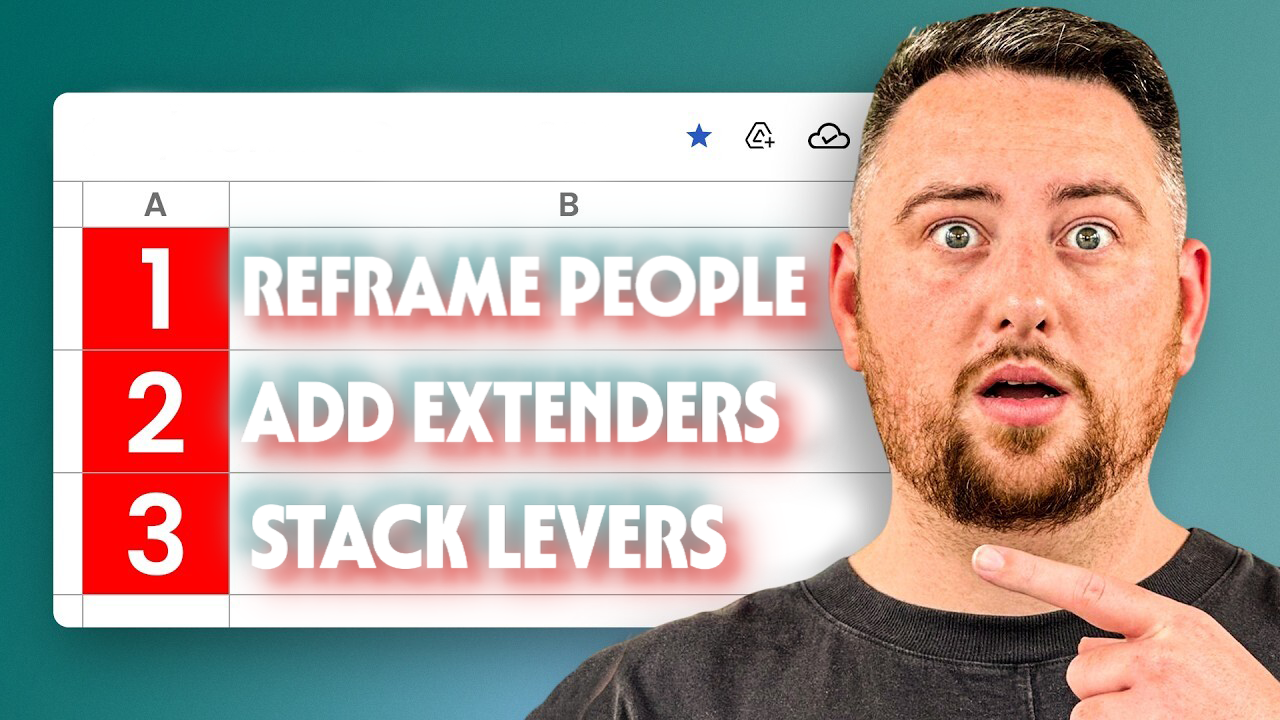
These levers don’t work in isolation. They stack.
You add an extender. That frees your schedule for higher-margin work and enables expanded capacity. Expanded capacity creates demand for additional services. Additional services require support staff to operate. Support staff make both you and your extender more efficient.
Each lever amplifies the others.
Walking through how this framework operates: You are running an agency at a certain revenue level. Your fixed costs are set. Your variable costs are set. You’re netting a certain amount.
You add a senior account manager. They generate additional collections at meaningful margins after their compensation.
But you’ve also freed up your schedule to focus on higher-margin work. You shift your focus and increase your average value per client.
Then you add expanded capacity staffed by the account manager. Additional collections at high margins because fixed costs are covered.
You have expanded profit without expanding your hours. In fact, you’re probably working less because the extenders and support staff are handling routine work.
That is what stacking levers looks like. And it is only possible when you treat people as revenue assets instead of cost centers.
How to Build Accountability Without Burning Out Your Team
Addressing the obvious question: how do you implement this without burning people out or creating a toxic culture?
The answer is alignment.
Radical accountability doesn’t mean squeezing people. It means tying their success to the business’s success. It means clear expectations, transparent metrics, and compensation structures that reward performance.
In my experience, the operators who do this well use performance-based incentives alongside salary, including bonuses tied to outcomes, profit sharing, and equity stakes for key personnel. Gallup’s research on employee recognition shows how consistent recognition can reinforce motivation and performance.
When your account manager knows they participate in upside above a baseline, they’re motivated to serve more clients, deliver better outcomes, and grow their book. When your support staff know they benefit from practice profitability, they care about efficiency and client experience.
This is not exploitation. It is partnership. You are sharing upside in exchange for accountability.
What happens: turnover drops, performance increases, and people stop thinking like employees and start thinking like owners because they have skin in the game.
Gallup’s employee-engagement guidance identifies clear expectations, regular feedback, and opportunities to use individual strengths as core conditions for engagement.
The operators who fail at this are the ones who demand accountability without offering upside. They want people to perform like owners but pay them like hourly workers. That is a recipe for resentment and churn.
If you want radical accountability, you need radical alignment.
How to Measure Employee ROI So You Know What’s Working
You can’t manage what you don’t measure.
If you’re going to treat employees as revenue assets, you need to track their ROI the same way you’d track ROI on any other investment.
The framework: For every person on your team, you should know their fully loaded cost and their revenue contribution.
Fully loaded cost includes salary, benefits, taxes, training, everything. Revenue contribution is what they directly generate or what they enable you to generate.
For extenders, this is straightforward. They serve clients and generate collections. Track collections per extender per month. Track cost per extender per month. Calculate the spread.
For support staff, it’s slightly more complex. They don’t generate revenue directly; they enable you and your extenders to generate more revenue. So track productivity metrics: clients served per day before and after adding support, revenue per hour worked, time spent on administrative tasks versus revenue-generating tasks.
The goal is to see a clear multiple. If someone costs you a certain amount per month, they should be contributing meaningfully more than that in direct revenue or enabled revenue. Anything less remains a cost center.
In my experience, operators who approach this well review these metrics monthly. They know exactly which roles are generating returns and which aren’t. Their decisions follow the data.
Common Pitfalls That Turn Revenue Assets Back Into Cost Centers
Where this goes wrong:
Hiring for tasks instead of outcomes. You hire someone to answer phones, file paperwork, or schedule appointments. That is a cost center. You should hire someone to increase client volume, improve collections, or free your capacity for higher-margin work. That is an asset.
Under-investing in training. You can’t expect someone to generate meaningful output if you give them two days of onboarding and throw them to the wolves. Training is the difference between a mediocre extender who creates more problems than they solve and a high-performer who multiplies your capacity.
Misaligned incentives. If you pay everyone a flat salary regardless of performance, you get flat performance. People optimize for what you measure and reward. If you measure hours worked, you get people who sit at their desks. If you measure revenue generated, you get people who generate revenue.
Failing to stack levers. Adding one extender is good. But if you don’t also add support staff to make that extender efficient, and you don’t optimize infrastructure to maximize their utilization, you’re leaving significant returns on the table.
Operators who avoid these pitfalls hire for outcomes, invest in training, align incentives, and stack every lever they can find.
Building the System Step by Step So It Actually Works
So how do you actually implement this?
Start with one lever. Don’t try to overhaul your entire operation overnight.
If you’re doing everything yourself, the first hire should be an extender, someone who can take routine work off your plate and generate revenue doing it.
Once that’s working, add support staff, someone who makes both you and your extender more efficient.
Once that’s working, optimize infrastructure. Extend capacity, add services, maximize your fixed costs.
Then stack. Keep adding levers, keep measuring ROI, keep refining.
And throughout all of it, build accountability into the culture: clear expectations, transparent metrics, performance-based incentives, and regular reviews where you’re looking at the numbers together and making decisions based on data.
This isn’t complicated, but it requires a fundamental shift in how you think about people. They’re not costs. They’re investments. And like any investment, you should be calculating returns and optimizing for the highest ROI.
The operators who get this right build businesses that scale without them. They turn employees into revenue assets. And they create leverage that compounds over time.
That is the game. And if you are an established operator, this is the framework that takes you to the next level.
If you want to go deeper on building these systems, check out my Inner Circle, our private mastermind where we work directly with agency operators on implementing frameworks like this.
Results are not typical. Your results will vary and depend entirely on your individual capacity, business experience, expertise, and level of desire. There are no guarantees concerning the level of success you may experience. The testimonials and examples used are not intended to represent or guarantee that anyone will achieve the same or similar results. We don’t believe in get-rich-quick programs. We believe in hard work, adding value and serving others. As stated by law, we can not and do not make any guarantees about your own ability to get results or earn any money with our information, courses, programs, or strategies.
Get my content first on Google
Add jeremyhaynes.com as a preferred source and Google shows my articles more prominently in your search results, including AI Overviews and AI Mode.


Jeremy Haynes
Owner and CEO of Megalodon Marketing
Jeremy Haynes is the founder of Megalodon Marketing. He is considered one of the top digital marketers and has the results to back it up.