
Before You Agree to a JV Split, Decide Who Does the Work

I hope you enjoy reading this blog post. If you want my team to just do your marketing for you, click here.
Author: Jeremy Haynes | Published October 14, 2026
Earnings Disclaimer: You have a .1% probability of hitting million-dollar months according to the US Bureau of Labor Statistics. As stated by law, we cannot and do not make any guarantees about your own ability to get results or earn any money with our ideas, information, programs, or strategies. We don’t know you, and your results in life are up to you. We’re here to help by giving you our greatest strategies to move you forward, faster. However, nothing on this page or any of our websites or emails is a promise or guarantee of future earnings. Any financial numbers referenced here, or on any of our sites or emails, are simply estimates or projections or past results, and should not be considered exact, actual, or as a promise of potential earnings – all numbers are illustrative only.
You can agree on a generous JV split and still have a bad partnership. One person thinks they are making introductions. The other expects them to build the funnel, help close, and keep promoting until the offer works. Before choosing a JV partnership structure, get clear on what each person is actually taking responsibility for.
A referral, a promotional campaign, and an ongoing growth engagement are different commitments. Calling all of them a joint venture makes the conversation sound bigger without making the work clearer. I want the work, the decisions, and the money being measured on the table before anyone starts negotiating a percentage.
That is how I would approach a deal that goes beyond affiliate commissions. First establish what the partner contributes and what they can influence. Then evaluate compensation against the business you actually have, including the cost of selling and delivering the offer.
7 weeks. Real frameworks. Covering copywriting, funnels, paid ads, and conversion systems.
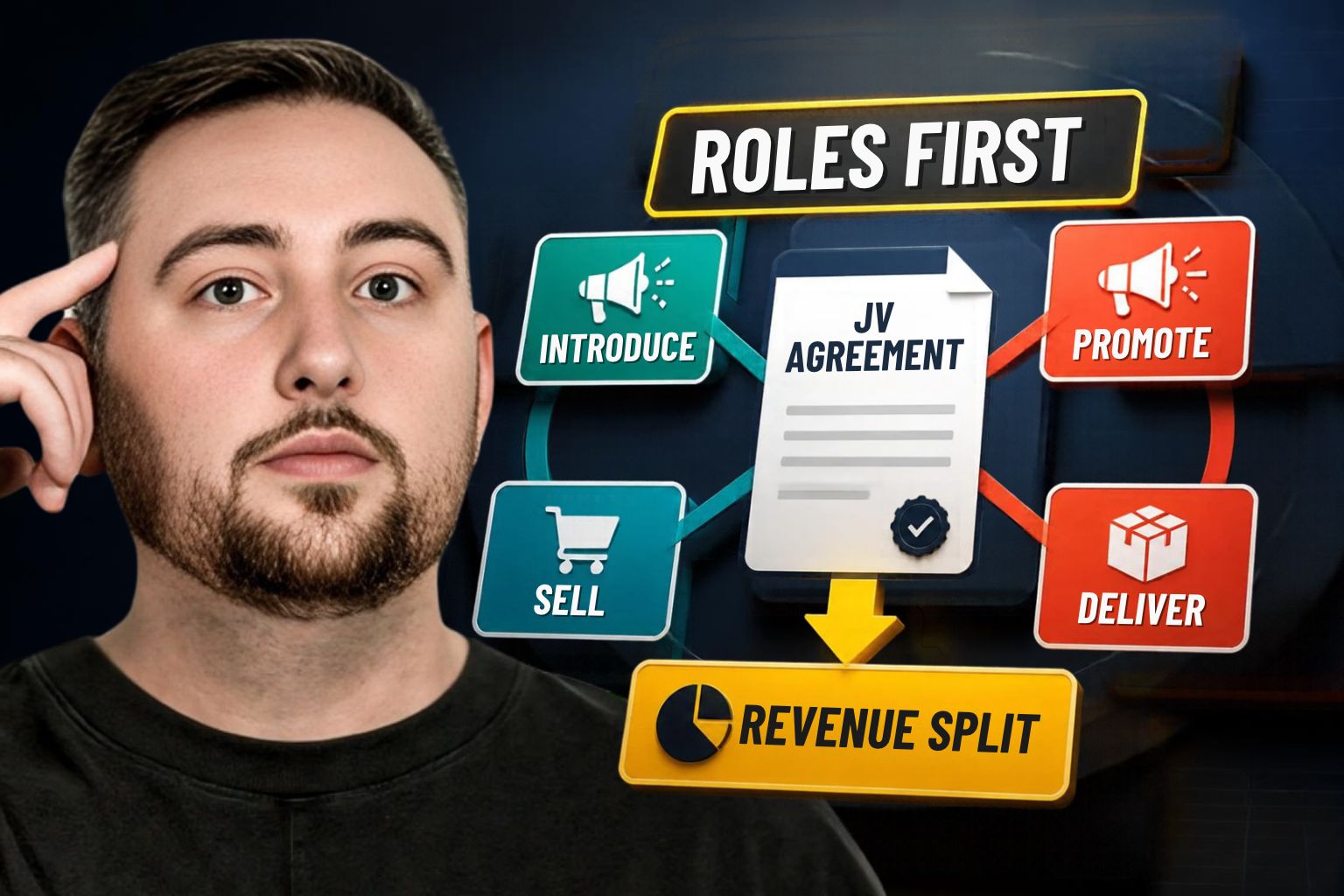
What the Partner Agrees to Do Comes First
The partner’s responsibilities come before the payout structure. Otherwise, both sides can agree to the same number while imagining different jobs.
Ask them to describe what they will do once the agreement starts. Will they introduce specific buyers? Promote to an audience? Build and manage acquisition? Participate in the sales process? Keep the answer specific enough that you could tell whether the work happened.
Do the same for your side. If you own the offer, you may be responsible for supplying accurate sales material, handling applications, taking calls, collecting payment, and delivering. A partner cannot compensate for missing work just by sending more people.
A deal gets easier to evaluate when both sides can describe the job without mentioning the split. If that description keeps changing, the economics discussion is happening too early.
Someone lending access to their audience may make a valuable contribution without joining your operation. Someone managing acquisition is committing to ongoing work. The relationship should reflect that difference instead of using the same broad promise for both.
The existing affiliate model has its own promotion and tracking questions. Going beyond that model starts with a genuinely different contribution. A more impressive label alone does not establish one.
Why Access to Buyers Does Not Cover the Whole Sale
A partner can create access to buyers while leaving your business responsible for turning that access into a sale. Keep those two jobs visible.
When an introduction arrives, someone still needs to explain the offer, answer questions, establish fit, and handle the next step. The customer also needs to receive what was promised. Those responsibilities remain even when the lead comes through a trusted relationship.
If the partner only makes the introduction, evaluate that contribution honestly. Do not quietly expect ongoing follow-up or campaign management because you offered a percentage. If you need those services, discuss them before relying on them.
The reverse matters too. If someone is building assets and managing the acquisition process, treat that as real work. The contribution is different from putting a link in a newsletter and waiting for a sale.
Ask where the handoff occurs. At an introduction, registration, qualified conversation, or completed purchase? Each point leaves a different amount of work for the business receiving the buyer.
A warm introduction can begin a useful conversation. It cannot establish that the prospect is ready, that the sales team will handle the conversation well, or that the buyer will pay. Your expectations should survive those distinctions.
Which Decisions the Partner Can Actually Influence
Before tying compensation to an outcome, identify who controls the decisions that affect it. A deal can create tension when someone is responsible for a result but cannot change the weak step.
For acquisition work, look at the offer, messaging, funnel, and sales handoff together. Who approves the creative? Who can change the page? Who follows up with leads? Who decides whether the offer needs adjustment?
The answer does not have to be that the partner controls everything. It does need to be understood. You can retain approval while agreeing on how a recommendation gets reviewed and what information the partner receives.
If the sales team is leaving opportunities untouched, the traffic partner needs to know that. If buyers are raising the same concern about delivery, the offer owner needs to hear it. Silence makes each side defend their department while the buyer gets a disconnected experience.
In my revenue-share approach, trackable business outcomes matter. That is a reason to understand the operation behind those outcomes before accepting a performance-linked relationship.
Keep approval rights, access, and responsibilities clear in the reviewed agreement. Ask qualified counsel to handle the terms. A marketing conversation should clarify the intended work, without pretending a handshake has settled every legal consequence.
What Money the Proposed Share Is Based On
Name the money being shared before judging the percentage. Gross sales, cash collected, and profit after agreed costs are different amounts.
A high-ticket sale can involve acquisition expense, sales commissions, processing, and delivery. A payment plan adds another question about when the money arrives. The same percentage can mean a different commitment depending on which amount you apply it to.
My public revenue-share teaching focuses on trackable outcomes and a clearly defined calculation. Carry that discipline into the partnership conversation. Have the finance owner show what the proposed deal means using the business’s actual costs and collections.
Do not describe an arrangement as profit share while leaving the meaning of profit unresolved. Both sides need to know what expenses belong in the calculation and how the underlying figures will be checked.
If the buyer pays over time, keep collection timing in the discussion. A scheduled future payment is not cash already available to cover a partner payout.
Refunds also change the money picture. Stripe explains that refunds use the available balance rather than pending funds. Decide how the commercial agreement handles those events before they happen, with appropriate legal and accounting review.
For the marketing education behind these business decisions, you can explore Master Internet Marketing, my 7-week live comprehensive training. Your own advisers still need to review the specific financial and contractual commitments.
Results are not typical. Your results will vary and depend entirely on your individual capacity, business experience, expertise, and level of desire. There are no guarantees concerning the level of success you may experience. The testimonials and examples used are not intended to represent or guarantee that anyone will achieve the same or similar results. We don’t believe in get-rich-quick programs. We believe in hard work, adding value and serving others. As stated by law, we can not and do not make any guarantees about your own ability to get results or earn any money with our information, courses, programs, or strategies.
How Both Sides Will Recognize the Partner’s Work
The reporting needs to show the contribution you agreed to measure. A tracking link alone does not answer every question about a high-ticket sales process.
If the partner brings prospects into a funnel, record their source and follow the relevant sales events. If they make direct introductions, keep a record of those introductions and what happened afterward. Use the same definitions when both sides review the relationship.
Google Analytics supports campaign parameters that identify traffic sources. Those parameters can help label visits. They do not, by themselves, establish the compensation owed under your agreement.
A buyer may return through another channel or speak to the team without using the original link again. Agree on how those situations will be handled. Avoid choosing an attribution rule only after a sale creates an argument.
Keep sales and billing records connected to the reporting where appropriate. A closer marking a deal won and a buyer completing payment are separate events. If compensation depends on collections, the payment record needs to support the calculation.
Make the calculation understandable enough that both sides can check it. An elaborate dashboard is less useful than a simple report whose labels actually match the agreement.
If the records are incomplete, resolve that before treating a forecast as proof the deal works. You need a dependable account of what happened before you can learn from it or pay against it.
Why an Introduction Should Stay Honest About the Deal
A financial relationship should not make the partner’s introduction misleading. The buyer deserves to understand the recommendation without being given an exaggerated story.
Give the partner accurate information about who the offer serves, what is delivered, and what remains the customer’s responsibility. Do not hand over aggressive swipe copy and assume the partner will correct it.
The FTC’s endorsement guidance addresses unexpected material connections that can affect how people evaluate a recommendation. Have the promotion reviewed for the disclosures and claims relevant to the situation.
Keep the recommendation tied to what the partner genuinely knows. Someone can introduce you as a specialist they have evaluated without pretending they personally experienced every part of your offer.
The same care applies to testimonials and case studies. A past result needs context and substantiation. Paying a partner does not give either side permission to promise that the next buyer will get it.
If the partner is uncomfortable with the real offer, listen. A larger commission will not repair a recommendation they do not believe in. You are asking them to put a relationship behind the introduction, so the explanation needs to hold up.
When the Relationship Needs a Different Conversation
Revisit the relationship when the work changes. A successful promotion can create interest in doing more, but that does not mean the original agreement already covers it.
A partner who began by introducing buyers may later offer to build a campaign. Someone managing a campaign may want to take a wider role. Discuss that new responsibility on its own merits instead of treating past success as automatic permission.
Long-term participation and ownership are separate decisions with consequences beyond a marketing payout. Get qualified advice before committing to them. Access to an audience, enthusiasm, and a good launch are not enough information to settle that question.
You can also keep a relationship focused. A reliable referral arrangement does not need to become a shared company to remain useful. Choose the level of commitment that matches the work both sides actually want to do.
Changing the scope should change the questions you ask. What additional decisions will this person influence? What will they be expected to deliver? What new costs or obligations will the business take on?
Put the updated understanding into the appropriate reviewed agreement before acting as though it already exists. That protects the existing relationship from a new set of unspoken expectations.
Already making money? See what it takes to make a lot more.
Agree on the Work Before You Negotiate the Split
A useful JV conversation starts with what each person will contribute, the handoff between them, and the business evidence needed to evaluate the result. The compensation discussion follows those answers.
You should be able to explain what the partner does, what your team does, which decisions each side influences, and what money the payment is based on. If that explanation is still vague, a percentage will give the uncertainty a price without removing it.
Build a relationship that both sides understand before trying to make it bigger. A clear introduction, a well-defined campaign, and an ongoing growth engagement can each be useful. Choose the commitment deliberately and make the economics fit the job.
Bring those details when discussing partnership opportunities with other operators. You can review my Inner Circle if a peer mastermind fits where your business is now. The valuable conversation starts with an actual offer and a real division of work.
Results are not typical. Your results will vary and depend entirely on your individual capacity, business experience, expertise, and level of desire. There are no guarantees concerning the level of success you may experience. The testimonials and examples used are not intended to represent or guarantee that anyone will achieve the same or similar results. We don’t believe in get-rich-quick programs. We believe in hard work, adding value and serving others. As stated by law, we can not and do not make any guarantees about your own ability to get results or earn any money with our information, courses, programs, or strategies.
Get my content first on Google
Add jeremyhaynes.com as a preferred source and Google shows my articles more prominently in your search results, including AI Overviews and AI Mode.


Jeremy Haynes
Owner and CEO of Megalodon Marketing
Jeremy Haynes is the founder of Megalodon Marketing. He is considered one of the top digital marketers and has the results to back it up.