How to Get More People to Show Up to Your Sales Calls Already Wanting to Buy

I hope you enjoy reading this blog post. If you want my team to just do your marketing for you, click here.
Author: Jeremy Haynes | Published January 21, 2026
Earnings Disclaimer: You have a .1% probability of hitting million-dollar months according to the US Bureau of Labor Statistics. As stated by law, we can not and do not make any guarantees about your own ability to get results or earn any money with our ideas, information, programs, or strategies. We don’t know you, and besides, your results in life are up to you. We’re here to help by giving you our greatest strategies to move you forward, faster. However, nothing on this page or any of our websites or emails is a promise or guarantee of future earnings. Any financial numbers referenced here, or on any of our sites or emails, are simply estimates or projections or past results, and should not be considered exact, actual, or as a promise of potential earnings – all numbers are illustrative only.
We’re going to talk about indoctrination show rate sequences.
Look, we’ve talked a lot on this channel at length about different things you could do to get people to show up. But getting people to show up in a very qualified, well-framed way where they’re more probable to buy is a totally different conversation.
We’re going to go through those best practices right here.
I’ve helped 40 different people currently, and ideally that list continues to grow of course, get to the big million dollar months. Most of these people have been consistent. They’re not one-off months. We like to do it with a plural s, not a singular month.
Passing down the lessons from those people, we don’t imply income claims around here that you have any probability because the real probability is 0.1% to even get to $10 million a year.
All I do is just hand down the lessons.
Members of My Inner Circle are already scaling to $1M+ and beyond. This isn’t for beginners. It’s only for operators already at $100k+ per month who want proven strategies, speed, and focus. If that’s you, apply here.
How to Build Trust Before Your Sales Calls So People Show Up Ready to Buy
Indoctrination show rate mastery has come up many times over these last several weeks inside of my Inner Circle offer specifically. Because those people operate at such a high level with their high ticket product and service businesses, I knew that you would be having the exact same problem.
If you’re stuck around a couple hundred grand a month, somewhere between low couple hundred grand a month, high couple hundred grand a month, you do really well organically. You’ve tried to go into paid and you’re doing decent when you spend little tiny baby bits of money.
But you really start to struggle when you start to actually gas the ad spend up a little bit. This is going to be quite helpful.
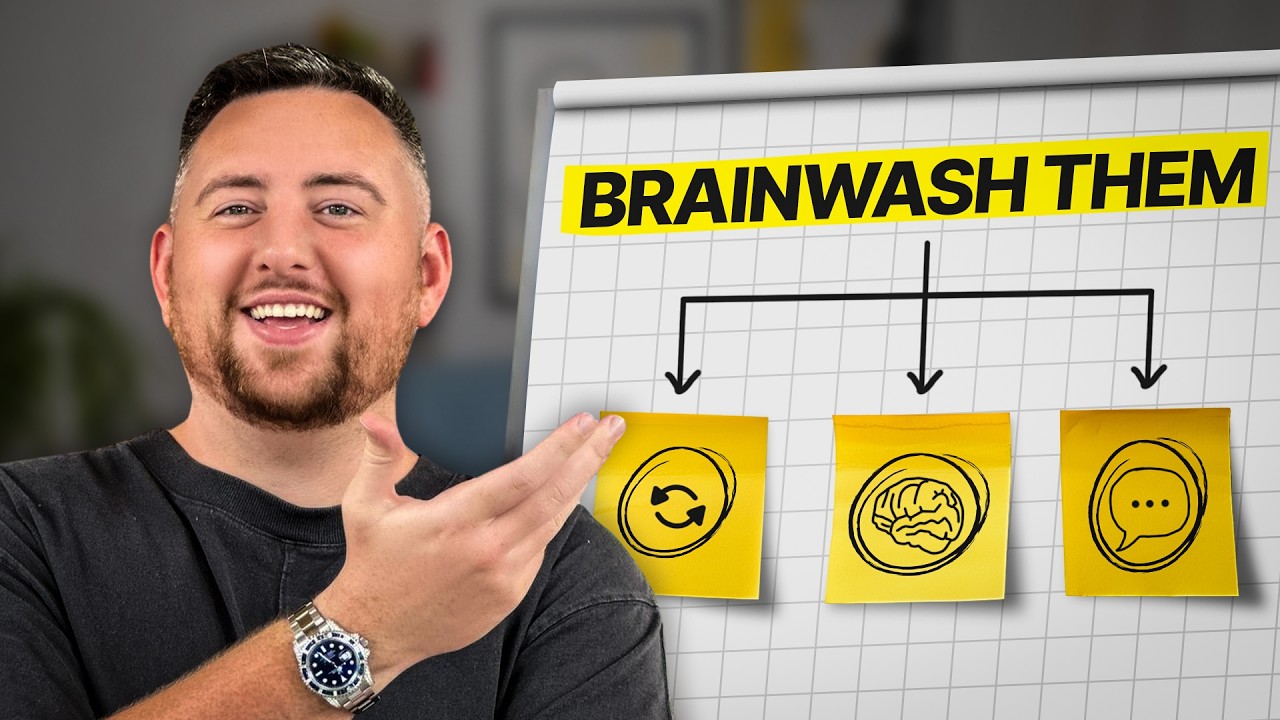
I have this concept that I call the trust flywheel. The trust flywheel has eight different spokes. Eight different key things that we like to leverage in order to get people to show up with a higher probability to actually buy.
I’m not going to give you all eight for free here of course, but I’m going to give you three of them.
How to Find and Address the Real Objections Killing Your Call Show Rates
The first one is this concept called handling the real objections.
Real objections and fake objections that you try to guess are two totally different things. You got to talk about things before they show up to the call, before they show up to the webinar that people actually care to hear about.
I’m going to give you a perfect example.
We had an Inner Circle member that had a $24,000 offer. 12,000 paid up front, another 12,000 paid after the student, or I should say the member, has gotten a particular level of result.
So 12K up front, 12K after a certain threshold of time and the result has passed.
This particular person historically had upwards of a 70% show rate. Then out of nowhere it felt like their show rate started to tank. It was as if every week they would look at their statistics for their show rate and it would drop another 10% on average.
It was dramatic. It felt random.
Until one day we go and Google the specific name of this brand and the word Reddit.
If you still aren’t aware of this, I’d be shocked, but a lot of people nowadays when they want to get real feedback about something, they’re going to go and look up the person’s name or business name and then just look up the word Reddit afterwards.
Research shows that nearly two in three people in the U.S. use Reddit as a search engine at least once a week, with 41% believing it’s better than Google.
It’s almost as if Google has just become a giant Reddit search engine.
Anyway, I digress. Point I’m trying to make is when you Google this specific company’s name and the word Reddit, a terrible, awful Reddit thread had been published where people who didn’t even buy this person’s offer were just talking about the sales process that they put people through.
What happened was all these people who had never even bought were posting about the price, were posting about their rather surface level perspective on the company and what they do. There were a good like couple dozen different takes on this company.
Without the company actually addressing this Reddit thread, when somebody had booked a call with their organization and preemptively would do a little bit of research, they would go and find this Reddit thread. Then without the company again having any take on the whole thing, it would talk people out of buying.
It would talk people out of even showing up to the call.
When you looked at the exact date that this Reddit thread was published and you looked at the date that their show rate started to tank, they were perfectly correlated.
So what did we do?
First of all, we had the company make a video. This video was posted on YouTube because here’s the thing. It’s not rocket science. Google owns YouTube.
When you post YouTube videos, they rank in the search engines as one of the first ranking things in almost all instances.
So we named the video in a search engine optimized way where it was company name, the word Reddit, and addressing the thread, something along those lines.
The company just straight up would go through the process of reading these different Reddit comments and just addressing them one at a time. Going through the process of saying like, look, here’s what we do to deal with this. Here’s what we do to deal with this. Here’s how we handle this person’s perspective.
That video, just that one video, as soon as that was dropped, got the show rate up about 20%. Was a little less than that, was like 18, 19% give or take the week that you addressed it.
That improved it a lot.
Second thing that they did is they took that same Reddit thread and they shared it to their existing community of students who had actually bought their program. They just said, “Hey guys, if you don’t mind, go share your perspective. Go share your take on what your experience has been both during the sales process and then after the sales process and just how everything from your perspective is going through our offer.”
They flooded it.
They flooded it because their students and the people that bought from them have gotten tremendous results and love the offer of course. So without shock, all of a sudden when you get dozens and dozens more than the people who hadn’t even bought that are reflecting on the sales process, going in and positively endorsing, giving feedback, testimonials, and just again sharing their feedback on the offer and their experiences with it.
This directly addressed a real objection.
But it didn’t get the show rate back up to 70%. It got it back up to high 50s.
Their show rate had tanked all the way down into the 30s by the way. It was nuts. After this specific set of comments, it worked its way back up eventually into the low 60s.
Then the final nail in the coffin to really address an actual objection that was going on was them taking both the video and the Reddit thread directly and sharing it as one of the first emails that would go out to people.
In addition to that, if you’ve ever read any content on this channel before, we talk about this strategy that we created called the hammer them strategy. The hammer them strategy conceptually is very simple. We take videos both short and long form and we hammer people after they take a specific action like booking a call, opting in for a webinar, something like this.
Moral of the story is we would take that video that was otherwise posted on YouTube and also run it both in short form clips and the full long form video directly to people who just booked a call.
That way preemptively all of this is addressed.
What do you think that did?
Worked miracles for this business. They got their show rate higher than what it was prior before it tanked. Got it back up to about mid 70s, which is huge nowadays by the way, as I’m sure you know dealing with a call funnel yourself.
Point I’m trying to make is in this whole trust flywheel concept where we talk about eight specific key things that right now just to be clear I only talk about inside of my Inner Circle offer, long story short, handling real objections, talking about what people actually care to have addressed is what gets people to show up.
Not just show up though. Show up and actually have a mental frame where they have a dramatically higher probability to buy because you indoctrinated them with what they actually want to know.
How to Build Trust When Your Market Is Full of Scammers and Skeptical Buyers
We had a guy who had a trading offer where he was selling this trading bot. Unlike all of the non-compliant people that are probably going to end up indicted by the SEC and the DOJ here soon enough, this guy operates in a compliant way, thank God.
However, I digress. Point I’m trying to make is this guy’s offer when he initially came to work with us and he joined into our Inner Circle program had a very interesting problem.
He was operating in bloody waters. There were so many other people that had the same exact offer. On top of that, here’s the worst part. Most of those other offers were just scamming people out of their money.
They would operate as essentially Ponzi schemes and eventually go down.
Now this guy had a very legitimate offer in comparison. A highly regulated niche where he was operating compliantly and had a great product and a long track record. He was doing it for real.
Because there was so much skepticism that other people had created, some of these other companies when you went and looked at what they did in order to build trust, you can’t do the same thing. Otherwise you get compartmentalized into the same box that the scam companies did.
What some of the scam companies would do that eventually went down and created a lot of skepticism inside of this niche, they would do these live trading sessions where they would have their bot deployed and they would show the bot’s performance in real time.
But the bots would be using sim accounts. They would never put their own money on the line.
There was one to two companies max, give or take the time that we’re referring to, that we were able to find when we were doing some due diligence and our research. What we noticed was some of these companies would do very low dollar value personal accounts, like something like risking $10,000 and maybe $25,000.
So what did we have this Inner Circle member do?
We had the Inner Circle member throw $150,000 into a live account and literally run the bot 24/7. Not just on one pair by the way. So this guy inside of this niche, you can trade the bot with forex pairs, you can trade the bot with crypto pairs, you can trade the bot with indices and individual stocks.
He did four different bots. Each with real dollars on the line at substantial sums of cash comparatively to what everybody else was doing. Demonstrated literally 24/7 what the bot’s performance was, what its running trade profitability has been, what its win loss ratio was.
It was as transparent as it could possibly be.
What they would do is they would take all four of these different live videos that literally ran 24/7 and they would publish them. They would put them into their email sequences. Their salespeople would send them out and they would give people a lot of perspective.
How to Get Leads to Respond Before Their Sales Call So They Actually Show Up
Here’s the next tip. Outside of handling the real objections, you got to do this thing called engagement bait.
One of the things that actually gets people to show up is them communicating with you prior to whatever the thing is.
So if they’re going to show up for a webinar, ideally you can have people that can communicate to the person before they actually show up. I understand that at scale that becomes improbable to execute on simply because of the scale you’re operating at.
We have clients where we spend upwards of $200,000 on a single webinar where we get 20 to 40,000 people with organic factored in to just register for the thing. That’s less probable to get people to be responsive or at least all of them. We’re not going to be able to proactively reach out to all those folks.
In a call funnel and a DM strategy and any kind of funnel like a lead form funnel like a Hydra as an example, we have the capacity to be able to reach out to every person. But we have to do it in a strategic way.
We can’t send messages from CRM phone numbers. They show up as green texts. People have gotten the absolute living daylights spammed out of them by political texts, every text you can imagine that’s automated. They’ve just come to ignore all that stuff.
What do they still view as a real person? Blue text messages. Research confirms that iMessage response rates are 2x higher than standard SMS, with some businesses seeing engagement increases up to 116%.
I do not at this time endorse any software or service besides literally using an actual iPhone that claims they can send from blue text messages to be clear. Don’t ask me about that. At least at the time I’m making this, other softwares do nothing better than an actual iPhone.
The reason that we want to use an iPhone to be clear, it comes off as us being a real person first of all. But second of all, we can send selfie videos. We can send other engagement bait.
We have to make sure that we have something that gets people to respond at a high rate.
I shared this tip inside of my Inner Circle recently where we did this sent from iPhone email. I remember doing this on an account that had 400,000 emails. We had to cease operations for the day from how many people it got to respond to us.
As a result of blasting out this email to 400,000 plus people, our response rate without exaggeration was upwards of like 20 to 25% give or take the time. The first day it was like upwards of 20% and then there was some trickling responses as people check their emails the following days.
It was such a simple email. Again, I won’t show you an example here. It comes from one of my very old bosses that I worked with, a very well-known sales trainer. But I shared it with the Inner Circle group and I’ve also shared many instances and examples of how we’ve done it since.
Dude, it just gets such a dramatic response rate and that’s the whole point of the email.
You can also leverage a lot of different texts. Again, selfie videos are your best friend when it comes to text messages and showing that you’re a real person.
You can with different softwares and tools nowadays create a singular selfie video and just leverage the tool to be able to create them on the fly. All you really need to change in the video in almost all instances is the name of the person and some of the application data that’s being leveraged in the video to increase the response rate.
Point I’m trying to make, when I can have a back and forth conversation with somebody where I’m answering some of their questions prior to their call, I have a much higher probability of them showing up to the call and treating it like a sales call instead of an education call.
We just recently had one of our Inner Circle members test out this specific strategy with the sent from my iPhone email and some selfie videos and some other best practices for show rate mastery.
Long story short, he got this response from a guy from the sent from my iPhone email where it was a question, right? That’s what the sent from my iPhone email is. It’s like a single one liner question based email.
With the response the guy says, “Honestly I don’t even really know what you do. I booked a call because I’m curious but like what do you do?”
Think about that.
If that question and that back and forth conversation that then happened after did not occur before the sales call, that wouldn’t have been a sales call. It would have been an education call.
The salesperson would have been upset. The salesperson would have given feedback that that person was unqualified.
It ended up being an extremely qualified person who just hadn’t put in the time yet to actually go through the pre-call material and figure it out.
We’ve talked on this channel in very recent content about this concept called person number one and person number two. That’d be a great example of person number two. The person who generally doesn’t just immediately indulge themselves in a lot of the pre-call material, the indoctrination sequences, your videos that you have for them.
They prefer to have communication.
So this works extremely well for that person, but it also works extremely well to get person number one excited. The person who is going to consume all that stuff anyway, they love getting in contact with you guys.
This specific strategy alone of doing engagement bait, we’ve seen improve show rates as much, and this is a very dramatic statistic, as much as 30% in terms of the lift that we see just from doing engagement bait and getting people in communication prior to these actual calls.
All these things are very important to understand.
Why One Star Reviews Matter More Than Five Star Reviews for Sales Call Show Rates
Last one I’m going to leave you with for this specific thing when it comes to the trust flywheel and having a proper indoctrination sequence. Let’s talk a little bit about testimonials.
Most of the time, really think about this in your own behavior. When you go look at testimonials, do you actually read all the five star reviews or do you immediately go to the one and two star reviews? Studies show that customers are five times more likely to filter their search for 1-star ratings than anything else, seeking credibility and authenticity.
Most people have it backward where they think dude, if I flood a Trust Pilot or a Google review platform with just a ton of people leaving me five star reviews, most of the five star reviews by the way are very surface level as well.
They’ll say like, “Oh it was a great experience. Had an awesome time. Worked really well.”
But in reality, the person most of the time is going to go to your review page and they’re going to click on the one star reviews and they’re going to read through those. They’re going to have more weight on the handful of one star reviews that might have been left for your business comparatively to all of the hundreds of five star or maybe even thousands of five star reviews that your business has comparatively.
Yeah, perceptually the five star reviews help for sure. But remember, people are looking for two things when they’re doing some due diligence and research. Reasons to trust you and reasons not to trust you.
You have to cater to both.
It’s a big mistake that most companies make when they’re considering how to get people to show up more qualified, indoctrinated and wanting to buy.
The whole point of a properly built, well executed indoctrination show rate sequence via email, via the hammer them content, via what the salespeople are going to communicate is to essentially just help expedite proper due diligence on you and your company.
So when you ignore that the person just really wants to get some due diligence done and you don’t give them what they’re really looking for, they go out into the wild and they try to find it anyway. They’re probable to find it from other sources.
If you don’t control those sources, well I mean that might be why you have a show rate issue.
Why not feed people both the wins and the losses? Research shows that a well-handled mistake can actually create stronger loyalty than if everything had gone perfectly, as customers respect transparency and accountability.
How Being Transparent About Your Failures Builds More Trust Than Hiding Them
We have this client that raises capital. Won’t say their name so I can talk more in depth about this.
This specific client does so well at building these things we’ve talked about on this channel before called trust assets. They’re things like what we’re talking about right now to get somebody properly framed and showing up further along in the sales process.
This specific organization, they take somebody’s capital and they go and build these luxury storage facilities for RVs, boats and things like this.
They’ve had a total, at the time when I first started working with them, of about 152 investors. 151 of those investors have consistently every single project reinvested with this company.
The one person who hadn’t, I proposed to them, I was like, “Listen, the statistic first of all of just your reinvestment rate is huge. It’s awesome. However, the question is naturally going to come up, why didn’t that one person reinvest?”
I think a nice proper immediately following that statistic explanation that peppers in there would be why that one person didn’t reinvest in an honest way.
We also have in this company, they have dozens and dozens of locations that they’ve successfully built and cash flow with. They’ve had two specifically that have fallen into a state where it didn’t go well or it just wasn’t executed as well as all the other ones that went really successful and on the proper timeline.
There were a few delays in two out of the projects. Two of the projects out of all the other ones, like permit delays, the wrong subcontractors being hired that slowed the project down dramatically. There were just some issues simply put that came up.
Here’s my point. We don’t just want to talk about all the good projects. We want to in depth talk about the two that went poorly.
Because when somebody’s going to deploy hundreds of thousands to potentially millions of dollars in a capital raise to a specific project and they’re coming off of an ad in this case, the trust has to be built rapidly.
What builds trust rapidly are things like what we’re talking about right now.
I could sit here and again I could go on and on and on about this. There’s eight total spokes on the trust flywheel that I did an entire mastermind talk on at our recent Q1 2025 Inner Circle mastermind. But I only talk about this stuff in depth to my Inner Circle members currently.
We do twice a month one on one calls, weekly group calls. We have a group chat full of rich people trying to get richer.
Somebody in the group actually just recently, Kevin, who coincidentally lives here in the same building as me, was giving me some perspective that I got to share a lot more detail on what this group chat is truly like.
I apparently don’t set the bar or the expectation clear enough for how valuable it truly is.
It’s not some mastermind group that you’ve probably joined in and been let down by in the past. No, no, no, no. We curate the people that we let into it. You got to already be a big dog if you want to actually get into that group.
We don’t let people in there who aren’t serious. You’re not going to join in even doing a high couple thousand a month and feel like you’re the top of the chart here. As a matter of fact, to be very transparent with you, the current average of the group is about 2 to 300K a month.
You have 15 guys in there that do million dollar months and guess what? They’re active and they talk.
The group chat itself is very important to understand in terms of the value proposition for what it is. Everybody is transparently sharing their problems, what’s working.
We had a guy today, he said, “Hey, just had a buddy’s business go under that was running for five years. The guy was doing $80 million a year. He ended up selling it, so now he’s exiting and the business that bought it is just getting rid of literally everybody. They’re acquiring it mainly for the assets and infrastructure. There’s an executive assistant that’s been helping that guy. He’s going to do nothing now that he just exited the company and who wants this executive assistant?”
That’s a good example of something random that happened today that I can think of off the top of my head.
We have people share their indoctrination email sequences, their trust flywheel assets that we create. Everybody, not just me, everybody shares perspective. It’s a very value forward community because everybody’s in there from a perspective of a give and take relationship.
It’s very valuable. Then of course we do our quarterly in person masterminds right here at the penthouse in Miami, Florida.
These three strategies alone, handling real objections, engagement bait, and proper testimonial strategy, can dramatically improve your show rates and get people showing up ready to buy instead of just looking for free education.
The difference between a 30% show rate and a 70% show rate is massive. It’s the difference between struggling to scale and printing money consistently.
If you’re stuck with low show rates, go back through these strategies and honestly assess whether you’re implementing them correctly. Most people aren’t. They’re guessing at objections instead of addressing real ones. They’re sending green text spam instead of personal blue text messages. They’re hiding their losses instead of being transparent about them.
Fix these three things and watch your show rates climb.
Most business owners waste years figuring out what actually works. In my Master Internet Marketing program, I compress that learning curve into 7 weeks, covering copywriting, funnels, ads, and more. If you’re ready to invest $5k and get serious about your skills, apply here.
Watch the video:
Get my content first on Google
Add jeremyhaynes.com as a preferred source and Google shows my articles more prominently in your search results, including AI Overviews and AI Mode.


Jeremy Haynes
Owner and CEO of Megalodon Marketing
Jeremy Haynes is the founder of Megalodon Marketing. He is considered one of the top digital marketers and has the results to back it up.