Five $1M/Month Businesses and the Levers They Pulled

I hope you enjoy reading this blog post. If you want my team to just do your marketing for you, click here.
Author: Jeremy Haynes | Published September 1, 2026
Earnings Disclaimer: You have a .1% probability of hitting million-dollar months according to the US Bureau of Labor Statistics. As stated by law, we cannot and do not make any guarantees about your own ability to get results or earn any money with our ideas, information, programs, or strategies. We don’t know you, and your results in life are up to you. We’re here to help by giving you our greatest strategies to move you forward, faster. However, nothing on this page or any of our websites or emails is a promise or guarantee of future earnings. Any financial numbers referenced here, or on any of our sites or emails, are simply estimates or projections or past results, and should not be considered exact, actual, or as a promise of potential earnings – all numbers are illustrative only.
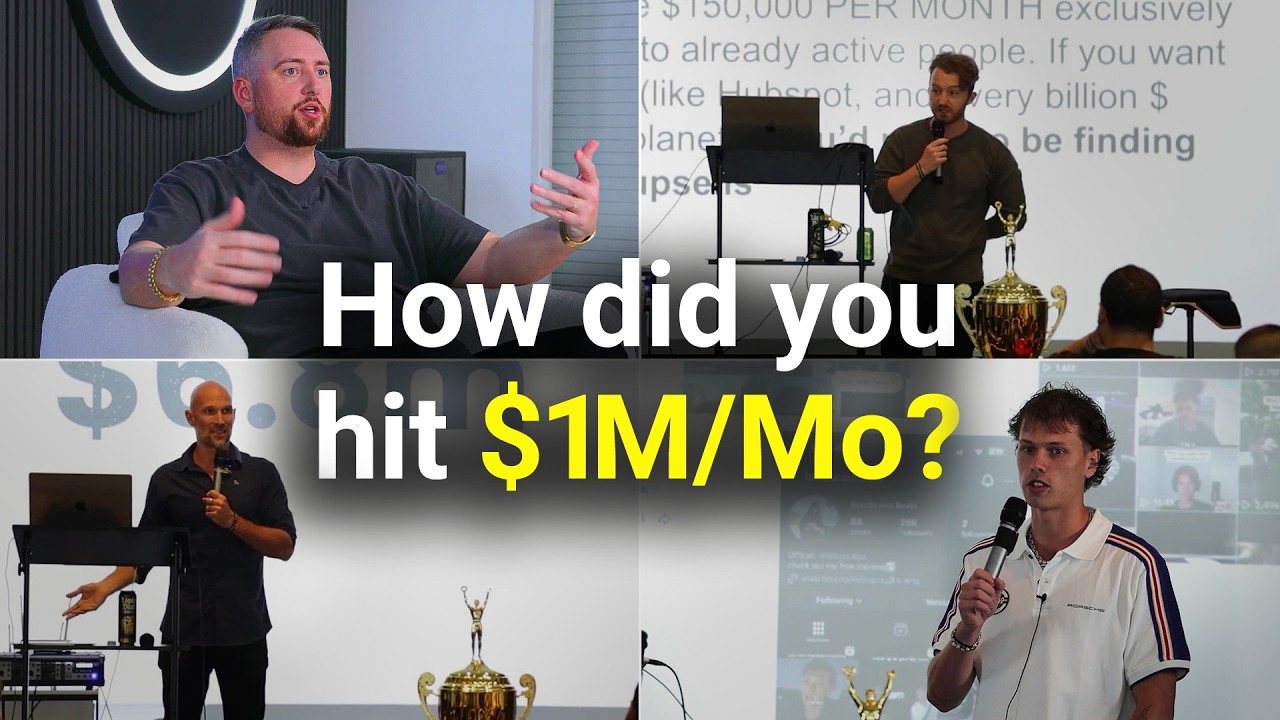
Five businesses reached $1M/month through five very different growth levers. One expanded revenue from current customers. Another built demand through organic distribution. A third kept a simple funnel and removed friction after the sale, while the last two learned how quickly revenue becomes meaningless when costs and complexity climb with it.
The shared lesson is not one funnel. It is knowing which constraint matters in your business right now. These are specific, illustrative examples from the source video, and they should not be treated as typical outcomes or a forecast for anyone else’s business.
Already making money? See what it takes to make a lot more.
Five Businesses Reached the Same Number Differently
The video behind this article was built from five talks given by operators inside my Inner Circle. Each operator reached a major monthly revenue milestone, but the mechanics underneath the number barely resembled one another.
That is what makes the comparison useful. If you look only at the trophy, every story appears to be about scale. Once you look underneath it, the real subjects are retention, distribution, sales operations, offer economics, headcount, and profit.
One operator needed more revenue from an existing customer base. One needed a distribution engine before paid ads could amplify demand. One had a funnel that already worked and needed the sales process to stop leaking momentum. Another pushed one offer and one funnel far enough to expose the limits of both. The final operator had already won the revenue game and discovered that the company underneath it was losing.
This is why broad advice about scaling from $100K to $1M a month has to begin with the business in front of you. The next move depends on what is working, what is breaking, and which number is hiding the real problem.
Results are not typical. Your results will vary and depend entirely on your individual capacity, business experience, expertise, and level of desire. There are no guarantees concerning the level of success you may experience. The testimonials and examples used are not intended to represent or guarantee that anyone will achieve the same or similar results. We don’t believe in get-rich-quick programs. We believe in hard work, adding value and serving others. As stated by law, we can not and do not make any guarantees about your own ability to get results or earn any money with our information, courses, programs, or strategies.
Retention Changed What the First Operator Measured
The first operator had been stuck around $300,000 to $400,000 a month. The change came when he stopped treating churn as the only customer-base metric and started watching net revenue retention, or NRR.
Stripe defines NRR as the change in recurring revenue from existing customers after expansion, contraction, and churn. New-customer revenue stays out of the calculation. That distinction matters because it shows whether the current customer base is growing or shrinking before acquisition enters the picture.
At 100% NRR, expansion revenue replaces the revenue lost from existing customers.
Below 100%, the current base contracts unless new acquisition fills the gap.
Above 100%, expansion from current customers exceeds contraction and churn.
The operator responded by creating more relevant products for customers who had already bought. He also built a sales function focused on active accounts. By the month he reported crossing the milestone, roughly $200,000 came from upsells and cross-sells, while the front-end return on ad spend was about 1.3x.
That detail changes the interpretation. Looking only at that month’s acquisition spend would make the front end appear far more efficient than it was. The larger result depended on customers acquired over prior months and the business’s ability to keep serving them with additional offers.
Acquisition created the customer base. Expansion changed what that base was worth. The point is not to bury churn beneath aggressive upselling. Stripe also notes that strong NRR can mask customer losses, which is why NRR and gross retention need to be read together.
The operating question becomes more precise. Which customers are leaving, which are expanding, and what additional problem are they already asking you to solve? A client milestone system for upsells is useful when the next offer follows real progress instead of becoming a random add-on.
Organic Distribution Built Demand Before Paid Ads
The second business reportedly reached about $500,000 a month before using paid advertising. The owner was publishing long-form content, but the growth lever was the distribution system around it.
At the time of the talk, he described a clipping community with more than 43,000 people and roughly 2,000 active clippers. The clippers turned long-form videos into short-form content for platforms such as Instagram and TikTok. He reported spending about $50,000 a month on that operation while acknowledging that the return could not be tracked directly.
That uncertainty is part of the lesson. Organic distribution can create search demand, familiarity, and repeated exposure without giving you a clean campaign-level return. The owner made the investment because people saw the clips, became curious, searched for him, and moved deeper into the content ecosystem.
YouTube’s own creator guidance shows one version of the same mechanism. A creator can turn an uploaded long-form video into a Short, and that Short links viewers back to the original video. The platform feature is smaller than the distribution operation in this example, but the logic is the same. One substantial source becomes several discovery points.
The content was not doing one job. Long-form built depth. Clips created reach. Search behavior connected the two. Paid ads arrived later and amplified an audience connection that already existed.
This is different from publishing clips because a calendar says to post. A useful content repurposing system starts with source material worth distributing and gives every derivative asset a reason to exist.
A Simple Funnel Worked Because Sales Removed Friction
The third business began with a number written on a whiteboard and crossed it exactly one year later. The marketing path was straightforward. A Facebook or YouTube ad sent a prospect to a video sales letter, then to an application and a two-call close.
The operator reported that the main VSL funnel generated $6.8 million during the year even though the video had not been changed for eight months. That does not prove every old VSL should be left alone. It shows that the funnel was already capable of producing demand, so the company had other constraints worth solving first.
The head of sales described what the business looked like before the operational cleanup. Calls and payment information moved through a WhatsApp chat. There was no real customer relationship management system, and the sales process depended on people remembering what happened next.
They replaced that with a daily sequence inside Slack. After a sale, the closer took payment, sent the agreement, booked onboarding, completed the new-member background, and triggered a personalized welcome video from the founder. On one reported day, the team made five sales and generated $100,000 in revenue without the sales manager speaking to the representatives.
The funnel created the opportunity. The handoff protected it. Fast post-sale movement reduced uncertainty for the buyer and gave the team a repeatable path from payment into fulfillment.
This is the same reason automation systems should remove specific handoff failures instead of adding software for its own sake. The useful system is the one that tells the next person what to do, records whether it happened, and exposes the exception quickly.
One Funnel Carried the Business Until Economics Broke
The fourth operator described a company that evolved through several offer and funnel models. It began with a low-priced app, moved into selling an information product by phone, shifted toward a higher-ticket service, and eventually built a multi-lead, multi-buyer model.
One VSL opt-in funnel reportedly produced $72 million before the company launched another funnel. That is a useful counterweight to the instinct to keep adding acquisition mechanisms. When one mechanism still works, pushing it can create more learning and more volume than dividing attention across several half-built funnels.
The complication was inside the economics. During one fast-growth period, annual revenue moved from roughly $10 million to $30 million. The company also grew beyond 100 team members, costs climbed, and margin percentage fell. The operator said total profit dollars increased only slightly despite the much larger top line.
That is where scale stops being a marketing question. CPA, fulfillment cost, management layers, payroll, and operational control begin moving at the same time. A funnel can keep producing sales while the company becomes harder to run.
A working funnel can hide a weakening business. The right response is not automatically another campaign. Sometimes it is cleaning up delivery, reducing fixed cost, or deciding whether the offer can support the organization built around it.
The distinction is covered more directly in my breakdown of scaling an agency profitably. Revenue is useful only when the cost of producing it leaves a business worth owning.
The Agency Chose Profit After Revenue Became a Trap
The final operator had already reached $1.9 million a month at the agency’s peak. He also had 125 people and almost no profit. When the technology market contracted, clients broke annual agreements, the company lost $1.6 million during a $21 million revenue year, and the business was losing about $200,000 a month at the worst point he described.
The mistake was treating revenue growth like enterprise value. That can happen in businesses where investors reward growth despite current losses, but the same logic does not automatically transfer to a professional service firm.
Corporate Finance Institute’s explanation of EBITDA shows why earnings before interest, taxes, depreciation, and amortization is widely used in valuation. It also warns that EBITDA has limits and should be read alongside net income and cash flow. The practical point is simple. Revenue alone does not tell you what the owner keeps or what the company may be worth.
The agency changed direction. The operator put his business partner in charge, adjusted the equity so the incentives matched the responsibility, refinanced debt, and reduced monthly debt payments from $180,000 to $24,000. At the time of the talk, the agency had 45 full-time employees and was tracking toward $12.4 million for the year.
He was running less revenue than the peak with far more profit. The smaller team also reduced the distance between leadership, the people doing the work, and customers.
He stopped asking how large the agency could look and started asking what kind of asset he wanted to own. That decision gave the rest of the operating changes a direction.
The Right Lever Depends on What Already Works
These five businesses do not produce one universal path to a million-dollar month. They produce a better set of questions.
If acquisition works but the customer base keeps shrinking, inspect retention and expansion.
If the offer converts but too few people know you, inspect distribution.
If sales are happening but onboarding feels improvised, inspect the post-sale handoff.
If revenue rises while margin falls, inspect fulfillment, payroll, and management complexity.
If the company is valuable only on a revenue slide, decide whether you are building cash flow or an asset for sale.
These are the kinds of operating choices I work through inside Master Internet Marketing, my 7-week live comprehensive training. The purpose is to understand the mechanics well enough to identify the real constraint before copying a tactic from a business with different economics.
Results are not typical. Your results will vary and depend entirely on your individual capacity, business experience, expertise, and level of desire. There are no guarantees concerning the level of success you may experience. The testimonials and examples used are not intended to represent or guarantee that anyone will achieve the same or similar results. We don’t believe in get-rich-quick programs. We believe in hard work, adding value and serving others. As stated by law, we can not and do not make any guarantees about your own ability to get results or earn any money with our information, courses, programs, or strategies.
7 weeks. Real frameworks. Covering copywriting, funnels, paid ads, and conversion systems.
Build Around the Constraint You Can See
Do not leave these stories with a favorite tactic. Leave with a clearer way to read your own business. The operator using NRR had a different problem from the operator using organic distribution. The company with the simple VSL needed different work from the agency buried under fixed costs.
Start with the numbers that describe the whole business. Read acquisition beside retention, revenue beside profit, sales beside delivery capacity, and headcount beside customer experience. Then choose the move that addresses the visible constraint without creating a larger one somewhere else.
A comparison like this is useful because it removes the fantasy that one strategy creates every big business. The number may look the same from the outside. The business underneath it never is.
Results are not typical. Your results will vary and depend entirely on your individual capacity, business experience, expertise, and level of desire. There are no guarantees concerning the level of success you may experience. The testimonials and examples used are not intended to represent or guarantee that anyone will achieve the same or similar results. We don’t believe in get-rich-quick programs. We believe in hard work, adding value and serving others. As stated by law, we can not and do not make any guarantees about your own ability to get results or earn any money with our information, courses, programs, or strategies.
Get my content first on Google
Add jeremyhaynes.com as a preferred source and Google shows my articles more prominently in your search results, including AI Overviews and AI Mode.


Jeremy Haynes
Owner and CEO of Megalodon Marketing
Jeremy Haynes is the founder of Megalodon Marketing. He is considered one of the top digital marketers and has the results to back it up.