
What Your Failed Ad Scaling Test Actually Ruled Out

I hope you enjoy reading this blog post. If you want my team to just do your marketing for you, click here.
Author: Jeremy Haynes | Published October 28, 2026
Earnings Disclaimer: You have a .1% probability of hitting million-dollar months according to the US Bureau of Labor Statistics. As stated by law, we cannot and do not make any guarantees about your own ability to get results or earn any money with our ideas, information, programs, or strategies. We don’t know you, and your results in life are up to you. We’re here to help by giving you our greatest strategies to move you forward, faster. However, nothing on this page or any of our websites or emails is a promise or guarantee of future earnings. Any financial numbers referenced here, or on any of our sites or emails, are simply estimates or projections or past results, and should not be considered exact, actual, or as a promise of potential earnings – all numbers are illustrative only.
A failed ad scaling test can teach you the wrong lesson if you only remember the money you lost. You increased spend, the return fell, and now you tell yourself the account cannot go any further. I want to know what else changed during that attempt. Otherwise, the next decision starts with a conclusion the last test may never have proved.
You can be right that the attempt went badly and wrong about why it happened. That distinction matters when you decide whether to try again, change the message, or fix something after the lead comes in.
Already making money? See what it takes to make a lot more.
A Lower Return Does Not Explain What Went Wrong
Return on ad spend tells you how attributed revenue compares with advertising spend. It does not tell you which part of the business caused a change in that return.
If calls become more expensive, that gives you one place to investigate. If calls keep coming in at a similar cost but fewer become purchases, you have a different question. Combining those situations under the sentence “scaling did not work” hides the work you need to do next.
The distinction between a lower ROAS and the economics of higher spend matters too. A lower ratio alone does not establish that the attempt lost money. Check what was actually collected and what the business spent before deciding what failed.
Then get specific about the part of the attempt you are reviewing. A campaign can bring opportunities into a sales process that handles them poorly. A sales team can also receive leads that were never a good fit. You need enough detail to tell those explanations apart.
The Sales Handoff Can Change the Whole Explanation
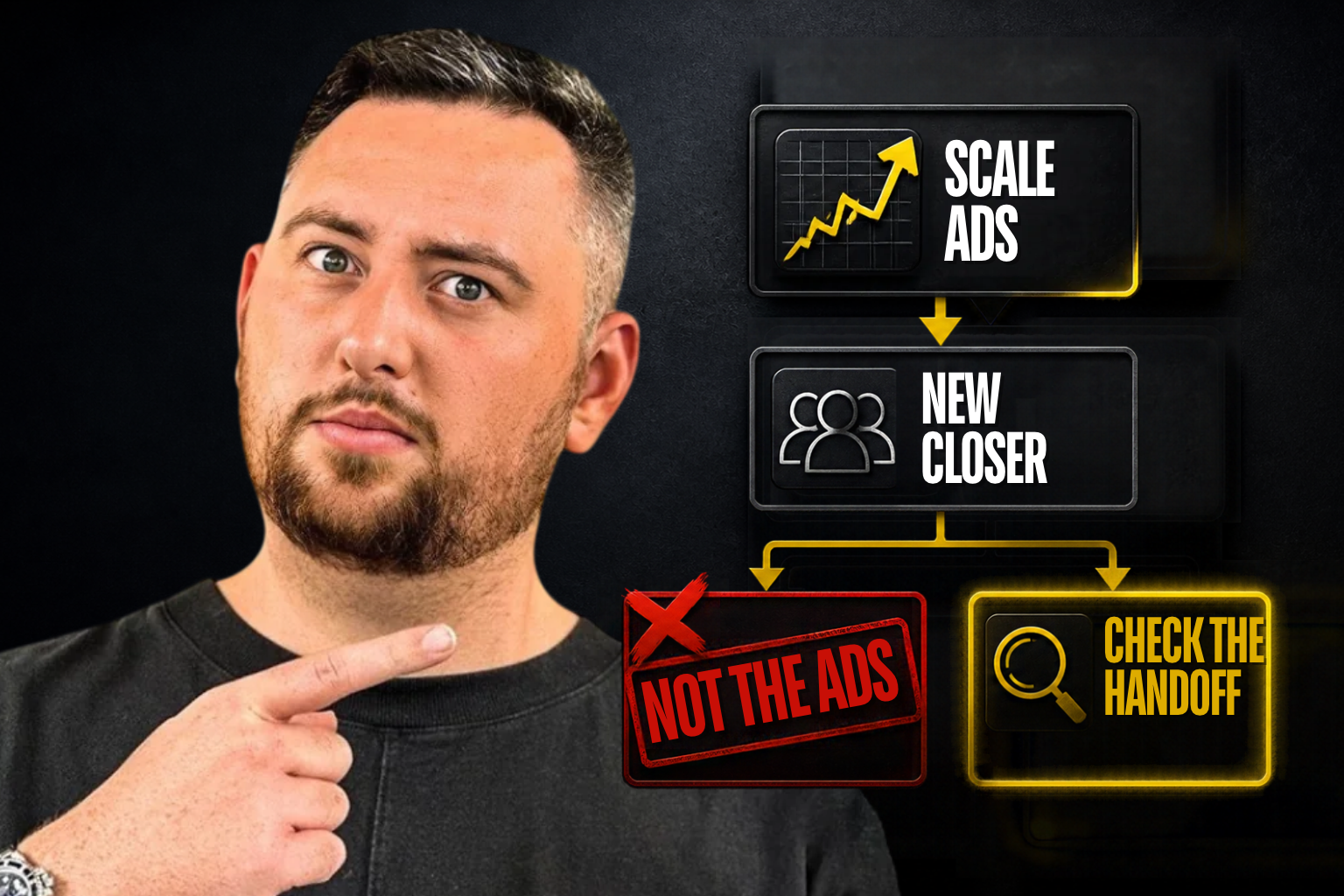
In a podcast-agency business breakdown, I initially explored whether the message had reached a ceiling. Later in the conversation, the owner mentioned something important. He had hired a closer and taken himself off calls while increasing ad spend.
He had also reduced his attention to cold email, a channel already contributing to the business. The attempt he remembered as an advertising failure included changes to acquisition, sales, and the owner’s involvement.
When I asked about cost per call, he said it had stayed similar. He then described the closer failing to convert the opportunities. That changed my explanation of that particular period.
After hearing that, I was not going to keep calling it a messaging ceiling. The sales handoff needed attention before the next attempt.
Similar cost per call does not prove identical lead quality. You still need to inspect who booked and what happened on the calls. But once you learn that the person handling the sale changed, you cannot keep acting as though the budget was the only thing tested.
The full podcast-agency breakdown covers the wider business. The lesson to take into your own review is narrower. Ask what changed after the lead arrived before blaming the way you acquired that lead.
Separate What Happened From the Reason You Gave It
“We spent more and collected less” describes an outcome. “The audience cannot support more spend” adds an explanation. You need evidence for that second sentence.
Look back at the ads, the destination, the offer, and the people handling the inquiries. Compare the actual versions from the period rather than relying on how you remember them. If you changed several of those things, say so.
That does not mean the loss was imaginary. It means the loss cannot identify its own cause.
Google’s guidance on campaign experiments makes a related point: changes to the original or experimental campaign during a test can make results harder to interpret. That guidance concerns Google Ads experiments, but the practical warning is useful here. Extra changes weaken the explanation you can confidently attach to a result.
You do not need to pretend an old attempt was a controlled experiment. You need to be honest about what it can tell you.
Replace the Broad Conclusion With a Specific One
I want a lesson you can act on. “Every time we spend more, it fails” gives you very little room to move. “We handed calls to an unprepared closer during the increase” points to work you can actually do.
Other reviews may point somewhere else. You may find that acquisition costs rose before the sales process changed. You may discover that a new message attracted a different buyer. Keep the conclusion tied to what you can see.
Do not turn an initial possibility into the final answer just because it sounded convincing at the beginning of the conversation. In that agency breakdown, the later information mattered more than protecting my first explanation.
The broader problem of carrying an old business belief into the next decision starts here. An experience becomes a rule, and the rule survives long after you stop checking the experience.
I teach how acquisition and sales fit together in Master Internet Marketing, my 7-week live comprehensive training. Understanding both sides helps you ask a better question than whether ads work.
Results are not typical. Your results will vary and depend entirely on your individual capacity, business experience, expertise, and level of desire. There are no guarantees concerning the level of success you may experience. The testimonials and examples used are not intended to represent or guarantee that anyone will achieve the same or similar results. We don’t believe in get-rich-quick programs. We believe in hard work, adding value and serving others. As stated by law, we can not and do not make any guarantees about your own ability to get results or earn any money with our information, courses, programs, or strategies.
The Next Attempt Should Address the Actual Weakness
A second attempt should reflect what you learned. Repeating the same handoff while changing the creative does very little to test whether the handoff was the problem.
In the agency conversation, I encouraged the owner to return to advertising and establish performance again before trying to exceed the earlier level. I also wanted a more responsible transition on sales calls. That was advice for the situation he described, not a promise that the next increase would succeed.
The question was whether the message could support more spend with the sales problem addressed. If acquisition costs then deteriorated, that would give us something different to investigate.
Be clear about what you intend to learn before you spend. NIST’s experimental-design guidance starts with objectives and the variables being studied. You do not need an engineering study to borrow that discipline. Decide what this attempt should clarify and avoid changing unrelated things at the same time.
You may still find that the current message has a limit. Reviewing the old attempt properly does not require believing that every campaign can scale indefinitely. It gives the next test a more useful starting point.
7 weeks. Real frameworks. Covering copywriting, funnels, paid ads, and conversion systems.
Keep the Lesson Without Keeping the Fear
A bad attempt can make the next one feel settled before it begins. I want you to keep the useful information and question the rest of the story.
What failed, what else changed, and what would you do differently now? Those answers should be concrete enough to change your next action. If the only answer is that you never want to feel that loss again, you have not finished the review.
That is a useful conversation to bring into my Inner Circle, a peer mastermind. Bring the actual sequence of decisions and results. The aim is to understand the earlier attempt well enough that the next decision is based on what happened, rather than the broadest conclusion you attached to it.
Results are not typical. Your results will vary and depend entirely on your individual capacity, business experience, expertise, and level of desire. There are no guarantees concerning the level of success you may experience. The testimonials and examples used are not intended to represent or guarantee that anyone will achieve the same or similar results. We don’t believe in get-rich-quick programs. We believe in hard work, adding value and serving others. As stated by law, we can not and do not make any guarantees about your own ability to get results or earn any money with our information, courses, programs, or strategies.
Get my content first on Google
Add jeremyhaynes.com as a preferred source and Google shows my articles more prominently in your search results, including AI Overviews and AI Mode.


Jeremy Haynes
Owner and CEO of Megalodon Marketing
Jeremy Haynes is the founder of Megalodon Marketing. He is considered one of the top digital marketers and has the results to back it up.