How to Create a Video Sales Letter That Gets High Play Rates and Engagement

I hope you enjoy reading this blog post. If you want my team to just do your marketing for you, click here.
Author: Jeremy Haynes | Published January 2, 2026
Earnings Disclaimer: You have a .1% probability of hitting million-dollar months according to the US Bureau of Labor Statistics. As stated by law, we can not and do not make any guarantees about your own ability to get results or earn any money with our ideas, information, programs, or strategies. We don’t know you, and besides, your results in life are up to you. We’re here to help by giving you our greatest strategies to move you forward, faster. However, nothing on this page or any of our websites or emails is a promise or guarantee of future earnings. Any financial numbers referenced here, or on any of our sites or emails, are simply estimates or projections or past results, and should not be considered exact, actual, or as a promise of potential earnings – all numbers are illustrative only.
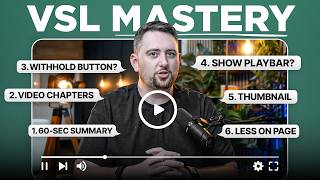
VSL pro tips. There are a few new ones.
We have an incredible piece on this site dedicated to VSL creation mastery. Definitely check that out.
Here I’m going to give you what’s been working best right now that all our clients, Inner Circle members, and students are using to maximize VSL play rates, VSL engagement rates, which means the average amount of time somebody’s actually going to consume it.
And of course, little pro tips like do you withhold a button or not until a certain time in the pitch? All that will be covered here today.
Welcome in to the site if you’re new. All we talk about around here is cracking million-dollar months. Whether it’s the first million a month or the next million a month around here.
All we do is hand down lessons from people that have been there, done that.
So you’re in the right place if that’s what you’re looking for.
However, there are no earnings claims. There is no income potential in reading free content.
All this is, is me just handing down some lessons from people that have been there, done that.
If you have any expectation of any kind of earnings from consuming this, you need to recalibrate because there is a 0.1% probability according to the US Bureau of Labor Statistics that you’re going to hit $10 million a year.
Let alone the even smaller probability than that you would ever hit million-dollar months. And the even smaller probability than that you would ever do a couple million dollars a month.
And you’re no special snowflake. You have a high probability to be within those categories of people who are not going to do it.
So again, these are just lessons. I’m just trying to hand down some stuff to you to help you out.
And anyway, welcome back to the site if you’re already following along. It’s a pleasure to have you.
If your business is already generating $100k+ per month, My Inner Circle is where you break through to the next level. Inside, I’ll help you identify and solve the bottlenecks holding you back so you can scale faster and with more clarity.
Without further ado, here we go.
Why You Should Summarize Your Entire VSL in the First Ninety Seconds
So the first thing I want to talk about is structure.
One thing that has specifically been proven for structure is a little pro tip where we call the summary section.
So ideally in the first 60 to 90 seconds, if you treated that period of time like it needed to be everything that’s covered throughout the entire VSL but said in just this tiny little window right here, that’s what you would do in the first 60 to 90 seconds.
Most people open up their VSLs with stuff that are either considered hooks or some people just dip right into it.
In certain instances, if you check out my link available for my Inner Circle, there’s a VSL on that page currently that says the price literally just straight away, and then I jump into everything that people want to know in that first 60 to 90 seconds.
As an example of this, it is an incredible pro tip. It works in a very effective way because here’s how human beings actually behave, which some of you get quite frustrated by, but it’s the reality of the situation.
When people go to watch anything on your page, what they’re looking for is their own efficiency and energy conservation.
They want to be able to get to the point of concluding whether it’s for them or not and whether they want to take an action or not in as little time invested as possible.
They don’t care about you at all. They don’t care about watching your whole video like you care about them watching it. It’s the exact opposite. They’re competing incentives.
What they actually care about, just to be clear, is efficiency and energy conservation.
That means that if you can effectively articulate yourself, kind of like the tweet version of what you otherwise might say in an expanded newsletter, you want to be able to say everything that needs to be said in the first 60 to 90 seconds of the video.
And then from there, you can expand on each one of those points for the rest of your VSL.
It’s an incredible pro tip and it works highly effectively.
How to Use Video Chaptering to Increase VSL Watch Time and Retention
One other thing that you want to do when you look at your VSL, and this is still an incredible tip, are the little chapters that you can add.
So in all video players nowadays, you have the opportunity to add those little options.
Kind of like on content where it says here’s what’s covered here, here, here, here, here.
That way when someone wants to skip around, they can just hover their mouse or hover their finger and scrub to that specific section because again, nobody actually wants to watch it in its entirety like you may want them to.
There’s a much higher quantity of people who are going to want to go through that information in a way that they prefer to go through it through.
As an example, some of you may have already skipped a section and been on to the next section.
So nonetheless, a great example of it.
Video chaptering is technically what this one’s called.
And video chaptering is a phenomenal tip in order to help with retention, in order to help with consumption, because again, when someone’s done consuming whatever it is that you’re saying, they’re just going to move on to the next thing anyway.
Should You Withhold the Apply Button Until Someone Watches Your VSL
Another incredible pro tip. So do you withhold the button?
This has been an ongoing battle amongst all marketers for a long time.
Meaning, do you want to be in a position where that button to apply or to do whatever the action is shows up as soon as the person hits the page or should there be a delay on this until a certain threshold of the VSL?
Some of you also from the same concept of withholding the button, should you show the video player, meaning do you want to actually reveal the opportunity for somebody to scrub through the video at the video chaptering?
And I will say in certain instances both of these options can make sense not to do.
So if you want to argue both sides, which I will for you, so you can make a decision based on what may work best for you, here’s how most people make the decision.
When you consider withholding a button, it’s because the people that are coming through your call funnel that has a VSL on that page where they’re applying or scheduling, a lot of people just aren’t watching it.
And so you start to grow frustrated and you think to yourself, before I make any other change, I’m just going to make the one single change of waiting for my VSL apply button to show up on the page.
So you put a time delay on it.
And some of you, you test for a minute or 2 minutes. Others have very long VSLs and they won’t even have the button show up until like 20 or 30 minutes of being onto the page.
Now what really determines this decision is your bank account.
So if you have the financial means to dramatically inflate your cost per call in the short term while you start to accumulate new data onto that pixel to help the pixel go after more people who are probable to actually watch and then take the action, then you could technically pull that action off.
Sometimes you see immediate benefit from doing it. A lot of the times you don’t.
A lot of the times when you initially take that action, you’re going to dramatically reduce the quantity of people that are scheduling.
You’re going to dramatically inflate your cost per qualified call.
In addition to that, and this is also something really important to consider, you are also going to limit the quantity of people converting that get sent back to that pixel.
That becomes problematic because then you start to break pixel conditioning best practices.
Why Getting Out of Learning Phase Matters for VSL Call Funnel Performance
One thing that really matters right now in 2026 is getting out of learning mode.
Historically this has mattered and then in other periods of history it hasn’t mattered at all to have to exit learning phase.
We have campaigns that are in learning limited that still absolutely perform well.
But what we see time and time again right now is exiting that learning phase makes a huge difference to the performance of a campaign.
So if you don’t get enough data back and there really is no static answer. That’s always the question that comes up is oh should I like 50 in a week used to be the static answer that was thrown around.
I mean sure that may do it but it could be like five people is all that’s needed.
It’s a very dynamic answer nowadays. I’ve seen it to where it’s required to have hundreds of people unfortunately although rare.
But anyway, point I’m trying to make, you have to get enough data back to exit learning phase to really have a lot better performance.
Now if you can get that data back because you’re operating at a large enough scale to be able to do so, that’s awesome.
What that’s going to enable you to do, and this is really important you understand this, it’s going to enable you to have a lot of the right people who are actively consuming a lot of the VSL and then applying, which likely increases intent dramatically.
Imagine following pixel conditioning best practices, but you do so in a way that improves the intent of the leads because you’re only sending back high intent leads to that pixel results column in the first place.
By the way, if you want an entire piece dedicated just to pixel conditioning best practices, we have one on this site of course because we’ve got your back.
Go check that piece out after this one because I still have a few more tips to throw your way.
Back to my point. Withholding the button can be beneficial if you can endure that process.
It’s not necessary. It’s also contingent on your sales team skills.
So if your sales team is poor and they are requiring you to make sure people watch content prior to showing up, you’re going to have to do that.
You may even switch funnels to something like a webinar or some type of content first ad strategy that we teach.
There’s all kinds of alternatives, but if you’re going to run a VSL call funnel, your salespeople, if they require somebody to have watched content prior to talking to them, that could also justify withholding the application button.
Something to consider.
Now if you’ve got a set of talented people in that sales team, they don’t care if people watch the full video. They’re going to nurture them and be able to close them regardless, then by all means, I don’t think that withholding the button needs to happen or makes a lot of sense.
In addition to that, the other thing that you could argue here for why it wouldn’t make any sense to withhold the apply button is because you are going to have a lower quantity of people that come in and you might have a sales team that is currently demanding of you to fill their calendars up with as much as you can, even if they’re not the most qualified people.
So there’s all kinds of little things that can make this decision and whichever one feels most appropriate for you, I would lean into.
Should You Show or Hide the Video Play Bar on Your VSL
Now to be clear, showing the video play bar is a whole different argument.
So when you actually look at a video itself and you have that little tiny bar at the bottom that shows how far along a person is in the video and obviously would give people the opportunity to scrub through the video if it was available and was visible.
That’s another argument that a lot of people make, doing or not doing.
Now for this one, it’s more majority of people are showing the play bar and they’re doing the video chaptering thing and seeing a lot of benefit in that.
However, here’s a really easy answer. If you’re going to withhold the apply now button, you might as well also withhold the play bar because it’s not going to make much sense if somebody scrubs through the entire video in a shorter duration of time and feels ready to take action and then there’s nothing to take action on because the time threshold to show the button didn’t pass yet.
Something to consider.
That’s really the only thing that kind of makes that decision.
You would think that withholding the play bar may be beneficial even if you have the button visible, but believe it or not, that would actually lower the intent because as soon as somebody gets annoyed and is just like “Oh I feel like I already understood this part, I want to skip along,” you’re forcing them to watch through it anyway.
So you attract usually a lower quality person when you do that kind of stuff to people, which is also something very important to consider.
How to Maximize Your VSL Play Rate with Better Thumbnails and Page Design
Now let’s talk about maximizing your play rate, which is the amount of people that hit the page and actually press play.
One of the most important things that we learned time and time again inside of 2025 and through this first part of 2026 is video thumbnails still absolutely perform well.
Research shows that viewers spend 100% more time on pages that have video compared to text-only pages, making compelling thumbnails essential for maximizing engagement from the moment prospects land on your page.
We like Wistia, we like Vidalytics for this. There’s not a lot of other players that are actively being used.
We stay away from YouTube. We stay away from Vimeo. We stay away from alternatives.
We just again, Wistia and Vidalytics are the two top options.
Video thumbnails are a great engaging way to be able to demonstrate a specific point in the video that somebody may care about.
As an example, if you go to any one of my pages, you click on the link available for my Inner Circle where we do our twice a month one-on-one calls, our weekly group calls, our quarterly in-person masterminds, our very active group chat, a ton of video trainings, a lot of access to very high-level people who can also help beyond just myself, the ability to DM me, unlimited access to Jeremy AI.
There’s a lot of great rich people trying to get richer in that group and we’d love to welcome you in if you’re a good fit.
But if you click the link available for that particular page, what you’ll see is my video thumbnail demonstrates what specifically people are most probable to care about when they hit the page.
What would they want to know? And as a result of that, it invites them in to watch the video.
And you’ll also notice if you click the link to go to that page, we isolate the assets on the page to where there’s a high probability somebody to get the information they want knows they need to watch the video to get it.
This is very important that you understand this.
If you put too much information on the page, again, people bias towards their energy conservation and efficiency.
They’re rather just going to scroll the page, determine whether it was for them or not, and then leave or take the action.
So you’re actually going to negate people from watching the VSL if you put too much information on the page.
We still to this day follow headline, VSL, and application embedded right onto the page or the button when we are running VSL call funnels like this.
And even if you’re running just a VSL in general, this may still apply.
If you want more people to watch the video, put less things on the page and make the focal point of the page the video itself for the clear way to get the information the person’s looking for.
Because at the end of the day, that’s what the VSL is. It’s a curated presentation where you’ve organized information in a particular flow with call to actions and strategic information to help validate your claims and provide certainty to people watching it.
So therefore, if you want people to watch it, again, there has to be an incentive to do so. It’s a high effort thing to do if you think about it.
So as a result of that, that VSL, that video thumbnail that shows, there has to be something that people actually care about.
That little couple seconds you get, whether it be 5 seconds or 10 seconds.
Again, ideally pick a section of the video or just make a whole separate little video thumbnail for it by itself that shows that information that people care about.
If you are going to use an image for the thumbnail instead, and this could be justified due to page speed optimization, video thumbnail will slow the page speed down a little bit.
So if you do use an image, it’s the same kind of concept. It should be something that invites people to watch the video by demonstrating what that video covers.
And what the video covers that you showcase should be stuff that the users actually care about.
Something very important to consider.
How to Boost VSL Engagement Rate Without Making the Video Too Long
Now when you’re looking to get the actual engagement rate of the video up, there’s a bunch of pro tips with this one.
Keep in mind, engagement rate represents how much on average is somebody consuming of what’s available in the VSL.
So as an example, if it’s a 10-minute VSL and somebody watches 3 minutes of it on average, no matter which 3 minutes it is, you’d average a 30% engagement rate in that example.
If somebody watched 9 minutes of your 10-minute VSL, that would represent a 90% engagement rate.
Just for clarity in this statistic, the higher the engagement rate, typically the higher the intent of the leads.
But believe it or not, and this might be a little bit contradicting to a degree, when you have a high play rate and you have a really high engagement rate, believe it or not, the high play rate represents a good thing, but the high engagement rate can represent a bad thing.
It means that people are either super hooked on what you’re saying, which would be the good side of things, and they really want to know all of what you’re talking about.
Or it could mean that they are highly interested but are having a hard time understanding what you can actually do for them and how it works.
So as a result of that, they have to watch more of the video. Industry research shows that embedding video on landing pages can increase conversions by up to 80% when viewers fully engage with the presentation.
And I know that kind of sounds counterintuitive because technically you’d think I want the highest engagement rate possible.
But again, just to be clear, if you are highly effective at articulating yourself in ways that prompt action and make people feel the certainty that you want them to feel to take that action in a way where they’re also qualified, you can get your point across in fewer words and still have that effectiveness that you’re looking for.
That’s something very important to consider.
Obviously when it comes to engagement rate in the day and age that we’re in, typically a nice edited video goes far. Recent industry data shows that VSL funnels achieve 20-50% higher conversion rates compared to text-based sales funnels. Video production quality is a worthwhile investment for serious marketers.
You can get away with jump cuts and just captions, no doubt. But if you edit it kind of like how you see my content edited, where there’s some visual edits that are factored in in addition to captions and jump cuts, there’s music occasionally or sound effects or little moments where there’s memes.
Those kind of things can help with retention because let’s be honest, this day and age, people’s brains are overwhelmed for the most part with the amount of things that they can pay attention to in a day.
So to be able to hold their attention for the average length of your VSL, you really have to go far nowadays to do it well.
And it doesn’t have to be anything crazy. Again, use my content as an example if you want to hand them off to your editors and also just go look at some of my VSLs that I’ve done on my pages that you can find examples of available.
One other very important thing to consider with the engagement rate, and a lot of people really mess this up, it’s the basics of just talking and communication.
Your tonality, the words you say, all the messaging feeling congruent from the ad that got them there or the organic content that got them there, the congruency, the messaging, tonality, just authority that you communicate with, storyline of the whole VSL.
There’s obviously all kinds of pro tips like this, but we save all those kinds of pro tips for my paid programs.
I will be fair in saying though, there’s an incredible free piece on this site. I mentioned it towards the very beginning. It’s our VSL mastery piece where we cover part of a very long thorough SOP that we give to our Inner Circle members and Master Internet Marketing students.
If you want the real sauce of course, check out the links available and take action on buying from us.
What Is the Ideal VSL Length for Rich People Versus General Public
I’m going to close it out with this for you because this is also a very important consideration, which is what should the length be nowadays?
Length is very important.
I’ll tell you this though, and this is something very important to consider. We’ve seen as short as 2 to 5 minutes absolutely perform well with rich people specifically.
The shorter the VSL and the more direct you are and the more concentrated information you can get off in a short duration of time, the better you fare with a richer demographic.
We’ve seen VSLs, and this might seem audacious I know, that are upwards of an hour long that are going towards the general public comparatively.
Like we have a client right now, he uses a literal podcast, like unedited, just intro and all like rough cuts.
The general public responds really well to longer content.
The general public generally responds really well if you’re going to withhold a button because you’re having quality issues.
Rich people comparatively, this really does determine this decision. They prefer shorter VSLs.
And if you’re going to do a longer VSL and it’s for rich people, do the summary tip that I taught you at the very beginning of this piece where you summarize everything in 60 to 90 seconds and then you elaborate further on it through the remaining part of the video.
That way it’s efficient for them and they can make the decision at any point they feel certain enough to do so.
Again, I know 10 minutes to an hour long is a super wide range.
And you might even be asking yourself, well what’s like the true average of that right now? What would that equate to?
And I’ll tell you, it’s all over the place currently.
Generally it falls somewhere between about 10 and 20 minutes. Data shows that 53% of viewers complete online videos from businesses, with completion rates dropping significantly for videos over 20 minutes. The 10-20 minute sweet spot is strategically optimal for balancing information delivery with viewer retention.
What VSL Styles Are Working Best Right Now Talking Head or Slides
And the styles have also changed a bit.
There’s a few people now who do a style where they have like a Google doc or some kind of slide deck on the left and then they are like the talking head on the right hand side of the screen and they’re looking over and kind of reading the Google doc.
That’s one style that’s worked well.
Obviously classic talking head content like how you see me here. This has also worked well for a long time and it still is very effective.
Another incredible way to do VSLs if you’re a little more shy and don’t necessarily want to be on camera is just slides and essentially just a screen recording with a voice over.
This combo is tried and true and also works really well.
I can’t stress this enough. There’s not really one or the other that’s currently working best.
It’s honestly a pretty even mix between the three of these.
Again, there’s not necessarily one that dominates the other.
In either scenario, whether it’s any one of these particular styles, 10 to 20 minutes is usually the norm.
Are there people who go well beyond that? Yeah.
Are there minorities that do things like the podcast example that I provided to you? Yeah.
But again, it’s all over the place.
So you can test all kinds of stuff. And I think the point I’m trying to make here is it’s all kinds of things that work and then you can get away with testing all kinds of different things to see some success yourself.
VSLs are still awesome. Whether it’s on a low ticket to high ticket page, whether it’s the focal point of the page in a call funnel, whether it’s something that you’re looking to use on the back end of something and you’re trying to get people to take an action later on, VSLs are one of the most important skill sets that you can master in this day and age and especially in 2026 onward.
What You Get in Free VSL Training Versus Paid VSL SOPs and Templates
We have incredibly in-depth SOPs. I’ll give you a little preview so you can check it out, but we’re going to blur it out. I’m just trying to show you the length of it so you can really see it in its entirety.
This mastering VSLs SOP has examples of VSLs for affluent demographics, for general populations, has slide decks that you can use for formatting and templates.
There’s all kinds of great information.
In addition to that, we have I think at least three or four different very in-depth training pieces on VSLs inside of all my paid programs.
Whether it be my Inner Circle or even Master Internet Marketing, they cross in this case. The training is shared amongst both for this specific set of lessons.
I can’t stress enough the importance of understanding this.
There’s a lot of people out there who will essentially give away everything that they know in free content and then it’s essentially a letdown when you get into their paid programs.
I am not that way.
I do not mislead you at all when I tell you that I withhold about 80% to 90% of what I know here in free content.
I give you more than enough to be able to go out there and get some results and see that I am not full of hot air and that I can help you in your journey of getting richer.
But again, I can’t stress enough the importance of you understanding this. My paid program is where the true sauce is.
And when you’re inevitably ready after you finally take action on all this and get some results with it for free and you accumulate some house money, please understand with the utmost confidence and certainty how much better the results that you can get will be when you start the process of joining one of my paid offers.
I look forward to that day. And in the meantime, I look forward to helping you regardless.
Most business owners waste years figuring out what actually works. In my Master Internet Marketing program, I compress that learning curve into 7 weeks, covering copywriting, funnels, ads, and more. If you’re ready to invest $5k and get serious about your skills, apply here.
Follow along on the site if you haven’t done so already. Check out some of my other pieces and go get richer.
Talk soon.
Watch the video:
Get my content first on Google
Add jeremyhaynes.com as a preferred source and Google shows my articles more prominently in your search results, including AI Overviews and AI Mode.


Jeremy Haynes
Owner and CEO of Megalodon Marketing
Jeremy Haynes is the founder of Megalodon Marketing. He is considered one of the top digital marketers and has the results to back it up.