
Choose Content Examples That Attract the Buyers You Want

I hope you enjoy reading this blog post. If you want my team to just do your marketing for you, click here.
Author: Jeremy Haynes | Published October 26, 2026
Earnings Disclaimer: You have a .1% probability of hitting million-dollar months according to the US Bureau of Labor Statistics. As stated by law, we cannot and do not make any guarantees about your own ability to get results or earn any money with our ideas, information, programs, or strategies. We don’t know you, and your results in life are up to you. We’re here to help by giving you our greatest strategies to move you forward, faster. However, nothing on this page or any of our websites or emails is a promise or guarantee of future earnings. Any financial numbers referenced here, or on any of our sites or emails, are simply estimates or projections or past results, and should not be considered exact, actual, or as a promise of potential earnings – all numbers are illustrative only.
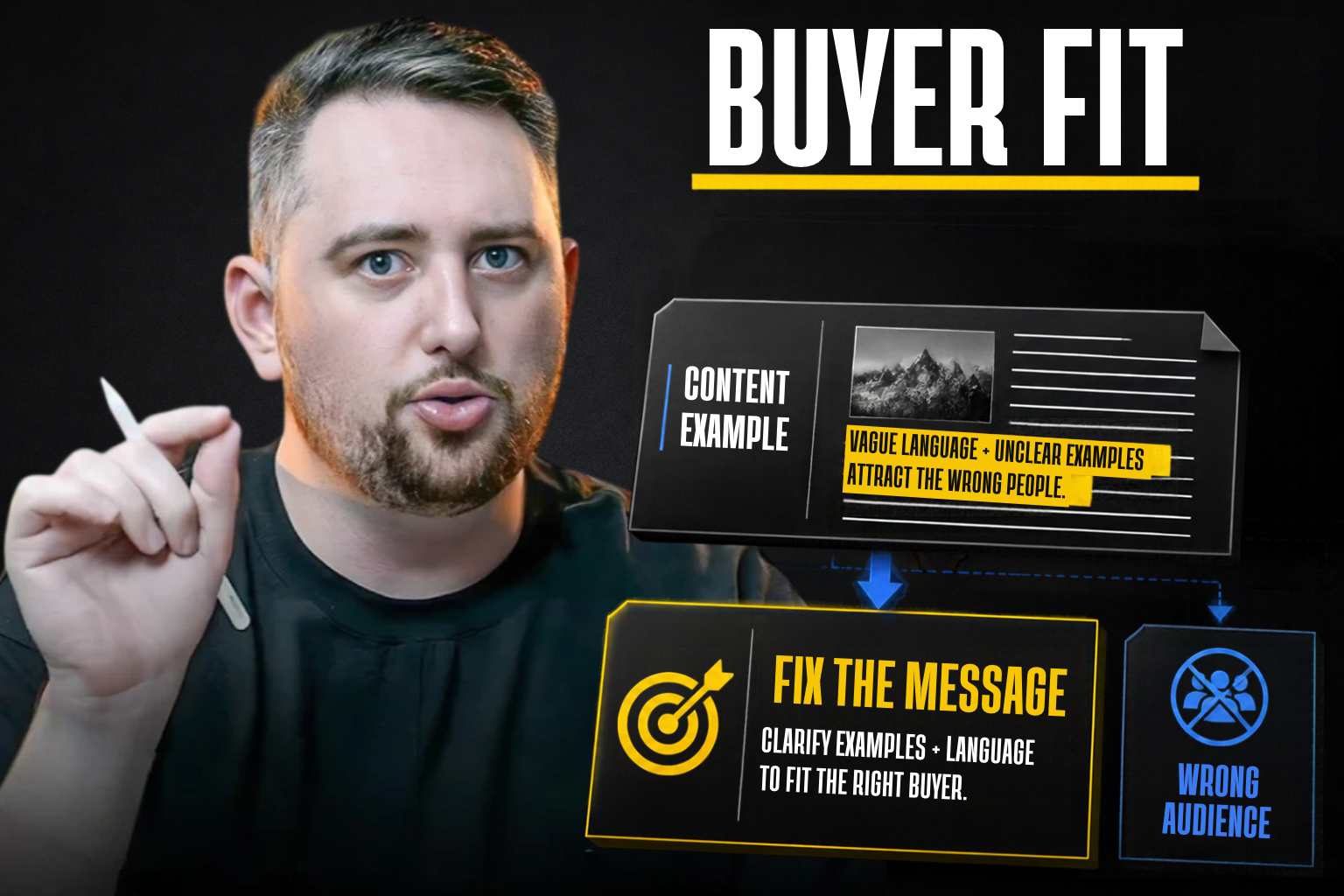
Your content can attract the wrong audience because of an example you barely thought about. A comparison that sounds clever to you may tell the viewer that you help a different kind of person. I want the hook, the examples, and the explanation to make sense to the buyer who could actually use the offer. Before changing the whole content strategy, look at who your words are inviting in.
This gets missed because the content can still perform. People watch, comment, and ask questions. Then the sales team keeps hearing from people with a different problem from the one the business solves.
That is worth fixing at the source. Publishing more of the same explanation can keep introducing you to the same mismatch.
Already making money? See what it takes to make a lot more.
A Clever Comparison Can Attract a Different Profession
An example can pull attention toward the example itself rather than the service you are selling. The response is what tells you whether that happened.
An operator I spoke with was selling copywriting education. One ad compared what people could do with AI to the work of a famous author. He reported that it brought in aspiring authors, which was not the audience he wanted.
The comparison was a small part of the message. It still gave people a recognizable reason to respond. Someone interested in becoming an author could hear that line and reasonably think the offer was for them.
I use that lesson when thinking about organic content too. If the analogy attracts interest in a different career or outcome, the attention can take you away from the buyer. I would keep the useful explanation and change the reference that creates the confusion.
That does not prove a particular word controls a recommendation system. It shows why the people arriving matter when you judge the message.
Keep the Example Inside the Buyer’s Actual Problem
The example should help the intended buyer recognize a decision they actually face. Start with the situation the offer helps them handle.
When I talk to established operators, I discuss the time, costs, and work behind a marketing choice. Those details belong to their world. They help someone understand whether the explanation applies to a business like theirs.
I would look back at the questions buyers ask before choosing an offer. Their uncertainty gives you something specific to explain. Keep enough context for the person to recognize why the decision matters.
You can make the language clear without changing who the lesson is for. If the problem assumes an existing offer or a working sales team, keep that fact in the explanation. Removing the operating context can make an advanced decision sound like an invitation to start an entirely different business.
The content engine behind my publishing starts with real conversations. Choosing an example is a smaller decision inside that process, but it deserves the same connection to the buyer.
The Visuals Should Support the Same Invitation
The setting and presentation should make sense alongside the words. A viewer starts interpreting the scene before you finish explaining the offer.
I normally dress in a relaxed way because that fits how I work and the internet-business operators I speak to. I do not need to put on a suit to make the explanation feel serious. A presentation can be credible without looking corporate.
The principle is consistency. Show the kind of work, environment, or decision you are actually discussing. A visual chosen only because it attracts attention may introduce an expectation the explanation cannot fulfill.
I have used Google Vision to demonstrate how much information software can identify in an image. Its label-detection documentation describes recognizing things such as objects and activities. That capability does not establish how a social platform ranks your post or reveal the income of the people watching.
The broader relationship between environment and messaging matters here. Keep the visuals truthful and relevant, then judge the actual audience response.
Make the Buyer Clear Without Turning Every Post Into a Pitch
A useful explanation can make the intended buyer clear through the problem it addresses. You do not need to repeat a qualification speech in every paragraph.
Describe the situation with enough precision that the right person can place themselves in it. Then explain the decision. If all the examples belong to a different stage of business, a sentence saying the offer is for advanced operators will not resolve the mismatch.
Depth matters as well. Someone considering a substantial purchase needs to see how you think through the issue. Give them a real distinction or an explanation they can assess, rather than a broad statement that could sit under any business headline.
I cover the wider marketing choices in Master Internet Marketing, my 7-week live comprehensive training. For the piece you are making now, keep one buyer problem clear enough that the person can recognize why the explanation is useful.
Results are not typical. Your results will vary and depend entirely on your individual capacity, business experience, expertise, and level of desire. There are no guarantees concerning the level of success you may experience. The testimonials and examples used are not intended to represent or guarantee that anyone will achieve the same or similar results. We don’t believe in get-rich-quick programs. We believe in hard work, adding value and serving others. As stated by law, we can not and do not make any guarantees about your own ability to get results or earn any money with our information, courses, programs, or strategies.
Check the Questions Your Content Brings Back
The questions people ask can reveal a different interpretation from the one you intended. Read them alongside what the piece actually says.
A comment count does not tell you whether people want the thing you sell. Listen for the problem they describe, the stage they are at, and what they believe your offer does. That is more useful than calling every enthusiastic response a qualified lead.
YouTube’s audience reports help you understand viewing patterns and audience characteristics. They do not replace the conversations that establish whether someone fits your offer.
Keep the measurement connected to the question. If a piece earns more reach, check whether the inquiries still match the intended buyer. If it reaches fewer people, check whether those people recognize the problem and continue into a relevant conversation.
The full path from discovery through education and an offer belongs in the awareness, nurture, and conversion system. Here, the narrower check is whether the content introduced you to the person you meant to reach.
7 weeks. Real frameworks. Covering copywriting, funnels, paid ads, and conversion systems.
Change the Confusing Example Before Changing the Market
Correct the part of the explanation that attracted the mismatch before concluding that the market itself is wrong. A misleading comparison is a different problem from an exhausted audience.
I would preserve the subject the buyer needs and reconsider the hook, the analogy, or the visual that points elsewhere. Then look at the response to the revised explanation. Changing everything together makes it harder to understand what helped.
Keep platform explanations in perspective. YouTube describes recommendations as drawing on several signals, including viewing history and feedback. It would be a stretch to promise that a keyword or a change of clothes can select the exact buyers who will see your work.
You can still be deliberate about who the message makes sense to. Explain the buyer’s real situation, choose an example that belongs to it, and give the interested person a relevant place to continue.
Operators in my Inner Circle can bring these decisions into a peer mastermind. I want to see the content and hear what people thought it meant. That gap between the intended lesson and the audience’s interpretation is often where the next useful change becomes clear.
Results are not typical. Your results will vary and depend entirely on your individual capacity, business experience, expertise, and level of desire. There are no guarantees concerning the level of success you may experience. The testimonials and examples used are not intended to represent or guarantee that anyone will achieve the same or similar results. We don’t believe in get-rich-quick programs. We believe in hard work, adding value and serving others. As stated by law, we can not and do not make any guarantees about your own ability to get results or earn any money with our information, courses, programs, or strategies.
Get my content first on Google
Add jeremyhaynes.com as a preferred source and Google shows my articles more prominently in your search results, including AI Overviews and AI Mode.


Jeremy Haynes
Owner and CEO of Megalodon Marketing
Jeremy Haynes is the founder of Megalodon Marketing. He is considered one of the top digital marketers and has the results to back it up.