
When Technical Work Crowds Out Client Success at Your Agency

I hope you enjoy reading this blog post. If you want my team to just do your marketing for you, click here.
Author: Jeremy Haynes | Published November 6, 2026
Earnings Disclaimer: You have a .1% probability of hitting million-dollar months according to the US Bureau of Labor Statistics. As stated by law, we cannot and do not make any guarantees about your own ability to get results or earn any money with our ideas, information, programs, or strategies. We don’t know you, and your results in life are up to you. We’re here to help by giving you our greatest strategies to move you forward, faster. However, nothing on this page or any of our websites or emails is a promise or guarantee of future earnings. Any financial numbers referenced here, or on any of our sites or emails, are simply estimates or projections or past results, and should not be considered exact, actual, or as a promise of potential earnings – all numbers are illustrative only.
If your client success manager spends the afternoon fixing tracking, someone still needs to tell the client what happens next. When both jobs belong to the same person, the technical issue can get resolved while the client sits there waiting. Before I hire another customer success manager, I want to know which work took that person’s time and what the client was waiting on.
I worked through this with agency owners who had people handling client communication and technical account work. They described differences in communication and technical ability across the team. That gave me a better question than whether the role needed another hire. What had the agency actually given those people to do, and what support did they have to do it?
Already making money? See what it takes to make a lot more.
Find the Client Work That Keeps Getting Pushed Back
Start with a real account where progress slipped. Look at the last thing the client was supposed to do, what your team promised to do, and the point where the next action stopped moving. The most useful clue may be a missed follow-up rather than the largest item on the project board.
Say the client needs to confirm that inquiries are reaching the right person. The manager might discover a routing problem and spend the afternoon working on it. Fixing the routing is useful work. But if nobody tells the client what changed or gets them to test it, the agency has solved its piece while leaving the handoff open.
Ask the manager to walk you through what displaced that conversation. Look at ticket history, calendar changes, and the messages surrounding the delay. Find the work that got postponed before you decide the person needs a lighter account list. A smaller account list won’t fix a handoff that has no owner.
Keep the Technical Work That Helps the Client Act
I want a client success manager to understand the service well enough to explain what’s happening. If they can look at a straightforward setup issue and tell the client what to check, making them hand it off can create another wait for no good reason.
Technical knowledge belongs in the role when it helps the person move the account forward. GitLab’s customer success role description includes the ability to explain technical concepts to customers. That’s a useful distinction. Someone can know the product deeply and still need backup when the work turns into an investigation.
Compare a quick explanation of a dashboard with rebuilding the tracking behind it. Both involve the same account. One helps the client make a decision during a conversation. The other could consume the rest of the manager’s day and require access or expertise they don’t have. A role scorecard can help here if it makes clear which client outcomes the manager must protect when the two jobs collide.
Give the Repair and the Client Update Separate Owners
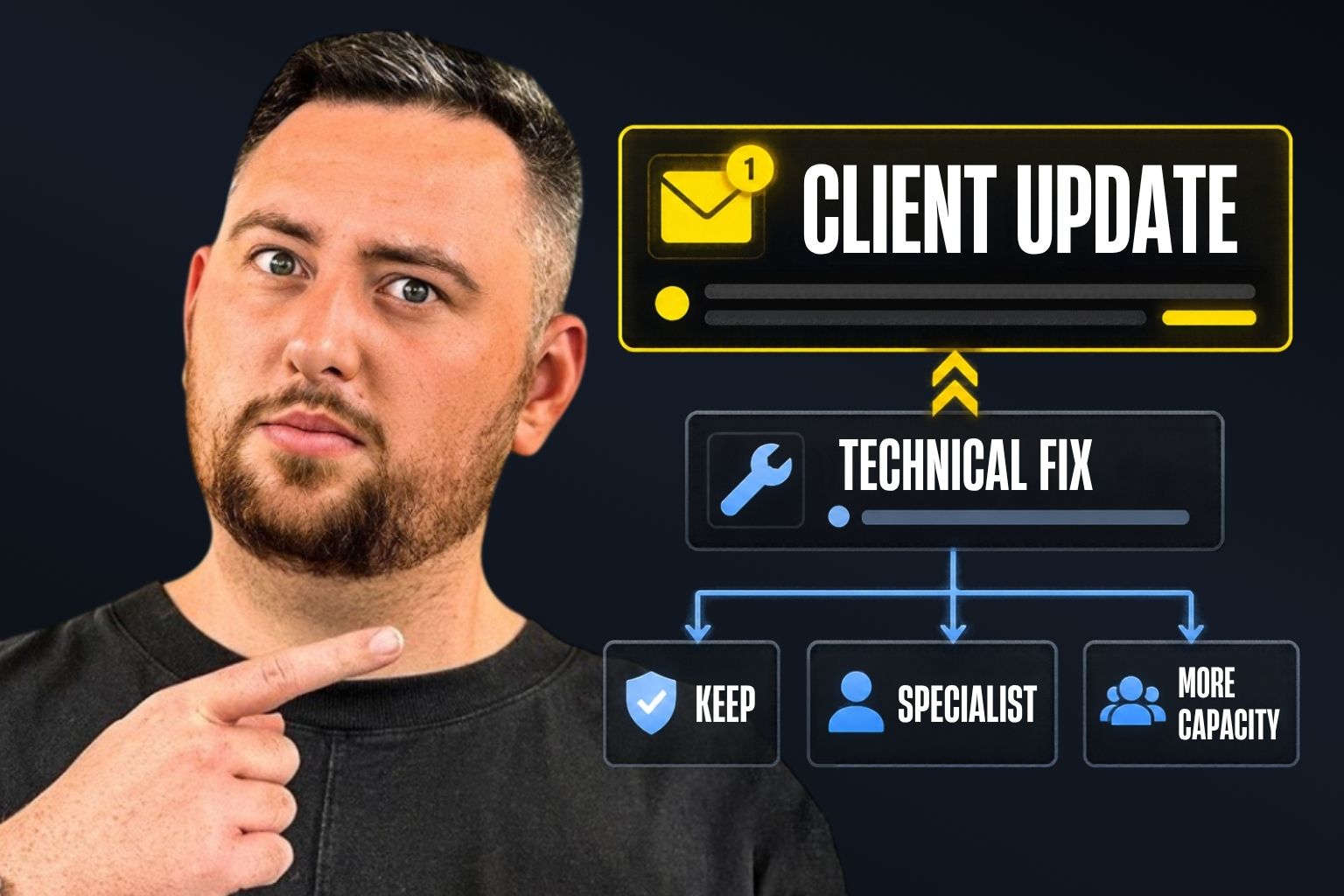
When a specialist takes over the fix, the client success manager can still own the conversation. Give the specialist the issue, the effect on the client, and what needs to be checked before calling it resolved. Keep the client update with the person who understands what that delay means for the account.
Atlassian’s migration roles show how those responsibilities can coexist. Its support engineers help resolve technical challenges while its customer success managers focus on adoption and change management. You don’t need the same job titles. You need the work to have an owner on each side.
A shared agency team structure can work if the specialist has room to respond and the manager knows when to escalate. If the specialist is overloaded too, moving the ticket changes where it waits. It doesn’t change what the client experiences.
Stop Making the Manager Solve the Same Setup Again
Recurring setup work deserves a different answer from an unfamiliar fault. If people keep making the same change account by account, look at why it needs to happen manually. Google’s guidance on operational toil distinguishes recurring manual work from work that makes a lasting improvement. The point for an agency is to notice which fixes disappear until the next client and which ones remove the problem.
The agency owners I spoke with also had to consider what their managers could give clients beyond another conversation. A clear example or a short walkthrough can help someone complete a routine step without waiting for another call. If you’re asking the client to do something unfamiliar, give them something they can actually use when the call ends.
In my Inner Circle, operators can compare what happens when work gets assigned without the tools or time to finish it. I would bring a real example of what got missed and what the person was doing instead. That gives the room more to work with than a general complaint about a busy team.
Results are not typical. Your results will vary and depend entirely on your individual capacity, business experience, expertise, and level of desire. There are no guarantees concerning the level of success you may experience. The testimonials and examples used are not intended to represent or guarantee that anyone will achieve the same or similar results. We don’t believe in get-rich-quick programs. We believe in hard work, adding value and serving others. As stated by law, we can not and do not make any guarantees about your own ability to get results or earn any money with our information, courses, programs, or strategies.
7 weeks. Real frameworks. Covering copywriting, funnels, paid ads, and conversion systems.
Decide Whether You Need Support or Another Hire
Make the staffing decision after you’ve seen where the work is going. If routine tasks keep interrupting client follow-up, see which ones can move to a specialist or become easier to repeat. If the manager has time but can’t explain the next step, work on training and give them better material. Those are different problems.
Sometimes there really is more work than the team can do. Look at whether clients are still waiting after the manager has the support, training, and authority the role needs. At that point, you have a clearer reason to add capacity and a better idea of what kind of person to look for. That fits the bigger job of building client success around the work clients need.
Master Internet Marketing, my 7-week live comprehensive training, covers the marketing work behind these accounts. Whatever work your agency sells, make sure the person explaining it to the client has enough time to get the client to the next step. Check what moved and what still waited before calling the workload fixed.
Results are not typical. Your results will vary and depend entirely on your individual capacity, business experience, expertise, and level of desire. There are no guarantees concerning the level of success you may experience. The testimonials and examples used are not intended to represent or guarantee that anyone will achieve the same or similar results. We don’t believe in get-rich-quick programs. We believe in hard work, adding value and serving others. As stated by law, we can not and do not make any guarantees about your own ability to get results or earn any money with our information, courses, programs, or strategies.
Get my content first on Google
Add jeremyhaynes.com as a preferred source and Google shows my articles more prominently in your search results, including AI Overviews and AI Mode.


Jeremy Haynes
Owner and CEO of Megalodon Marketing
Jeremy Haynes is the founder of Megalodon Marketing. He is considered one of the top digital marketers and has the results to back it up.