
Check Client Concentration Before You Front More Ad Spend

I hope you enjoy reading this blog post. If you want my team to just do your marketing for you, click here.
Author: Jeremy Haynes | Published October 29, 2026
Earnings Disclaimer: You have a .1% probability of hitting million-dollar months according to the US Bureau of Labor Statistics. As stated by law, we cannot and do not make any guarantees about your own ability to get results or earn any money with our ideas, information, programs, or strategies. We don’t know you, and your results in life are up to you. We’re here to help by giving you our greatest strategies to move you forward, faster. However, nothing on this page or any of our websites or emails is a promise or guarantee of future earnings. Any financial numbers referenced here, or on any of our sites or emails, are simply estimates or projections or past results, and should not be considered exact, actual, or as a promise of potential earnings – all numbers are illustrative only.
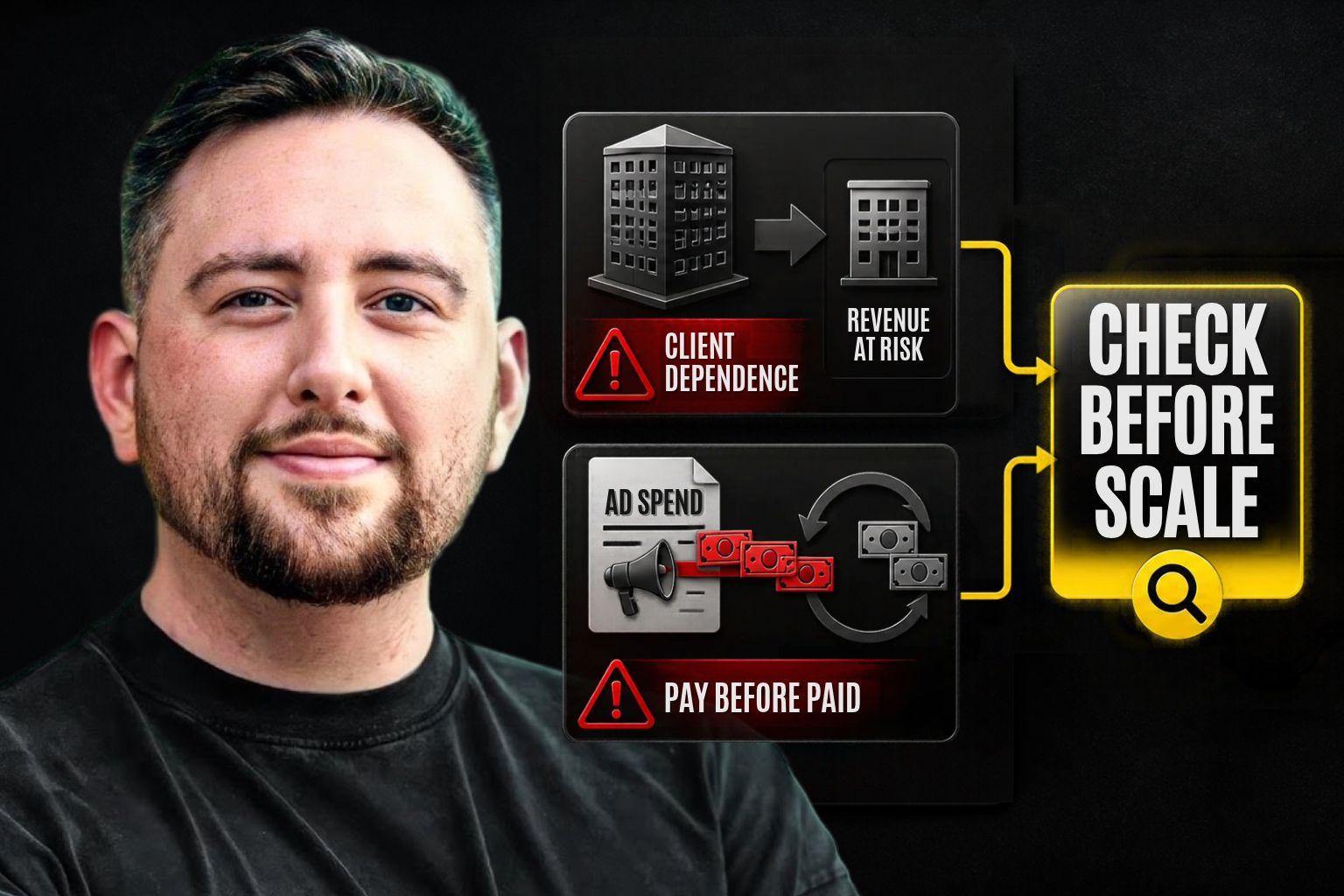
Client concentration risk in an agency becomes harder to judge when you also front the client’s ad spend. Losing the account would remove future business, but money already spent on its behalf may still be waiting to come back. I want both problems visible before the agency agrees to fund more volume. A strong relationship does not make those amounts disappear.
Start with the question the business has to answer. What would happen if the largest buyer stopped ordering, and what would happen if that buyer kept ordering but paid later than expected? Those situations can create different pressures.
Already making money? See what it takes to make a lot more.
Why Client Count Can Hide the Real Dependency
The number of names on your roster does not tell you how much you depend on the largest one. Look at how the business is actually divided among those accounts.
In a lead-generation business I reviewed, the owner had a dominant buyer alongside several smaller relationships. The larger buyer accounted for most of the business. Adding another small account would not, by itself, change that dependence very much.
You can calculate a client’s share by dividing that client’s revenue by total agency revenue for the same period. Keep the definition and time period consistent. Do not compare an invoiced figure for one account with cash collected for the whole agency.
That gives you a starting point, not a universal pass-or-fail threshold. I would still ask what the agency keeps from the account and what it has to spend before collecting payment.
Working with fewer, deeper client relationships can be a deliberate choice. The question is whether you understand the dependence that comes with the particular roster you have.
Who Pays for the Ads Changes What Is at Risk
When the agency pays for media first, it is committing its own cash before the buyer settles the bill. That is a different arrangement from receiving client funds before buying the traffic.
The lead-generation operator described both models. He fronted media for a buyer he trusted and used prepaid arrangements with others. I would not treat those accounts as equivalent simply because both bought leads.
For an agency-funded account, look at the media already purchased, what is still unpaid, and when payment is due. Then look at the next spending commitment. If the buyer asks for more volume, the amount you have to fund can grow before the next collection arrives.
Available credit tells you what you can borrow. It does not tell you what a client has paid. Keep the card balance and the outstanding client payment visible together rather than treating remaining credit as spare operating cash.
Business Queensland distinguishes credit risk from liquidity and borrowing risk. That distinction is useful here. A client payment problem and the agency’s ability to meet its own obligations can be connected without being the same question.
What Still Has to Be Paid If the Buyer Pauses
A client pause can stop new orders without immediately removing the costs already attached to that account. Look at what remains due after the work slows down.
Some advertising costs have already been incurred. Work already promised may still need to be delivered. Team and supplier commitments need to be checked against the arrangements actually in place.
Do not assume every expense disappears with the revenue. Do not assume every expense stays forever either. Find out which commitments end, which continue, and when they change.
Then look at the rest of the roster. How much cash do those accounts contribute after the work required to serve them? Can that remaining business support the costs that continue?
The time between spending and collecting matters alongside that question. An account can look valuable over a full period while leaving a difficult gap before the next bill is due.
Use the actual terms for the review. If you are unclear about obligations after a pause or termination, resolve them with the appropriate adviser before relying on an assumption.
A Late Payment Can Hurt Before an Account Leaves
You do not have to lose the client for concentration to affect cash. A delayed payment from the dominant buyer can put pressure on the agency while the relationship is still active.
That is why I would look at payment timing separately from account retention. A client can be happy, want more leads, and still have a payment that has not reached your bank.
Check the money due in against the money due out. What has already been spent? Which payments are confirmed, and which are simply expected? What additional exposure would another period of delivery create?
Business.gov.au’s cash flow guidance tracks inflows and outflows over time. Use that view to see the gap rather than trying to answer a timing question with a monthly revenue total.
Clear invoicing and payment terms also matter. Its guidance on improving cash flow includes reviewing those terms and managing money owed by customers. That does not guarantee collection, but it gives you something concrete to inspect before funding more work.
I teach the marketing choices behind acquisition and client delivery in Master Internet Marketing, my 7-week live comprehensive training. Keep those choices connected to the money the agency can actually put behind them.
Results are not typical. Your results will vary and depend entirely on your individual capacity, business experience, expertise, and level of desire. There are no guarantees concerning the level of success you may experience. The testimonials and examples used are not intended to represent or guarantee that anyone will achieve the same or similar results. We don’t believe in get-rich-quick programs. We believe in hard work, adding value and serving others. As stated by law, we can not and do not make any guarantees about your own ability to get results or earn any money with our information, courses, programs, or strategies.
Why Trust and Financial Dependence Need Different Answers
A relationship can be collaborative and still account for most of your agency’s income. Being treated well does not change how much the rest of the business depends on that buyer.
The operator I spoke with felt he had a genuine partnership. I took that seriously. I also wanted him to answer whether deeper integration was the direction he wanted, or whether he wanted additional independent buyers.
Do not turn the review into an accusation against a good client. You are examining what your own business can support. A payer’s good history and the effect of a future disruption are different things.
The same care applies to performance-based deal structures. Understand which payments depend on the relationship and how the costs and reporting work. A label such as partner or revenue share cannot answer those details for you.
More Accounts Only Help If They Add Useful Business
Taking poor-fit clients to improve the appearance of diversification can create a different problem. You need suitable additional business, not just a larger roster.
The lead-gen operator’s smaller prospects often lacked the resources or operations needed for his offer. Pursuing more of those firms would consume attention without necessarily replacing the value of the dominant relationship.
Look for buyers that can use the service, sustain their side of the arrangement, and work within realistic expectations. Account size alone does not establish those things.
Keep the dominant relationship healthy while deciding what other business you want. A concentration review is not an instruction to fire the account supporting the agency.
You may choose to pursue independent buyers, change how future work is funded, or examine a deeper partnership. Those are different decisions. Understand the tradeoffs rather than using another small sale to postpone the choice.
7 weeks. Real frameworks. Covering copywriting, funnels, paid ads, and conversion systems.
Know the Exposure Before Agreeing to More Volume
Before committing more agency cash to the account, be able to explain the dependence in plain language. How much business comes from the buyer, how much cash is already committed, and what remains if payments or orders change?
If you cannot answer, the next useful action may be getting the records and terms in front of the person responsible for finance. Guessing a safe concentration percentage will not fill in missing payment information.
Bring the actual numbers and the direction you are considering into my Inner Circle, a peer mastermind. A focused conversation starts with the relationship you have and the exposure you understand. Then you can decide what to expand without confusing a valuable client with a dependency you never examined.
Results are not typical. Your results will vary and depend entirely on your individual capacity, business experience, expertise, and level of desire. There are no guarantees concerning the level of success you may experience. The testimonials and examples used are not intended to represent or guarantee that anyone will achieve the same or similar results. We don’t believe in get-rich-quick programs. We believe in hard work, adding value and serving others. As stated by law, we can not and do not make any guarantees about your own ability to get results or earn any money with our information, courses, programs, or strategies.
Get my content first on Google
Add jeremyhaynes.com as a preferred source and Google shows my articles more prominently in your search results, including AI Overviews and AI Mode.


Jeremy Haynes
Owner and CEO of Megalodon Marketing
Jeremy Haynes is the founder of Megalodon Marketing. He is considered one of the top digital marketers and has the results to back it up.