
This Is What Your Job as CEO Actually Comes Down To

I hope you enjoy reading this blog post. If you want my team to just do your marketing for you, click here.
Author: Jeremy Haynes | Published October 6, 2026
Earnings Disclaimer: You have a .1% probability of hitting million-dollar months according to the US Bureau of Labor Statistics. As stated by law, we cannot and do not make any guarantees about your own ability to get results or earn any money with our ideas, information, programs, or strategies. We don’t know you, and your results in life are up to you. We’re here to help by giving you our greatest strategies to move you forward, faster. However, nothing on this page or any of our websites or emails is a promise or guarantee of future earnings. Any financial numbers referenced here, or on any of our sites or emails, are simply estimates or projections or past results, and should not be considered exact, actual, or as a promise of potential earnings – all numbers are illustrative only.
Your job as a CEO is to decide where your attention is worth the most, then organize your work around that decision. I want to know what you could do right now, what each action could contribute, and what you would give up by choosing it. A full day tells me you were occupied. It takes a closer look to tell me whether you spent that day on the work the business actually needed from you.
That is how I approach my own schedule, hiring decisions and the unexpected requests that land in the middle of a workday. Sometimes the right move is to film. Sometimes it is to take a sales call or resolve a customer issue yourself. The answer depends on the business you have today, and it needs to change as that business changes.
7 weeks. Real frameworks. Covering copywriting, funnels, paid ads, and conversion systems.
What Your Working Hour Is Actually Worth
Start by comparing the revenue of the business with the hours you put into it. That gives you a rough starting point for thinking about your time, provided you understand what the calculation measures.
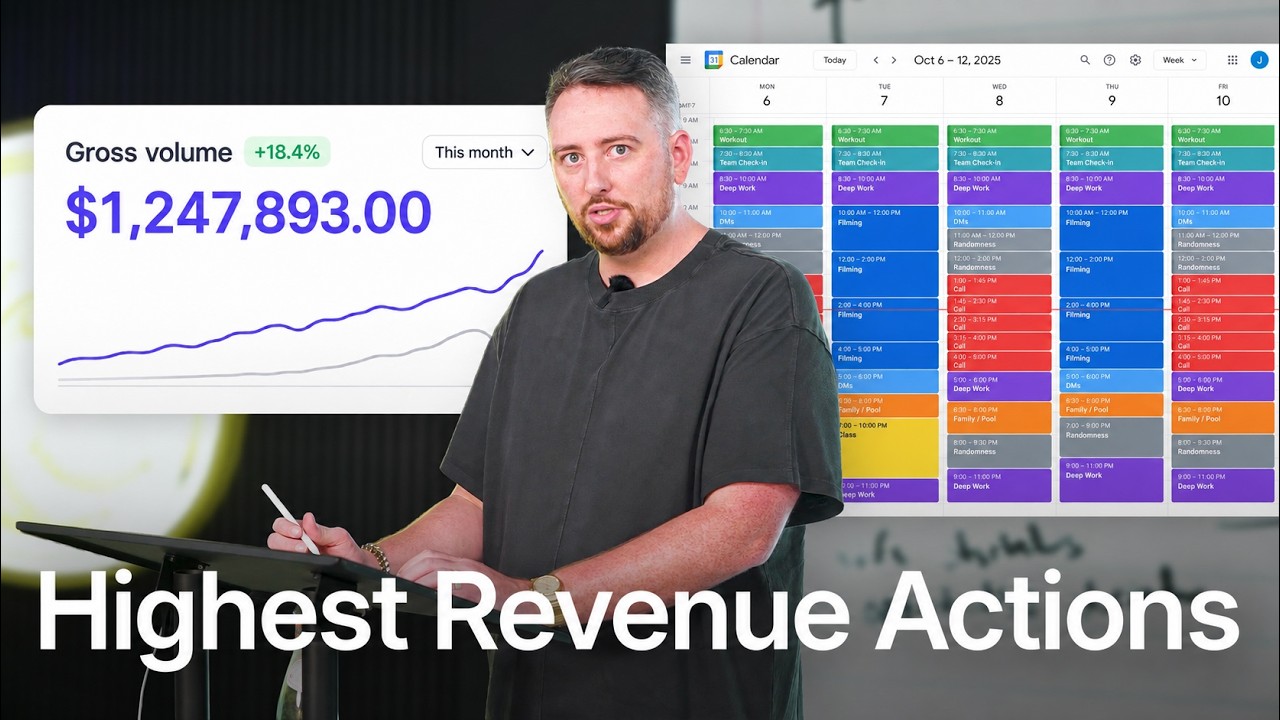
In my public example, I average recent monthly gross revenue using a 90-day period. For a business changing rapidly, I discuss shortening that lookback to 45 days. Then I map the hours actually worked across the week rather than guessing from what the calendar appears to contain.
The example adds up to 63 working hours a week. Using a simplified four-week month gives 252 hours. Those are the inputs from that example, not a schedule I am prescribing for you or a claim that every month contains exactly four weeks.
Average monthly gross revenue divided by working hours gives an organizational revenue-per-hour figure. It does not tell you your take-home pay. It also does not establish that you personally created every dollar included in the numerator.
The rough number becomes useful when you start asking what actually produced it. I explicitly want you to get more specific about your contribution and what other people in the business produce. Otherwise, the calculation can turn into an excuse to dismiss work without understanding it.
Include the time that never became an appointment. Reviewing work, answering messages and making decisions all take time. If you use Google Calendar, its Time Insights can show how meeting time is allocated on eligible accounts. It is a meeting view, so keep the rest of your working time in the audit too.
Which Actions Deserve Your Attention Today
The work worth doing depends on your present opportunities and your ability to act on them. Make a list of the available actions, then compare the time they need with what they could contribute.
Content is a valuable use of my time because I have an audience and offers connected to that audience. I also describe managing particular agency relationships where compensation is tied to net profit. Those are reasons for my priorities. They do not make the same list correct for every founder.
Sales calls can belong near the top for an operator who still makes a meaningful contribution to closing and has not developed a replacement. Taking yourself off those calls because you think a CEO should never sell ignores the situation you are actually in.
There is a longer-term decision about reducing the business’s dependence on your time. That does not erase the work that needs doing while the replacement is being built. Account for both when deciding what stays on your calendar.
I also leave room for analysis. If the team is arguing from impressions, looking through the relevant numbers may be the most useful action available. The result you want is a better decision about where effort belongs.
Do not force every activity into an exact hourly return when the evidence cannot support one. Use what you know, state what remains an estimate and revisit it. Precision in a spreadsheet means very little if the inputs are invented.
Why the Best Use of Your Time Changes
Your priority list has to change when the business changes. An activity can deserve a limited test at one stage and a protected place in the week later.
When I first committed to regular YouTube content, I allocated far less time to it than I do now. The audience and the reason to invest additional time developed. Copying my later filming schedule at the beginning would skip the part where I learned whether that allocation made sense.
I describe another operator who had an audience, available time and an interest in adding a new offer. That is a different starting point from a founder with an unfinished offer and a full calendar. His available options were shaped by what already existed in the business.
The same applies when something stops deserving your attention. You may have someone capable of owning it now. The opportunity may have changed. Or the task may have stayed in your routine because nobody questioned why you were still doing it.
A routine should reflect your current priorities, not preserve every decision you made while building the company. Revisit the work itself before moving time blocks around.
When an Unplanned Task Is Worth Taking
An unplanned task can deserve your attention when it has a concrete purpose and compares favorably with the work it would interrupt. I call this category randomness, and it includes more than dealing with emergencies.
One example I describe is a disagreement that became harder to resolve through messages. A brief phone conversation helped the people involved get back on the same page. The point is the choice of action and its timing. I am not assigning a predictable return to customer calls.
Another example is a sales rep asking for help issuing an invoice while away from their desk. If a ready buyer is waiting and you can remove the obstacle, dismissing it as beneath your title may be the wrong decision. Compare the actual situation with what else you would be doing.
That does not mean every interruption qualifies. Ask what needs to happen, why it needs your involvement and what happens if it waits. A vague request to jump on a call still needs a reason.
For me, randomness also includes selected deep work. I describe using uninterrupted time to work on internal process material and improve an AI agent in the customer relationship management system. It is a place in the schedule for useful work that does not fit a recurring appointment.
The distinction matters when delegating work and decisions. You can respond to a meaningful exception while still building a team that owns the recurring task.
Why Customer Conversations Still Belong
Customer conversations can inform other work you are responsible for. I pay attention to the problems people describe because those conversations help me decide what to explain, what to improve and what the sales team needs to understand.
In my Inner Circle, conversations with members give me direct context about the decisions operators are making. I use that context when thinking about content and the questions a potential buyer may bring into a sales conversation.
Results are not typical. Your results will vary and depend entirely on your individual capacity, business experience, expertise, and level of desire. There are no guarantees concerning the level of success you may experience. The testimonials and examples used are not intended to represent or guarantee that anyone will achieve the same or similar results. We don’t believe in get-rich-quick programs. We believe in hard work, adding value and serving others. As stated by law, we can not and do not make any guarantees about your own ability to get results or earn any money with our information, courses, programs, or strategies.
This is what I mean by a stacked action. Time spent on a conversation can also produce useful input for another part of the business. That possibility is a reason to examine the purpose of a meeting before deleting it simply because no sale happens during it.
I describe scheduled calls on Mondays, Wednesdays and Fridays, from 1 to 5 in the afternoon. That is 12 hours in the example week, or 48 hours using the same simplified four-week month. Compared with the 252-hour example, it is roughly 19% of working time.
That percentage describes the schedule I showed. It is not an ideal meeting allocation for every founder. The useful question is what those conversations contribute and whether you follow through on what you learn.
I also describe using material from my conversations to improve my AI resource. That is another application of the same idea. Look for an actual use of the information after the conversation instead of treating attendance as the finished work.
How I Build a Week Around Those Choices
I put recurring work into specific parts of the week and leave deliberate room for other decisions. Scheduled calls have their place; filming has its place; the remaining working time still needs a purpose.
The schedule I describe reserves Tuesdays and Thursdays for filming. That includes the material the business needs, such as YouTube content and confirmation-page videos. I distinguish those planned blocks from a brief call that resolves something as it comes up.
Communication also has time allocated to it. I describe catching up while riding as a passenger between home and the office. The practical point is to account for messages in the schedule instead of pretending they take no time.
If you use an eligible account, Google Calendar allows focus-time events that can mute chat notifications and decline meetings. Tools can support a boundary once you have chosen it. They cannot decide which work deserves that boundary.
Family time and exercise are part of the week too. I do not want every waking minute turned into a revenue calculation. Make the distinction between the hours you choose to work and the rest of your life.
Travel does not automatically erase the routine either. If filming remains important, account for the equipment and people it requires. A schedule is more useful when you can maintain the necessary work beyond the familiar setting of your office.
When reviewing your own founder calendar and meetings, start with what those hours are supposed to accomplish. Keep a block because the work belongs there, rather than because it has always appeared on that day.
When Hiring Makes More Sense Than Doing It Yourself
Hiring becomes a clearer decision when you define the work, its cost and the contribution you need it to make. A task can be worth paying someone to own even when it should not become your own priority.
The example I use is email marketing in a business that already has traffic and a database but gives the channel limited attention. The founder sees a potential opportunity without wanting to become the person responsible for every email.
My illustrative calculation uses monthly pay of $12,500 and 160 working hours. I then discuss a target of three times payroll in revenue associated with the role. That is the target used in the example, not a promised return or a hiring benchmark you can assume will hold.
Results are not typical. Your results will vary and depend entirely on your individual capacity, business experience, expertise, and level of desire. There are no guarantees concerning the level of success you may experience. The testimonials and examples used are not intended to represent or guarantee that anyone will achieve the same or similar results. We don’t believe in get-rich-quick programs. We believe in hard work, adding value and serving others. As stated by law, we can not and do not make any guarantees about your own ability to get results or earn any money with our information, courses, programs, or strategies.
The next question is whether the actual business supports the assumption. What offers could those emails sell, who is already in the database, and what evidence supports the sales expectation? Work backward from that rather than treating an attractive multiple as proof that the hire will pay for itself.
Revenue is also different from profit. A payroll comparison does not account for every expense of acquiring and serving the resulting customers. Keep the calculation tied to what it actually measures when evaluating the decision.
Once you decide to hire, explain the expected contribution before the person starts. The Office of Personnel Management describes performance standards as objective, measurable and realistic, with clear written expectations. That is useful support for making the expected work understandable; its guidance is written for federal performance management.
My example also includes an initial review period with expectations discussed in advance. The broader lesson is to define what you will evaluate and give the person a fair understanding of it. A disappointing result should send you back to the assumptions, execution and role expectations, rather than rewriting the original target afterward.
Already making money? See what it takes to make a lot more.
What Changes After the Meeting Ends
Your next action is what turns a useful conversation into a change in the business. Feeling clear about a problem and acting on that clarity are separate events.
I see the distinction when someone leaves a conversation enthusiastic about what to do. That enthusiasm can be useful. The work still needs to happen before there is something concrete to evaluate.
A decision about email marketing needs an owner and actual execution. A decision to protect filming time needs a schedule the team can work with. A conversation about sales needs a change that can be reviewed against what happened afterward.
Judge a meeting by what it enables people to do after they leave it. That does not require eliminating conversations. It requires noticing when discussion repeatedly replaces action.
My priorities and routine are open to review for the same reason. If the week keeps producing explanations for why the work did not happen, I need to look at the structure I created. The calendar should help the business act on decisions.
That is the responsibility I want you to take seriously as CEO. Know where your attention matters, make room for that work and check what changed because you did it. If you want to explore Master Internet Marketing, my 7-week live comprehensive training, the application page is available. Start with an honest look at your own working week and the decisions it is currently making for you.
Results are not typical. Your results will vary and depend entirely on your individual capacity, business experience, expertise, and level of desire. There are no guarantees concerning the level of success you may experience. The testimonials and examples used are not intended to represent or guarantee that anyone will achieve the same or similar results. We don’t believe in get-rich-quick programs. We believe in hard work, adding value and serving others. As stated by law, we can not and do not make any guarantees about your own ability to get results or earn any money with our information, courses, programs, or strategies.
Get my content first on Google
Add jeremyhaynes.com as a preferred source and Google shows my articles more prominently in your search results, including AI Overviews and AI Mode.


Jeremy Haynes
Owner and CEO of Megalodon Marketing
Jeremy Haynes is the founder of Megalodon Marketing. He is considered one of the top digital marketers and has the results to back it up.