
Why Your Funnel Plan Should Change When the Results Do

I hope you enjoy reading this blog post. If you want my team to just do your marketing for you, click here.
Author: Jeremy Haynes | Published October 23, 2026
Earnings Disclaimer: You have a .1% probability of hitting million-dollar months according to the US Bureau of Labor Statistics. As stated by law, we cannot and do not make any guarantees about your own ability to get results or earn any money with our ideas, information, programs, or strategies. We don’t know you, and your results in life are up to you. We’re here to help by giving you our greatest strategies to move you forward, faster. However, nothing on this page or any of our websites or emails is a promise or guarantee of future earnings. Any financial numbers referenced here, or on any of our sites or emails, are simply estimates or projections or past results, and should not be considered exact, actual, or as a promise of potential earnings – all numbers are illustrative only.
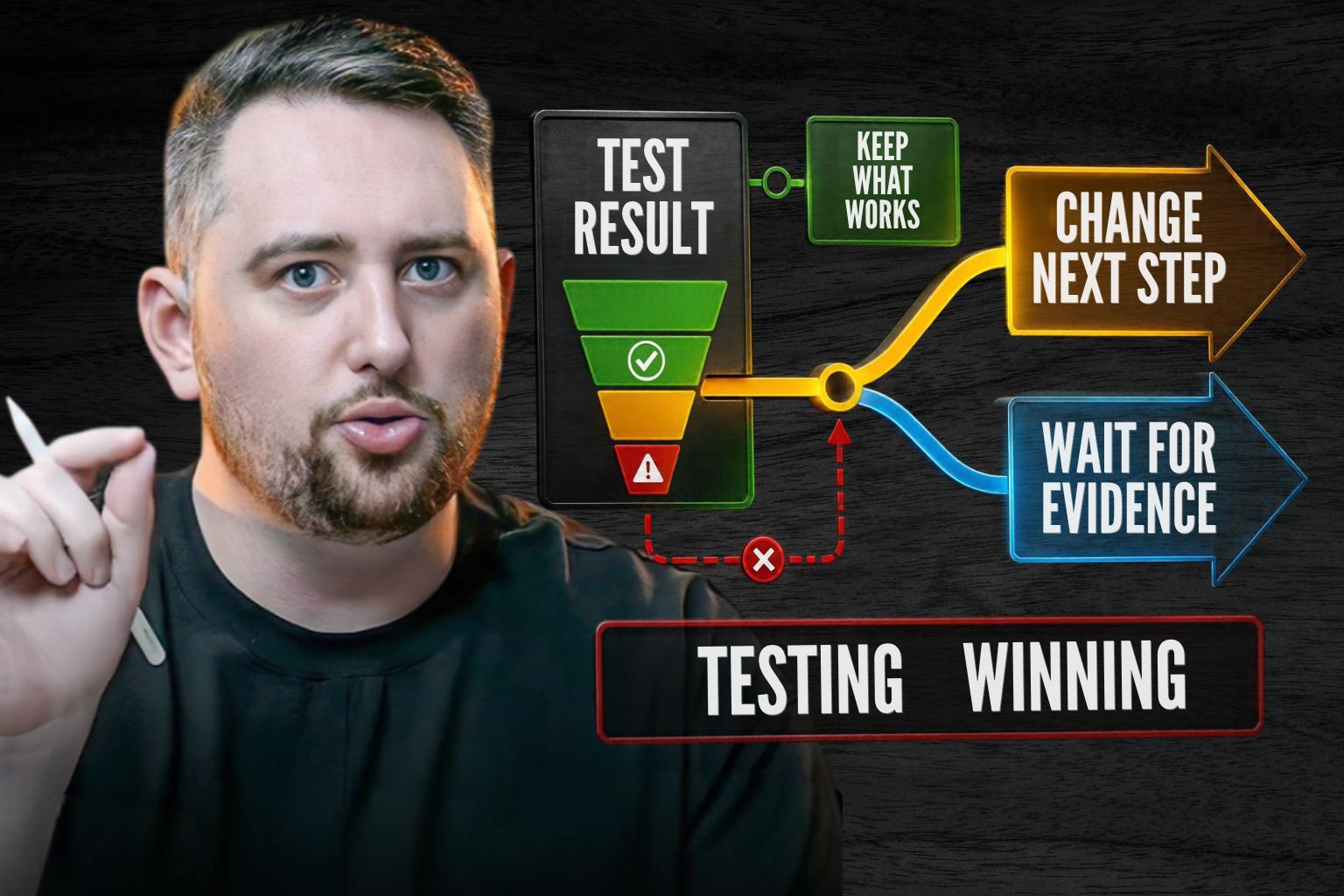
Your funnel plan should change when a test gives you a reason to change it. You can choose a sensible next step without knowing every problem the business will encounter afterward. What creates wasted work is treating the original sequence as a promise, then continuing through it after the results point somewhere else.
I think about this like following clues across an island. You know what you are trying to reach, but you do not have the whole route. Each useful action gives you more information about the next one. The job is to use that information while keeping the business’s actual goal in view.
Already making money? See what it takes to make a lot more.
Why the First Funnel Plan Has Missing Pieces
The first funnel plan has missing pieces because it includes assumptions you have not tested yet. You can estimate what happens after the click, but buyers still have to show you what they actually do.
You may expect the page to produce applications and the applications to become sales conversations. You may plan to hire after the calendars fill. Those are useful connections to think through. They are also conditional on the earlier parts of the path working.
Write down the difference between what you have observed and what you need to find out. A page that has converted real buyers is different from a page you believe should convert. An available calendar is different from proven sales capacity for the kind of lead your new funnel attracts.
The plan needs to tell you what to learn next. It should not require you to act as if every later assumption is already true. That distinction lets you prepare without building every possible fix in advance.
What I Mean by Following the Next Clue
Following the next clue means using the result of the current action to choose the next useful question. The island comparison is a way to stay oriented when the entire route is not visible.
You take an action, inspect what happened, and work out what the result just made more likely or less likely. Sometimes the next move is obvious. Sometimes you discover that the question was too broad, the tracking was incomplete, or the result could have several explanations.
That uncertainty changes the next action. If the evidence is unclear, collect what would distinguish those explanations. If the evidence is clear enough, act on it. You do not need to pretend the clue contains more information than it actually does.
Do not turn the metaphor into a guarantee that every test eventually leads to a profitable funnel. Some versions deserve to be changed or dropped. The point is to make a better next decision from what you learned, including a decision to stop an approach that no longer makes sense.
The larger business plan still needs the math. Following clues connects that plan to the results coming back from the market. It prevents an estimate from quietly becoming an instruction nobody is allowed to question.
When New Results Should Change the Next Job
New results should change the next job when they challenge the assumption that made the original task useful. A later task can remain sensible in general and still be premature now.
Suppose the planned next move is expanding traffic after a page change. If the page produces more applications but the extra applicants do not meet the qualification standard, the immediate question has changed. Before expanding that result, inspect what the new wording encouraged people to believe.
If the extra applications do become suitable booked calls, look at what happens next. Available appointment slots, follow-up, and delivery capacity may now deserve more attention. More demand can make a previously quiet limitation visible.
Check those possibilities against your own lead records. An attractive rate near the top of the funnel cannot establish what happened later in the sales process. Keep the people who entered through the changed page visible as they move through it.
Google Ads distinguishes qualified and converted leads for exactly these different stages. A submission and a later sales outcome should remain separately visible while you decide what the changed funnel actually produced.
The next job follows that answer. You might need another message test or a scheduling correction. You might need to leave the campaign stable while sales outcomes arrive. The result chooses among those paths more usefully than the original task list can.
Why Every Disappointing Day Is Not a New Direction
A disappointing day does not automatically justify changing direction because the result may be incomplete. Following clues requires knowing whether you have enough information to interpret one.
Check whether tracking worked and whether the people involved have had time to move through the sales process. A newly booked call cannot also be a completed sales outcome just because the campaign review is due.
Google’s conversion-delay guidance explains why recent results can be incomplete when customers convert later. Your review should account for the time your actual buyers take, rather than forcing every campaign into the same arbitrary deadline.
Keep the spending limit and stopping conditions visible while you wait. Waiting for a meaningful answer is different from funding an unclear test indefinitely. You still need an acceptable cost for learning and a reason the next stretch of observation could resolve the question.
The loss limit for an ad test belongs in that decision. The island analogy never gives a campaign permission to consume money without a useful question or a clear boundary.
How to Change the Plan Without Resetting Everything
Change the part of the plan the evidence challenged and leave unrelated working parts alone. A new clue does not make every previous decision wrong.
If the message needs work, you do not automatically need a different platform. If scheduling creates a delay, you do not automatically need another offer. Keep the response proportional to what you can actually show.
Before changing the next task, be able to finish this thought in ordinary language. We expected this, we observed that, and this is why the next action is different. If you cannot explain the connection, you may be reacting to the discomfort of a result rather than learning from it.
Google’s experiment guidance warns that changing several things together makes the cause of a result harder to identify. Avoid turning a useful course correction into a pile of simultaneous changes that hides the next clue.
A narrow update also makes the work easier to assign. The page owner can change the relevant message while the sales team keeps the qualification standard consistent. If the evidence later points toward sales capacity, that becomes a separate decision with its own requirements.
Operators in my Inner Circle can bring the current result and the action they are considering into the room. The useful question is what the evidence justifies doing next, rather than whether the original plan deserves to survive unchanged.
Results are not typical. Your results will vary and depend entirely on your individual capacity, business experience, expertise, and level of desire. There are no guarantees concerning the level of success you may experience. The testimonials and examples used are not intended to represent or guarantee that anyone will achieve the same or similar results. We don’t believe in get-rich-quick programs. We believe in hard work, adding value and serving others. As stated by law, we can not and do not make any guarantees about your own ability to get results or earn any money with our information, courses, programs, or strategies.
What the Team Needs When the Next Step Changes
The team needs to know which assumption changed, which work is affected, and what remains in place. Otherwise, a reasonable course correction can feel like the owner changed direction for no clear reason.
Explain what happened in terms people can inspect. Show the qualification answers, the booking gap, or the changed page result. Then identify the work that now matters and the work that should wait.
A task that loses its place in the sequence does not have to become a bad idea. Keep the condition that would make it useful again. Expanding traffic may still be appropriate after the qualification problem is addressed. Recruiting may still be appropriate when the calendars show a real need for capacity.
Keep a short note of the expectation, the result, and the decision. That prevents the team from having to reconstruct why the work changed at the next review. Atlassian’s decision-making retrospective similarly looks back at how choices were made and where the process created delay. Use the record to improve the next decision rather than assign blame.
An owner’s backlog of approvals can delay this work even after the evidence is clear. Tell people which changes they can make and which still need your decision. Otherwise, the new plan can sit in the same queue as the old one.
7 weeks. Real frameworks. Covering copywriting, funnels, paid ads, and conversion systems.
Keep the Goal Clear While the Route Changes
The goal gives the changing route a purpose. A qualified sales conversation, a deliverable offer, and acceptable acquisition economics still matter even when the sequence of work changes.
Use the current result to check which requirement is still unmet. Do not declare the whole business broken because another problem appears. Equally, do not call the route proven because an early part improved.
You can prepare for the next stage without committing to every expense it might require. Know what would justify more traffic, another closer, or more delivery capacity. When that condition appears, the next action is easier to explain and easier to own.
Keep enough structure that the team knows where it is going and enough flexibility that new information can change the work. A plan earns its place by helping you respond to reality. When the next clue challenges it, update the route and make the next decision deliberately.
Inside Master Internet Marketing, my 7-week live comprehensive training, the copywriting, paid-advertising, and funnel work gives you more ways to act on what buyers show you. Start with the result in front of you and the next question it creates.
Results are not typical. Your results will vary and depend entirely on your individual capacity, business experience, expertise, and level of desire. There are no guarantees concerning the level of success you may experience. The testimonials and examples used are not intended to represent or guarantee that anyone will achieve the same or similar results. We don’t believe in get-rich-quick programs. We believe in hard work, adding value and serving others. As stated by law, we can not and do not make any guarantees about your own ability to get results or earn any money with our information, courses, programs, or strategies.
Get my content first on Google
Add jeremyhaynes.com as a preferred source and Google shows my articles more prominently in your search results, including AI Overviews and AI Mode.


Jeremy Haynes
Owner and CEO of Megalodon Marketing
Jeremy Haynes is the founder of Megalodon Marketing. He is considered one of the top digital marketers and has the results to back it up.